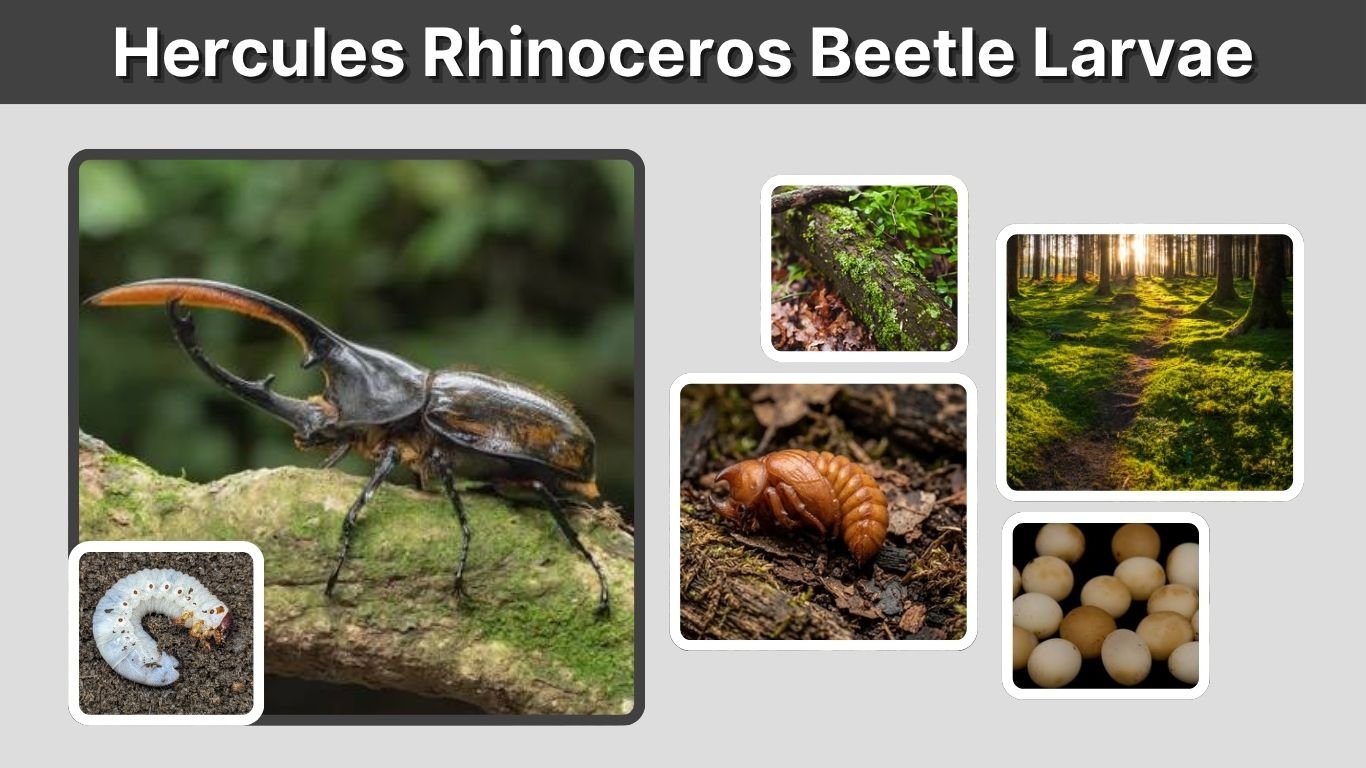
Hercules rhinoceros beetle larvae are among the largest beetle grubs in the world, known for their thick, creamy-white bodies and remarkable growth. These larvae eventually transform into giant Hercules beetles, famous for their impressive horns and extraordinary strength. Found mainly in tropical forests, they spend much of their lives feeding on decaying wood. Understanding their identification, diet, growth stages, habitat, life cycle, and care requirements helps insect enthusiasts appreciate these fascinating beetles and their important role in forest ecosystems.
What Are Hercules Rhinoceros Beetle Larvae?
Hercules rhinoceros beetle larvae are the immature stage of the Hercules beetle (Dynastes hercules), a large scarab beetle belonging to the family Scarabaeidae.
The species is part of the rhinoceros beetle subfamily, Dynastinae, which includes numerous horned beetles.
Unlike the striking adult males, larvae have no horns. Instead, they possess soft, curved bodies designed for living and feeding inside decomposing wood.
They spend most of their development hidden within rotting logs and tree trunks, gradually accumulating the nutrients needed to become adults.
The larval period is much longer than the adult stage, making it the most significant growth phase in the beetle’s life.
Hercules Rhinoceros Beetle Larvae Identification
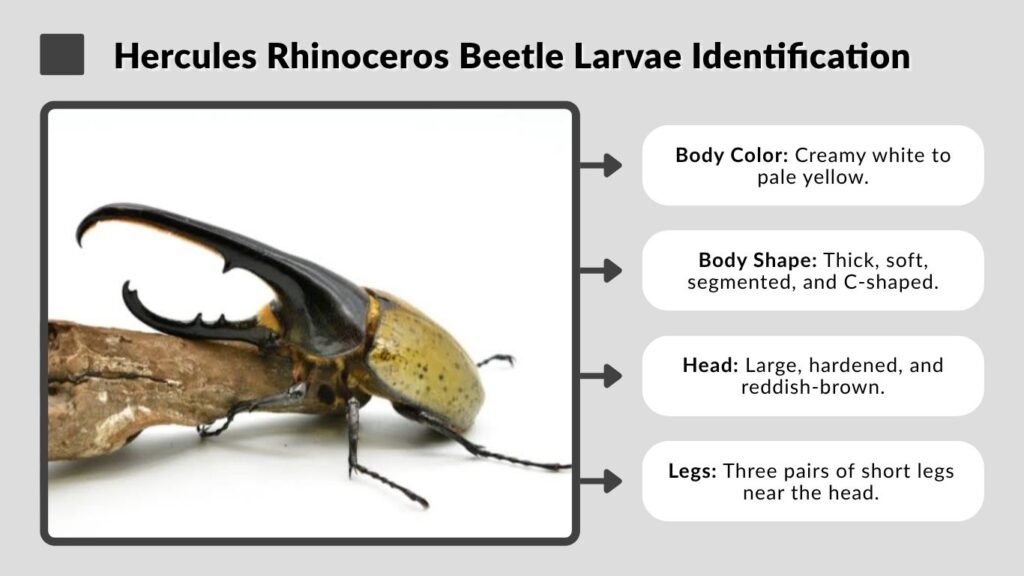
Hercules beetle larvae have several distinctive physical characteristics. Although they resemble other scarab beetle grubs, their exceptional size and habitat provide useful identification clues.
Physical Characteristics
- Body Color: Creamy white to pale yellow.
- Body Shape: Thick, soft, segmented, and C-shaped.
- Head: Large, hardened, and reddish-brown.
- Legs: Three pairs of short legs near the head.
- Body Texture: Soft with scattered fine hairs.
- Spiracles: Small, dark breathing openings along the sides.
- Size: Large mature larvae may exceed 15 cm in length.
- Weight: Exceptional specimens can reportedly reach approximately 140 grams.
Because several rhinoceros beetle species produce similar-looking grubs, species identification may require examining specialized anatomical features or knowing the adults that produced them.
Why Are Hercules Beetle Larvae So Large?
Hercules beetle larvae grow considerably larger than most familiar garden grubs because they need to accumulate energy reserves for metamorphosis.
Their diet consists primarily of decomposing wood, which they consume over many months.
Proper nutrition, suitable temperatures, and available space contribute to their development.
Larger, well-nourished larvae often produce larger adult beetles, although genetics and environmental conditions also influence adult size.
Where Do Hercules Rhinoceros Beetle Larvae Live?
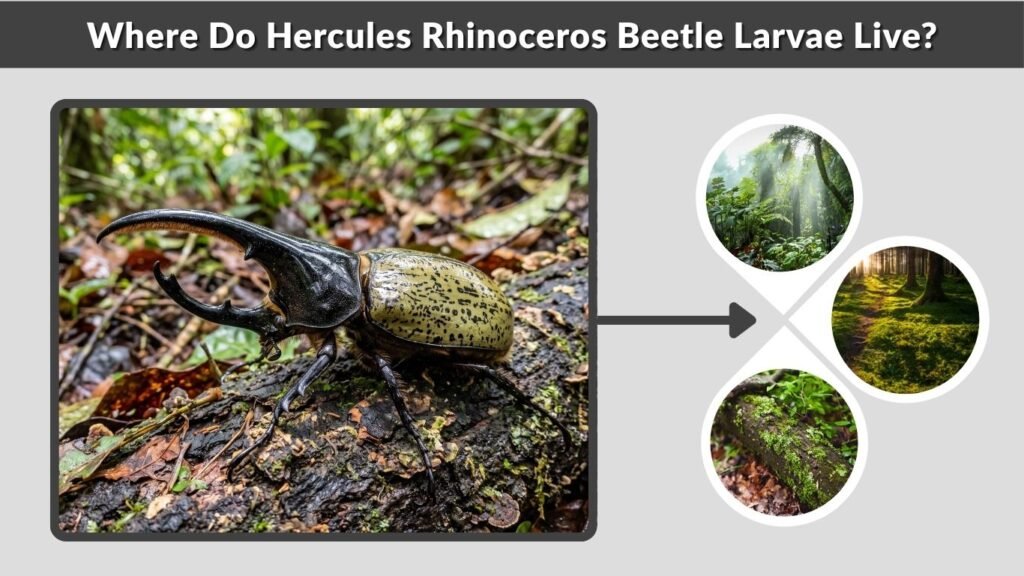
Hercules beetles are native to tropical regions of Central and South America and several Caribbean islands.
They inhabit rainforests where fallen trees, rotting logs, and decomposing woody materials provide suitable breeding environments.
Their larvae generally develop inside decaying tree trunks rather than feeding on healthy living trees.
Common habitats include:
- Tropical Rainforests: Provide consistently warm and humid conditions.
- Rotting Logs: Offer food and protection from predators.
- Decaying Tree Trunks: Support growing larvae within softened wood.
- Forest Floors: Contain decomposing organic materials and fallen timber.
- Moist Woodland Areas: Maintain conditions that support wood decomposition.
These habitats also contain microorganisms that help break down wood, making it more suitable for larval consumption.
What Do Hercules Rhinoceros Beetle Larvae Eat?
Hercules beetle larvae are saproxylic insects, meaning they depend on dead or decaying wood.
They primarily consume decomposed hardwood and the organic materials associated with it.
Their natural food sources include:
- Soft, decomposing hardwood.
- Rotten tree trunks and branches.
- Decayed woody material rich in organic nutrients.
- Microorganism-conditioned wood particles.
Unlike adult beetles, larvae do not primarily feed on fresh fruit.
Adults usually consume soft, rotting fruits and other available sugary materials.
Why Is Decaying Wood Important?
Fresh hardwood is difficult for many beetle larvae to digest. As fungi and bacteria break it down, its physical and nutritional properties change.
These processes make decomposing wood more accessible to developing larvae.
By consuming decayed wood, Hercules beetle larvae also contribute to decomposition and nutrient recycling in forests.
Hercules Rhinoceros Beetle Life Cycle
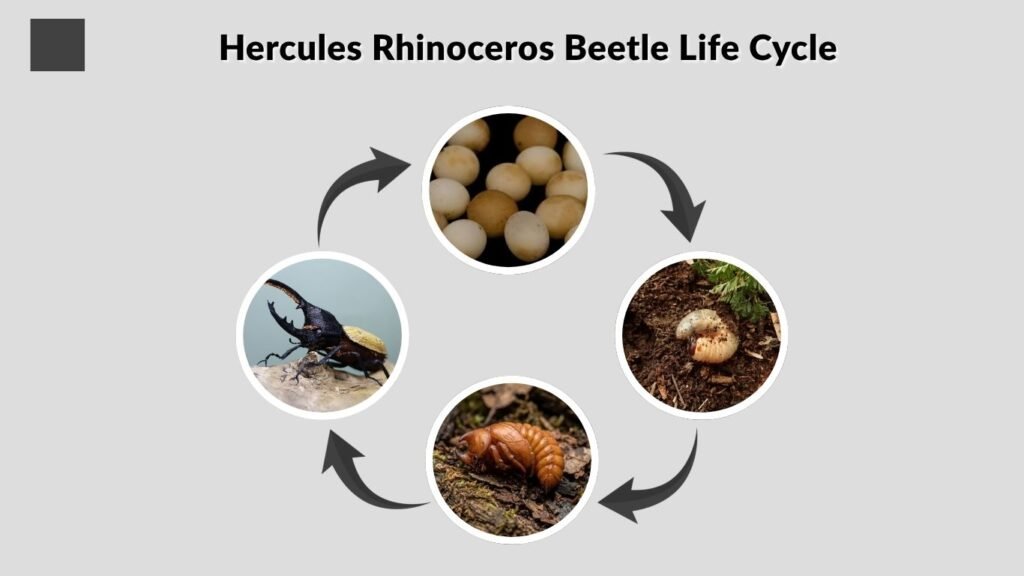
The Hercules beetle undergoes complete metamorphosis, developing through four stages: egg, larva, pupa, and adult.
Its development is relatively slow compared with many smaller beetle species.
1. Egg Stage
Female Hercules beetles lay eggs in suitable decomposing wood or organic substrate.
Under studied laboratory conditions, the eggs hatch after approximately 28 days.
Newly hatched larvae are small and immediately begin feeding on surrounding organic material.
2. Larval Stage
The larvae pass through three growth stages called instars.
- First Instar: The young larva begins feeding and increasing in size.
- Second Instar: Its body becomes larger, and feeding activity increases.
- Third Instar: The larva reaches its greatest size and accumulates energy reserves.
The third instar lasts significantly longer than the earlier stages.
Research conducted under controlled conditions recorded approximately 50 days for the first instar, 56 days for the second, and 450 days for the third.
3. Pupal Stage
After completing larval growth, the beetle forms a protective pupal chamber within its substrate.
Inside this chamber, the larval body transforms into the recognizable adult beetle.
The pupal stage lasts around one month under favorable laboratory conditions.
4. Adult Beetle Stage
The adult emerges after metamorphosis is complete.
Males develop distinctive horns, while females remain hornless.
Adult Hercules beetles may survive for approximately three to six months in captivity.
Overall development: Research indicates that the complete egg-to-adult life cycle can take approximately 19–21 months under studied conditions.
Hercules Beetle vs Rhinoceros Beetle
Many people wonder whether Hercules beetles and rhinoceros beetles are different insects.
A Hercules beetle is actually a type of rhinoceros beetle. The term rhinoceros beetle describes a large group within the subfamily Dynastinae.
| Feature | Hercules Beetle | Rhinoceros Beetles |
| Classification | Dynastes hercules | Dynastinae subfamily |
| Size | Among the largest beetles | Varies considerably |
| Male horns | Two opposing horns | Number and shape vary |
| Larvae | Very large, pale grubs | Usually C-shaped grubs |
| Distribution | Tropical Americas | Many parts of the world |
Therefore, every Hercules beetle is a rhinoceros beetle, but not every rhinoceros beetle is a Hercules beetle.
The eastern Hercules beetle (Dynastes tityus), found in parts of the United States, is another related but separate species.
How to Care for Hercules Rhinoceros Beetle Larvae
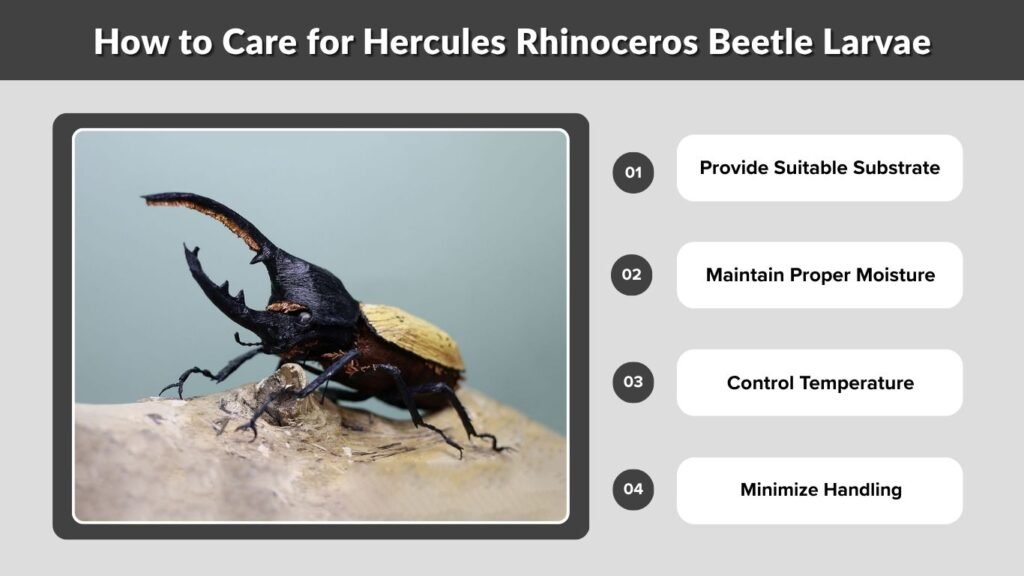
Hercules beetle larvae are sometimes raised by experienced insect enthusiasts because of their unusual size and transformation.
However, their long development period and specialized feeding requirements make them demanding to maintain.
1. Provide Suitable Substrate
Larvae require deep, properly decomposed hardwood-based substrate.
Specially prepared fermented hardwood flake soil is commonly used in captive breeding.
Ordinary potting soil does not provide sufficient nutrition for these wood-feeding grubs.
2. Maintain Proper Moisture
The substrate should remain consistently moist without becoming waterlogged.
Excessively dry conditions can cause dehydration, while overly wet conditions may encourage harmful microbial growth.
3. Control Temperature
Tropical Hercules beetles require a stable, warm environment.
Many specialist breeders maintain temperatures around 22–26°C, although requirements vary among populations and rearing methods.
4. Minimize Handling
Large larvae are sensitive to unnecessary disturbance.
Frequent handling can cause stress, particularly when they are preparing to pupate.
Avoid disturbing established pupal chambers because damage can interfere with successful metamorphosis.
5. Provide Adequate Space
Mature larvae require substantial substrate volume.
Spacious containers allow them to move, feed, and eventually construct secure pupal chambers.
Always follow species-specific captive breeding guidance and local regulations. Never release captive exotic beetles into the wild.
Are Hercules Rhinoceros Beetle Larvae Dangerous?
Hercules beetle larvae are not venomous and do not possess stingers.
They are generally harmless to people when left undisturbed.
However, their strong chewing mouthparts can pinch if handled carelessly.
Adult beetles are also nonvenomous, although large males can grip or pinch with their horns.
In nature, these larvae are beneficial decomposers rather than pests that attack people or healthy trees.
Interesting Hercules Rhinoceros Beetle Facts
Hercules beetles possess several fascinating characteristics that distinguish them from ordinary beetles.
- Massive Larvae: Mature grubs can become exceptionally large and heavy.
- Long Development: The larval stage may last well over a year.
- Impressive Horns: Adult males use their horns to fight rivals.
- Strong Fliers: Adults possess functional wings and can fly.
- Color Changes: Male wing covers may darken when humidity increases.
- Important Decomposers: Larvae help break down dead wood and recycle nutrients.
These adaptations make Hercules beetles important members of tropical forest ecosystems.
FAQs
1. How Long Do Hercules Rhinoceros Beetle Larvae Live?
Hercules beetles may remain in the larval stage for more than a year. The complete development from egg to adult can take approximately 19–21 months under studied conditions.
2. What Do Hercules Rhinoceros Beetle Larvae Eat?
They feed primarily on rotting hardwood and decomposing woody material. Captive larvae are usually raised in specially prepared fermented hardwood substrate.
3. Can You Keep a Hercules Rhinoceros Beetle as a Pet?
Yes, where legally permitted. However, Hercules beetles require specialized food, appropriate temperature and moisture conditions, sufficient space, and long-term care.
4. Do Hercules Rhinoceros Beetle Larvae Bite?
Larvae are not venomous or aggressive toward humans. However, their chewing mouthparts are strong enough to cause an uncomfortable pinch if handled improperly.
5. What Is the Difference Between Male and Female Hercules Beetles?
Adult males have two prominent opposing horns used during contests with other males. Females lack these large horns and generally have darker wing covers.