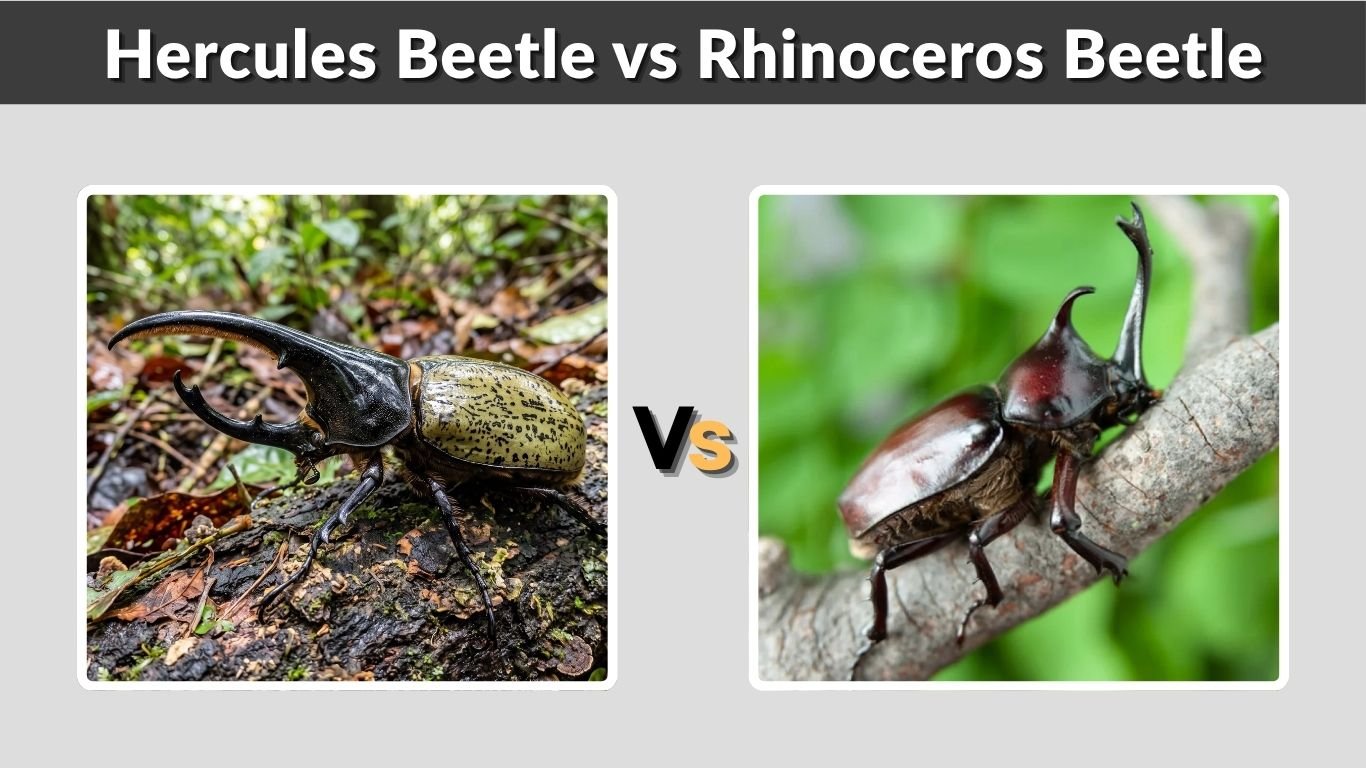
The Hercules beetle vs rhinoceros beetle comparison often confuses insect enthusiasts because both insects are famous for their large bodies, impressive horns, and remarkable strength. However, the Hercules beetle is actually a type of rhinoceros beetle, rather than a completely separate group. Hercules beetles are particularly recognizable for their long opposing horns, while other rhinoceros beetles display different horn shapes, sizes, and colors. Understanding their classification, physical characteristics, diet, habitat, life cycle, and behavior makes it easier to identify these fascinating insects.
Hercules Beetle vs Rhinoceros Beetle: Quick Comparison
Hercules beetles and other rhinoceros beetles belong to the Scarabaeidae family and Dynastinae subfamily. The main distinction is that the name Hercules beetle identifies particular species, while rhinoceros beetle refers to a much larger group.
| Feature | Hercules Beetle | Other Rhinoceros Beetles |
| Scientific classification | Dynastes hercules | Dynastinae |
| Family | Scarabaeidae | Scarabaeidae |
| Size | Up to about 18 cm, including horns | Varies by species |
| Male horns | Two long opposing horns | Various shapes and numbers |
| Body color | Often yellow-olive and black | Brown, black, greenish, or yellow |
| Habitat | Tropical forests | Tropical and temperate habitats |
| Larval food | Decaying wood | Usually decaying organic matter |
| Flight | Capable of flying | Most species can fly |
A useful example is the Japanese rhinoceros beetle (Trypoxylus dichotomus), which looks considerably different from the tropical Hercules beetle despite belonging to the same subfamily.
What Is a Hercules Beetle?
The Hercules beetle (Dynastes hercules) is one of the world’s longest beetles. It is native to tropical areas of Central and South America and several Caribbean islands.
Adult males possess enormous horns that extend from the head and thorax. These horns create a powerful, pincer-like structure used during competition for mates.
The male’s wing covers are usually yellowish or olive-green with scattered black markings, while females are generally darker and lack the large horns.
Hercules beetles are primarily active during twilight or nighttime. Although their bulky bodies make them look incapable of flight, they possess functional wings hidden beneath hardened wing covers.
What Is a Rhinoceros Beetle?
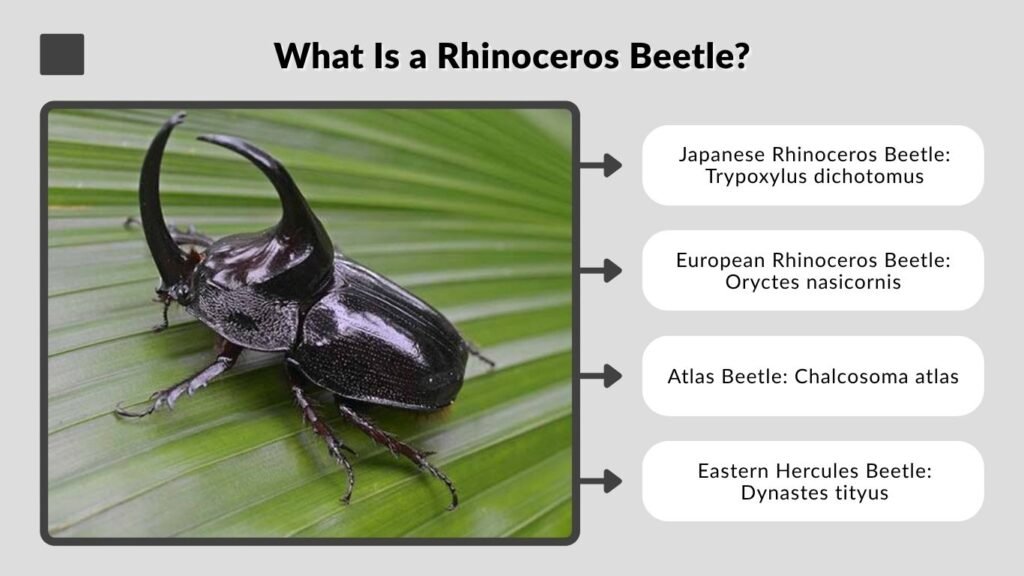
Rhinoceros beetles are members of the subfamily Dynastinae, a diverse group of scarab beetles found across much of the world.
Their common name comes from the distinctive horns found on males of many species.
Unlike the Hercules beetle, which refers to a particular species, rhinoceros beetles include numerous species with different appearances.
Some well-known examples include:
- Japanese Rhinoceros Beetle: Trypoxylus dichotomus
- European Rhinoceros Beetle: Oryctes nasicornis
- Atlas Beetle: Chalcosoma atlas
- Eastern Hercules Beetle: Dynastes tityus
- Western Hercules Beetle: Dynastes grantii
- Elephant Beetle: Megasoma elephas
These beetles vary in size, body coloration, habitat preferences, and horn development.
Main Differences Between Hercules and Rhinoceros Beetles
Although Hercules beetles share many characteristics with other rhinoceros beetles, several physical and ecological features help distinguish them.
1. Size and Body Structure
Hercules beetles are among the longest beetles in the world when their horns are included in measurements.
Exceptional males can reach approximately 18 cm in total length, although most individuals are smaller.
Other rhinoceros beetles show considerable size variation. Some species are relatively small, while giant species in the genus Megasoma are exceptionally heavy.
The Hercules beetle’s elongated horns contribute substantially to its impressive total length.
2. Horn Shape and Appearance
The most recognizable feature of a male Hercules beetle is its pair of long, opposing horns.
One horn extends from the head, while another projects forward from the thorax. Together, they function like pincers.
Other rhinoceros beetles may have a single horn, several horns, or forked projections.
For example, the Japanese rhinoceros beetle has a prominent forked head horn and a smaller thoracic horn.
Horn structure is one of the most useful characteristics for distinguishing adult males.
3. Body Color and Patterns
Male Hercules beetles typically have yellowish-green or olive-colored wing covers decorated with dark markings.
Interestingly, their wing covers can become darker when humidity increases.
Other rhinoceros beetles display different colors, including glossy black, reddish-brown, dark brown, and occasionally greenish shades.
Color alone is not always sufficient for identification because sex, age, humidity, and species variation can affect appearance.
4. Habitat and Geographic Distribution
The tropical Hercules beetle inhabits rainforests extending from southern Mexico into parts of South America and the Caribbean.
Other rhinoceros beetles occupy a much broader geographical range.
They occur in Asia, Africa, Europe, Australia, and the Americas.
Depending on the species, they may inhabit tropical rainforests, temperate woodlands, grasslands, agricultural areas, or gardens.
5. Feeding Habits
Adult Hercules beetles mainly consume soft, decaying fruits that have fallen onto the forest floor.
Their larvae feed on decomposing wood, helping recycle organic material.
Other rhinoceros beetles have more varied diets.
Depending on the species, adults may consume tree sap, fruits, or other plant-derived materials.
Most rhinoceros beetle larvae develop in decomposing organic matter, although some species are agricultural pests whose larvae or adults damage living plants.
Hercules Beetle vs Rhinoceros Beetle: Which Is Stronger?
Hercules beetles are famous for their remarkable strength and ability to lift or displace other beetles during fights.
Their horns operate like pincers, allowing males to grip, lift, and overturn rivals.
Other rhinoceros beetles also possess powerful muscles and specialized horns used during competition.
For example, Japanese rhinoceros beetles use their horns to push and flip competing males away from feeding or mating sites.
However, determining which is stronger requires comparing particular species under controlled conditions.
There is no universally established winner between Hercules beetles and all other rhinoceros beetles because Hercules beetles are themselves members of that group.
Hercules Beetle vs Rhinoceros Beetle Life Cycle
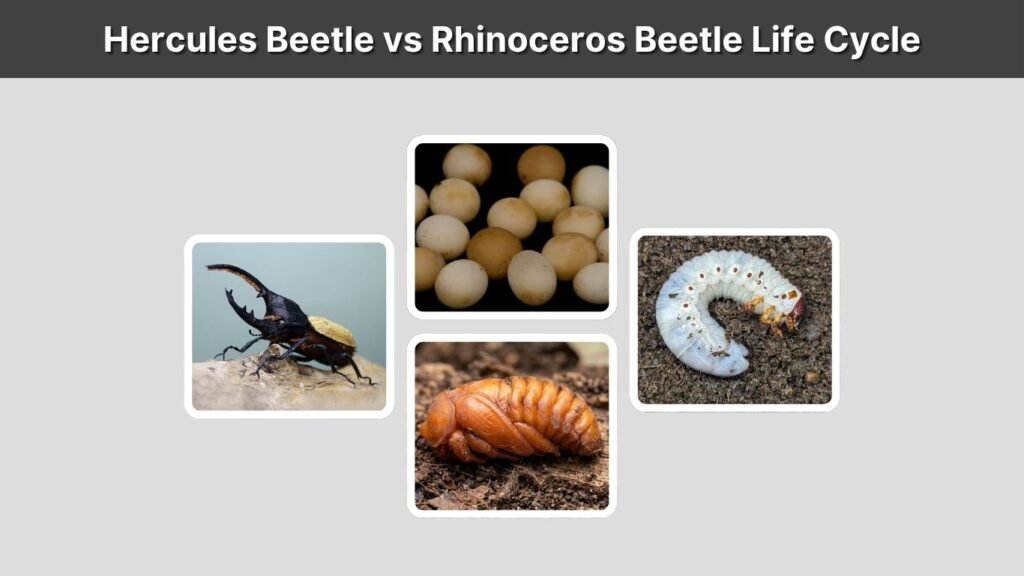
Both Hercules beetles and other rhinoceros beetles undergo complete metamorphosis through four developmental stages.
Egg Stage
Females lay eggs in suitable decomposing wood, soil, or organic material, depending on the species.
The eggs hatch after an incubation period influenced by temperature and environmental conditions.
Larval Stage
Newly hatched larvae develop into large, creamy-white, C-shaped grubs.
Hercules beetle larvae spend much of their lives consuming decaying wood.
Under studied laboratory conditions, Dynastes hercules larvae pass through three instars, and their development can last well over a year.
Pupal Stage
When larval growth is complete, the beetle transforms into a pupa inside a protective chamber.
During this period, the adult body structures and horns develop.
Adult Stage
After metamorphosis, the adult beetle emerges and begins seeking food and mates.
The complete development of Dynastes hercules can take approximately 19–21 months under studied conditions.
Other rhinoceros beetle species may complete development more quickly or slowly.
Hercules Beetle Male vs. Female
Male and female Hercules beetles show remarkable differences in appearance, a characteristic known as sexual dimorphism.
Male Hercules Beetle
Males possess two large horns and usually have yellowish or olive-colored wing covers.
Their horns are primarily used during competition with rival males.
Larger males often develop more impressive horns, although horn size also depends on nutrition and genetics.
Female Hercules Beetle
Females lack the distinctive long horns and generally have darker, more rounded bodies.
They spend considerable time locating suitable breeding materials in which to lay eggs.
Female rhinoceros beetles of many other species also lack the prominent horns seen in males.
Eastern vs. Western Hercules Beetle
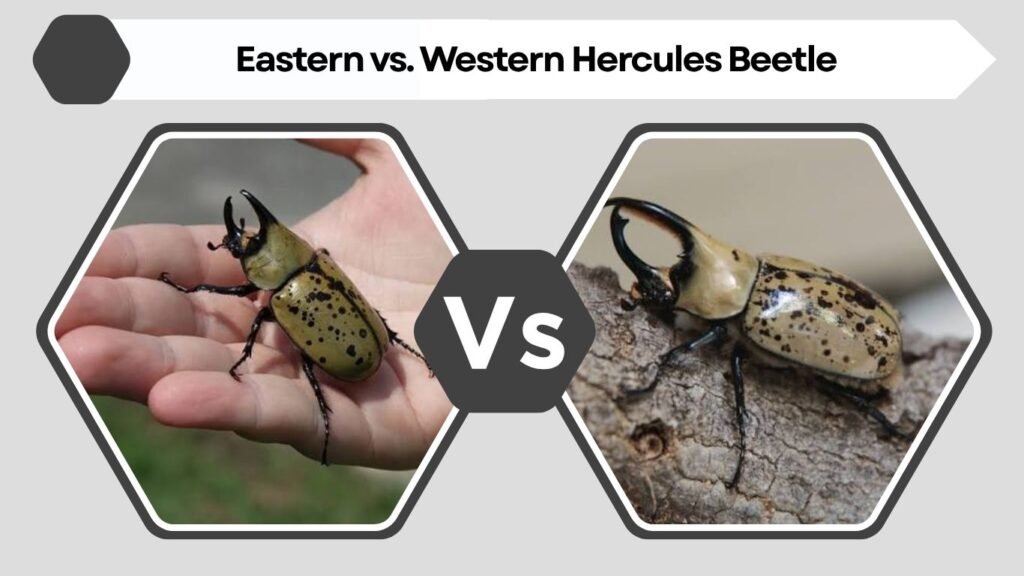
The eastern Hercules beetle (Dynastes tityus) and western Hercules beetle (Dynastes grantii) are separate North American species.
The eastern species inhabits parts of the eastern United States, while the western species is associated with the southwestern United States.
Both have prominent male horns and pale wing covers, but their horn proportions and coloration differ.
Neither should be confused with the much larger tropical Hercules beetle, Dynastes hercules.
Hercules Beetle vs. Stag Beetle
Hercules beetles and stag beetles may appear similar because males of both groups have large structures used during combat.
However, they belong to different beetle families.
Hercules beetles belong to Scarabaeidae and use horns extending from the head and thorax.
Stag beetles belong to Lucanidae, and their males possess enlarged mandibles rather than horns.
These mandibles resemble deer antlers and help male stag beetles grapple with competitors.
FAQs
1. Is a Hercules Beetle a Rhinoceros Beetle?
Yes. The Hercules beetle (Dynastes hercules) belongs to the rhinoceros beetle subfamily Dynastinae. It is one of many species within this diverse group.
2. Which Is Bigger, a Hercules Beetle or a Rhinoceros Beetle?
Hercules beetles are among the longest rhinoceros beetles, reaching approximately 18 cm when their horns are included. However, some other rhinoceros beetles are heavier.
3. Can Hercules Beetles and Rhinoceros Beetles Fly?
Yes. Hercules beetles and most other rhinoceros beetles have functional hindwings concealed beneath their hardened wing covers. Many are active at night.
4. Are Hercules Beetles Dangerous to Humans?
Hercules beetles are not venomous and are generally harmless to humans. However, their legs and horns can pinch when handled carelessly.
5. Do Hercules Beetles and Rhinoceros Beetles Fight?
Male Hercules beetles and many other horned rhinoceros beetles compete for access to females and resources. They use their horns to push, lift, or overturn rival males.