
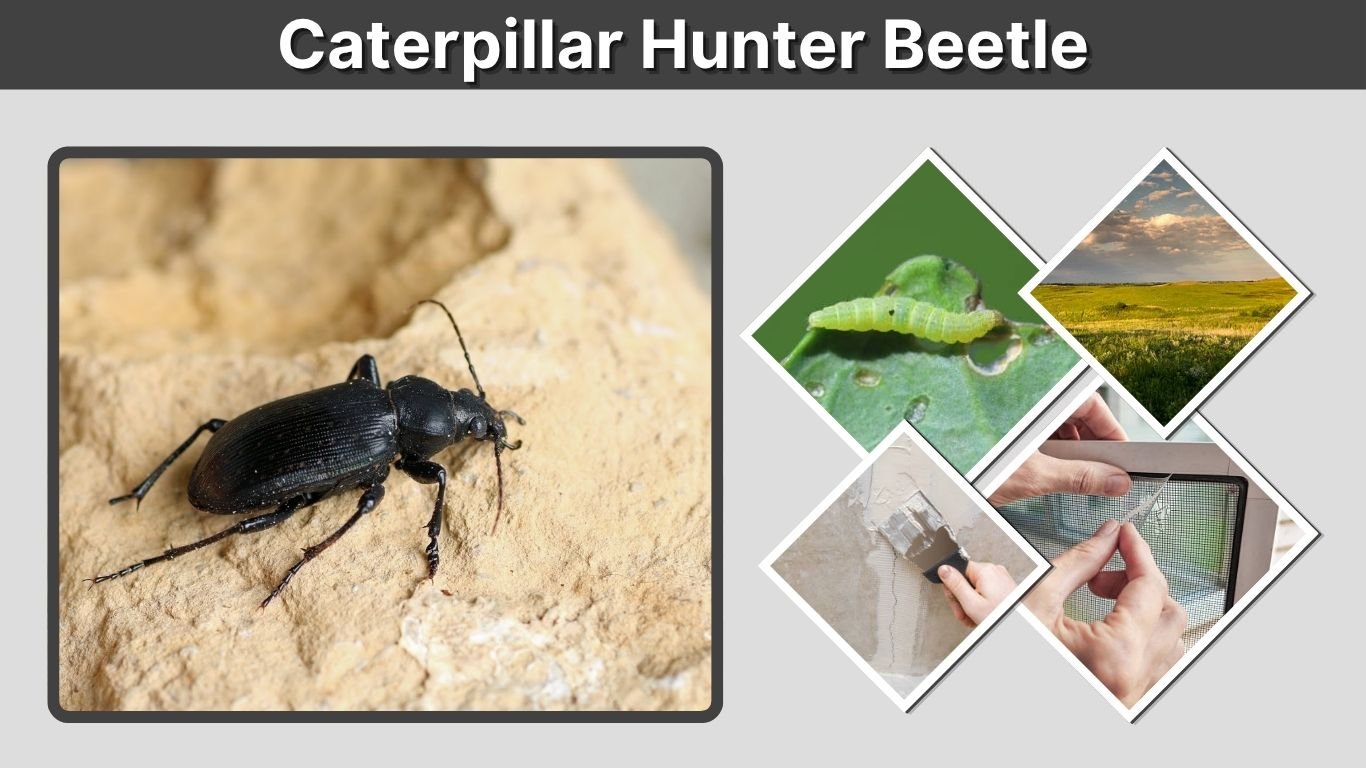
The caterpillar hunter beetle is a large, predatory ground beetle known for hunting caterpillars and other soft-bodied insects. Belonging mainly to the genus Calosoma, these beetles have powerful jaws, long legs, and distinctive body colors ranging from glossy black to metallic green. Common examples include the black caterpillar hunter (Calosoma sayi) and fiery searcher (Calosoma scrutator). Although their appearance can seem intimidating, they help control destructive caterpillar populations in gardens and forests. Understanding their identification, habitat, feeding behavior, life cycle, and defensive abilities reveals why these beetles are valuable natural predators.
What Is a Caterpillar Hunter Beetle?
Caterpillar hunter beetles belong to the family Carabidae, commonly known as ground beetles. These insects are active predators that hunt caterpillars, insect larvae, and other small invertebrates. Unlike many ground beetles that primarily hunt at ground level, some caterpillar hunters climb trees and shrubs to capture prey.
Scientific Classification
Caterpillar hunters are primarily associated with the genus Calosoma. Their scientific classification includes the order Coleoptera, family Carabidae, and subfamily Carabinae.
Two frequently encountered North American species are the black caterpillar hunter (Calosoma sayi) and fiery searcher (Calosoma scrutator). Both are beneficial predators, although their coloration, size, and geographic distribution differ.
Caterpillar Hunter Beetle Identification
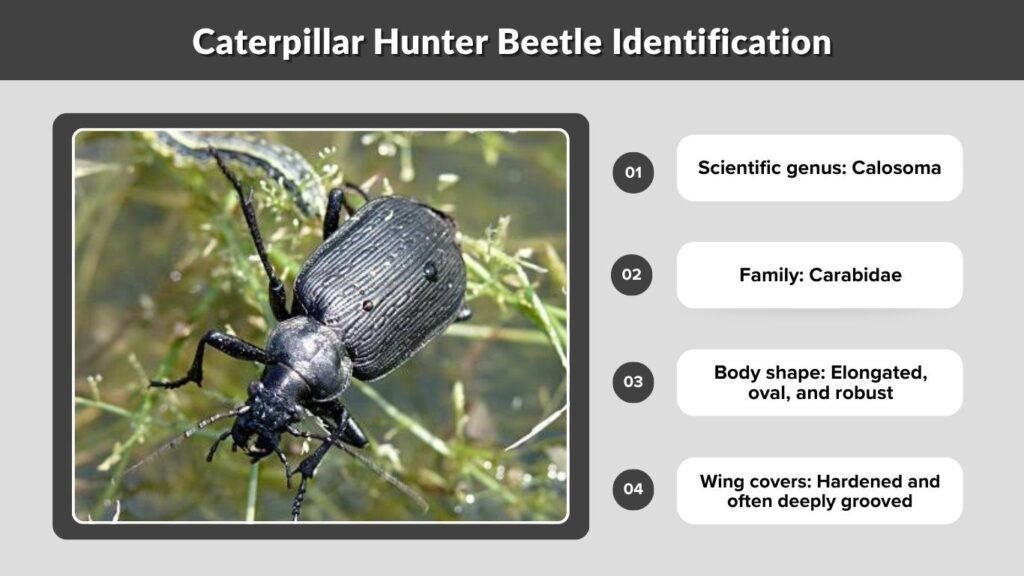
Caterpillar hunter beetles are recognized by their elongated bodies, powerful mandibles, and strong running legs. Their hardened wing covers often have visible grooves or metallic markings. Although their appearance varies by species, most have large eyes and long antennae that help them locate prey in gardens and wooded environments.
Key Identification Features
- Scientific genus: Calosoma
- Family: Carabidae
- Size: Common North American species measure approximately 25–35 mm
- Color: Black, metallic green, blue, bronze, or purple, depending on species
- Body shape: Elongated, oval, and robust
- Wing covers: Hardened and often deeply grooved
- Legs: Long and powerful, adapted for running
- Mandibles: Strong and curved for capturing prey
- Antennae: Long, slender, and segmented
Black Caterpillar Hunter Beetle
The black caterpillar hunter (Calosoma sayi) has a glossy black body with rows of small, sometimes reddish metallic pits along its wing covers.
Adults typically measure 25–28 mm long. They occur in forests, grasslands, cultivated land, and other open habitats.
Their dark coloration helps distinguish them from brightly colored caterpillar hunters, although similar black species may require closer examination.
Fiery Searcher Caterpillar Hunter
The fiery searcher (Calosoma scrutator) is famous for its striking metallic appearance. Adults have bright green wing covers edged with reddish-gold or purple, along with a blue-violet thorax.
They measure approximately 25–35 mm long. The species is especially noticeable because of its vivid coloration, powerful jaws, and ability to climb trees while hunting caterpillars.
Where Do Caterpillar Hunter Beetles Live?
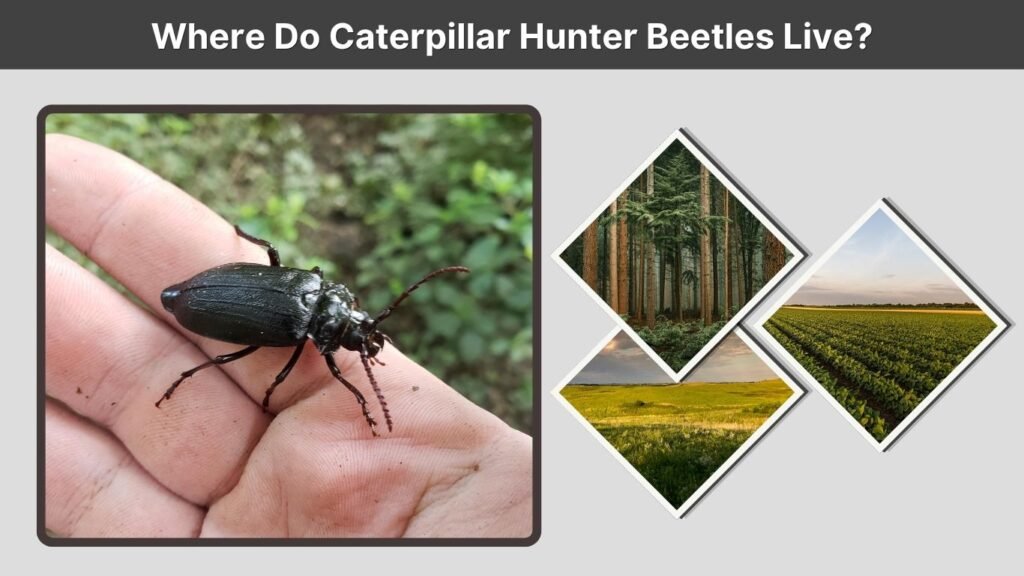
Caterpillar hunter beetles inhabit forests, grasslands, gardens, agricultural fields, and areas with abundant vegetation. They prefer environments where caterpillars and other insects provide reliable food sources. Most are active predators that move through leaf litter, climb vegetation, or search beneath fallen wood for prey and shelter.
Natural Habitat and Distribution
Different species occur across North America and other regions.
Black caterpillar hunters are widely distributed in the United States, particularly in eastern and southern regions.
Fiery searchers occur across much of the continental United States, southern Canada, and parts of Central America.
Both species frequently shelter beneath stones, logs, and leaf litter during inactive periods.
Caterpillar Hunting Behavior
Caterpillar hunters use their strong legs and mandibles to locate and capture prey.
Many are particularly active at night, although they may also hunt during daylight.
Unlike ground beetles that remain close to soil surfaces, fiery searchers can climb shrubs and trees in pursuit of caterpillars.
Their hunting behavior makes them important natural enemies of leaf-feeding insects.
What Do Caterpillar Hunter Beetles Eat?
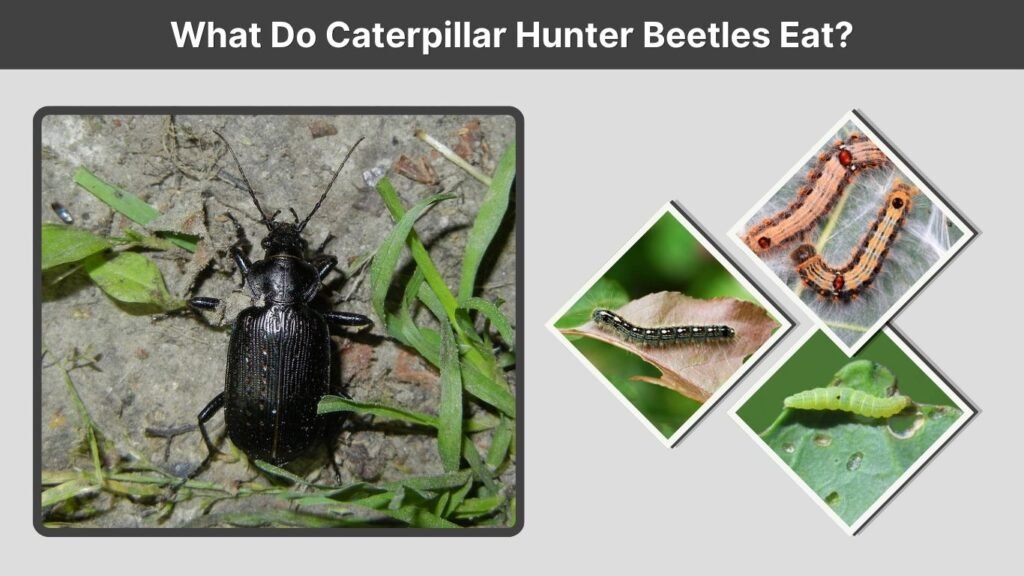
Caterpillar hunter beetles are primarily carnivorous insects that feed on caterpillars and other invertebrates. Both adults and larvae are active predators. Their feeding habits help reduce populations of several forest and garden pests, especially insects that consume leaves and damage ornamental plants or trees.
Common Caterpillar Hunter Prey
Fiery searchers commonly consume tent caterpillars, spongy moth caterpillars, and various moth larvae.
They may also attack insect pupae and other soft-bodied prey.
Research summarized by the University of Florida indicates that a fiery searcher larva may consume approximately 50 caterpillars during development, while an adult can consume hundreds over its lifetime.
How Do Caterpillar Hunters Catch Prey?
Caterpillar hunters actively search for food rather than waiting in webs or constructing traps.
They use their strong mandibles to grab caterpillars and restrain them while feeding.
Their speed allows them to pursue moving prey across soil, branches, and foliage.
Because they can hunt both above and below ground level, they can encounter caterpillars in several parts of their habitat.
Caterpillar Hunter Larvae and Life Cycle
Caterpillar hunter beetles undergo complete metamorphosis, passing through egg, larva, pupa, and adult stages. Their larvae are also predatory and contribute to caterpillar control. Developmental timing varies between species, but eggs and pupae typically develop in soil, providing protection during these vulnerable stages.
What Do Caterpillar Hunter Larvae Look Like?
Caterpillar hunter larvae have elongated, segmented bodies with prominent jaws and three pairs of legs.
Young fiery searcher larvae are initially pale but darken soon after hatching.
As they develop, their bodies become more robust and their mandibles remain adapted for capturing prey.
Their flattened bodies allow them to move through soil debris and sheltered environments.
Egg, Pupa, and Adult Stages
Female fiery searchers lay individual eggs in soil during the warmer months.
The larvae pass through three developmental stages before entering the soil to pupate.
For this species, pupation generally lasts about 10–15 days, depending on conditions.
Adults are relatively long-lived compared with many insects, commonly surviving around two years and occasionally longer.
Do Caterpillar Hunter Beetles Bite Humans?
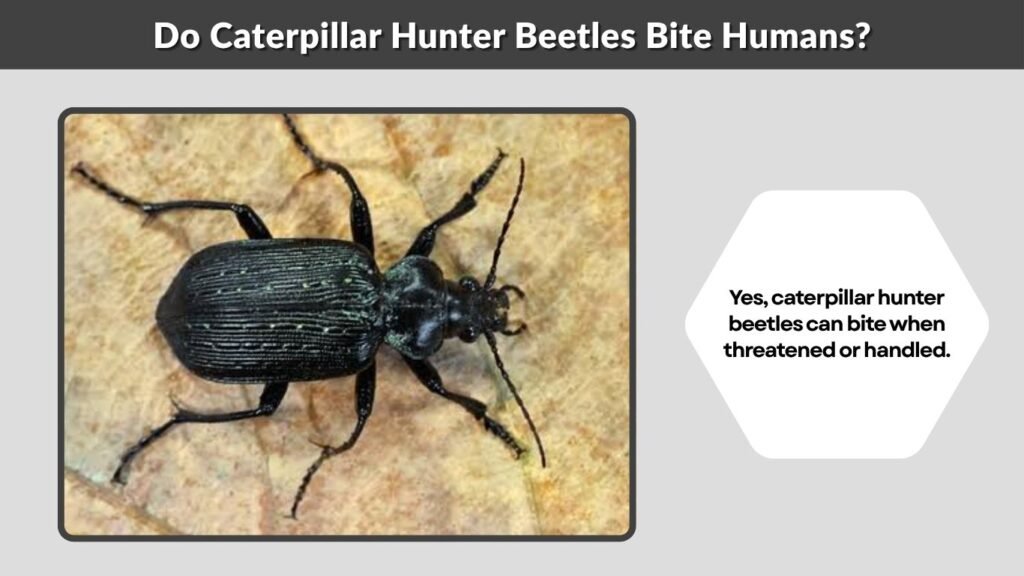
Caterpillar hunter beetles have large mandibles that may appear dangerous. However, their jaws are primarily designed for catching other insects. They do not normally attack people, and encounters rarely cause serious problems. Still, handling them can provoke defensive behavior, including biting or releasing unpleasant-smelling chemicals.
Caterpillar Hunter Beetle Bite
Yes, caterpillar hunter beetles can bite when threatened or handled.
Their strong mandibles may produce a painful pinch, particularly in larger species such as the fiery searcher.
However, they are not venomous and do not seek out humans as prey.
Avoid picking them up with bare hands to reduce the possibility of a defensive bite.
Why Do Caterpillar Hunters Smell Bad?
Some caterpillar hunter beetles release defensive fluids from specialized glands when disturbed.
The fiery searcher produces a strong musky odor that can remain noticeable after contact.
These secretions discourage predators and may irritate sensitive skin.
The unpleasant smell is a defensive adaptation rather than an indication that the insect is dangerous to encounter outdoors.
Caterpillar Hunter Beetles in the House
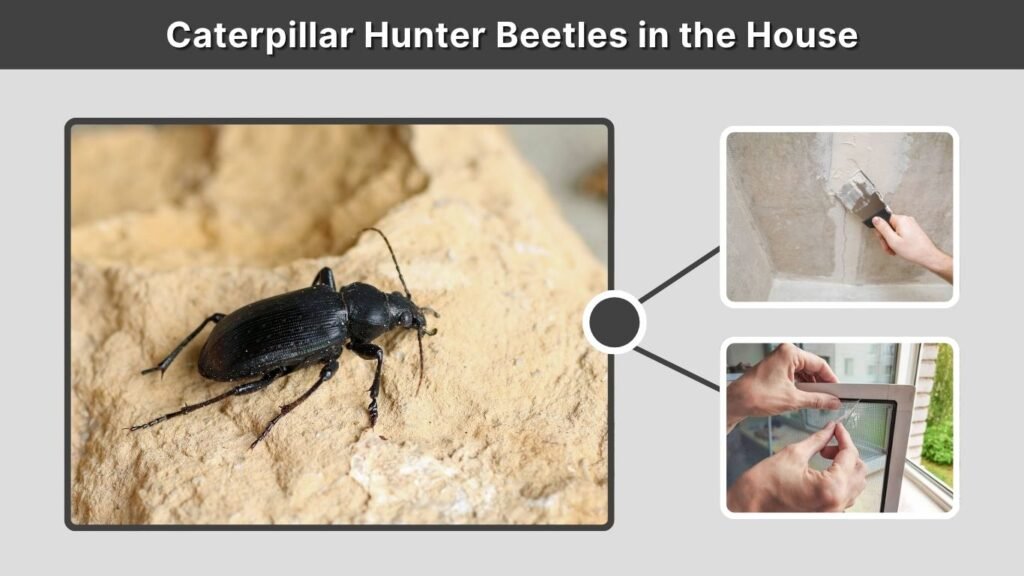
Caterpillar hunter beetles occasionally wander indoors, especially near exterior lighting or homes surrounded by gardens. Their presence does not usually indicate an infestation because these predators primarily live and reproduce outdoors. A beetle found inside is generally searching for shelter or has entered accidentally.
How to Remove Caterpillar Hunters Safely
If a caterpillar hunter enters your house, avoid crushing or handling it directly.
Instead, guide it into a container using a piece of stiff paper and release it outdoors.
Repair damaged window screens, seal foundation gaps, and reduce unnecessary outdoor lighting to help prevent future entry.
Chemical treatment is rarely necessary because these beetles are beneficial predators rather than typical household pests.
FAQs
1. Are black caterpillar hunter beetles dangerous?
Black caterpillar hunter beetles are generally not dangerous to humans. They can bite defensively with their strong mandibles, but they do not hunt people or inject venom. Their primary role is capturing caterpillars and other insects. Avoid handling them directly because some caterpillar hunters also release irritating defensive secretions.
2. Can caterpillar hunter beetles fly?
Some caterpillar hunter beetles can fly, although many spend most of their time running across the ground or climbing vegetation. The fiery searcher has functional wings but flies relatively infrequently. Its strong legs make running and climbing effective ways to locate caterpillars in gardens and woodland habitats.
3. Are caterpillar hunter beetles beneficial?
Yes, caterpillar hunter beetles are beneficial predators because they consume caterpillars that damage trees, shrubs, and garden plants. Both adults and larvae help reduce populations of destructive insects. Their presence supports natural pest management and may reduce the need for unnecessary insecticide treatments in suitable outdoor environments.
4. How long do caterpillar hunter beetles live?
Caterpillar hunter beetles can live considerably longer than many other insects. Fiery searcher adults commonly survive around two years, and some have been recorded living up to four years. Lifespan varies depending on species, environmental conditions, available food, and exposure to predators or other threats.
5. What is the difference between a caterpillar hunter beetle and a caterpillar hunting wasp?
Caterpillar hunter beetles belong to the order Coleoptera and have hardened wing covers and strong running legs. Caterpillar hunting wasps belong to the order Hymenoptera and often capture caterpillars as food for their developing young. Unlike beetles, many predatory wasps can sting when defending themselves or their nests.
