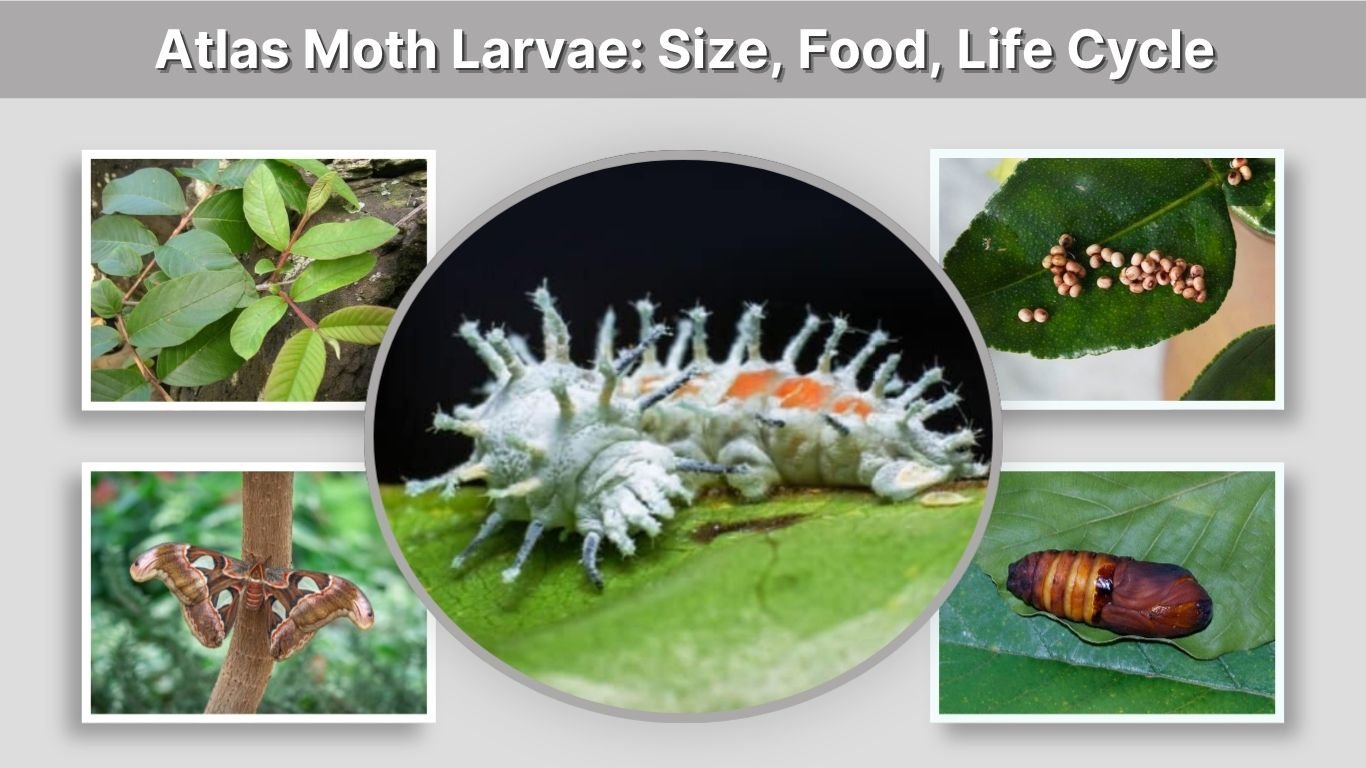
Atlas moth larvae are among the most impressive caterpillars in the insect world. Before becoming one of the largest moths on Earth, the atlas moth begins life as a hungry, fast-growing larva that feeds heavily on leaves. Many people search for atlas moth larvae size, food, care, and life cycle because this species is both beautiful and unusual from caterpillar to adult stage.
What Is an Atlas Moth?
The atlas moth is a giant silk moth known for its massive wings, rich reddish-brown patterns, and snake-like wing tips. Its scientific name is Attacus atlas, and it is native to parts of South and Southeast Asia.
Basic overview
The atlas moth is famous because of its size. Adult atlas moths have some of the largest wing surfaces of any moth species. However, the larval stage is just as fascinating because the caterpillar grows quickly and stores the energy the adult moth will later depend on.
Unlike many insects that feed throughout adulthood, adult atlas moths do not eat. This makes the larval stage especially important. The caterpillar must consume enough food to support growth, pupation, cocoon formation, and the short adult life that follows.
Atlas Moth Larvae Size
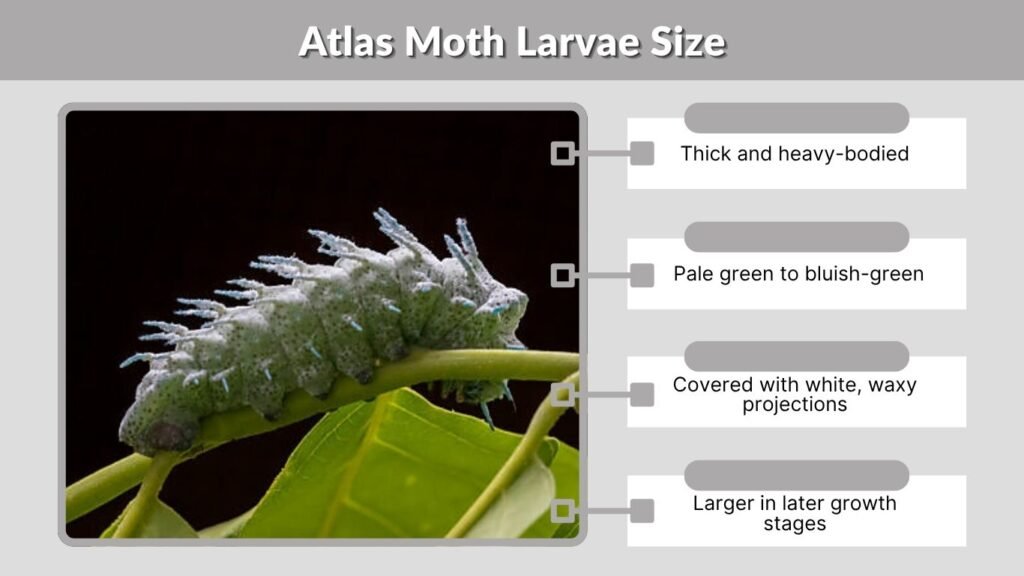
Atlas moth larvae are large, thick-bodied caterpillars. They can reach about 4 to 5 inches long when fully grown, making them one of the more impressive caterpillars seen in tropical regions.
How big do atlas moth caterpillars get?
A mature atlas moth caterpillar can grow to around 11 centimeters or more in length. Its body is bulky, soft, and covered with a pale waxy coating. This gives the larva a powdery or frosted appearance.
Atlas moth larvae are usually:
- Thick and heavy-bodied
- Pale green to bluish-green
- Covered with white, waxy projections
- Larger in later growth stages
- Noticeably different from many common garden caterpillars
Their size is one reason people often search for terms like “giant atlas moth larvae” and “atlas moth caterpillar size.” The caterpillar looks almost oversized compared with many familiar moth larvae.
Why are atlas moth larvae so large?
Atlas moth larvae become large because they must store energy for the rest of the moth’s life. Once the adult emerges, it cannot feed. This means the larva must build enough fat reserves to power metamorphosis, wing development, mating, and reproduction.
What Do Atlas Moth Larvae Eat?
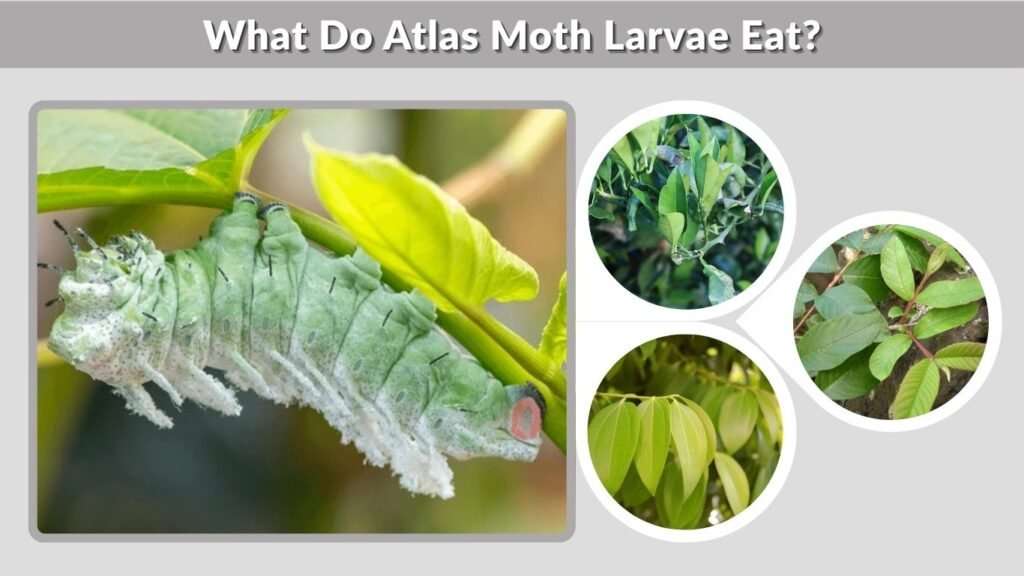
Atlas moth larvae are leaf eaters. They feed on the leaves of specific host plants, especially tropical and subtropical trees. Their diet is one of the most important parts of their development.
Common food plants
Atlas moth larvae may feed on several types of host plants, including:
- Citrus leaves
- Guava leaves
- Cinnamon leaves
- Privet leaves
- Custard apple leaves
- Mango leaves in some regions
- Other suitable broadleaf plants
In captivity, keepers often use the host plants that are easiest to source locally. However, larvae should not be switched suddenly between unrelated plants unless necessary, because sudden food changes can stress them.
Atlas moth larvae food requirements
Young larvae need fresh, clean leaves. Older caterpillars eat much more and may need frequent feeding. Leaves should be free from pesticides, herbicides, road dust, and chemical sprays.
A good feeding setup usually includes:
- Fresh leaves changed daily
- Good airflow
- Clean containers or mesh cages
- No moldy or dried leaves
- Safe host plants from reliable sources
Because atlas moth caterpillars grow quickly, they can consume large amounts of foliage in their later stages. This is normal and shows that the larva is preparing for pupation.
Atlas Moth Life Cycle
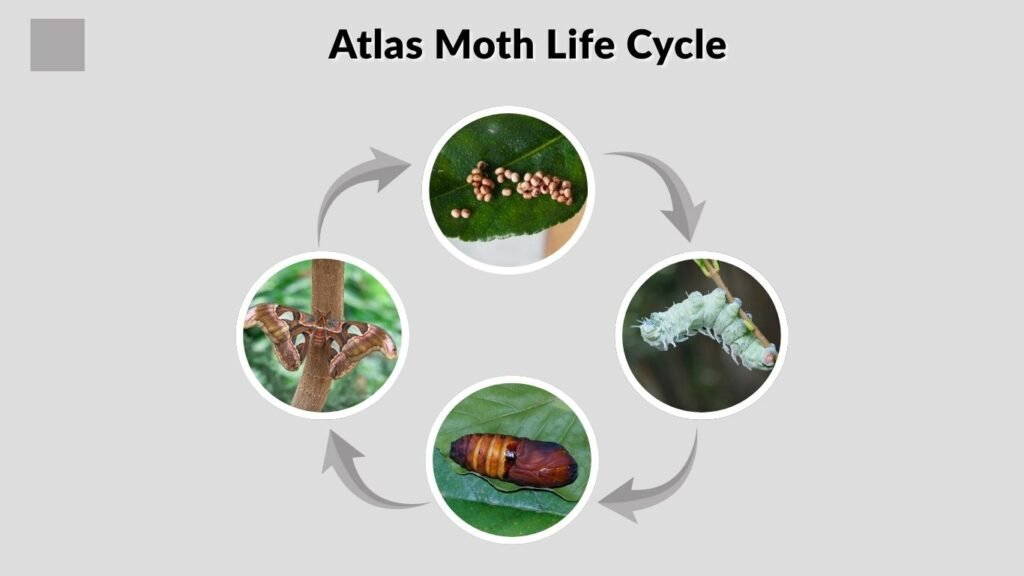
The atlas moth life cycle includes four main stages: egg, larva, pupa, and adult. Like butterflies and other moths, it undergoes complete metamorphosis.
Atlas moth life cycle table
| Life Stage | What Happens | Main Purpose |
|---|---|---|
| Egg | Female lays small eggs on host plant leaves | Begin development |
| Larva | Caterpillar hatches and feeds heavily | Grow and store energy |
| Pupa | Larva spins a cocoon and transforms | Metamorphosis |
| Adult | Giant moth emerges, mates, and reproduces | Continue the species |
Egg stage
The female atlas moth lays eggs on or near suitable host plants. These eggs are small, round, and usually placed where the newly hatched larvae can find food quickly.
After hatching, young larvae may first consume part of the eggshell before moving on to leaves. This provides a small early energy boost.
Larval stage
The larval stage is the feeding and growing stage. This is when the atlas moth caterpillar increases dramatically in size. It molts several times as it grows, shedding its old skin to make room for a larger body.
During this stage, the caterpillar’s main job is to eat, grow, and store energy.
Pupal stage
Once fully grown, the larva spins a strong silk cocoon. Inside the cocoon, it becomes a pupa and begins transforming into an adult moth.
The cocoon is usually papery, brownish, and attached to leaves or twigs. It protects the developing moth during metamorphosis.
Adult stage
The adult atlas moth emerges with large wings that need time to expand and dry. Once ready, the moth’s main purpose is reproduction.
Adult atlas moths do not feed because they lack functional mouthparts. Their adult life is short, often lasting only several days to about two weeks.
Atlas Moth Size and Adult Appearance
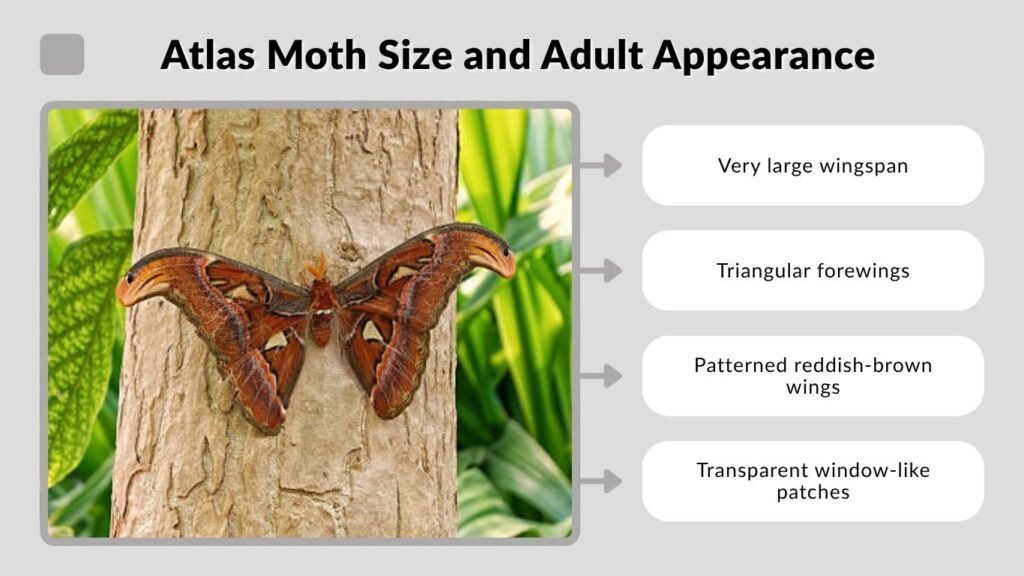
The atlas moth is best known for its enormous wings. Adult moths can have a wingspan that reaches up to around 9 to 12 inches in some cases, although size varies by individual and location.
What does an atlas moth look like?
The adult atlas moth has broad wings with reddish-brown, tan, black, and cream markings. The wing tips are curved and resemble snake heads, which may help scare predators.
Key adult features include:
- Very large wingspan
- Triangular forewings
- Patterned reddish-brown wings
- Transparent window-like patches
- Snake-like wing tips
- Heavy body compared with smaller moths
The name “atlas moth” is often linked to its large size and bold wing patterns. It is one of the most recognizable giant moths in the world.
Are Atlas Moths Rare?
Atlas moths are not considered rare everywhere, but they may be uncommon in some areas. Their local abundance depends on habitat, host plants, climate, and human activity.
Where are atlas moths found?
Atlas moths are native to tropical and subtropical parts of Asia. They are found in countries such as India, Malaysia, Indonesia, China, Thailand, and the Philippines.
The keyword “Philippine atlas moth larvae” likely refers to atlas moth populations found in the Philippines, where tropical conditions and suitable host plants can support their development.
Are they endangered?
Atlas moths are not generally known as globally endangered, but local populations may be affected by habitat loss, pesticide use, and collection pressure. In some regions, they may be seen regularly; in others, they may be much harder to find.
It is better to describe them as locally variable rather than simply “rare” or “common.”
Raising Atlas Moths
Raising atlas moths can be fascinating, but it requires careful attention to food, cleanliness, humidity, and legal rules. In some places, keeping or importing live moths may be regulated.
Basic care needs
Anyone raising atlas moths must provide the right conditions. The most important requirement is a steady supply of safe host plant leaves.
Basic raising needs include:
- Correct host plant leaves
- Clean rearing containers
- Proper ventilation
- Stable warmth and humidity
- Space for larvae to molt
- A safe place for cocoon formation
Larvae should be handled as little as possible. Their bodies are soft, and rough handling can injure them.
Common problems when raising larvae
Atlas moth larvae may suffer if conditions are too wet, too dry, dirty, or poorly ventilated. Mold is a common problem in enclosed containers. Spoiled leaves can also harm larvae.
Good care means removing waste, replacing old leaves, and keeping the enclosure clean without disturbing the caterpillars too much.
Can you catch an atlas moth?
Searching “how to catch atlas moth” suggests curiosity, but catching wild atlas moths is not always recommended. In many places, wildlife collection may be restricted. Even where it is legal, it is better to observe and photograph them rather than remove them from the wild.
If you find an atlas moth outdoors, avoid touching its wings. Moth wings are delicate, and handling can damage the scales that help protect and support flight.
Atlas Moth Labelled Diagram: Main Body Parts
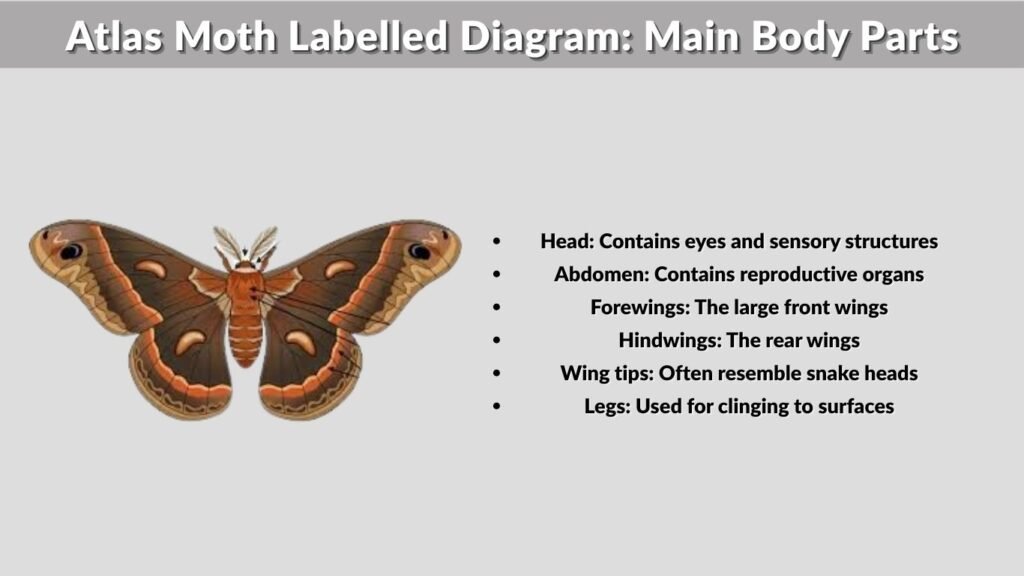
A labelled diagram of an atlas moth usually includes the main adult body parts. While a visual diagram is helpful, the key parts are easy to understand in words.
Important parts to label
The main atlas moth body parts include:
- Antennae: Used to detect scent and pheromones
- Head: Contains eyes and sensory structures
- Thorax: Supports the wings and legs
- Abdomen: Contains reproductive organs
- Forewings: The large front wings
- Hindwings: The rear wings
- Wing tips: Often resemble snake heads
- Legs: Used for clinging to surfaces
For larvae, a labelled diagram would show the head, thoracic legs, abdominal prolegs, body segments, spiracles, and waxy projections.
How Long Do Atlas Moths Live?
Atlas moths spend more time as larvae and pupae than they do as adults. The adult stage is very short because the moth does not eat after emerging.
Adult lifespan
Adult atlas moths often live about 5 to 14 days. Their exact lifespan depends on temperature, energy reserves, sex, and environmental conditions.
During this time, their main goals are:
- Finding a mate
- Conserving energy
- Reproducing
- Laying eggs if female
Because they cannot feed, adult atlas moths rely completely on energy stored during the caterpillar stage.
Why the larval stage matters so much
The larval stage determines how strong the adult moth will be. A well-fed larva has better energy reserves for pupation and adult survival. Poor nutrition during the caterpillar stage can result in smaller adults or weaker moths.
FAQs
1. What do atlas moth larvae eat?
Atlas moth larvae eat leaves from suitable host plants. Common food plants include citrus, guava, cinnamon, privet, and other broadleaf trees depending on region and availability. In captivity, they need fresh, pesticide-free leaves and should not be given wilted, moldy, or chemically treated foliage.
2. How large do atlas moth larvae get?
Atlas moth larvae can grow to around 4 to 5 inches long when fully developed. They become thick, heavy caterpillars with a pale green body and waxy white coating. Their large size helps them store enough energy for cocoon formation and adult life.
3. How long do atlas moths live?
Adult atlas moths usually live only several days to about two weeks. They do not have functional mouthparts, so they cannot eat as adults. Their short adult life is focused on mating and reproduction, using energy stored during the larval stage.
4. Are atlas moths rare?
Atlas moths are not rare everywhere, but their abundance depends on location. In parts of South and Southeast Asia, they may be seen in suitable habitats. However, habitat loss, pesticides, and collection can reduce local populations, making them uncommon in some areas.
5. Can you raise atlas moth larvae at home?
Atlas moth larvae can be raised by experienced keepers, but they need proper host plants, clean conditions, ventilation, warmth, and careful handling. Local laws should be checked first, especially when importing eggs, cocoons, or live insects from another region.