
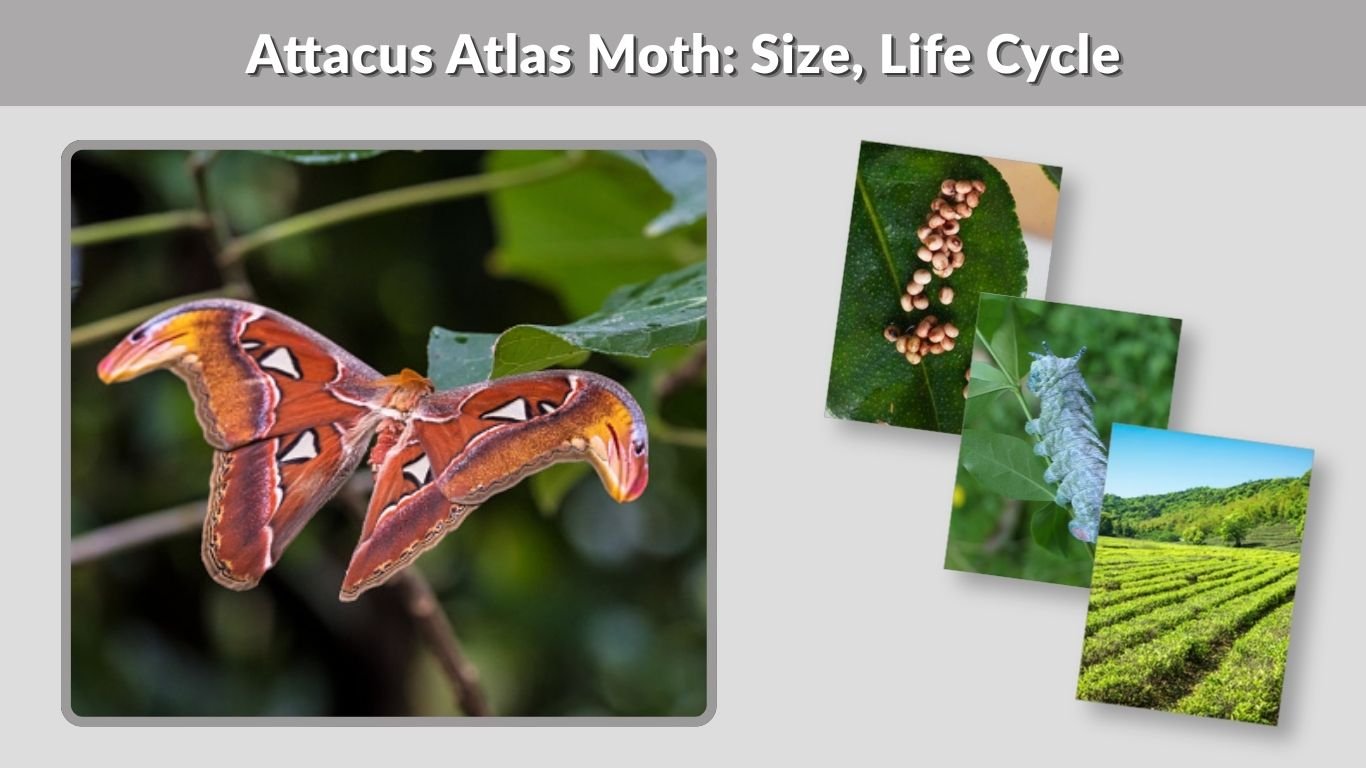
The Attacus atlas, commonly known as the atlas moth, is one of the largest and most dramatic moths in the world. With huge patterned wings, snake-like wing tips, and a short adult lifespan, it attracts interest from insect lovers, collectors, students, and nature photographers. This guide explains its size, caterpillar stage, eggs, life cycle, diet, safety, and common identification questions.
What Is Attacus Atlas?
Attacus atlas is the scientific name of the atlas moth, a giant silk moth from the family Saturniidae. It is native to parts of South Asia, Southeast Asia, and East Asia, where it lives in warm forested habitats, plantations, gardens, and areas with suitable host plants.
Although many people search for “Attacus atlas butterfly,” this insect is not a butterfly. It is a moth. The confusion is understandable because atlas moths are large, colorful, and visually impressive, much like many tropical butterflies.
Attacus atlas common name
The common name of Attacus atlas is the atlas moth. The name is often linked to Atlas, the giant figure from Greek mythology, because of the moth’s enormous size. In some regions, it is also associated with snake imagery because the tips of its wings resemble snake heads.
Is Attacus atlas a butterfly or a moth?
Attacus atlas is a moth, not a butterfly. It belongs to the giant silk moth group. Unlike butterflies, atlas moths are mostly nocturnal, have thick bodies, and males often have large feathery antennae used to detect female pheromones.
Attacus Atlas Size and Appearance
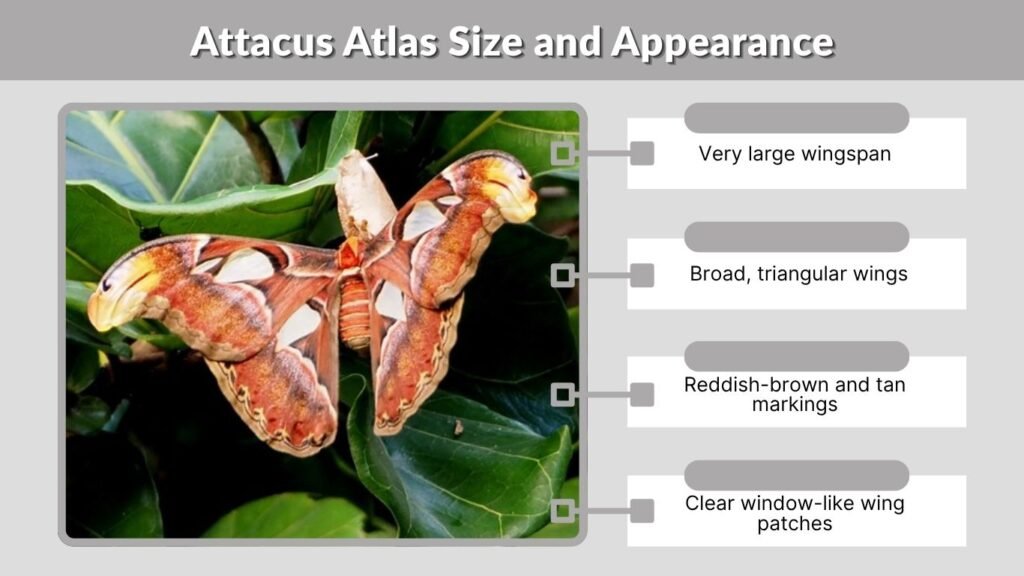
The atlas moth is famous for its size. Adult atlas moths can have a wingspan of about 25 to 30 centimeters, or roughly 10 to 12 inches. This makes them one of the largest moths in the world by wing surface area.
Key appearance features
The adult atlas moth has a striking pattern that makes it easy to recognize. Its wings are usually reddish-brown, orange, tan, black, and cream, with transparent triangular patches.
Important features include:
- Very large wingspan
- Broad, triangular wings
- Reddish-brown and tan markings
- Clear window-like wing patches
- Curved wing tips that look like snake heads
- Thick, hairy body
- Reduced adult mouthparts
The atlas moth’s appearance is one of the biggest reasons people search for “Attacus atlas images,” “atlas moth Attacus atlas photo,” and “giant Attacus atlas moth.”
Attacus atlas maximum wingspan
The maximum wingspan varies by individual, sex, and environment. Large atlas moths may reach around 30 centimeters across. Females are usually larger and heavier than males, while males tend to have broader, more feathery antennae.
Attacus Atlas Snake Disguise
One of the most famous atlas moth facts is its snake-like wing tip pattern. The upper tips of the forewings curve outward and resemble the head of a snake. This is why searches such as “Attacus atlas snake,” “Attacus atlas moth snake,” and “Attacus atlas butterfly with snake wings” are common.
Why does the atlas moth look like a snake?
The snake-like pattern may help scare away predators. A bird, lizard, or small mammal approaching the moth may hesitate when it sees markings that resemble a snake’s head. Even a brief delay can give the moth a better chance to escape or remain undisturbed.
This is not a true snake defense, of course. The moth does not bite like a snake and is not venomous. The pattern is a visual disguise.
Attacus Atlas Caterpillar
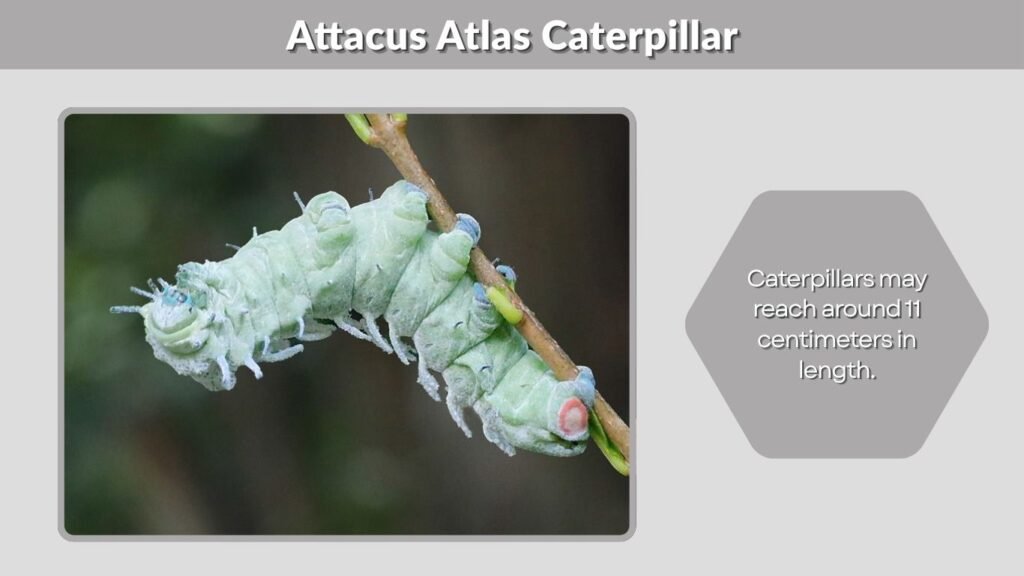
The Attacus atlas caterpillar is also impressive. Before becoming a giant moth, it spends its larval stage feeding heavily on leaves. This stage is extremely important because the adult moth does not eat.
What does the caterpillar look like?
The atlas moth caterpillar is large, thick, and usually pale green to bluish-green. It has a waxy coating and fleshy projections along the body. Mature caterpillars may reach around 11 centimeters in length.
The caterpillar may look unusual because of its powdery surface and soft spines. These features help make it look less appealing to predators and may provide some protection.
Attacus atlas larvae and growth
Atlas moth larvae grow through several instars. An instar is a growth stage between molts. As the caterpillar becomes larger, it sheds its old skin and continues feeding.
During this stage, the larva’s main goals are:
- Eat fresh host plant leaves
- Grow rapidly
- Store energy
- Prepare for cocoon formation
- Build reserves for adult life
Because adult atlas moths do not feed, the caterpillar stage determines much of the moth’s future strength, size, and reproductive potential.
Attacus Atlas Diet and Host Plants
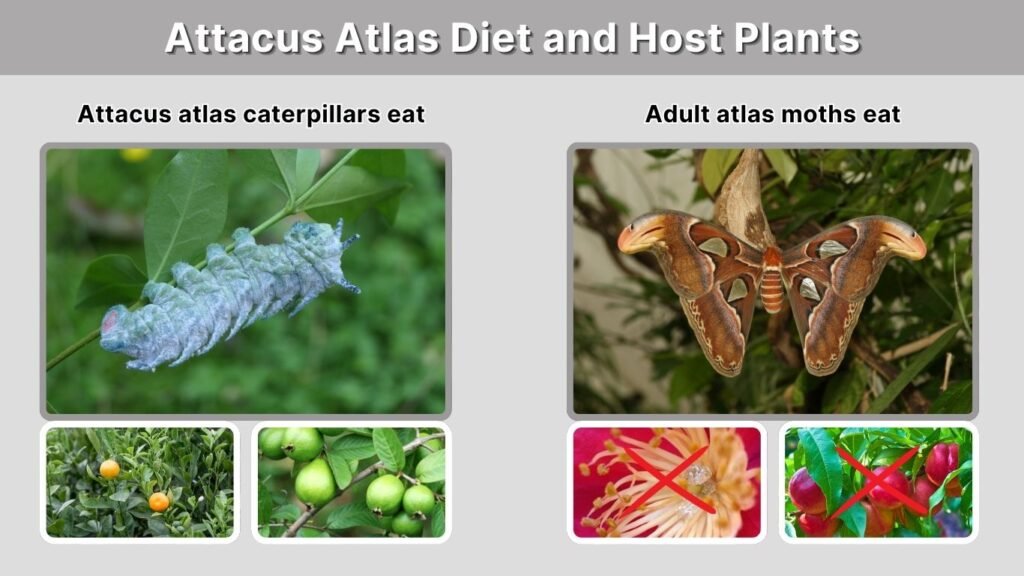
The diet of Attacus atlas changes depending on life stage. Caterpillars eat leaves, while adults do not eat at all.
What do Attacus atlas caterpillars eat?
Atlas moth caterpillars feed on the leaves of suitable host plants. Common host plants include citrus, cinnamon, guava, and other broadleaf plants. In different regions, they may use different local host plants.
Common food plants may include:
- Citrus
- Guava
- Cinnamon
- Privet
- Mango
- Custard apple
- Other suitable tropical trees and shrubs
Fresh, chemical-free leaves are essential if the caterpillars are being raised in captivity. Leaves treated with pesticides or herbicides can kill larvae.
Do adult atlas moths eat?
Adult atlas moths do not eat. Their mouthparts are reduced, so they cannot feed on nectar, fruit, or leaves. Instead, they survive on fat reserves stored during the caterpillar stage.
This is why the adult atlas moth has such a short life. It emerges, mates, reproduces, and dies within a limited period.
Attacus Atlas Life Cycle
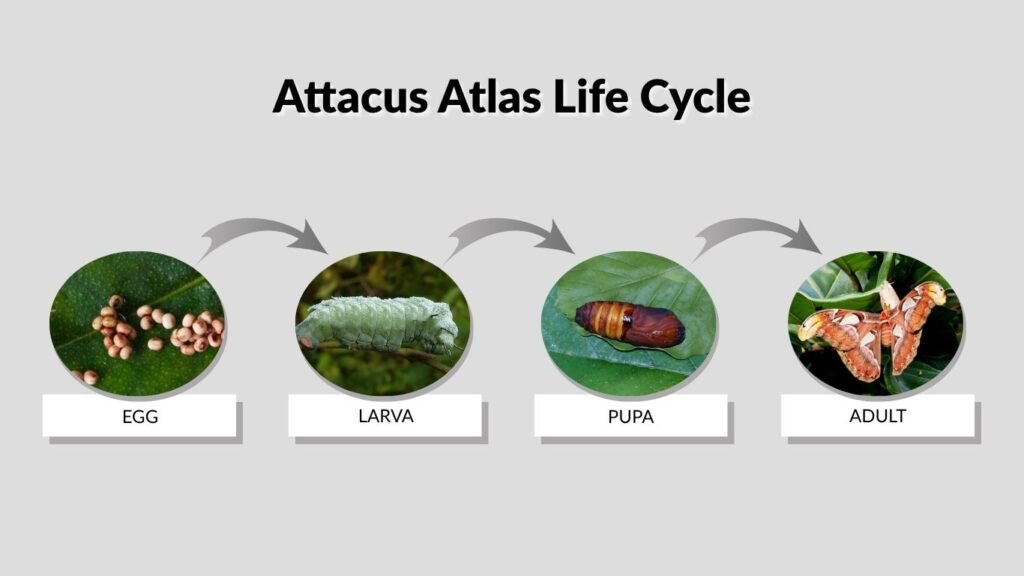
The atlas moth goes through complete metamorphosis. Its life cycle includes egg, larva, pupa, and adult stages.
| Life Stage | Description | Main Purpose |
|---|---|---|
| Egg | Female lays eggs on or near host plant leaves | Begin development |
| Larva | Caterpillar hatches and feeds heavily | Growth and energy storage |
| Pupa | Caterpillar spins a cocoon and transforms | Metamorphosis |
| Adult | Giant moth emerges, mates, and reproduces | Reproduction |
Egg stage
The female atlas moth lays eggs on suitable host plants. The eggs are small, rounded, and placed where newly hatched larvae can access food. After about one to two weeks, the larvae hatch, depending on temperature and environmental conditions.
Larval stage
The larval stage is the feeding stage. Young caterpillars begin small but grow quickly. They consume leaves and molt multiple times. By the end of this stage, the larva is large enough to spin a cocoon.
Cocoon and pupa stage
When fully grown, the caterpillar spins a silk cocoon. The cocoon is usually brownish, papery, and attached to leaves or twigs. Inside, the caterpillar becomes a pupa and transforms into an adult moth.
Atlas moth cocoons are sometimes collected in parts of Asia for silk-related uses or craft purposes. However, wild collection should be avoided unless it is legal and sustainable.
Adult stage
The adult atlas moth emerges from the cocoon with soft, folded wings. It must pump fluid into the wings and allow them to expand and dry. After that, the adult’s main purpose is reproduction.
Attacus Atlas Male and Female
Male and female atlas moths look similar at first, but there are differences in size, body shape, and antennae.
Female Attacus atlas
Female atlas moths are usually larger and heavier. Their bodies are fuller because they carry eggs. Females release pheromones to attract males, often staying relatively still while waiting for a mate.
Male Attacus atlas
Male atlas moths are usually smaller and more active. Their antennae are broader and more feathery, helping them detect female pheromones from long distances. Males fly in search of females, especially at night.
How to tell male and female atlas moths apart
The easiest clues are:
- Females are usually larger and heavier
- Males often have broader, feather-like antennae
- Females have fuller abdomens
- Males are more active in mate searching
- Females release pheromones to attract males
These differences are common in many giant silk moths.
Attacus Atlas Lifespan
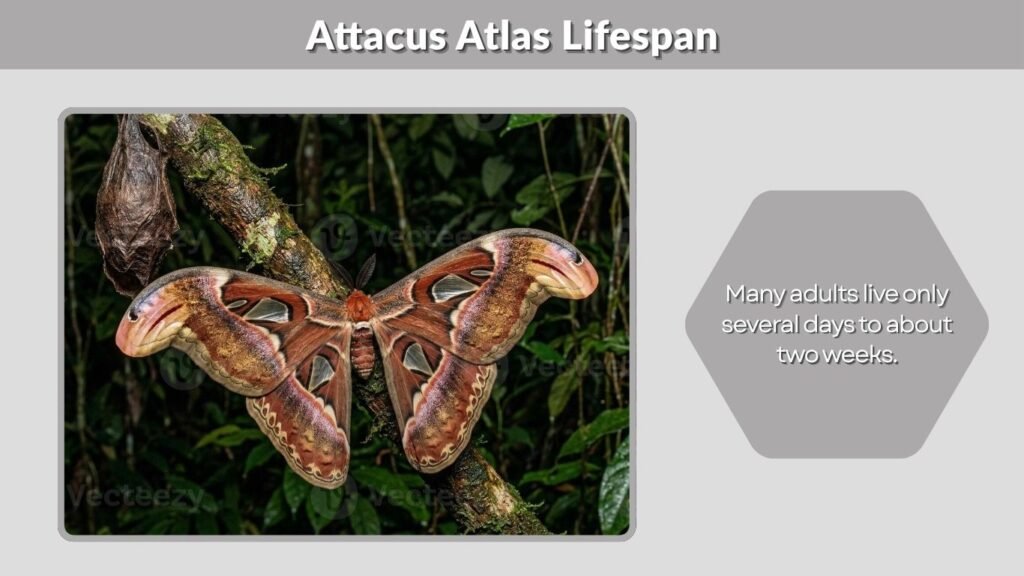
The adult atlas moth has a very short lifespan. Many adults live only several days to about two weeks. Because they cannot eat, they rely entirely on stored energy from the larval stage.
Why is the adult lifespan so short?
The adult stage is designed mainly for reproduction. Atlas moths do not need to spend time feeding, defending territory, or living through long seasons. Their energy is focused on mating and egg laying.
This short lifespan is one reason the caterpillar stage is so important. A well-fed larva becomes a stronger adult with better energy reserves.
Is Attacus Atlas Dangerous?
The atlas moth is not dangerous to humans. It does not sting, bite, or inject venom. Its snake-like wing pattern may look intimidating, but it is only a visual defense.
Is the caterpillar dangerous?
Atlas moth caterpillars are not generally considered dangerous, but they should still be handled carefully. Their bodies are soft and delicate, and some people may experience skin irritation from contact with insects or plant material.
For safety, it is best to observe rather than handle them.
Safe observation tips
If you find an atlas moth or caterpillar:
- Do not grab or squeeze it
- Avoid touching the wings
- Photograph from a safe distance
- Leave wild specimens in place
- Check local rules before collecting eggs, larvae, or cocoons
The wings of adult moths are delicate. Handling can damage wing scales and reduce the moth’s ability to fly.
Attacus Atlas for Sale: What to Know
Some people search for “Attacus atlas moth for sale,” “Attacus atlas eggs for sale,” “Attacus atlas cocoons for sale,” or “Attacus atlas price.” This usually relates to insect keeping, framed specimens, educational displays, or breeding.
Before buying atlas moth eggs or cocoons
Buying live insects can be regulated. Rules vary by country, state, and region. In some places, importing or keeping non-native insects may require permits.
Before purchasing, consider:
- Whether live atlas moths are legal in your area
- Whether the seller is reputable
- Whether the insects are captive-bred
- Whether you have the correct host plants
- Whether you can provide proper humidity and temperature
- Whether release into the wild is illegal or harmful
Never release non-native insects outdoors. Even beautiful species can create ecological problems outside their natural range.
Framed Attacus atlas moths
Framed atlas moth specimens are sold for display and education. If buying one, look for ethical sourcing. Captive-bred or naturally deceased specimens are preferable to unsustainable wild collection.
Attacus Atlas in Different Regions
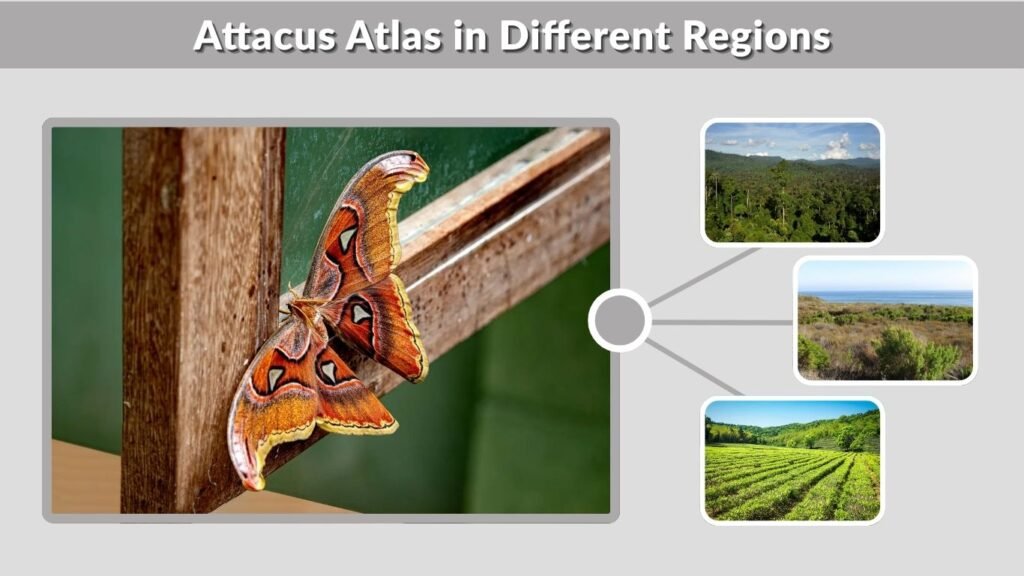
The atlas moth is found across parts of Asia, but local forms and related species can vary. Some searches include names such as Attacus atlas ryukyuensis, Attacus atlas formosa, and Attacus atlas edwardsii. These may refer to regional forms, subspecies, or related naming uses depending on the source.
Distribution and habitat
Atlas moths are associated with warm regions where host plants are available. They may live in:
- Tropical forests
- Secondary forests
- Shrublands
- Plantations
- Gardens with suitable host plants
- Forest edges
Their exact presence depends on climate, food plants, and local habitat quality.
Attacus Atlas Facts
The atlas moth is popular because it combines huge size, dramatic camouflage, and an unusual adult lifestyle.
Quick facts
- Scientific name: Attacus atlas
- Common name: Atlas moth
- Insect type: Moth, not butterfly
- Family: Saturniidae
- Native range: Parts of Asia
- Adult food: None
- Caterpillar food: Host plant leaves
- Adult lifespan: Usually several days to about two weeks
- Defense feature: Snake-like wing tips
- Life cycle: Egg, larva, pupa, adult
Why is Attacus atlas so popular?
The atlas moth is popular in museums, insect collections, classrooms, and nature photography because it is visually unforgettable. Its huge wings, snake-head disguise, and short adult life make it one of the most interesting moths for educational content.
FAQs
1. Is Attacus atlas a moth or butterfly?
Attacus atlas is a moth, not a butterfly. It belongs to the giant silk moth family, Saturniidae. People often mistake it for a butterfly because of its large size and colorful wings, but its nocturnal habits, thick body, and feathery antennae identify it as a moth.
2. What does the Attacus atlas caterpillar eat?
The caterpillar eats leaves from suitable host plants, including citrus, guava, cinnamon, privet, and other broadleaf plants. In captivity, larvae need fresh, pesticide-free leaves. Adult atlas moths do not eat because they have reduced mouthparts and rely on stored energy.
3. How big is the Attacus atlas moth?
The atlas moth can reach a wingspan of about 25 to 30 centimeters, or around 10 to 12 inches. Females are usually larger and heavier than males. Its huge wing surface area makes it one of the largest moths in the world.
4. Why does Attacus atlas look like a snake?
The tips of the atlas moth’s forewings resemble snake heads. This snake-like disguise may help scare or confuse predators. The moth itself is not venomous or dangerous; the pattern is a visual defense that may help it survive in the wild.
5. Is Attacus atlas dangerous to humans?
No, the atlas moth is not dangerous to humans. It does not bite, sting, or carry venom. However, it should be handled gently or not at all because its wings and body are delicate. Observation and photography are better than touching or collecting it.
