
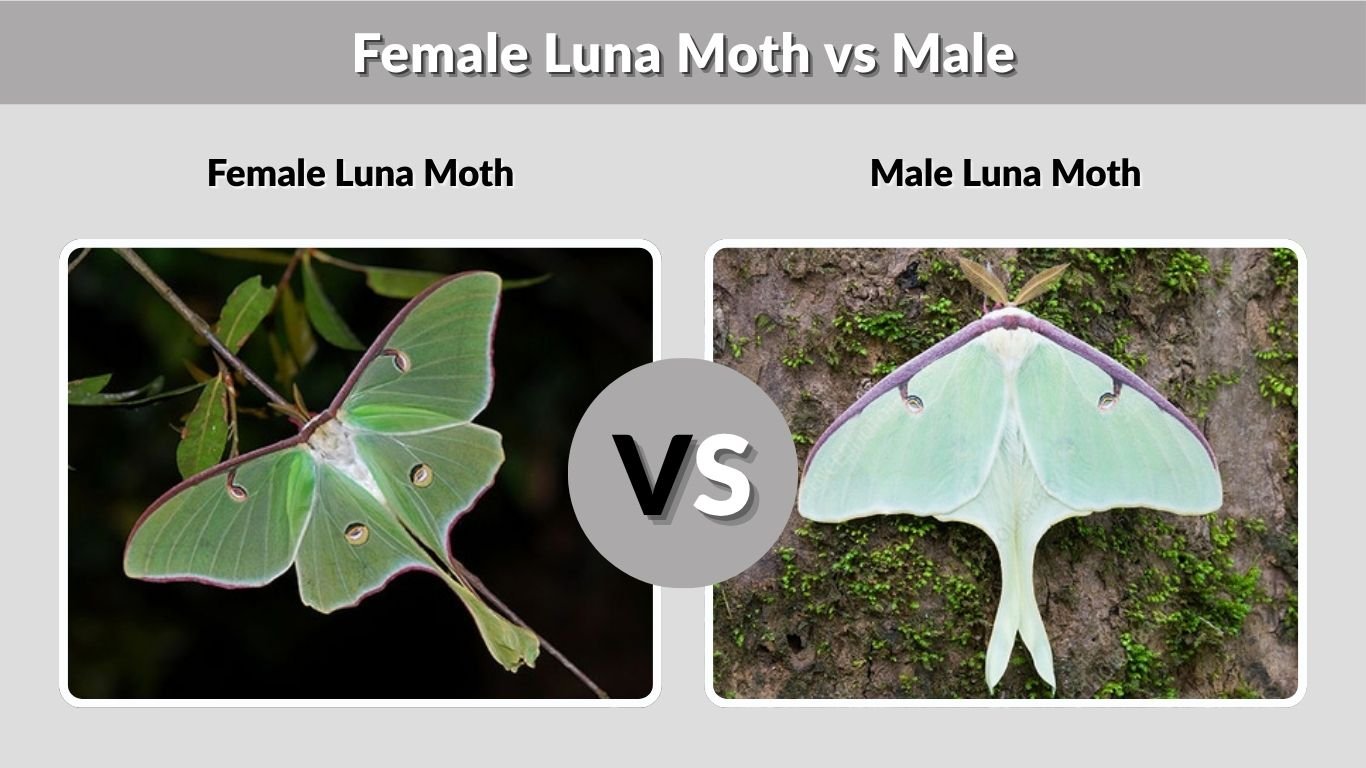
The luna moth is one of North America’s most recognizable and beautiful silk moths, often searched through terms like “female luna moth,” “male vs female luna moth,” and “how to tell a male from a female luna moth.” Because both sexes look similar at first glance, confusion is common. However, subtle differences in antennae, body size, and behavior make identification easier once you know what to look for.
What Is a Luna Moth?
The luna moth (Actias luna) is a large, pale green silk moth found across North America. It is most active at night and is known for its long, elegant tail-like hindwing extensions and crescent-shaped eyespots.
Species overview and lifecycle
Luna moths undergo complete metamorphosis, moving through egg, caterpillar, cocoon, and adult stages. The adult moth’s main purpose is reproduction, as it does not feed and survives only about one week.
Key characteristics include:
- No functional mouth in adulthood
- Strong nocturnal activity
- Attraction to light sources
- Short adult lifespan focused on mating
The species is especially admired for its delicate appearance, making “female luna moth images” and identification guides popular search topics.
Female Luna Moth vs Male: Key Differences
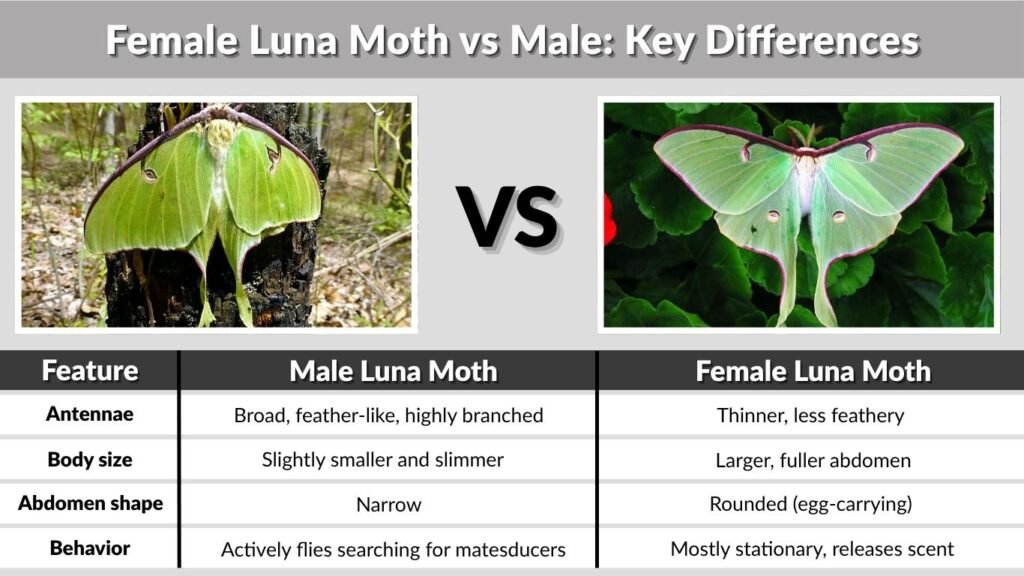
Understanding “luna moth male vs female” differences mainly comes down to physical structure and behavioral roles. While they look nearly identical in color and wing pattern, antennae and body shape are the most reliable indicators.
Comparison table
| Feature | Male Luna Moth | Female Luna Moth |
| Antennae | Broad, feather-like, highly branched | Thinner, less feathery |
| Body size | Slightly smaller and slimmer | Larger, fuller abdomen |
| Abdomen shape | Narrow | Rounded (egg-carrying) |
| Pheromone sensitivity | Very high (detects females) | Produces pheromones |
| Behavior | Actively flies searching for mates | Mostly stationary, releases scent |
1. Antennae differences
One of the most searched identifiers in queries like “male vs female luna moth antennae” is antenna shape.
- Males have large, feathery antennae designed to detect female pheromones from long distances.
- Females have thinner antennae because they do not need to actively search for mates.
2. Size and body structure
Females are typically larger and heavier due to egg development. Their abdomen appears fuller, especially after mating.
- Male moths appear more slender and agile.
- Female moths look bulkier in the abdomen area.
3. Behavioral differences
Behavior is another major clue in identifying sex:
- Males are active fliers, often seen traveling at night.
- Females tend to remain still, releasing pheromones to attract males.
4. Wing appearance and similarity
Despite differences elsewhere, both sexes share:
- Pale green wings
- Long hindwing tails
- Similar eyespot patterns
This similarity is why many people search “male and female luna moth pictures” for visual comparison.
How to Identify a Female Luna Moth in the Wild
Spotting a female luna moth can be challenging because they are less active and better camouflaged when resting.
Key identification steps
- Look for a larger abdomen compared to wing size
- Observe thin, non-feathery antennae
- Watch for a stationary position on leaves or bark
- Check for pheromone-releasing behavior at night
- Compare nearby individuals for activity levels
Female luna moths are often found resting shortly after emerging from their cocoon, waiting for males to locate them.
Additional field clues
In natural environments:
- Females are more likely to remain in trees
- Males may be seen flying in zigzag patterns
- Light sources may attract more males than females
These traits are often included in searches like “how to tell if it’s a female luna moth.”
Behavior, Mating, and Lifespan Differences
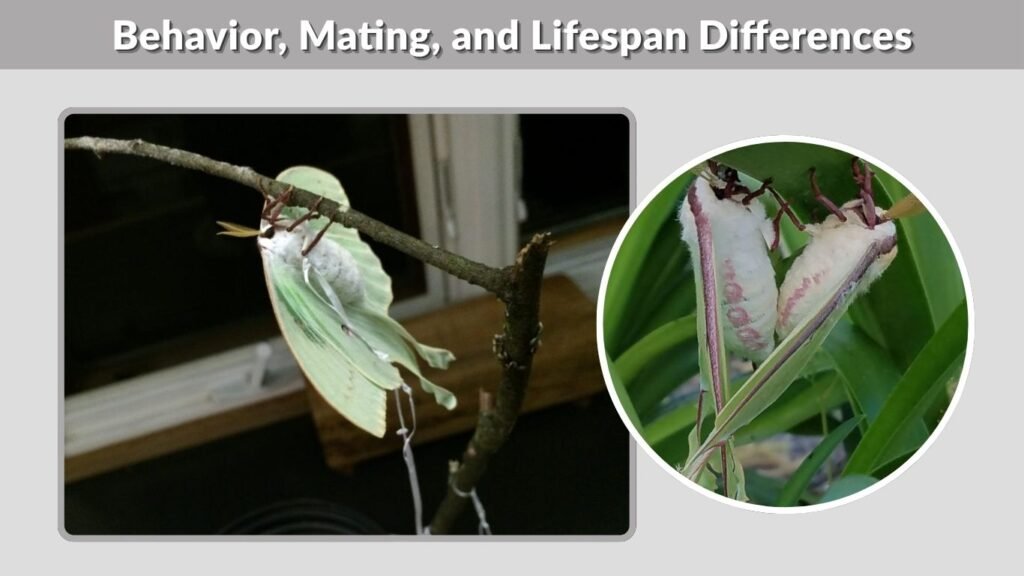
The life strategy of male and female luna moths is highly specialized and revolves around reproduction.
Mating behavior differences
- Females emit pheromones at night to attract males
- Males detect these chemicals using their large antennae
- Once a male locates a female, mating occurs quickly and can last several hours
Key behavioral points
- Males may travel long distances searching for a mate
- Females prioritize energy conservation for egg production
- After mating, females begin laying eggs on host plants
Lifespan comparison
Both sexes share a short adult lifespan of about 5–7 days, but their activity patterns differ:
- Male lifespan is often spent searching for mates
- Female lifespan is focused on attracting a mate and laying eggs
Ecological role
Luna moths play a key role in forest ecosystems:
- Larvae feed on leaves of walnut, hickory, and birch trees
- Adults serve as prey for nocturnal predators like bats and birds
- They contribute to biodiversity in woodland habitats
FAQs
1. How can you tell a male from a female luna moth?
The easiest way is by looking at the antennae. Males have large, feathery antennae for detecting pheromones, while females have thinner, less branched antennae. Females also tend to have larger, fuller abdomens due to egg development.
2. Are female luna moths bigger than males?
Yes, female luna moths are generally larger, especially in the abdomen area. This size difference is related to egg production. Males are usually slimmer and more lightweight, which helps them fly longer distances while searching for females.
3. Do male and female luna moths look different in color?
No, both sexes share the same pale green color and similar wing patterns. The most noticeable differences are structural, such as antennae shape and body size, rather than coloration or markings.
4. Why do male luna moths have bigger antennae?
Male luna moths have large, feather-like antennae to detect pheromones released by females. This adaptation allows them to locate mates from long distances in dark, forested environments during nighttime activity.
5. How long do female luna moths live after emerging?
Female luna moths typically live only about 5 to 7 days as adults. During this short lifespan, their main focus is attracting a mate, mating, and laying eggs on suitable host plants before dying naturally.
