
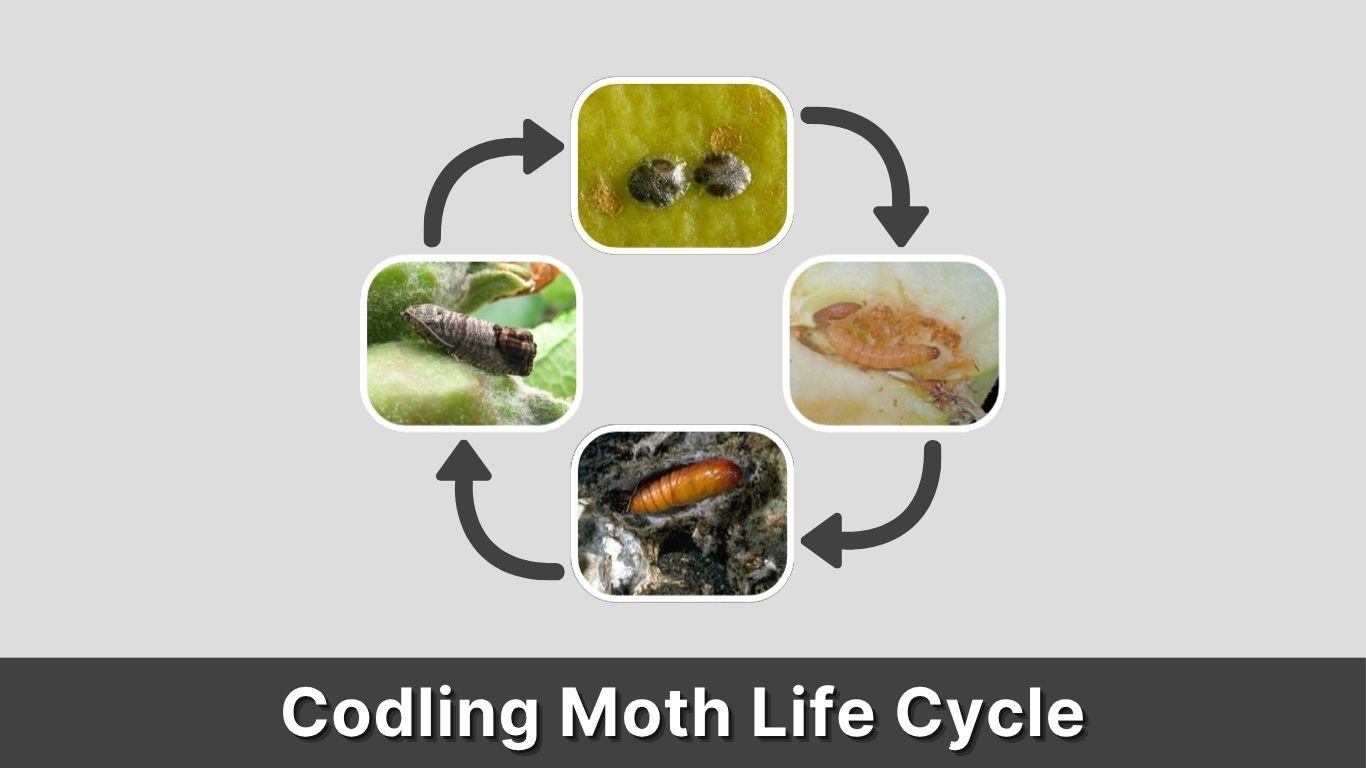
The codling moth (Cydia pomonella) passes through four life stages: egg, larva, pupa, and adult. It is best known as the caterpillar that tunnels into apples and pears and feeds near the core. Codling moths usually overwinter as mature larvae hidden in silken cocoons beneath loose bark or in debris around trees. Adults emerge in spring, lay eggs, and begin a new generation. Depending on temperature and location, codling moths may produce one to four generations per year, making an understanding of their life cycle essential for effective control.
What Are the Four Life Stages of a Codling Moth?
Codling moths undergo complete metamorphosis. This means each insect develops through four distinctly different stages before reproducing.
The cycle is:
Egg → Larva → Pupa → Adult moth
The larval stage causes almost all fruit damage, while adults are primarily responsible for mating and egg laying.
1. Codling Moth Egg Stage
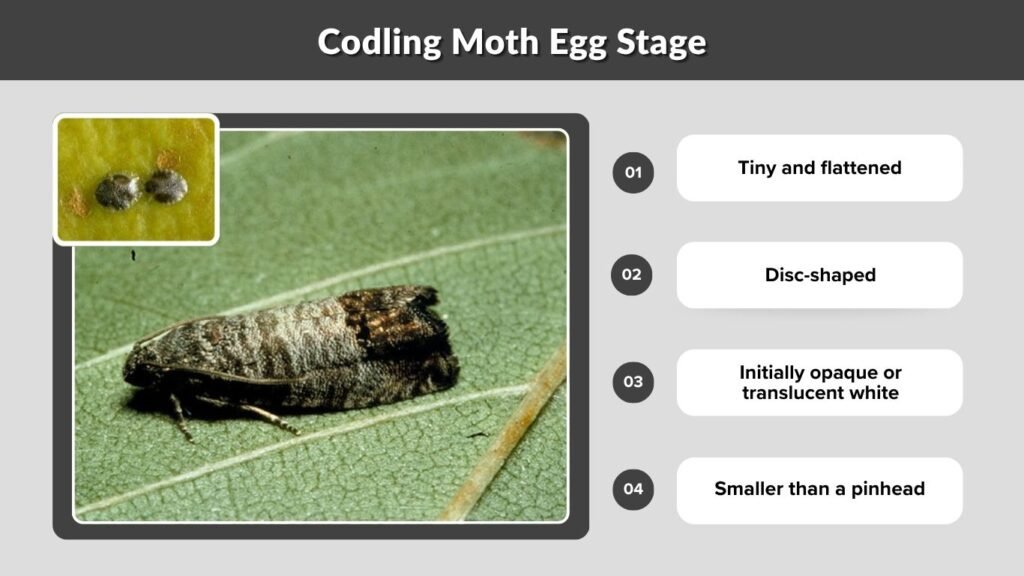
Female codling moths lay tiny eggs singly rather than in clusters.
The eggs are usually placed on developing fruit, leaves, fruit spurs, or nearby plant surfaces.
What Do Codling Moth Eggs Look Like?
Codling moth eggs are:
- Tiny and flattened
- Disc-shaped
- Initially opaque or translucent white
- Smaller than a pinhead
- Laid individually
- Darker shortly before hatching
Just before hatch, the developing caterpillar’s dark head may become visible through the egg.
A female may deposit several dozen eggs during her reproductive period.
How Long Do Codling Moth Eggs Take to Hatch?
Temperature determines how quickly the eggs develop.
Oregon State University Extension reports that eggs may hatch in approximately 6–20 days, with development occurring faster during warm weather.
Once the egg hatches, the tiny larva begins searching for fruit almost immediately.
2. Codling Moth Larval Stage
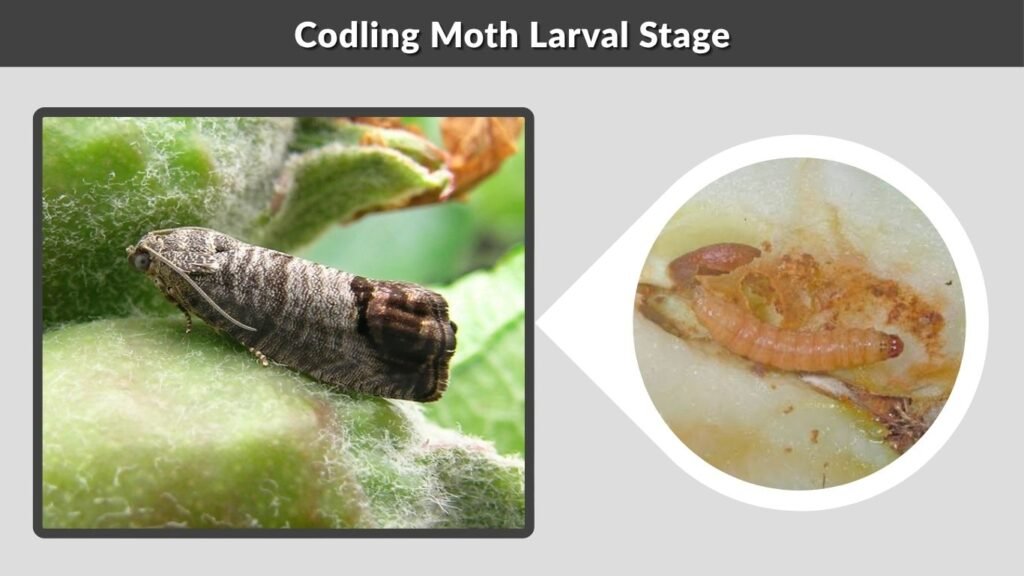
The larva, or caterpillar, is the most destructive stage of the codling moth life cycle.
Newly hatched larvae are extremely small and whitish with dark heads. They soon enter apples, pears, or other suitable fruits.
What Happens Inside an Apple?
The larva usually tunnels through the fruit toward the core and feeds on flesh and seeds.
Signs include:
- Small entry holes
- Brown or reddish frass
- Internal tunnels
- Damaged seeds
- Rotten areas around tunnels
- Premature fruit drop
As the caterpillar grows, its body becomes increasingly cream-colored or pinkish.
Mature larvae are generally around 1/2–3/4 inch long.
How Long Does the Larval Stage Last?
Oregon State University Extension gives a typical larval period of approximately three to four weeks.
When fully developed, the caterpillar leaves the fruit and looks for a protected location in which to spin a silken cocoon.
3. Codling Moth Pupal Stage
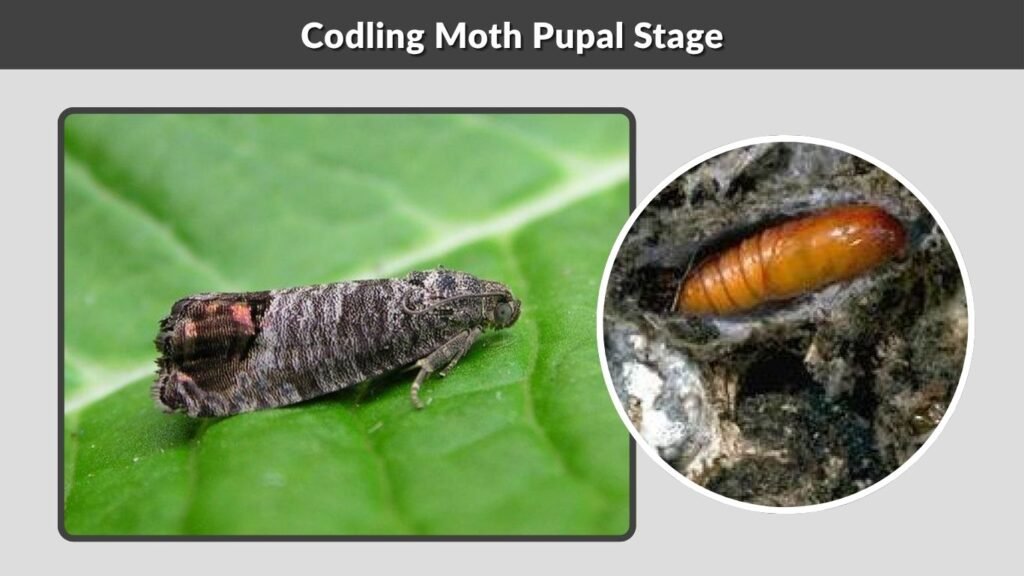
A mature caterpillar may crawl down the trunk, drop to the ground, or hide beneath loose bark.
It then spins a protective silken cocoon.
Where Do Codling Moths Pupate?
Common sites include:
- Beneath loose tree bark
- Bark cracks and crevices
- Leaf litter
- Soil near the tree
- Orchard debris
- Protected objects near host trees
During the growing season, the mature larva changes into a pupa inside its cocoon.
The adult eventually emerges to begin another generation.
Oregon State reports that summer pupation can last approximately two to three weeks.
4. Adult Codling Moth Stage
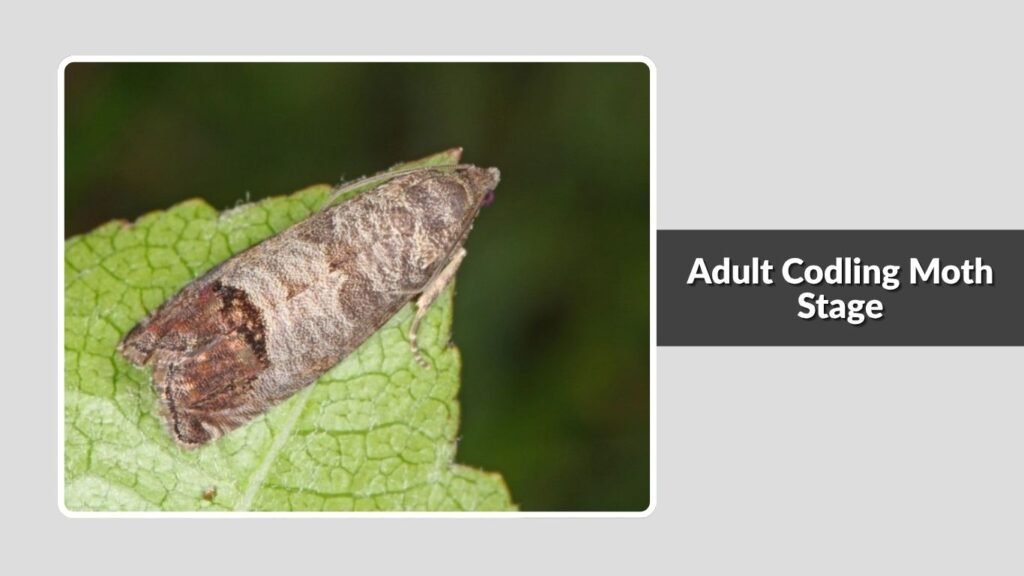
Adult codling moths are small grayish-brown moths with characteristic coppery-brown markings near the ends of their forewings.
Adults do not cause the familiar worm damage inside apples.
Their main purpose is reproduction.
Adult Behavior
Adults are mostly active around dusk.
They mate during sufficiently warm evening conditions. UC IPM notes that mating occurs when temperatures around sunset exceed approximately 62°F (16.7°C).
After mating, females begin laying individual eggs on or close to developing fruit.
Those eggs start the next generation.
How Do Codling Moths Survive Winter?
The codling moth’s winter survival strategy is an important part of its life cycle.
Most overwinter as mature larvae in thick silken cocoons.
Overwintering Sites
They may hide:
- Beneath loose bark
- Inside bark crevices
- In leaf litter
- In orchard debris
- Near the base of trees
These larvae enter a dormant condition known as diapause.
In early spring, they pupate as temperatures increase. Adults then emerge around bloom and begin the year’s first moth flight.
How Many Generations Do Codling Moths Have Each Year?
The number of generations depends largely on temperature and climate.
Typical Generations
Cooler regions may support only one complete generation.
Moderate climates commonly have two generations.
Warm areas may have three, and particularly favorable climates can sometimes support a partial or complete fourth generation.
UC IPM reports two, three, and occasionally four generations annually, depending on climate.
The generations may overlap, which can make infestations difficult to control later in summer.
Codling Moth Life Cycle in California
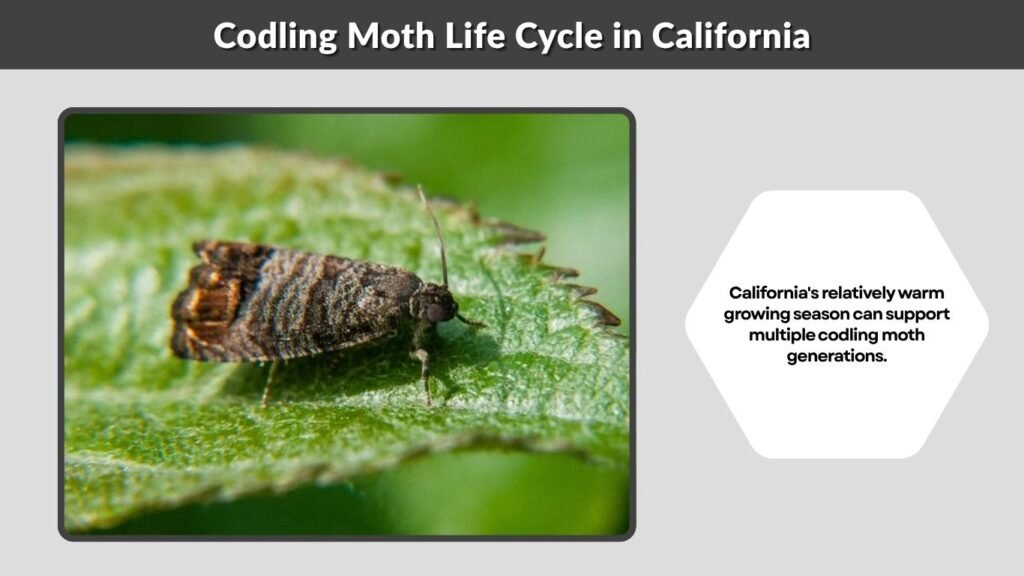
California’s relatively warm growing season can support multiple codling moth generations.
The first moth flight comes from overwintering larvae that pupated in spring.
Later Generations
A second flight begins after the first generation completes development.
In sufficiently warm locations and years, a third generation may also develop. UC IPM notes that later generations depend heavily on accumulated temperature.
For this reason, California growers frequently use pheromone traps and degree-day models instead of relying solely on calendar dates.
Codling Moth Life Cycle in Australia
Codling moth biology follows the same four-stage pattern in Australia, but seasonal timing is reversed compared with the Northern Hemisphere.
Australian Development
Agriculture Victoria reports that overwintering larvae begin pupating in early spring as temperatures increase.
Adults emerge around the flowering period, reproduce, and produce new larvae.
Up to three generations per season may occur in Victoria, depending on weather conditions.
Codling Moth Life Cycle in New Zealand
Codling moth is established throughout New Zealand and attacks apples and other pome fruits.
It overwinters as a dormant fifth-instar larva inside a cocoon, commonly beneath tree bark.
Number of Generations
Climate has a strong influence.
New Zealand research reports approximately one annual generation from the Manawatū southward, while northern areas may experience two generations and occasionally part of a third.
Codling Moth Life Cycle on Pear Trees
The codling moth life cycle on pears is essentially the same as on apples.
Females place eggs on leaves or fruit. Newly hatched caterpillars enter pears and feed internally.
Depending on climate and location, pear orchards may experience two to three generations annually.
Codling Moth Life Cycle and Degree Days
Codling moth development is closely tied to temperature.
Growers therefore use degree days to predict egg hatch and other important events.
What Is Biofix?
Biofix is a starting point established when adult moth activity is detected using pheromone traps under suitable temperature conditions.
Degree days are then accumulated from that point.
One UC IPM model estimates an average generation from egg to adult at roughly 1,060 Fahrenheit degree-days, although exact values depend on the model used.
This allows growers to predict when vulnerable young larvae are likely to appear.
Why the Life Cycle Matters for Control
Timing is crucial because codling moth larvae become protected once they tunnel inside an apple or pear.
Spraying after a larva is already deep inside the fruit is much less effective.
Best Stage to Target
The most vulnerable period is around egg hatch and immediately afterward, before young larvae enter fruit.
Pheromone traps help identify moth flights, while degree-day models help predict when the resulting eggs will hatch.
Colorado State University Extension places the beginning of first-generation egg hatch at roughly 220–250 degree-days after biofix in its management model.
Removing infested fruit and overwintering cocoons can also interrupt the life cycle.
False Codling Moth Life Cycle
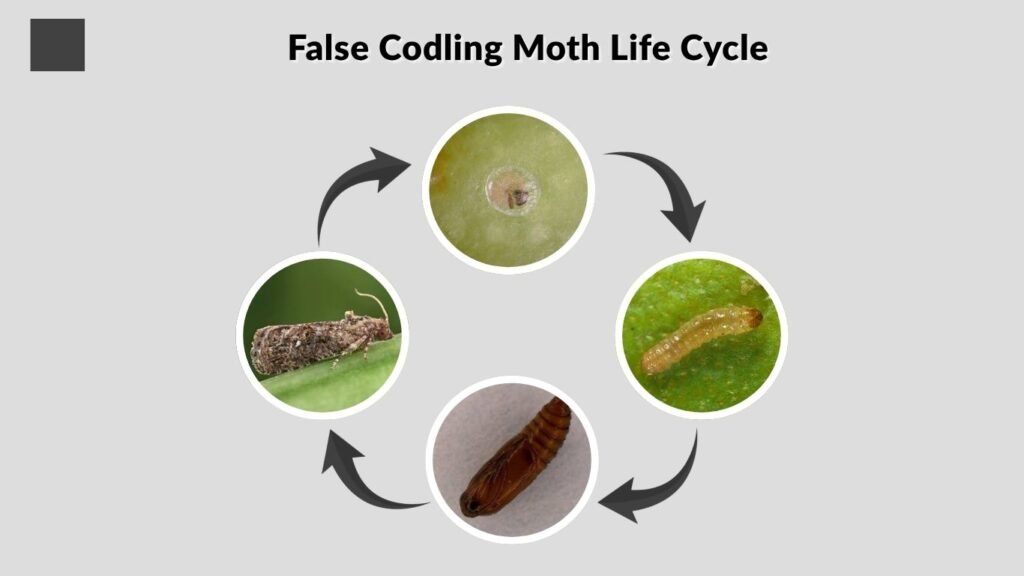
False codling moth (Thaumatotibia leucotreta) is a different insect and should not be confused with Cydia pomonella.
Both have the general moth life cycle:
Egg → Larva → Pupa → Adult
However, false codling moths have different host plants, climatic requirements, geographic distribution, and quarantine importance.
Control recommendations for ordinary codling moths should therefore not automatically be applied to false codling moths.
How Long Is the Codling Moth Lifespan?
There is no single fixed number of days for the complete codling moth lifespan.
Temperature has a strong effect on development.
An actively developing generation may progress from egg through adulthood within part of a growing season, while an overwintering individual remains dormant as a mature larva for several months.
This is why the full calendar lifespan of an overwintering codling moth can be substantially longer than that of a summer generation.
FAQs
1. What are the four stages of the codling moth life cycle?
The four stages are egg, larva, pupa, and adult moth.
2. Where do codling moths overwinter?
They generally overwinter as mature larvae inside silken cocoons beneath loose bark or in soil and debris near host trees.
3. How long does the codling moth larval stage last?
The feeding larval stage typically lasts around three to four weeks, although temperature affects the exact duration.
4. How many generations do codling moths have?
Depending on climate, there may be roughly one to four generations per year. Warm locations generally support more generations than cool regions.
5. Which stage causes damage to apples?
The larval stage causes the damage. Newly hatched caterpillars tunnel into apples and feed internally, often reaching the core and seeds.
