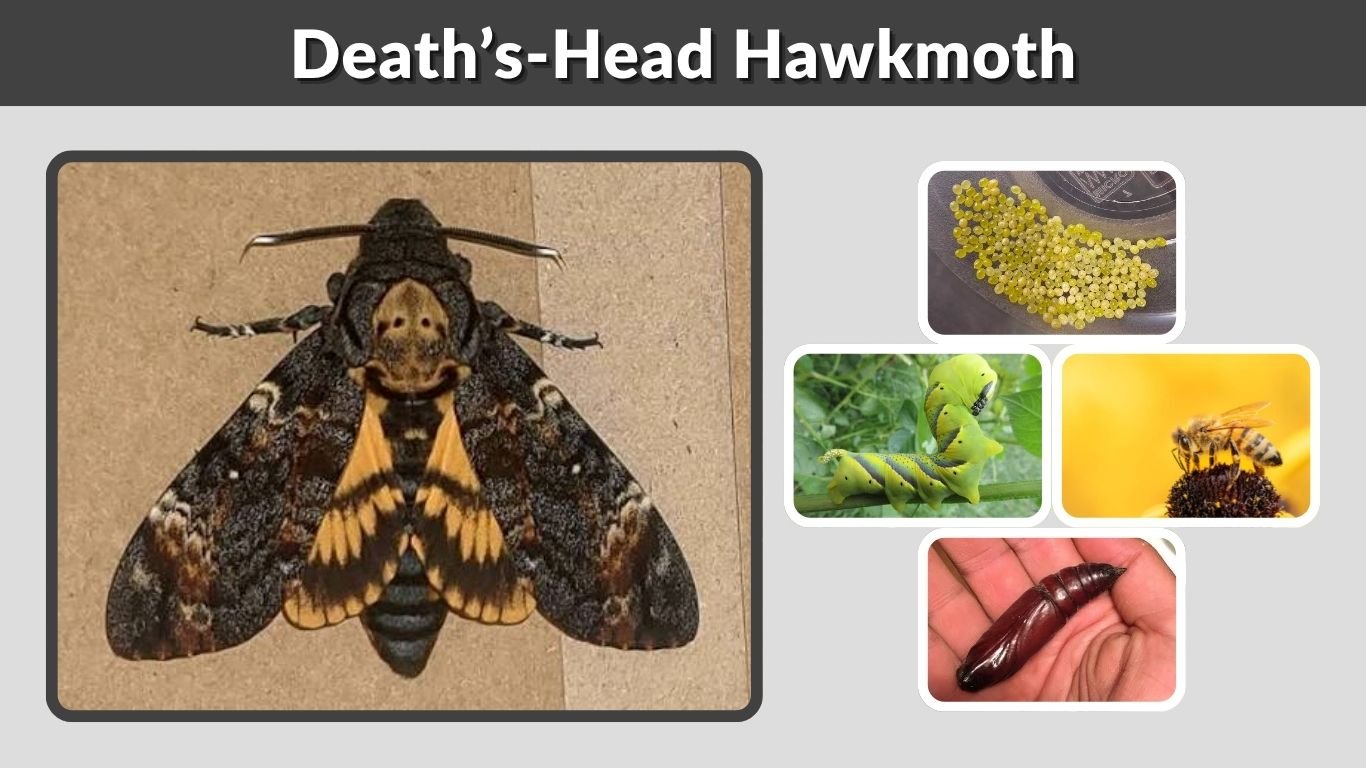
The death’s-head hawkmoth is one of the world’s most recognizable moths, famous for the skull-like marking on its thorax and its unusual ability to squeak. The name usually refers to the African death’s-head hawkmoth, Acherontia atropos, although two related Asian species share the same common name. These large nocturnal hawkmoths also have remarkable caterpillars and an unusual habit of entering honeybee colonies to feed on honey. This guide covers identification, size, caterpillars, diet, habitat, life cycle, sound, and symbolism.
What Is a Death’s-Head Hawkmoth?
Death’s-head hawkmoths belong to the genus Acherontia in the hawkmoth family Sphingidae. Three species are recognized: Acherontia atropos, Acherontia styx, and Acherontia lachesis. The African death’s-head hawkmoth, A. atropos, is the species most often meant when the common name is used in Europe and popular culture.
Death’s-Head Hawkmoth Identification
The adult moth is large, heavy-bodied, and difficult to confuse with most other moths. Important identification features include:
- Brown, black, and cream mottled forewings
- Bright yellow hindwings crossed by dark bands
- Yellow-and-black banding across the abdomen
- A pale skull-shaped marking on the thorax
- Thick, powerful body typical of hawkmoths
- Short, strong proboscis adapted for accessing honey
- Adult wingspan commonly around 80–120 mm
In Britain, A. atropos is among the largest moths recorded, with exceptionally impressive individuals approaching the upper end of that wingspan range.
Why Does It Have a Skull on Its Back?
The famous “skull” is simply a pattern of pale and dark scales on the thorax. Its resemblance to a human skull is coincidental and has no supernatural function.
However, the unusual marking has strongly influenced the moth’s reputation. Historically, people associated its appearance with death, misfortune, and omens, helping explain both its common name and its lasting place in art and popular culture.
Death’s-Head Hawkmoth Caterpillar
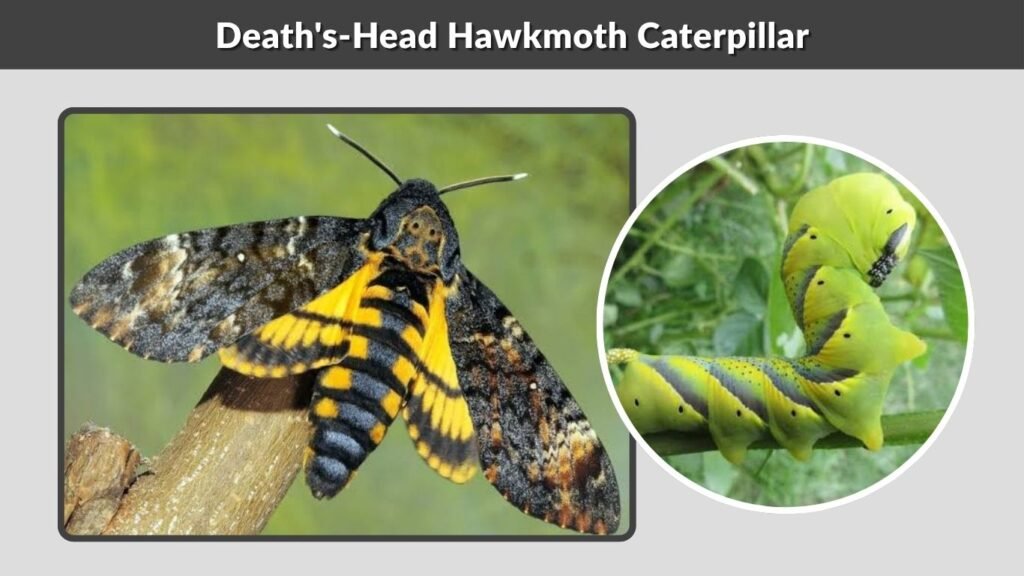
The caterpillar is almost as spectacular as the adult. A fully grown A. atropos larva is very large and can occur in yellow, green, or brown forms. Like other hawkmoth larvae, it carries a prominent curved horn at the rear of its body. Despite its size and threatening appearance, the caterpillar is not a stinging species.
Caterpillar Size and Appearance
Fully grown caterpillars may reach approximately 125 mm, making them among the largest caterpillars likely to be encountered in Britain during migration years. Mature larvae have diagonal side markings and a rough, downward-curving tail horn.
Their coloration varies considerably. Yellow forms can be especially striking, while green individuals blend effectively into foliage. Brown forms provide camouflage when caterpillars begin wandering near the ground before pupation.
What Do Death’s-Head Hawkmoth Caterpillars Eat?
Potato is one of the best-known larval food plants, which explains historical records of caterpillars appearing in potato fields. However, the larvae are not restricted to potatoes.
They can use several other plants, including jasmine, privet, ash, olive and other members of suitable plant families. This flexibility helps the species reproduce across a broad geographic range.
Death’s-Head Hawkmoth Life Cycle
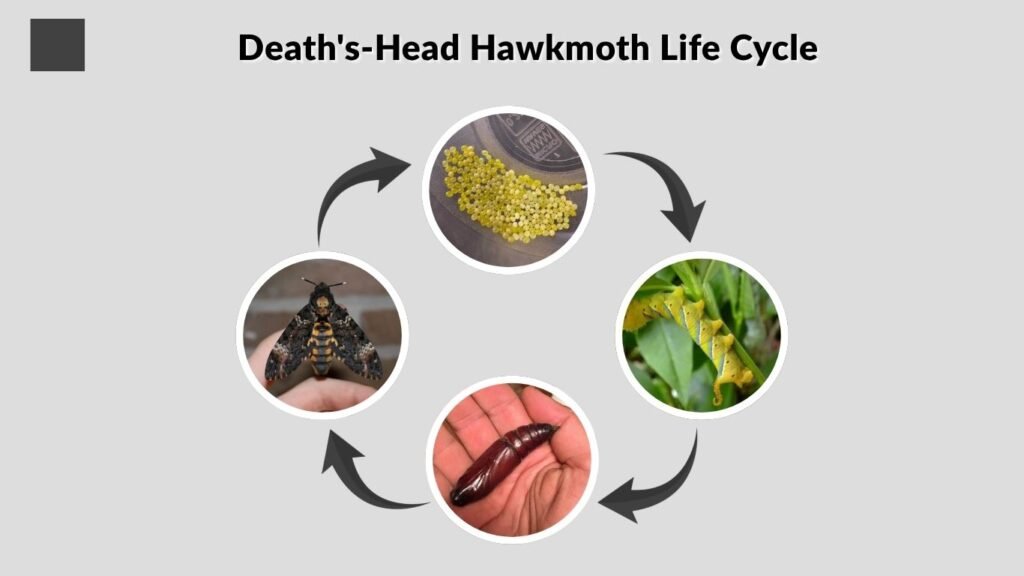
Like all moths, death’s-head hawkmoths undergo complete metamorphosis through egg, larva, pupa, and adult stages. Development can be rapid in warm climates, whereas populations or migrants reaching cooler northern regions face greater difficulty completing the cycle, particularly when pupae must survive cold winters.
Egg to Caterpillar
Females deposit eggs individually on suitable host plants. After hatching, young caterpillars begin feeding and pass through several instars as they increase dramatically in size.
Under warm conditions, larvae can reach full size in less than a month. During this period they consume substantial amounts of foliage and produce large quantities of frass.
As maturity approaches, feeding eventually stops and the caterpillar leaves its host plant.
Pupa to Adult
A mature caterpillar searches for suitable soil and digs underground to pupate. It creates an earthen chamber several centimeters below the surface, where transformation occurs.
In warm areas, development may continue relatively quickly. In cooler parts of the species’ northern range, the pupa may attempt to overwinter. Many late-season pupae in Britain do not survive prolonged low temperatures, which is one reason the species remains primarily a migrant there rather than a consistently established resident.
Death’s-Head Hawkmoth Habitat and Distribution
The African death’s-head hawkmoth has a broad range centered on Africa and extending into southern Europe and neighboring regions. It is also an exceptionally strong migrant capable of traveling far beyond its main breeding range. Migrants regularly reach northern Europe, including the British Isles, particularly during late summer and autumn.
African Death’s-Head Hawkmoth Range
Acherontia atropos occurs widely across Africa and parts of southern Europe and the Middle East. Migrating individuals can travel much farther north.
In Britain, it is not regarded as a native resident. Most observations involve migrants arriving from southern Europe and Africa, with records concentrated from summer into autumn. Some migrants successfully lay eggs, resulting in locally discovered caterpillars.
Is It Native to the USA?
The well-known Acherontia death’s-head hawkmoths are Old World species rather than native North American moths. Therefore, photographs claiming to show a native U.S. death’s-head hawkmoth should be examined carefully.
North America has many large native sphinx and hawk moths, but they belong to other genera and should not automatically be identified as Acherontia.
Why Does a Death’s-Head Hawkmoth Squeak?
One of this moth’s strangest characteristics is its ability to make an audible squeaking noise. The sound may occur when the moth is disturbed or handled and is unusually loud for an insect of its type.
How Does It Make the Sound?
The sound is associated with movement of air through the moth’s feeding apparatus. The Natural History Museum explains that air is drawn in and passed over structures associated with the proboscis, producing vibration, before being expelled again and creating another sound.
The result is a distinctive high-pitched squeak that may surprise anyone encountering the moth for the first time.
Death’s-Head Hawkmoths and Honeybees
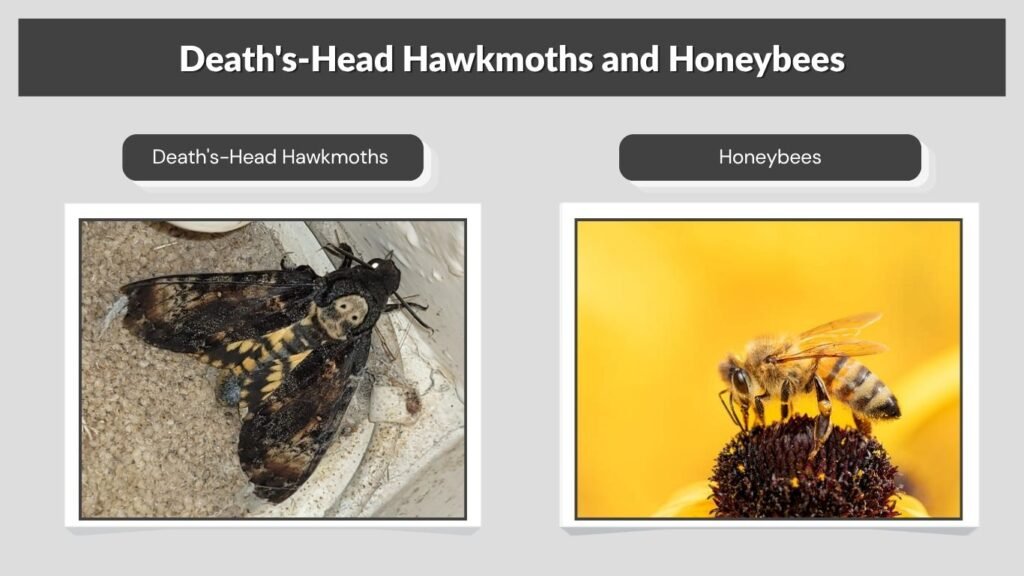
Perhaps the most extraordinary feature of Acherontia is its relationship with honeybees. Adult death’s-head hawkmoths are well known for entering bee colonies and stealing honey directly from combs. This behavior is unusual among hawkmoths and has led researchers to describe the genus as having specialized honey-stealing adaptations.
How Do They Steal Honey?
The moth’s proboscis is relatively short, thick, and strong compared with the long nectar-feeding tubes of many other hawkmoths. It can penetrate honey-filled cells and suck out their contents.
Research indicates that Acherontia species possess a combination of physical and behavioral adaptations that help them enter honeybee colonies and obtain honey. All three species in the genus have been associated with honey feeding.
Three Types of Death’s-Head Hawkmoth
“Death’s-head hawkmoth” is actually a group name rather than the exclusive name of one species. All three Acherontia species share the skull-like thoracic pattern and unusual honey-feeding behavior, but their geographic distributions differ substantially.
African, Greater and Lesser Death’s-Head Hawkmoths
African death’s-head hawkmoth (Acherontia atropos) occurs mainly in Africa, southern Europe and nearby regions and is the species that migrates into Britain.
Greater death’s-head hawkmoth (Acherontia lachesis) is an Asian species distributed through parts of South and Southeast Asia.
Lesser death’s-head hawkmoth (Acherontia styx) is also Asian and occurs from parts of western and southern Asia eastward. Scientific analysis confirms that the genus contains these three recognized species.
Death’s-Head Hawkmoth Meaning and Symbolism
Few moths have accumulated as much cultural symbolism as the death’s-head hawkmoth. Its skull-shaped marking, dark wings, large size, nighttime activity and audible squeak created a powerful combination that encouraged frightening stories long before its biology was understood.
Does the Moth Symbolize Death?
Historically, yes. The skull pattern caused the moth to be interpreted as an omen of death or misfortune in European folklore. Its scientific names also draw heavily on Greek mythology associated with death and the underworld.
Today, death’s-head hawkmoth imagery appears in tattoos, artwork, films and other designs, where it may represent mortality, transformation, mystery or change. Those meanings are cultural interpretations rather than biological characteristics of the moth.
FAQs
Death’s-head hawkmoths attract unusual levels of attention because they combine several remarkable traits rarely found together in one insect. Their enormous caterpillars, skull markings, squeaks and honey-stealing habits have all contributed to centuries of fascination.
Are death’s-head hawkmoths dangerous?
No. They are not considered dangerous to humans. Adults do not have a venomous sting, and their dramatic skull marking is simply coloration.
What is the scientific name of the death’s-head hawkmoth?
The African death’s-head hawkmoth is Acherontia atropos. The genus also contains Acherontia styx and Acherontia lachesis.
How big is a death’s-head hawkmoth?
Adult A. atropos generally has a wingspan of around 80–120 mm, making it an exceptionally large hawkmoth.
What does a death’s-head hawkmoth caterpillar eat?
Potato is a major host plant, but caterpillars can also feed on plants such as jasmine, privet, ash and several other suitable hosts.
Why do death’s-head hawkmoths enter beehives?
They enter honeybee colonies to feed on stored honey. Their unusually strong, short proboscis can pierce honeycomb cells so the moth can suck out the honey.