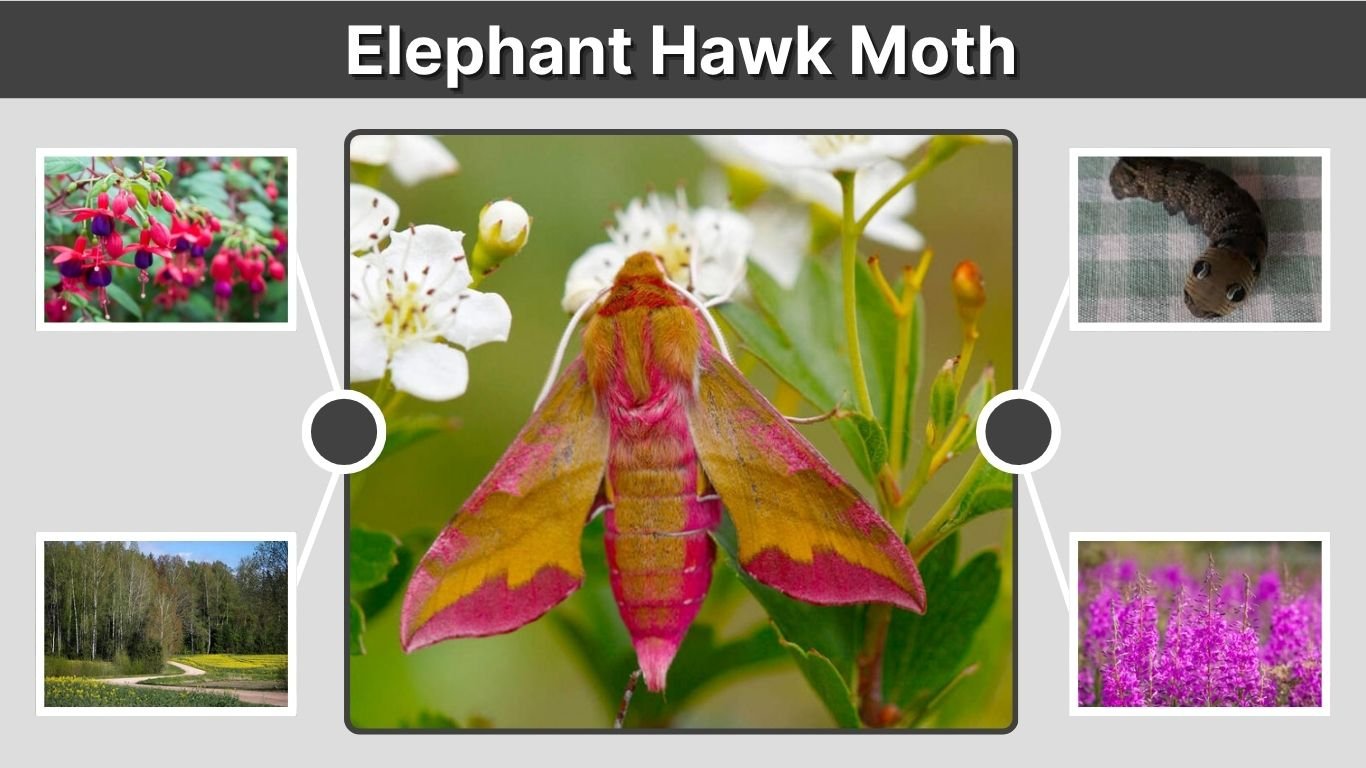
The elephant hawk moth is one of the most colorful hawk moths, combining vivid pink markings with olive-green wings. Scientifically known as Deilephila elpenor, it is especially common across much of Britain and is active mainly at night. Its large caterpillar is equally distinctive, with eye-like markings that can make it resemble a small snake. Despite its intimidating appearance, it is harmless to people. This guide covers elephant hawk moth identification, size, caterpillar, diet, habitat, life cycle, safety, and similar species.
What Is an Elephant Hawk Moth?
The elephant hawk moth belongs to the family Sphingidae, a group known for powerful flight, streamlined bodies, and nectar-feeding adults. Its unusual name actually comes from the caterpillar rather than the adult moth. When disturbed, the caterpillar retracts its head, producing a trunk-like shape that was thought to resemble an elephant’s trunk.
Elephant Hawk Moth Identification
Adult elephant hawk moths have several recognizable characteristics:
- Olive-green or brownish forewings
- Bright pink wing borders and stripes
- Pink-and-green body
- Streamlined, pointed wings
- Thick, tapered abdomen
- Long proboscis for drinking nectar
- Wingspan of about 45–60 mm
- Mostly nocturnal activity
The vivid combination of pink and green makes this one of Britain’s easiest hawk moths to recognize.
How Big Is an Elephant Hawk Moth?
Adults usually have a wingspan of approximately 45–60 mm, or about 1.8–2.4 inches. Their strong body and elongated wings can make them appear larger when flying.
The term “giant elephant hawk moth” is sometimes used informally online, but the normal species name is elephant hawk moth or, occasionally, large elephant hawk moth. It should not be confused with unrelated giant hawk moth species.
Elephant Hawk Moth Caterpillar Identification
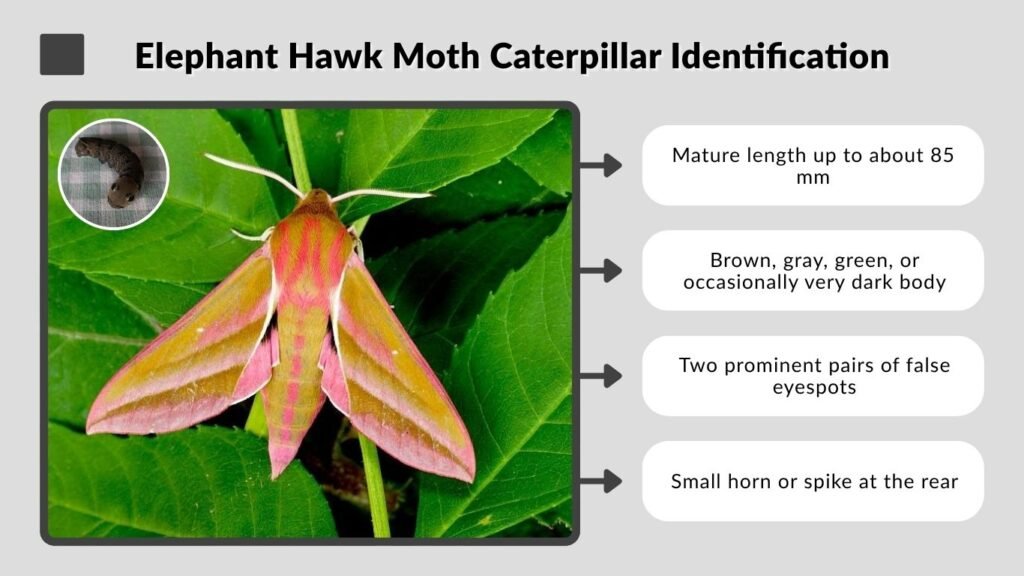
The caterpillar is dramatically different from the brightly colored adult. Mature larvae are large, thick-bodied, and usually gray-brown, although green and almost black forms also occur. Their most famous features are two pairs of large eye-like markings near the front of the body, which become especially conspicuous when the caterpillar feels threatened.
What Does the Caterpillar Look Like?
Look for these features:
- Mature length up to about 85 mm
- Brown, gray, green, or occasionally very dark body
- Two prominent pairs of false eyespots
- Small horn or spike at the rear
- Thick, smooth body without dense hairs
- Retractable head and front body segments
- Snake-like appearance when disturbed
Newly hatched caterpillars are much smaller and greener. Wildlife Insight reports that larvae begin around 4 mm and can reach approximately 85 mm when fully grown.
Why Does It Look Like a Snake?
When threatened, the caterpillar pulls its head backward into its body. This makes the swollen segments carrying the false eyespots appear like the head of a much larger animal.
The resulting shape can resemble a small snake. This defensive display may startle birds or other predators long enough for the caterpillar to escape.
Its rear horn can also appear threatening, but it is not a stinger.
What Do Elephant Hawk Moth Caterpillars Eat?
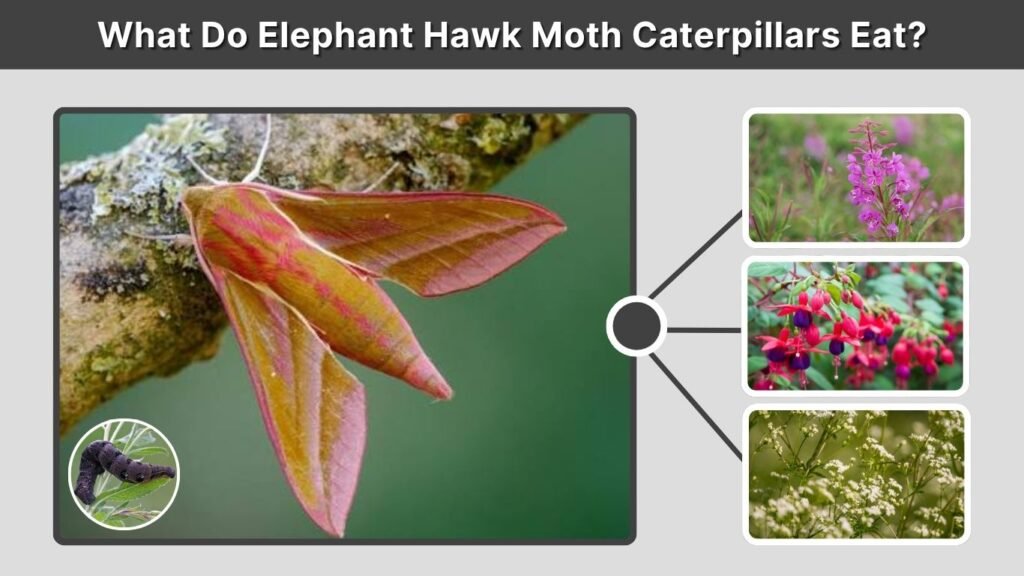
Elephant hawk moth caterpillars feed on several low-growing plants and are often found in gardens because some common ornamental plants provide suitable food. Rosebay willowherb is one of their principal wild food plants, while bedstraws are also frequently used. Garden fuchsias can attract egg-laying females and feeding larvae.
Caterpillar Food Plants
Common host plants include:
- Rosebay willowherb
- Other willowherbs
- Bedstraws
- Fuchsia
- Hedge bedstraw
- Occasionally other suitable garden plants
Young caterpillars remain close to their food plants, while mature larvae may wander considerable distances when ready to pupate.
How Much Do They Eat?
Caterpillars spend most of their growing period eating leaves. Their appetite increases dramatically as they approach their final larval stage.
Large droppings, known as frass, underneath willowherb or fuchsia can sometimes reveal a caterpillar before the insect itself is found.
Once fully grown, the caterpillar suddenly stops feeding and begins wandering. This normally means it is searching for a protected location in which to pupate.
Elephant Hawk Moth Habitat and Distribution
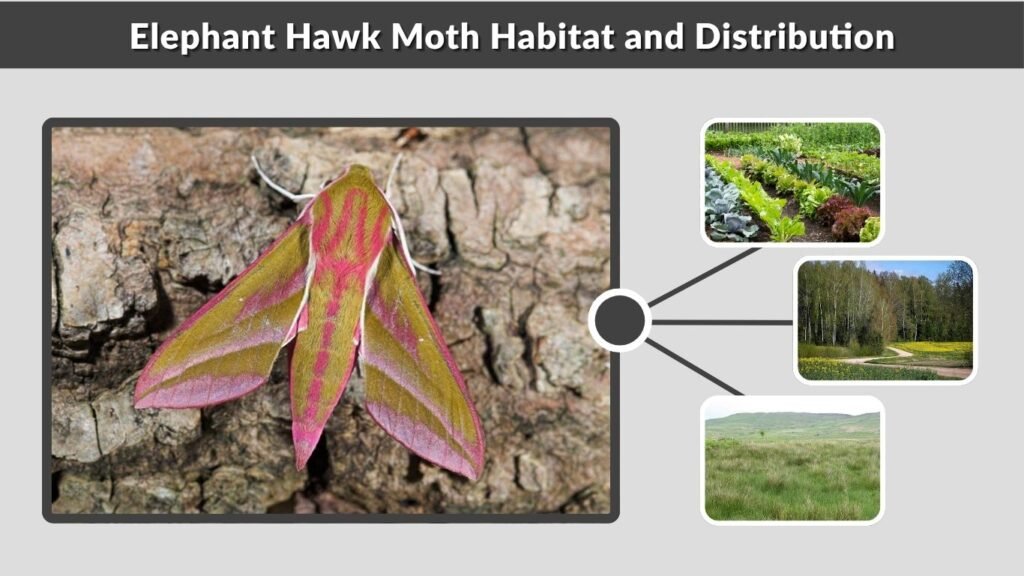
Elephant hawk moths occupy many habitats where their caterpillar food plants and adult nectar sources are available. They can occur in gardens as readily as in more natural landscapes. In Britain, the species is widespread and common, including in Scotland, where its range has expanded.
Where Do Elephant Hawk Moths Live?
Typical habitats include gardens, woodland edges, rough grassland, hedgerows, waste ground, riverbanks, and places where willowherbs grow.
The species has a broad Palearctic distribution extending through Europe and into parts of Asia. It has also become established in a limited part of northwestern North America, including British Columbia and Washington.
Reports of an “elephant hawk moth caterpillar” from places such as Texas should therefore be checked carefully because several other large sphinx moth caterpillars can look similar.
Are Elephant Hawk Moths Rare in the UK?
No. The elephant hawk moth is considered common across most of Britain. Adults are recorded mainly from May through July, although later sightings also occur.
The caterpillars become especially noticeable later in summer when large larvae leave their food plants and cross lawns, patios, paths, or gardens searching for pupation sites.
Elephant Hawk Moth Life Cycle
The elephant hawk moth undergoes complete metamorphosis through egg, caterpillar, pupa, and adult stages. Britain normally has one main generation each year, although occasional partial second generations may occur in southern areas. Adults fly at night and females deposit their eggs individually on suitable larval food plants.
Egg and Larval Stages
Females lay small eggs on plants such as willowherb and bedstraw. Depending on temperature, eggs may hatch after roughly 7–10 days.
The caterpillars then grow rapidly through several molts. Young larvae are commonly green, while later stages often become brown or gray.
Under favorable conditions, they can become fully grown in around a month.
Chrysalis and Pupation
When mature, the caterpillar leaves its host plant and searches through leaf litter or loose soil.
It pupates:
- At or just beneath the soil surface
- Among dry leaves and plant debris
- Inside a loose protective structure
- Usually during late summer or autumn
- In a pupa that normally overwinters
The adult moth emerges when conditions become suitable the following year.
What Do Adult Elephant Hawk Moths Eat?
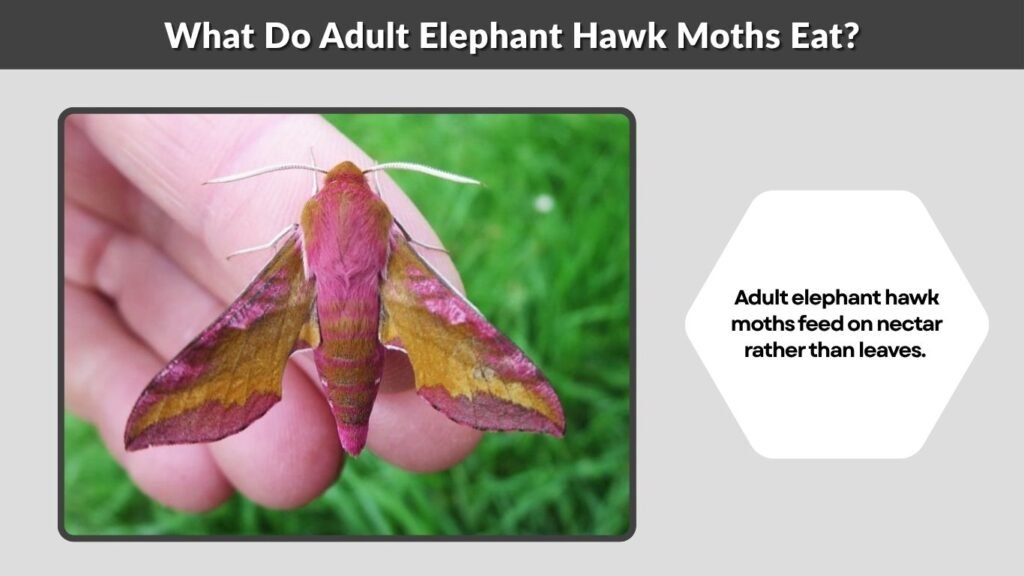
Adult elephant hawk moths feed on nectar rather than leaves. They are strong nighttime flyers and use a long proboscis to reach nectar inside flowers. Their low-light vision allows them to locate flowers under conditions in which many other insects are less active.
Flowers That Attract Adults
Honeysuckle is a well-known nectar source for adult elephant hawk moths.
They can also investigate other strongly scented, nectar-rich evening flowers. Gardens containing night-flowering plants can therefore provide useful feeding habitat.
The adult usually hovers or lands near a flower and extends its proboscis to drink nectar before moving rapidly to another bloom.
Are Elephant Hawk Moths Poisonous or Dangerous?
The caterpillar’s false eyes and tail horn make it look much more dangerous than it really is. Elephant hawk moth caterpillars are not among the stinging hairy caterpillars that cause significant skin irritation. Their defensive strategy relies mainly on appearance rather than venom or dangerous spines.
Do Elephant Hawk Moth Caterpillars Bite?
They have chewing mouthparts for eating leaves but do not normally bite people defensively.
The tail spike is also harmless and cannot sting. Hawk moth tail horns can look threatening, but they are not venomous structures.
There is no need to handle a caterpillar unnecessarily. If one must be moved from a dangerous location, encouraging it onto a leaf or container is preferable to squeezing it.
Are They Poisonous to Dogs?
Elephant hawk moth caterpillars are not known as venomous or stinging caterpillars. However, pets should still be discouraged from eating insects or caterpillars.
If a dog swallows one and later develops vomiting, excessive drooling, swelling, or other unusual symptoms, veterinary advice is appropriate because reactions can vary and the caterpillar may also have been misidentified.
Elephant Hawk Moth vs Small Elephant Hawk Moth
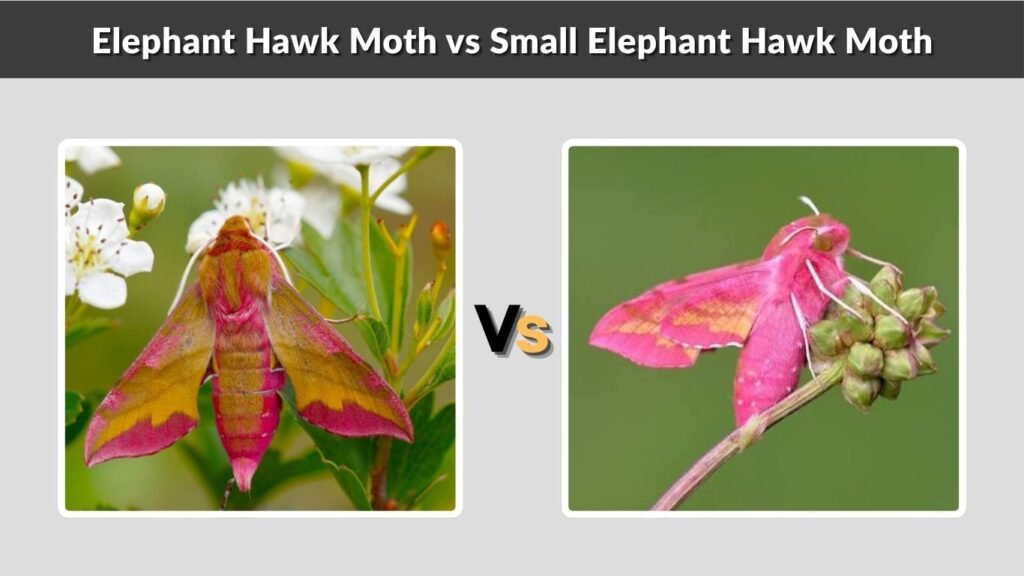
The small elephant hawk moth (Deilephila porcellus) is the species most likely to be confused with D. elpenor. Both display beautiful pink and olive coloration, but the small elephant hawk moth is genuinely smaller and has somewhat different markings.
Key Differences
- Elephant hawk moth: Wingspan about 45–60 mm
- Small elephant hawk moth: Wingspan about 40–45 mm
- Size: D. elpenor is noticeably larger
- Larval food: Elephant hawk moth often uses willowherb; the smaller species favors bedstraw
- Habitat: Small elephant hawk moth is particularly associated with dry, grassy and chalky areas
- Distribution: Elephant hawk moth is generally more widespread in Britain
Both are harmless and both can show striking pink coloration as adults.
FAQs
Elephant hawk moths are often noticed because either the brilliantly colored adult or enormous snake-like caterpillar suddenly appears in a garden. Despite their unusual appearance, they are beneficial components of local ecosystems and require no pest control in ordinary situations.
Are elephant hawk moth caterpillars poisonous?
No. They are not considered poisonous or venomous caterpillars. Their intimidating eyespots and tail horn are defensive visual features rather than dangerous weapons.
How big is an elephant hawk moth caterpillar?
A fully grown caterpillar can reach approximately 85 mm, or around 3.3 inches, making it one of the more impressive caterpillars commonly encountered in British gardens.
What do elephant hawk moth caterpillars eat?
They primarily eat rosebay willowherb, other willowherbs, bedstraws, and sometimes garden fuchsias.
Why does an elephant hawk moth caterpillar look like a snake?
When threatened, it retracts its small head and enlarges the appearance of the segments carrying its false eyespots. This makes the caterpillar resemble a larger, snake-like animal.
How long do elephant hawk moths live?
The species spends much of its annual life cycle as a caterpillar and then an overwintering pupa. Adults are relatively short-lived and mainly focus on feeding, mating, and reproduction during their seasonal flight period.