
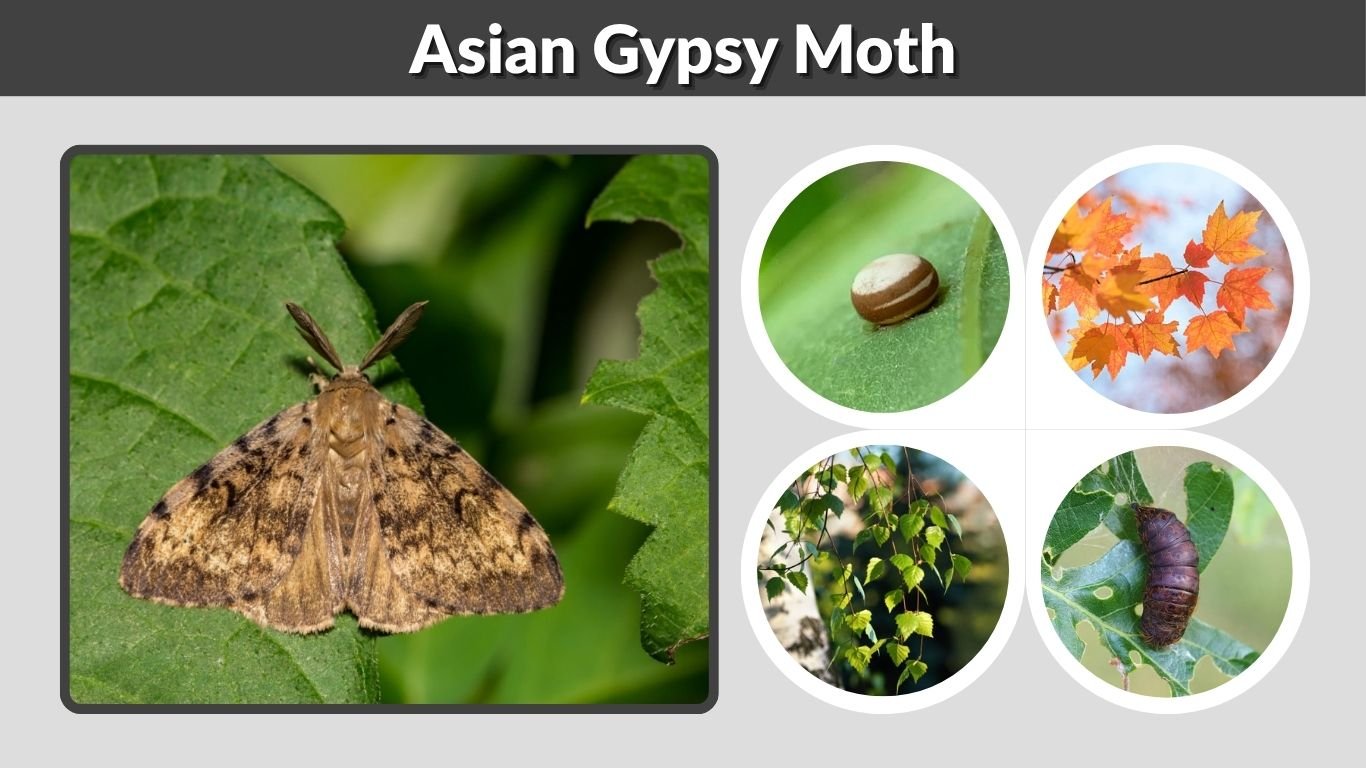
The Asian gypsy moth is a destructive group of invasive forest moths now officially called the Flighted Spongy Moth Complex (FSMC). Unlike the established European spongy moth, females in this Asian group can fly, allowing them to disperse quickly and deposit egg masses on trees, ships, containers, vehicles, and other surfaces. Their caterpillars feed on a broad range of trees and shrubs and can cause severe defoliation. FSMC is native to Asia and remains a major biosecurity concern for the United States, Canada, Australia, and other countries.
What Is the Asian Gypsy Moth?
“Asian gypsy moth,” often abbreviated AGM, is an older collective name rather than the name of a single species. In 2022, U.S. and Canadian authorities adopted Flighted Spongy Moth Complex as the preferred terminology.
Scientific Names
The group includes:
- Lymantria dispar asiatica
- Lymantria dispar japonica
- Lymantria albescens
- Lymantria umbrosa
- Lymantria postalba
These moths occur naturally in parts of Asia. They are particularly concerning outside their native range because females can fly and their larvae feed on many economically and environmentally important plants.
Asian Gypsy Moth Identification
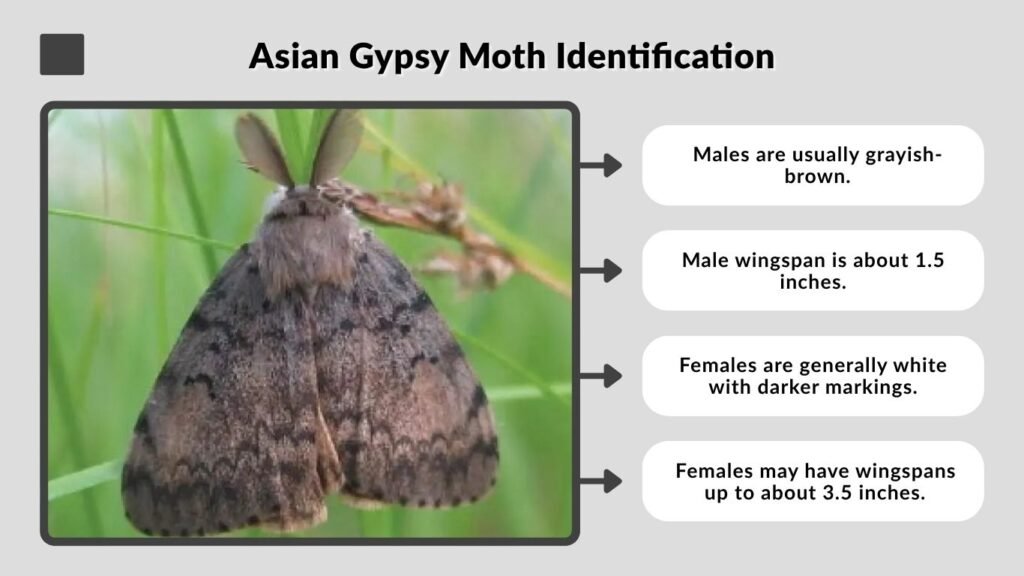
The adults show clear differences between males and females. Identification based only on appearance can still be difficult because FSMC looks almost identical to other spongy moth populations.
Identification
- Males are usually grayish-brown.
- Male wingspan is about 1.5 inches.
- Females are generally white with darker markings.
- Females may have wingspans up to about 3.5 inches.
- Females are capable of flight.
- Adults are particularly active around dusk.
- Females are strongly attracted to lights.
USDA notes that DNA testing may be necessary to distinguish FSMC reliably from other spongy moth forms.
Asian Gypsy Moth Caterpillar
The caterpillar is the damaging feeding stage. Young larvae can disperse surprisingly far by producing silk threads that are carried by wind.
Caterpillar Identification
- Newly hatched larvae are about 1/8 inch long.
- Young caterpillars are brownish and hairy.
- Mature larvae are often mottled gray.
- Color can range from yellowish to almost black.
- Two rows of blue and red spots occur along the back.
- Fully grown larvae may reach about 2–3.5 inches.
The blue and red dorsal markings become particularly useful for recognizing older caterpillars.
Asian Gypsy Moth Eggs
Egg masses are one of the most important stages from a biosecurity perspective because they can survive long ocean voyages.
What Do Egg Masses Look Like?
Female moths produce fuzzy masses containing hundreds of eggs. USDA reports that a single mass may contain up to approximately 1,000 eggs.
Egg masses are usually buff or yellowish and average about 1.5 inches long by 0.75 inch wide, although smaller masses occur. On ships, they can sometimes resemble patches of rust.
Females may place eggs on tree trunks, walls, logs, cargo containers, ships, vehicles, outdoor equipment, and many other surfaces.
Asian Gypsy Moth Life Cycle
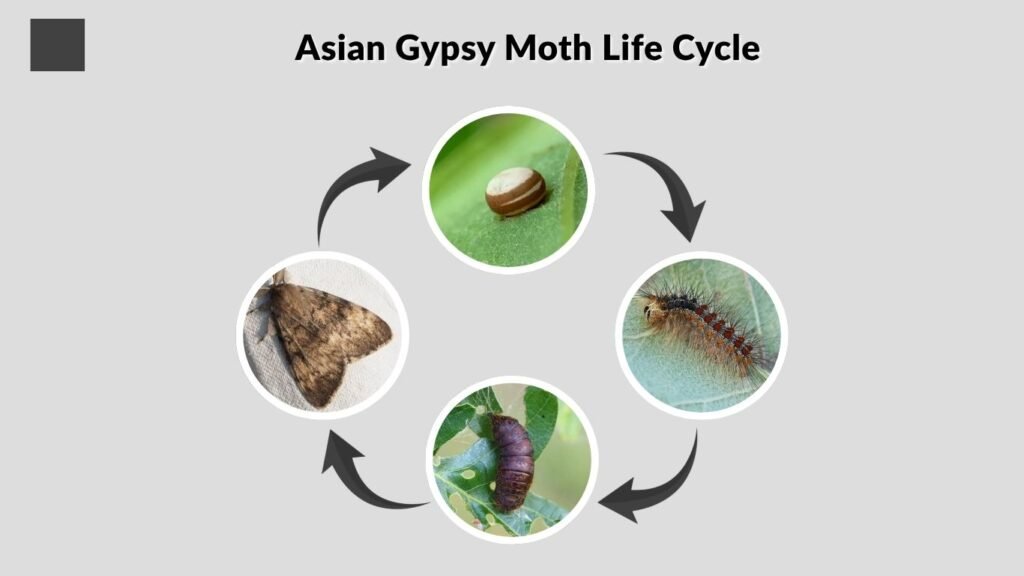
FSMC undergoes complete metamorphosis through four stages:
Egg → Caterpillar → Pupa → Adult moth
Eggs generally remain dormant through winter before hatching in spring. The caterpillars then begin feeding heavily on leaves.
From Caterpillar to Adult
After completing their feeding period, mature larvae pupate. USDA describes pupation as typically beginning around June or July, with adults emerging roughly 10–14 days later.
Adult moths do not feed. Their primary functions are mating and reproduction, with egg laying generally occurring from summer into early fall.
What Do Asian Gypsy Moths Eat?
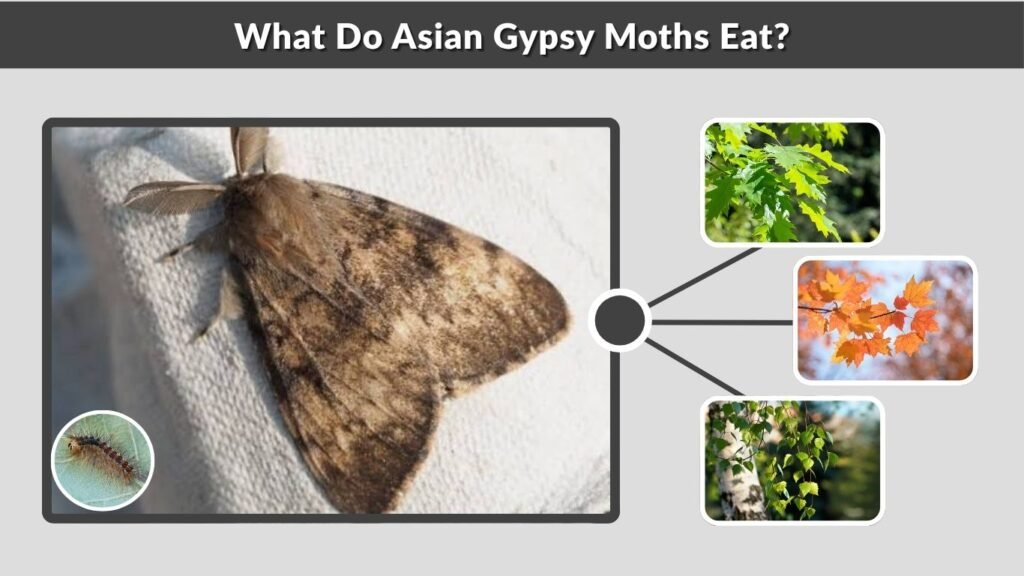
Only the caterpillar stage causes significant feeding damage.
FSMC has an exceptionally broad host range and can consume foliage from hundreds of species of trees and shrubs.
Common Host Plants
Potential hosts include:
- Oaks
- Maples
- Birch
- Willow
- Poplar
- Aspen
- Fruit trees
- Conifers
- Various ornamental shrubs
Its ability to feed on such a wide variety of plants is one reason authorities consider establishments particularly dangerous.
Asian Gypsy Moth Damage
Heavy caterpillar populations can strip trees and shrubs of their foliage.
A tree may survive a single defoliation, but severe or repeated leaf loss can weaken it and make it more vulnerable to drought, diseases, and other insects.
Three Major Threats to Forests
FSMC can threaten temperate forests by defoliating large numbers of trees, weakening or killing stressed plants, and spreading rapidly into new areas because adult females can fly.
Large infestations can affect forests, orchards, landscaping, biodiversity, and industries dependent on healthy trees.
Why Is the Asian Gypsy Moth Invasive?
FSMC combines several characteristics that make it an especially serious invasive threat.
Females can fly to new locations, newly hatched larvae can travel on wind-blown silk, and humans can accidentally transport egg masses on ships, cargo, vehicles, containers, equipment, and other objects.
Egg masses are also resistant to considerable changes in temperature and moisture, allowing them to survive international shipping.
How Did Asian Gypsy Moths Reach North America?
FSMC is not considered established in the United States or Canada, although incursions and interceptions have occurred.
One of the primary pathways is international shipping.
Ships Are a Major Pathway
Female moths are attracted to bright lights around ports. They may fly onto vessels at night and deposit eggs on hulls, decks, railings, cargo, or containers.
The ships then transport those eggs thousands of miles.
When larvae hatch near a destination port, they can use silk threads to disperse on the wind toward nearby vegetation.
Asian Gypsy Moth Season 2026
The exact high-risk period depends on the country and the Asian port visited.
Canada
For vessels arriving in Canada, the 2026 Canadian FSMC risk period runs:
Western Canadian ports: March 1–September 15
Eastern Canadian ports: March 15–September 15
Certain vessels that visited regulated Asian ports during specified flight periods in the current or previous year must provide approved certification and port-of-call information.
Australia
Australia began its 2026 heightened FSMC vessel surveillance on January 1, 2026, with the seasonal surveillance period expected to conclude on May 31, 2026.
Targeted vessels may receive an FSMC questionnaire, and authorities can require inspections or additional biosecurity measures based on assessed risk.
Asian Gypsy Moth Inspection and Certificates
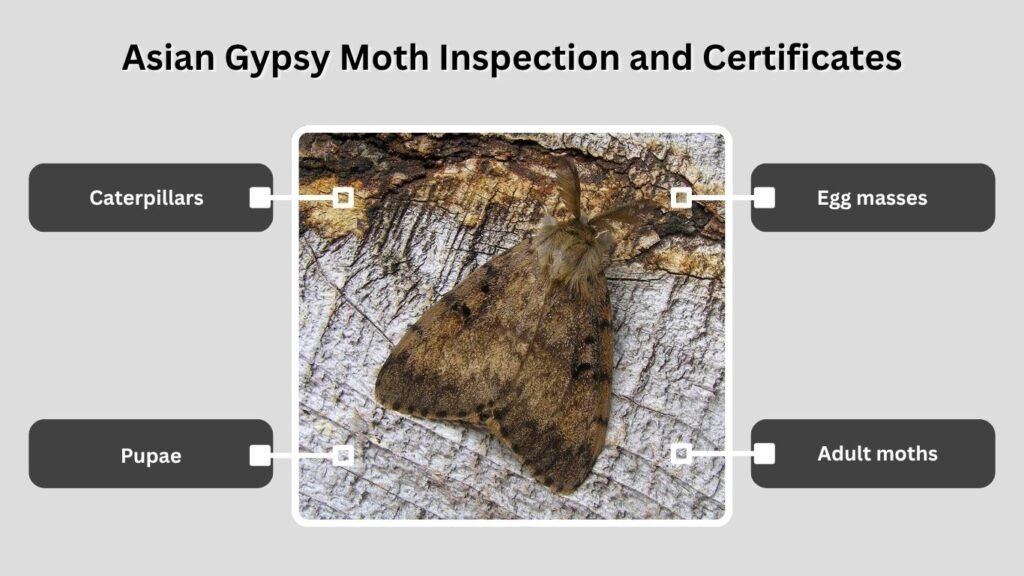
International vessels are particularly important in preventing FSMC spread.
Ships that visit regulated areas during moth flight periods may need inspections before departure and documentation showing that they are free of FSMC.
What Does an Inspection Look For?
Inspectors concentrate on:
- Egg masses
- Adult moths
- Caterpillars
- Pupae
- Deck structures
- Railings
- Hull surfaces
- Cargo and containers
- Areas around outdoor lights
Canada requires applicable vessels arriving during its high-risk season to carry an approved phytosanitary certificate or recognized pre-departure inspection certificate verifying freedom from FSMC.
How Long Is an Asian Gypsy Moth Certificate Valid?
There is no single worldwide validity period that applies to every FSMC certificate.
Validity depends on destination-country regulations, ports visited, dates of visits, and whether the ship entered a regulated area during its specified moth flight period.
For Canada, qualifying vessels arriving during the Canadian risk period must provide certification issued at least from the last regulated port visited during its specified risk period, or afterward before entering Canadian waters. Vessel history from the current and preceding year can also affect requirements.
Shipping operators should therefore verify current destination-country requirements rather than relying on an older certificate.
Asian Gypsy Moth vs European Spongy Moth
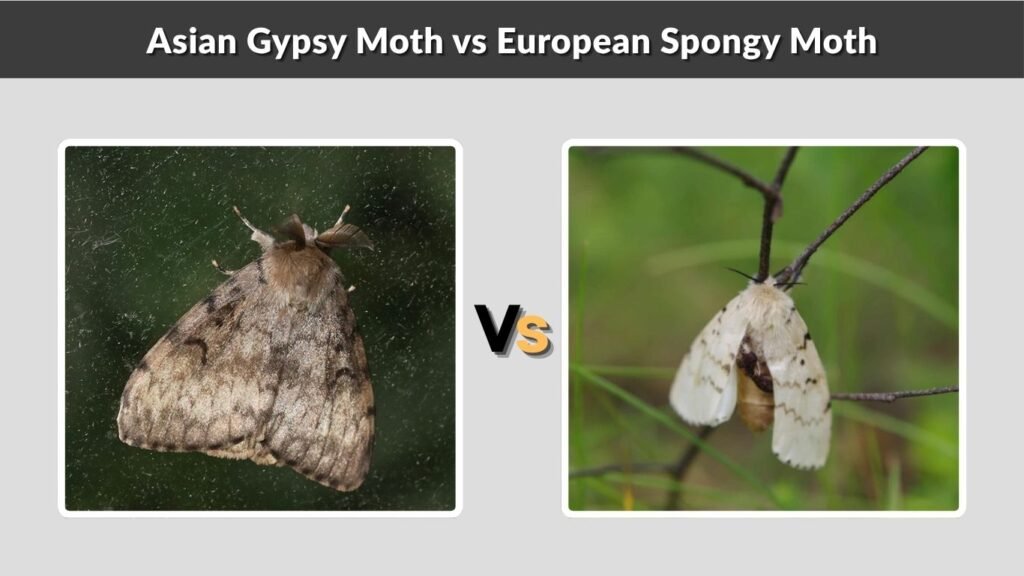
The two can be extremely difficult to distinguish visually.
The most important practical difference is female flight.
Females of the established European form, Lymantria dispar dispar, generally do not fly, whereas FSMC females are capable of sustained flight.
This ability potentially allows an introduced population to spread much faster.
Is There a Giant Asian Gypsy Moth?
“Giant Asian gypsy moth” is not a recognized standard species name.
The phrase is sometimes used informally for unusually large individuals. Female FSMC moths are naturally much larger than males and may reach a wingspan of approximately 3.5 inches, which can make them look unusually large.
FAQs
1. What is the Asian gypsy moth called now?
The current official term used by U.S. and Canadian authorities is Flighted Spongy Moth Complex (FSMC).
2. Can female Asian gypsy moths fly?
Yes. Female flight is one of the major characteristics distinguishing FSMC from the established European spongy moth form.
3. What does an Asian gypsy moth caterpillar look like?
Mature caterpillars are hairy and usually mottled gray, with distinctive rows of blue and red spots along their backs.
4. Is the Asian gypsy moth established in the United States?
No. USDA states that FSMC is not established in the United States, although the insects are periodically intercepted on vessels and eradication responses have occurred.
5. Why are ships inspected for Asian gypsy moths?
Female moths can lay long-lasting egg masses on ships and cargo in Asian ports. Those eggs can survive ocean transport and potentially introduce the pest into new countries.
