
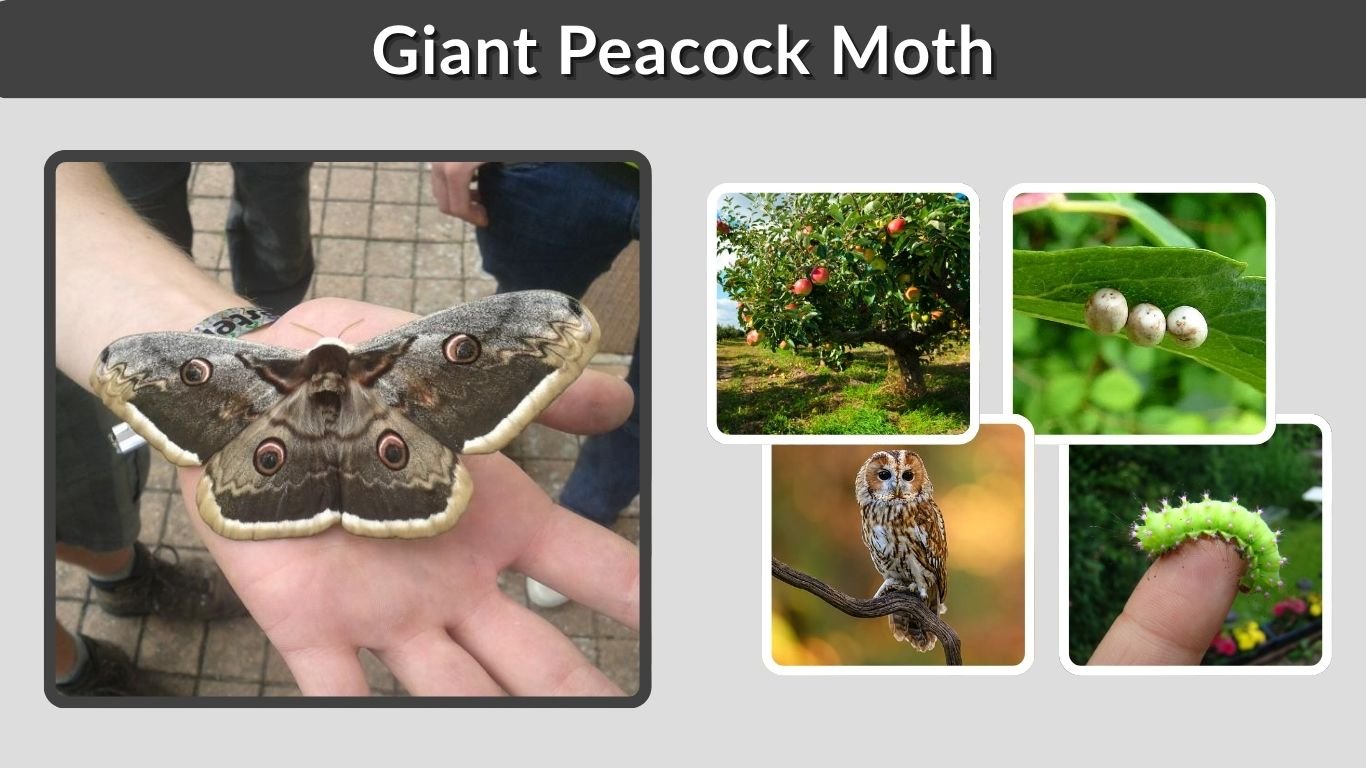
The giant peacock moth (Saturnia pyri) is Europe’s largest native moth, with a wingspan that can exceed 16 cm. Each brown-grey wing carries a colorful eyespot that resembles a peacock feather and helps frighten predators. The moth inhabits warm woodlands, orchards, scrublands, and gardens across southern Europe and neighboring regions. Its enormous green caterpillar feeds on fruit trees and other deciduous plants before spinning a tough cocoon. Adults cannot eat and live only long enough to mate and reproduce.
What Is a Giant Peacock Moth?
The giant peacock moth belongs to Saturniidae, a family containing many of the world’s largest silk and emperor moths. It is also known as the great peacock moth, giant emperor moth, or Viennese emperor.
Classification
Its basic classification is:
- Scientific name: Saturnia pyri
- Family: Saturniidae
- Order: Lepidoptera
- Genus: Saturnia
- Common names: Giant peacock moth and great peacock moth
- German name: Großes Nachtpfauenauge or Wiener Nachtpfauenauge
- Adult flight period: Usually April through June
The scientific name pyri refers to pear trees, although its caterpillars eat many other plants.
Identification
An adult giant peacock moth has:
- Broad grey, brown, and cream wings
- One large eyespot on each of its four wings
- Wavy black, white, and reddish wing bands
- Pale or cream-colored wing margins
- A thick body covered with brown scales
- A wingspan commonly between 10 and 16 cm
- Feather-like antennae, particularly in males
- No functional feeding proboscis
The prominent eyespots have concentric black, white, blue, and reddish rings. When the moth displays all four, a predator may hesitate because the pattern resembles the face of a larger animal.
Male vs. Female
Females are generally larger and heavier, with broader wings and a thick abdomen containing eggs. Their antennae are comparatively narrow.
Males are usually smaller but possess wide, feather-shaped antennae. These sensitive structures detect pheromones released by females. Males fly actively at night while searching for a mate, whereas females often remain close to where they emerged.
Giant Peacock Moth Size and Wingspan
The giant peacock moth is considered the largest moth native to Europe. Its wingspan is impressive, but it remains smaller than tropical giants such as the white witch, Hercules, and Atlas moths.
How Large Is a Giant Peacock Moth?
Most adults have a wingspan of approximately 10–16 cm, or 4–6.3 inches. A few sources report specimens approaching 17–20 cm, but such dimensions are exceptional and may reflect different measuring techniques.
Its broad wings and heavy body can cause it to be mistaken for a small bird or bat when it flies past a light at night.
Is It Europe’s Largest Moth?
Yes, Saturnia pyri is widely recognized as Europe’s largest moth. Other European silk moths, such as the small emperor and tau emperor, are noticeably smaller.
“Largest” refers mainly to its overall wingspan and body size within Europe. It does not hold the global record for moth wingspan, area, or weight.
Giant Peacock Moth Habitat and Geographic Range
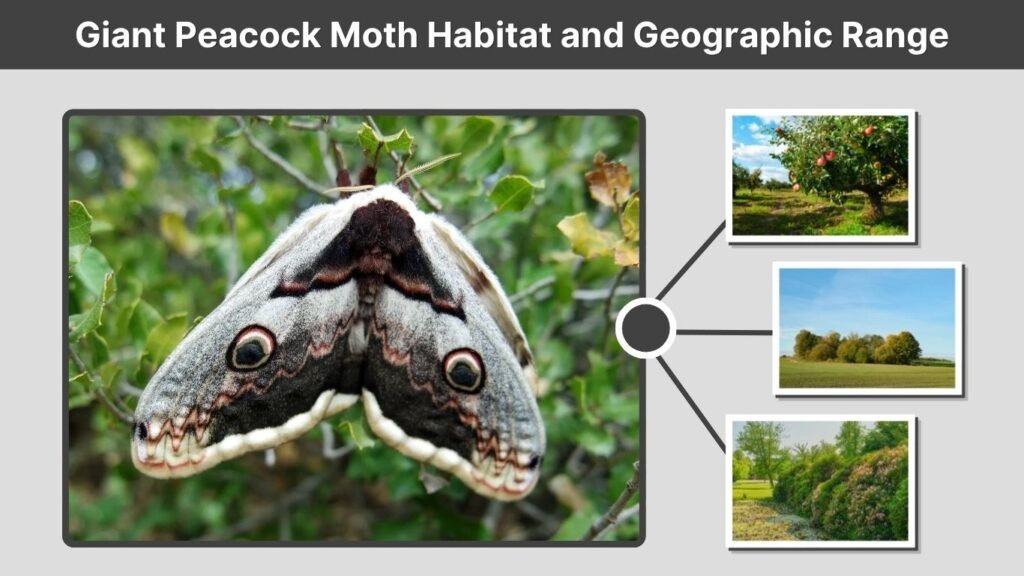
The giant peacock moth prefers warm environments containing trees and shrubs suitable for its caterpillars. It can survive in both natural habitats and human-managed landscapes such as orchards and gardens.
Geographic Distribution
Its range includes:
- Southern and central Europe
- The Iberian Peninsula
- Southern France
- Italy
- The Balkans
- Greece
- Parts of central and eastern Europe
- Turkey and the Caucasus
- The Middle East
- North Africa
- Parts of western and central Asia
Populations are often localized. The moth may be present in a country but absent from cooler, wetter, or heavily developed regions within it.
Preferred Habitat
Typical habitats include:
- Traditional fruit orchards
- Open deciduous woodland
- Warm forest edges
- Hedgerows and scrubland
- Gardens with mature fruit trees
- River valleys
- Dry slopes with scattered shrubs
- Farmland containing old trees
The loss of traditional orchards, removal of old trees, pesticide use, artificial lighting, and habitat fragmentation may reduce local populations.
Giant Peacock Moth in France
The species occurs mainly in warmer parts of France, particularly in southern regions such as Provence and areas around the Mediterranean. Adults generally fly during spring and may be attracted to outdoor lights.
Vincent van Gogh encountered the species while living in Saint-Rémy-de-Provence in 1889, creating one of the best-known artistic depictions of the moth.
Is It Found in the UK?
The giant peacock moth is not considered a native British species. UKMoths reports a historical Hampshire record from 1984 but notes that the individual may have originated from captive breeding.
A large peacock-like moth found naturally in the UK is more likely to be the smaller emperor moth. Any suspected giant peacock moth should be photographed and reported to a local moth recorder.
Is It Found in the United States?
The giant peacock moth is not native to the eastern United States. A huge North American silk moth with eyespots is more likely to be a cecropia, polyphemus, promethea, or imperial moth.
Captive specimens should never be released outside the species’ natural range.
Giant Peacock Moth Caterpillar Identification
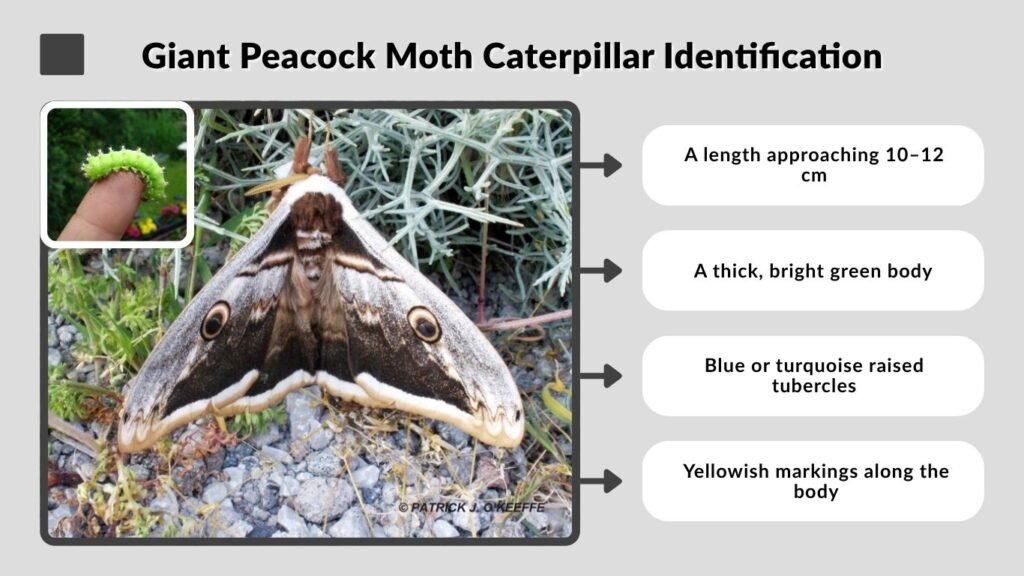
The giant peacock moth caterpillar is one of Europe’s largest and most colorful caterpillars. Its appearance changes significantly as it grows through several developmental stages.
What Does the Caterpillar Look Like?
A mature caterpillar may have:
- A length approaching 10–12 cm
- A thick, bright green body
- Blue or turquoise raised tubercles
- Rings of short black hairs around each tubercle
- Yellowish markings along the body
- A rounded reddish or brown head
- Strong jaws for chewing leaves
Young caterpillars are darker and may appear blackish with orange or red tubercles. They become progressively greener after each molt.
Is the Caterpillar Poisonous?
Giant peacock moth caterpillars are not regarded as dangerously poisonous or venomous. Their colorful tubercles and hairs primarily serve as a visual and physical defense.
However, the hairs may irritate sensitive skin through mechanical contact. Avoid handling the caterpillar with bare hands, and prevent its hairs from contacting the eyes or mouth. The insect is also easily injured by unnecessary handling.
What Do Caterpillars Eat?
The larvae feed on leaves from numerous deciduous trees and shrubs, including:
- Pear
- Apple
- Plum
- Cherry
- Almond
- Apricot
- Blackthorn
- Hawthorn
- Walnut
- Ash
- Elm
- Willow
- Poplar
Fruit trees are particularly important in agricultural areas. Although larvae are large and consume substantial foliage, they rarely occur in numbers high enough to seriously damage healthy mature trees.
Giant Peacock Moth Adult Diet and Lifespan
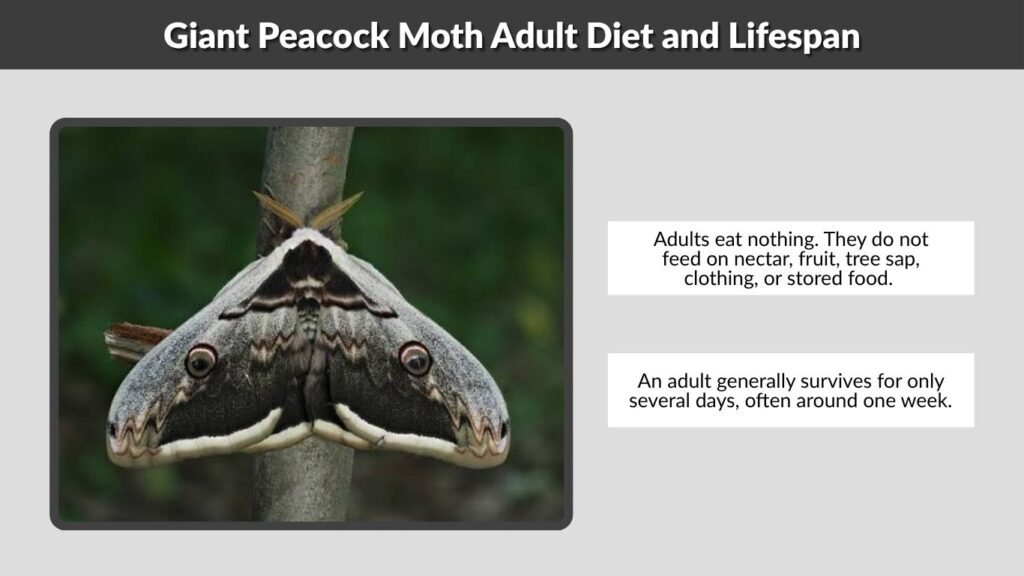
Adult giant peacock moths have no functional proboscis and cannot eat or drink. Every activity during adulthood is powered by energy stored while they were caterpillars.
What Do Adults Eat?
Adults eat nothing. They do not feed on nectar, fruit, tree sap, clothing, or stored food. Their digestive and feeding structures are greatly reduced.
After emerging, the moth concentrates entirely on finding a mate and producing the next generation.
How Long Do Adults Live?
An adult generally survives for only several days, often around one week. Exact longevity depends on temperature, activity, sex, mating success, and the energy accumulated during larval development.
Males may use their reserves rapidly during long searches for females. Females invest much of their remaining energy in producing and laying eggs.
Giant Peacock Moth Life Cycle
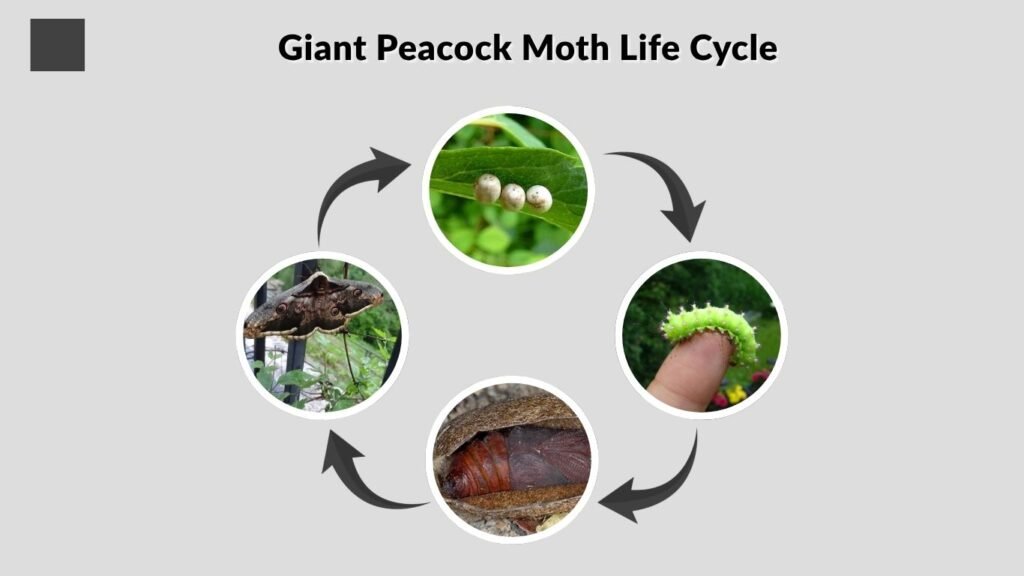
The species undergoes complete metamorphosis through egg, caterpillar, pupa, and adult stages. It normally produces one generation each year.
Eggs
After mating, the female lays clusters of oval eggs on twigs, branches, bark, or leaves of a suitable host plant. A single female may produce more than 100 eggs.
Eggs commonly hatch within one or two weeks. Temperature strongly influences the precise development time.
Caterpillar Stage
Newly hatched caterpillars initially remain close together before spreading across the host plant. They feed continuously, grow rapidly, and molt several times.
Larval development commonly takes five to eight weeks. A caterpillar’s colors and tubercles change as it passes through successive instars.
Cocoon and Pupa
A mature caterpillar stops feeding and searches for a protected location. It spins a strong brown, pear-shaped silk cocoon against:
- A tree trunk
- The base of a host plant
- A branch
- A wall or fence
- Leaf litter
- Another sheltered surface
Inside the cocoon, it transforms into a dark pupa. The pupa normally remains dormant through winter. Some pupae may remain in diapause for more than one season if environmental conditions are unsuitable.
Adult Emergence
Adults usually emerge from late April through June. The moth releases fluid that helps soften part of the cocoon, allowing it to escape.
Its wings are initially small and folded. The moth hangs from a secure surface, expands the wings by pumping fluid through their veins, and waits for them to harden before flying.
Giant Peacock Moth Behavior and Predators
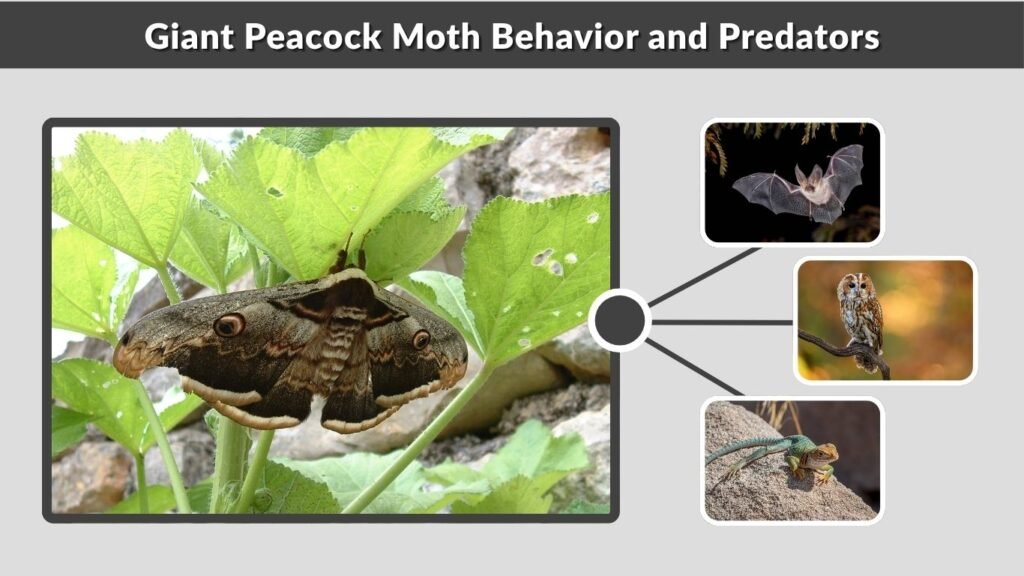
Giant peacock moths are mainly nocturnal. They rest during the day and become active after dusk, although newly emerged individuals may remain in the same place for many hours.
Mating Behavior
A receptive female releases a powerful pheromone. Male antennae can detect extremely low concentrations of this chemical and help the moth follow its source through the landscape.
Several males may arrive near one female. After mating, the female searches for suitable trees on which to place her eggs.
Defense and Predators
Potential predators include:
- Bats
- Owls and other birds
- Lizards
- Small mammals
- Predatory insects
- Parasitic flies and wasps
The adult’s eyespots may startle a predator or redirect an attack toward the less vulnerable wings. Caterpillars rely on their size, coloration, hairs, and tubercles for protection.
Giant Peacock Moth Symbolism
There is no universal traditional meaning attached to this species. Modern symbolism is based mainly on its metamorphosis, nocturnal life, short adulthood, and prominent eyespots.
Common Symbolic Meanings
The giant peacock moth may represent:
- Transformation
- Renewal
- Hidden beauty
- Intuition
- Watchfulness
- The shortness of life
- Attraction and desire
- Personal growth
- Resilience through change
Its eyespots may symbolize awareness or protection, while the progression from caterpillar to winged adult represents personal transformation.
Van Gogh’s Giant Peacock Moth
Vincent van Gogh encountered an enormous moth in the garden of the Saint-Paul asylum at Saint-Rémy-de-Provence in May 1889. He initially identified it as a death’s-head moth, but it was actually a giant peacock moth.
The 1889 Artwork
Van Gogh first made drawings of the insect. He then created the oil painting Giant Peacock Moth in May–June 1889, using his earlier study as a reference. The work measures 33.5 by 24.5 cm and is held by the Van Gogh Museum in Amsterdam.
Van Gogh added a skull-like mark to the moth’s thorax because he believed it was a death’s-head moth. The real giant peacock moth has stripes in that area rather than a skull. The Van Gogh Museum preserves the painting and explains the mistaken identification.
FAQs
What is the giant peacock moth’s scientific name?
Its scientific name is Saturnia pyri. It belongs to the giant silk moth family Saturniidae.
How large can a giant peacock moth become?
Its wingspan commonly reaches 10–16 cm. Exceptional individuals may be larger, making it Europe’s largest moth.
Can a giant peacock moth bite or sting?
No. Adults lack functional feeding mouthparts and cannot bite. They also have no stinger or venom.
Does the giant peacock moth caterpillar damage fruit trees?
A caterpillar can consume many leaves, but serious damage is unusual unless numerous larvae occur on a small or stressed tree.
Why did Van Gogh paint a skull on the moth?
Van Gogh mistakenly believed the insect was a death’s-head moth. He therefore added a skull-like marking that the actual giant peacock moth does not possess.
