
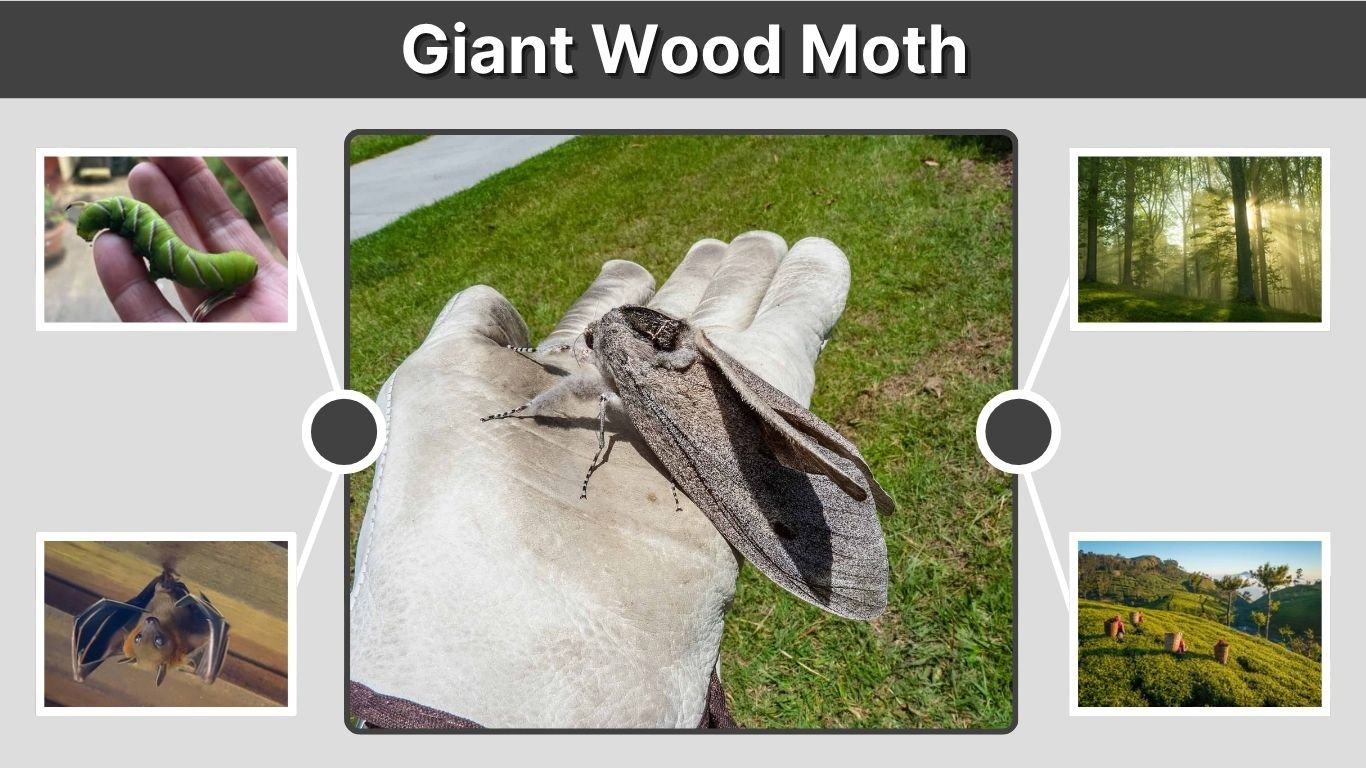
The giant wood moth (Endoxyla cinereus) is an enormous Australian insect recognized as the world’s heaviest moth. Large females can weigh around 30 grams and reach a wingspan of approximately 25 cm. Despite their imposing appearance, adult giant wood moths cannot eat, bite, or sting. Most of their lives are spent as caterpillars hidden inside living eucalyptus trees, where they create large tunnels and feed on soft plant tissue. Adults emerge during summer, mate, lay eggs, and die within only a few days.
What Is a Giant Wood Moth?
The giant wood moth belongs to Cossidae, a family commonly known as carpenter or wood moths. Members of this family have wood-boring caterpillars that spend much of their development concealed inside trees, branches, stems, or roots.
Identification
An adult giant wood moth has several recognizable characteristics:
- Large mottled grey or brown forewings
- A dark patch over the thorax
- Broad wings with curved outer margins
- A thick, heavy abdomen
- Alternating pale and dark abdominal bands
- Grey-brown hindwings
- Large compound eyes
- Shorter, more compact antennae than many silk moths
- A wingspan reaching approximately 25 cm in females
Its bark-like pattern provides camouflage when the moth rests against eucalyptus trunks. Smaller wood moth species can appear similar, so size, location, and detailed wing patterns should all be considered.
Giant Wood Moth Face
The face contains two compound eyes and a pair of antennae surrounded by grey or brown scales. Unlike nectar-feeding moths, the adult has no functional feeding mouthparts.
Its inability to eat means that the moth must rely entirely on fat and energy accumulated during its long caterpillar stage.
Male vs. Female
Female giant wood moths are considerably larger than males. A large female may have a wingspan of 20–25 cm and an exceptionally heavy abdomen filled with eggs.
Males may be only about half the female’s size. Their lighter bodies make them stronger and more agile fliers when searching for females. A male observed alone could be mistaken for a different wood moth species because the size difference is so dramatic.
Giant Wood Moth Size and Weight
The giant wood moth is not the species with the greatest wingspan, but it holds the most impressive verified weight record. Its massive abdomen accounts for much of this exceptional body weight.
How Heavy Is a Giant Wood Moth?
Females commonly cited as exceptionally large weigh close to 30 grams. Guinness World Records records a female weighing 31.2 grams, or approximately 1.1 ounces, as the heaviest moth specimen.
Most individuals will be smaller than the record holder. Sex, larval nutrition, environmental conditions, and the number of eggs carried by a female can influence body weight.
Giant Wood Moth Wingspan
Large females can reach approximately 25 cm, or almost 10 inches, across their extended wings. Males are generally much smaller, with wingspans commonly around 11–15 cm.
The wingspan is impressive but remains below the maximum measurements of the white witch, Atlas, and Hercules moths. The giant wood moth’s record is based on weight rather than wing length or surface area.
Giant Wood Moth Distribution and Habitat in Australia
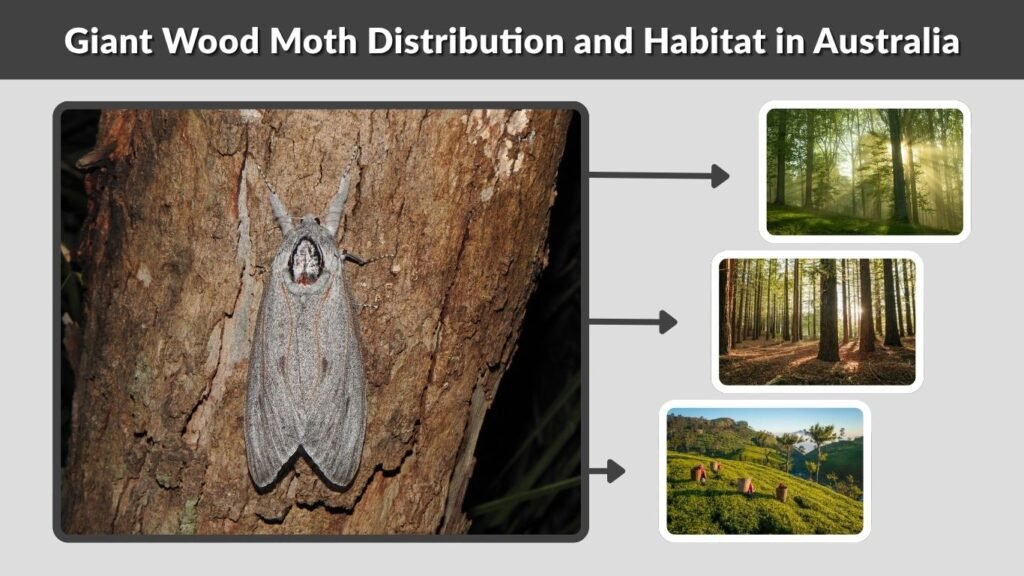
The best-documented range extends along coastal Queensland and into New South Wales. The moth inhabits areas containing suitable eucalyptus species, including forests, woodlands, plantations, and suburban environments with mature gum trees.
Where Are Giant Wood Moths Found?
Important areas include:
- Northern Queensland
- Southeastern Queensland
- Brisbane and surrounding districts
- Coastal New South Wales
- Areas around Sydney
- Some inland eucalyptus-growing regions
The Queensland Government describes the species as common along the Queensland coast and present in New South Wales, with some records extending inland.
Broader occurrence reports have attributed the species to other mainland states, including Victoria and South Australia. However, Australia has numerous similar Endoxyla species, and photographs or specimens from outside the moth’s core range should be professionally identified.
Are Giant Wood Moths Found in Tasmania or the UK?
The Australian giant wood moth is not native to the UK. A very large moth reported there is almost certainly another species or an imported specimen.
Tasmania has native wood moths, but sightings labeled Endoxyla cinereus should be verified because related species may be confused with it. The giant wood moth is most strongly associated with Queensland and New South Wales.
Giant Wood Moths in Brisbane
Brisbane lies within the species’ recognized range. Adults are occasionally found on school buildings, houses, paths, or tree trunks, particularly during summer and after rainfall.
A sighting can attract considerable attention because newly emerged females are exceptionally large. However, adults live briefly and do not infest furniture, houses, or stored food.
Giant Wood Moth Caterpillar
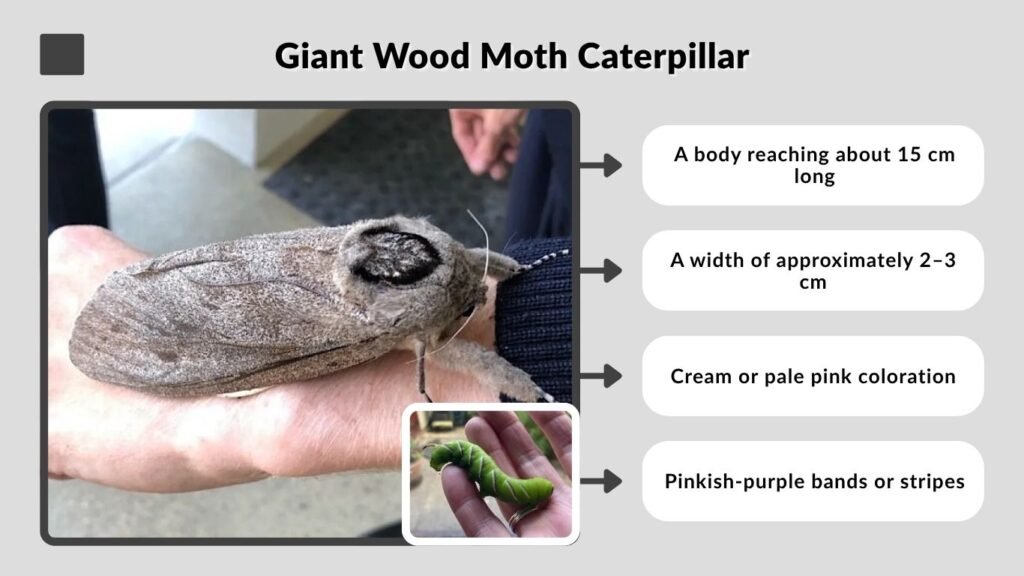
The caterpillar is a large wood-boring larva sometimes included among insects broadly called witchetty grubs. However, several Australian moth species produce larvae known by that name, so not every witchetty grub is a giant wood moth.
Caterpillar Identification
A mature giant wood moth larva may have:
- A body reaching about 15 cm long
- A width of approximately 2–3 cm
- Cream or pale pink coloration
- Pinkish-purple bands or stripes
- A reddish-brown head
- Strong jaws for excavating plant tissue
- A thick, soft-looking segmented body
The larva usually remains concealed inside a tree. Its presence is more commonly detected from holes, plugs, frass, or swelling than by seeing the caterpillar itself.
Does the Caterpillar Eat Wood?
The caterpillar excavates tunnels through sapwood and heartwood, but the wood itself is not considered its primary food. It mainly consumes soft callus tissue produced by the tree as it attempts to repair and close the larval burrow.
This relationship creates an unusual cycle: the caterpillar injures the tree, the tree produces healing tissue, and the caterpillar feeds on that fresh growth.
Signs in a Tree
Possible signs include:
- Coarse, sawdust-like frass near the trunk
- A plugged entrance hole
- Swelling around part of the stem
- A large circular emergence hole
- Dark staining within cut timber
- A brown pupal case projecting from the trunk
- Cockatoo damage around a larval tunnel
The main tunnel may be J-shaped and extend through both sapwood and heartwood. Entrance holes are often found within several metres of the ground but can occur higher in the tree.
Giant Wood Moth Eggs and Early Larvae
A female can produce thousands of tiny eggs. Rather than carefully placing each one on a specific leaf, she deposits them in crevices and irregularities in the bark of living trees.
How the Larvae Disperse
After hatching, young larvae produce silk threads and lower themselves from the tree. Wind can then carry them away, helping the siblings spread across a larger area.
Researchers believe that the earliest larvae may initially feed underground around plant roots. This stage remains incompletely understood. When they reach approximately 25 mm, the larvae enter suitable eucalyptus trunks or branches and begin their wood-boring phase.
Giant Wood Moth Life Cycle and Pupation
The giant wood moth’s development is unusually long compared with its adult life. The larva may feed and grow for around two years, while the winged moth survives for only a few days.
Life Cycle Stages
The main stages are:
- A female deposits thousands of eggs in bark crevices.
- Hatchlings descend on silk and disperse in the wind.
- Young larvae are thought to spend time around roots.
- Larger larvae bore into eucalyptus stems or branches.
- Each larva creates and seals a tunnel.
- The larva feeds on callus tissue for approximately two years.
- It pupates inside the protected tunnel.
- The pupa moves toward a prepared exit opening.
- The adult emerges, mates, and reproduces.
Empty pupal cases sometimes remain protruding from the tree after the moth has emerged.
Does It Make a Cocoon?
The giant wood moth does not create the large, exposed silk cocoon associated with an Atlas or Hercules moth. Instead, pupation occurs within the larval tunnel in the tree.
The surrounding wood and sealed chamber protect the pupa. Before emergence, the larva prepares a circular exit hole that may measure approximately 3–5 cm across.
Adult Emergence
Adults commonly emerge during summer, often following heavy rainfall. The pupa works toward the entrance, and the moth escapes from its casing before expanding and drying its wings.
A newly emerged moth may rest near the hole while its wings become firm enough for flight.
Giant Wood Moth Lifespan, Flying and Behavior
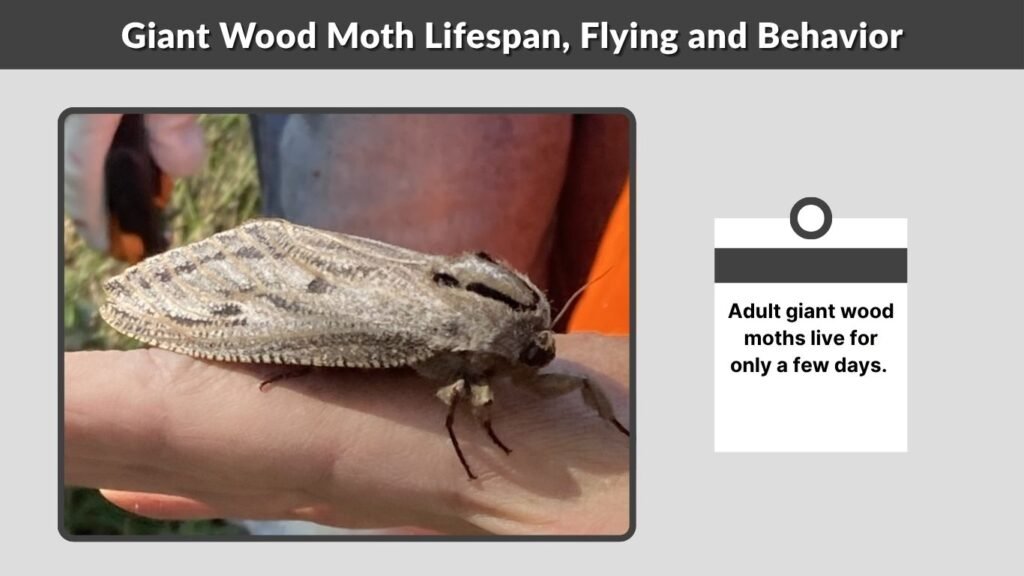
Adults are nocturnal and spend their limited time locating mates and reproducing. Their behavior is powered entirely by stored larval energy because they cannot replenish it by feeding.
How Long Do Adults Live?
Adult giant wood moths live for only a few days. Males use their energy while flying in search of females, while females invest heavily in egg production and laying.
The complete lifespan is much longer because the larval stage lasts around two years. Most of the animal’s life is therefore spent hidden inside or around its host tree.
Can Giant Wood Moths Fly?
Yes. Even heavy females can fly, although their flight may appear slower and more labored than that of males. Males are smaller, lighter, and better suited to traveling in search of pheromone-producing females.
Adults may fly around trees, land on nearby buildings, or become attracted to outdoor lights. Handling can damage their wings and waste their limited energy.
Do Giant Wood Moths Bite?
Adult giant wood moths cannot bite because they have no functional mouthparts. They also lack venom and a stinger, making them harmless to humans, dogs, cats, and livestock.
Are the Caterpillars Dangerous?
The caterpillar has powerful jaws for excavating and feeding within trees, but it does not hunt or attack people. Handling any large wild caterpillar is nevertheless discouraged because it may defend itself by wriggling or attempting to nip when restrained.
Neither the larva nor adult should be killed simply because of its size. Leave an adult in a safe outdoor location unless professional identification or tree-management advice is required.
Predators and Ecological Role
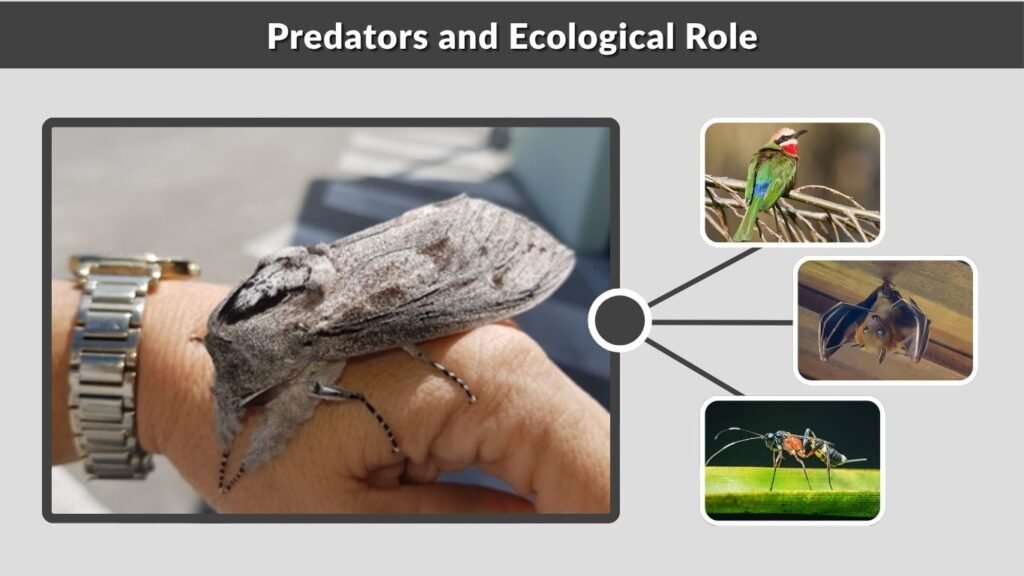
Giant wood moth larvae provide food for several native animals. Yellow-tailed black cockatoos can locate larvae inside trees and tear open trunks or branches to reach them. This feeding may cause more visible tree damage than the original tunnel.
Natural Enemies
Predators and parasites may include:
- Yellow-tailed black cockatoos
- Other insect-eating birds
- Bats that capture adults
- Parasitic wasps
- Ants attacking eggs or hatchlings
- Small animals that find exposed larvae or pupae
Larval tunnels can weaken young plantation trees and reduce timber quality. Large mature trees are less likely to suffer serious structural damage, although exit holes can allow moisture and fungi to enter before healing.
Giant Wood Moth vs. Atlas Moth
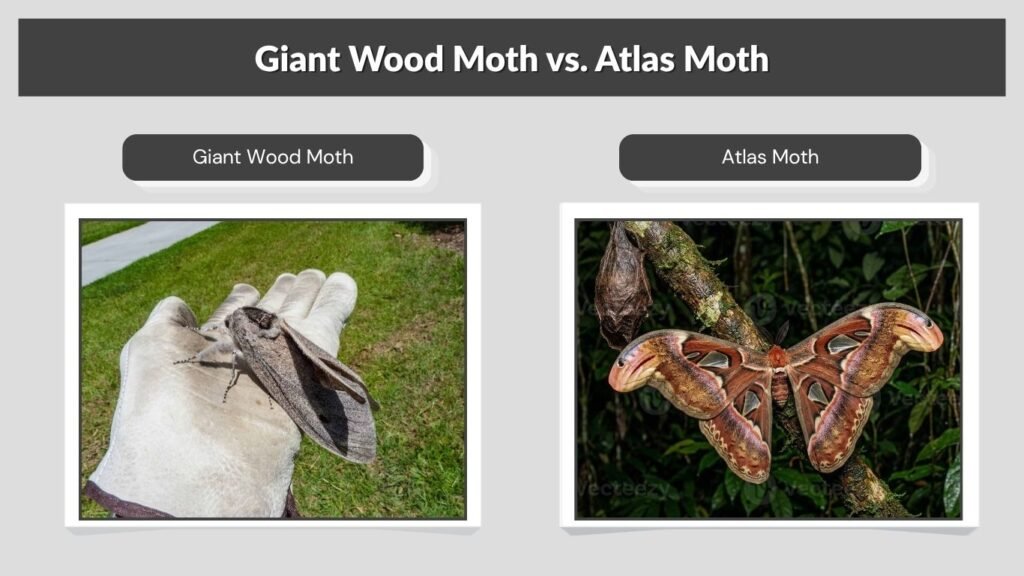
These species are both enormous but are unrelated beyond belonging to the moth order Lepidoptera.
| Feature | Giant Wood Moth | Atlas Moth |
| Scientific name | Endoxyla cinereus | Attacus atlas |
| Native region | Australia | South and Southeast Asia |
| Family | Cossidae | Saturniidae |
| Main record | Heaviest moth | Often considered largest overall |
| Maximum weight | 31.2 grams recorded | Commonly up to 25–28 grams |
| Wingspan | Up to about 25 cm | Up to about 30 cm |
| Caterpillar feeding | Inside trees | Externally on leaves |
| Pupation | Within a wood tunnel | Inside a silk cocoon |
| Adult feeding | Does not eat | Does not eat |
The Atlas moth has broader, more colorful wings with transparent patches and snake-like tips. The giant wood moth has a heavier body and mottled grey-brown camouflage.
Can You Keep a Giant Wood Moth as a Pet?
It is not a practical pet. The larva requires an appropriate living host tree and develops for about two years while creating a substantial internal tunnel. The adult cannot eat and lives only briefly.
Collecting, transporting, selling, or exporting native insects may also be regulated. Anyone considering a preserved specimen should confirm that it was legally and ethically sourced rather than taken illegally from the wild.
FAQs
What is the scientific name of the giant wood moth?
Its scientific name is Endoxyla cinereus. It belongs to the carpenter moth family Cossidae.
Is the giant wood moth the world’s biggest moth?
It is the heaviest recorded month. The white witch has a greater verified wingspan, while the Hercules moth has a greater wing surface area.
How much does a female giant wood moth weigh?
Large females may weigh around 30 grams. The heaviest recorded specimen weighed 31.2 grams.
Do giant wood moths damage houses?
No. Their larvae develop in living host trees, particularly eucalyptus. They do not normally infest structural timber, furniture, clothing, or stored food.
Why do adult giant wood moths not eat?
Their mouthparts are nonfunctional. Adults survive on energy stored during the larval stage and live just long enough to mate and reproduce.
