
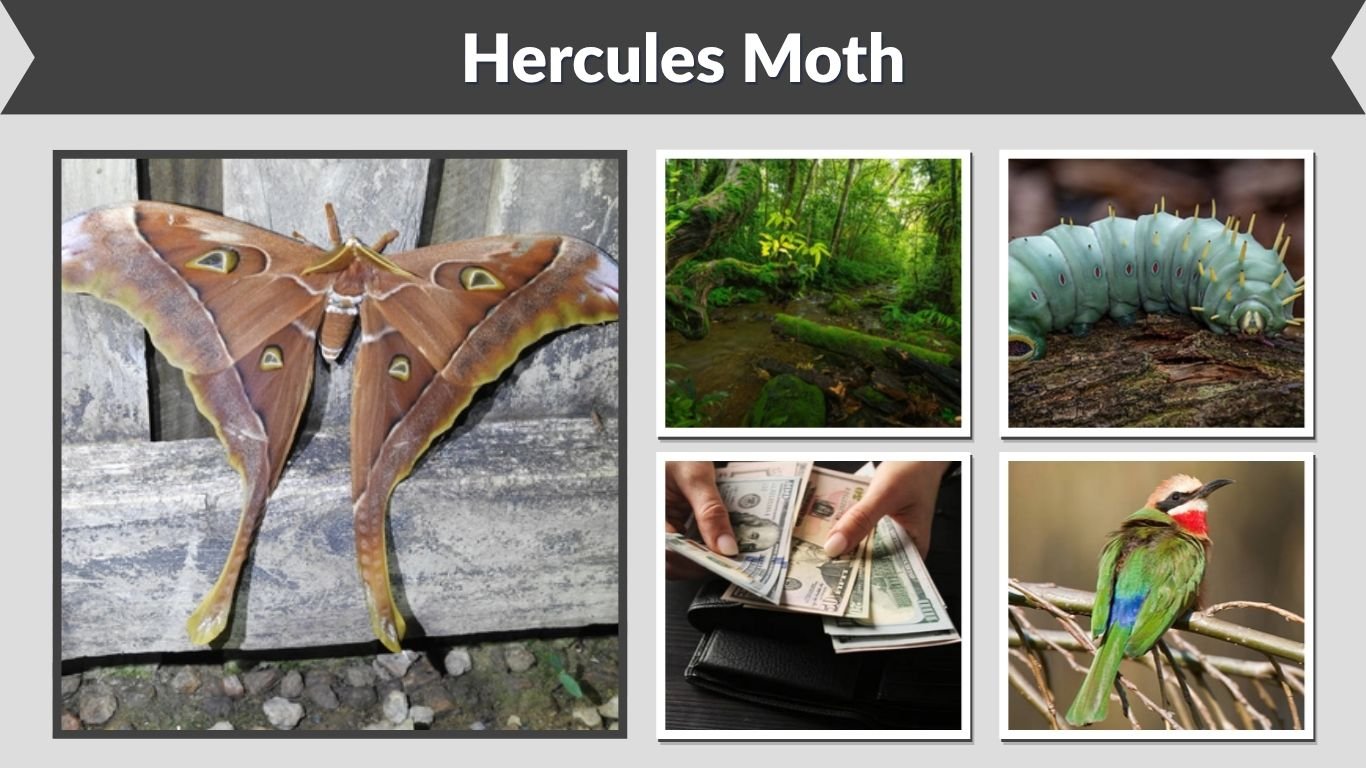
The Hercules moth (Coscinocera hercules) is an enormous silk moth native to northern Australia and New Guinea. It holds the record for the greatest wing surface area of any moth, while females can reach a wingspan of approximately 28 cm. Males are recognized by their spectacular hindwing tails and feathery antennae. Despite its intimidating dimensions, this tropical moth cannot bite or sting. Adults have no functional mouthparts, live for only a short period, and survive entirely on energy collected during their caterpillar stage.
What Is a Hercules Moth?
The Hercules moth belongs to Saturniidae, a family containing many of the world’s largest silk and emperor moths. It was scientifically described in 1876 and named after Hercules, the exceptionally strong hero from classical mythology.
Identification
Adult Hercules moths have several distinctive features:
- Enormous reddish-brown or golden-brown wings
- Pale triangular markings along the wing edges
- Transparent, window-like patches on all four wings
- A large body covered with hair-like scales
- Broad wings with gently curved margins
- Feathery antennae, especially in males
- Long hindwing tails on males
- A wingspan potentially exceeding 25 cm
The combination of transparent wing windows, brown coloration, and immense size makes this species difficult to confuse with an ordinary moth.
Hercules Moth Face
The moth has large compound eyes, two antennae, and a head covered with fine brown scales. Male antennae are broad and feather-shaped, providing a large surface area for detecting female pheromones.
The adult’s mouthparts are absent or nonfunctional. It cannot chew plants, bite people, or drink nectar. Its sole adult purpose is to reproduce.
Is the Hercules Moth Dangerous?
Hercules moths are harmless to humans and pets. Adults have no stinger, venom, or biting mouthparts. They may flutter forcefully when frightened, but this is an attempt to escape rather than attack.
The caterpillar has conspicuous fleshy spines. These are not comparable to the strongly venomous spines of some other caterpillars, but direct handling should still be avoided to protect both the insect and sensitive skin.
Hercules Moth Size and Wingspan
The Hercules moth is one of the largest insects in the world. Its exact position among giant moths depends on whether size is measured by wingspan, surface area, length, or weight.
How Large Is a Hercules Moth?
Large females may reach a wingspan of approximately 27–28 cm, or about 11 inches. Females have particularly broad wings that create an extraordinary total surface area.
Guinness World Records recognizes the female Hercules moth for having a wing surface area of up to 300 square centimetres. Measurements can vary depending on the individual and how a preserved specimen is positioned.
Claims of Hercules moths reaching 36 cm appear frequently, but they are based on an old, unconfirmed report. A wingspan of approximately 28 cm is the more reliable maximum.
Is It the World’s Largest Moth?
The Hercules moth has a strong claim to being the largest moth by wing area. Other species hold different records:
- Largest wing area: Hercules moth
- Greatest verified wingspan: White witch moth
- Largest overall size: Often credited to the Atlas moth
- Heaviest adult: Giant wood moth
- Greatest length with tails: Male Hercules moth is a contender
These different measurements explain why several species are described as the world’s largest moth.
Male vs. Female Hercules Moth
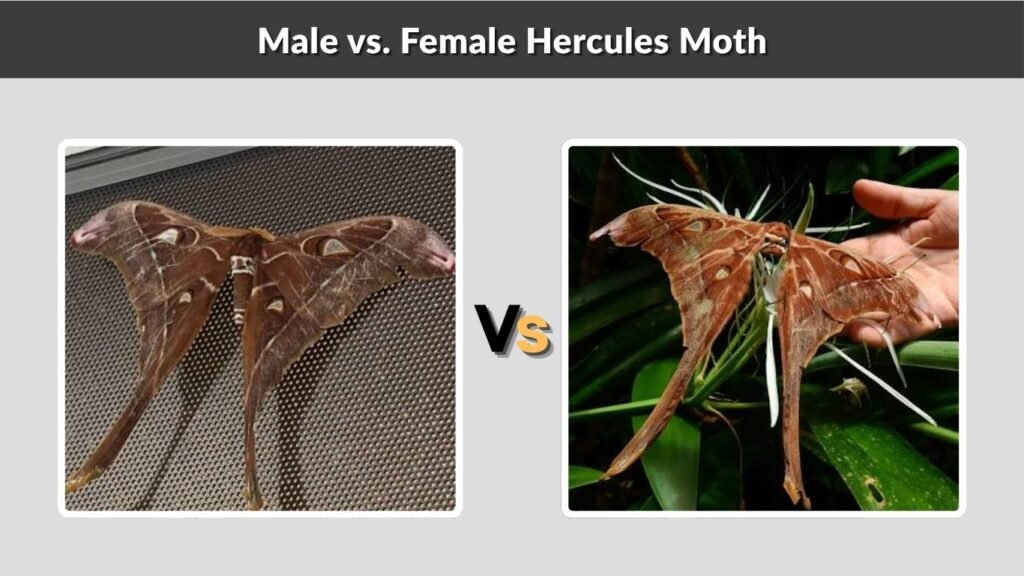
Male and female Hercules moths have different body shapes, antennae, and wing structures. Females are generally larger by wing area and body mass, while males have longer hindwing extensions.
Female Hercules Moth
A female typically has:
- A larger and heavier abdomen
- Broader, more rounded wings
- A wingspan approaching 28 cm
- Shorter hindwing extensions
- Narrower antennae
- A body capable of carrying hundreds of eggs
After emerging from her cocoon, the female usually remains relatively still while releasing pheromones. These airborne chemicals allow males to locate her from a considerable distance.
Male Hercules Moth
A male generally has:
- A slimmer and lighter body
- Broad, strongly feathered antennae
- Long tails extending from the hindwings
- More active nighttime flight
- A somewhat smaller wing surface than the female
The male’s sensitive antennae detect extremely small quantities of female pheromone. Once he locates and mates with a female, his biological role is largely complete.
Hercules Moth Habitat and Geographic Range
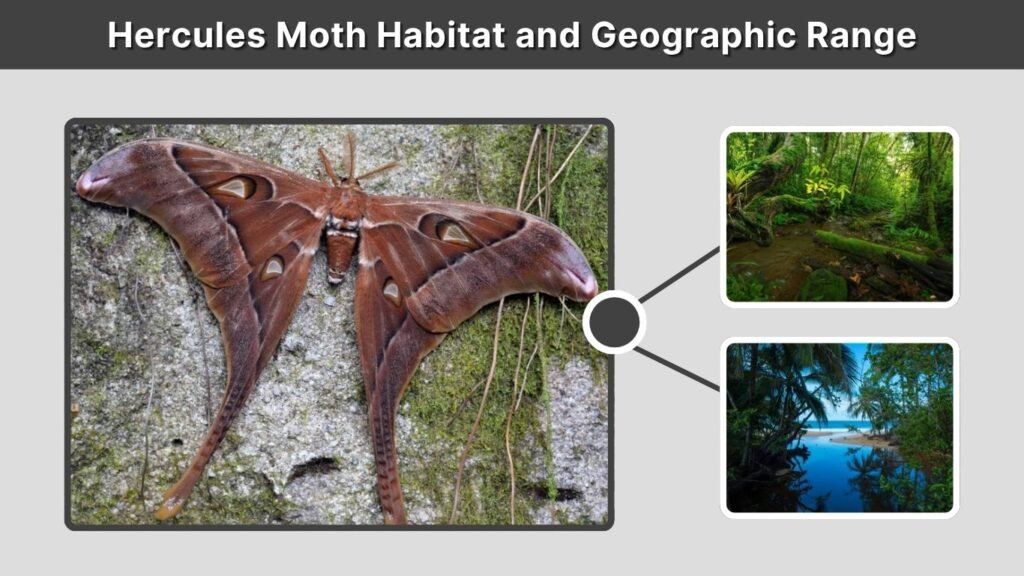
The Hercules moth is restricted to the Australasian region. Its distribution includes tropical northern Queensland and New Guinea, where warm, humid forests support the plants required by its enormous caterpillars.
Where Do Hercules Moths Live?
They are found in:
- Northeastern Queensland
- Cape York Peninsula
- Queensland’s Wet Tropics
- The Torres Strait region
- Papua New Guinea
- Parts of Indonesian New Guinea
Within Australia, the moth is associated mainly with tropical rainforest along the northeastern coast. It may occasionally appear around gardens and buildings located near suitable forest habitat.
Preferred Habitat
Hercules moth habitats include:
- Lowland tropical rainforest
- Humid coastal forest
- Rainforest edges
- Wooded gullies
- Suburban areas bordering rainforest
- Gardens containing larval food plants
Adults are nocturnal and may be attracted to outdoor lights. During daylight, they rest on trees, vegetation, walls, or other sheltered surfaces.
Hercules Moth Caterpillar
The caterpillar is almost as impressive as the adult. It is one of Australia’s largest caterpillars and spends much of its life consuming foliage and storing the energy needed for pupation and adult reproduction.
Caterpillar Identification
A mature Hercules moth caterpillar may have:
- A length of approximately 12–14.5 cm
- A thick, heavy body
- Pale blue-green or turquoise coloration
- Rows of yellow or cream fleshy spines
- Red or orange spots along its sides
- Dark feet
- False eyes near the rear of the body
Young caterpillars look different from mature ones. Early stages may be pale or white with darker bands and bristly projections. Their color and markings change through successive molts.
What Do Hercules Moth Caterpillars Eat?
The larvae feed on foliage from several rainforest trees, including:
- Bleeding heart tree
- Red bean tree
- Cheese tree
- Celery wood
- Queensland poplar
- Species of Timonius
- Other suitable rainforest trees
The caterpillar stage may last approximately two to three months under favorable conditions. Temperature and food quality can change its growth rate.
Adult Hercules moths do not eat. All energy used for flight, mating, and egg production comes from food stored while they were caterpillars.
Hercules Moth Cocoon and Life Cycle
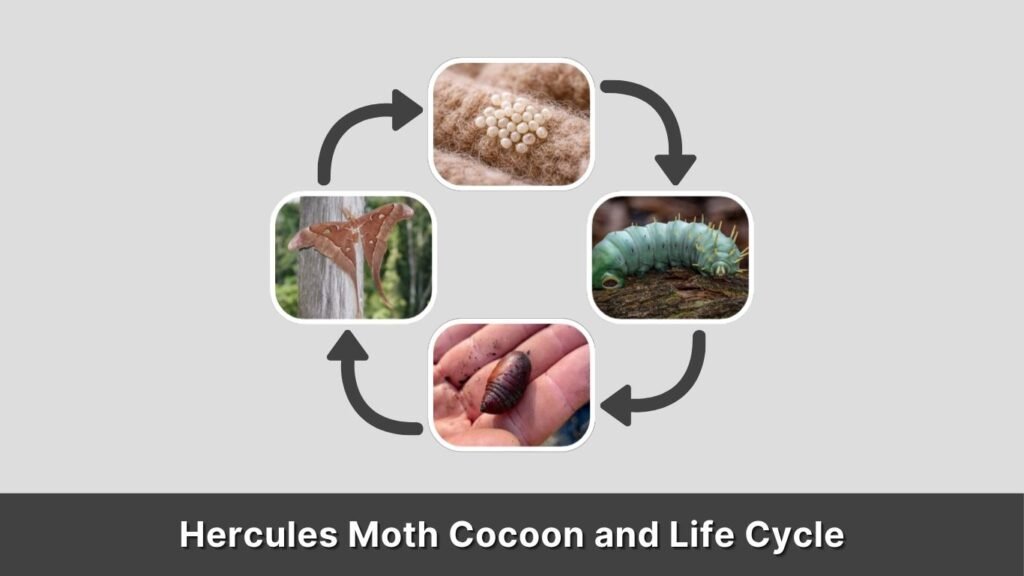
The Hercules moth undergoes four stages: egg, caterpillar, pupa, and adult. Most of its feeding and physical growth occurs before it enters the cocoon.
Eggs and Hatching
After mating, the female deposits rusty-red or brown eggs on the leaves of suitable food plants. Eggs may be laid individually or in small groups. A female can potentially produce several hundred during her short life.
The eggs hatch after approximately one to two weeks, depending on temperature and environmental conditions. Newly emerged caterpillars immediately begin feeding on nearby leaves.
Hercules Moth Cocoon
When fully grown, the caterpillar spins a large, strong silk cocoon. It usually incorporates leaves and attaches the cocoon securely to a branch or food plant.
Inside, the caterpillar transforms into a dark pupa. The pupal period can last for several weeks or months. Under unfavorable or seasonal conditions, emergence may be delayed considerably, with some captive reports describing cocoons remaining dormant for much longer.
Adult Emergence
The adult breaks out of the cocoon with small, folded wings. It climbs onto a stable surface and pumps body fluid into the wing veins, causing the wings to expand. They must then dry and harden before the moth can fly.
Because the adult cannot feed, it begins using its limited energy reserves immediately.
Hercules Moth Lifespan
The complete life cycle may last several months, with most of that time spent as a caterpillar or pupa. The adult stage is remarkably short.
How Long Do Adults Live?
Adult Hercules moths usually live for approximately 10–14 days. Lifespan depends on temperature, activity, successful mating, and the energy stored during larval development.
Adult males may exhaust their energy while flying in search of females. Females use much of their stored energy to develop and lay eggs. Neither sex can replace this energy by feeding.
Hercules Moth Behavior and Predators
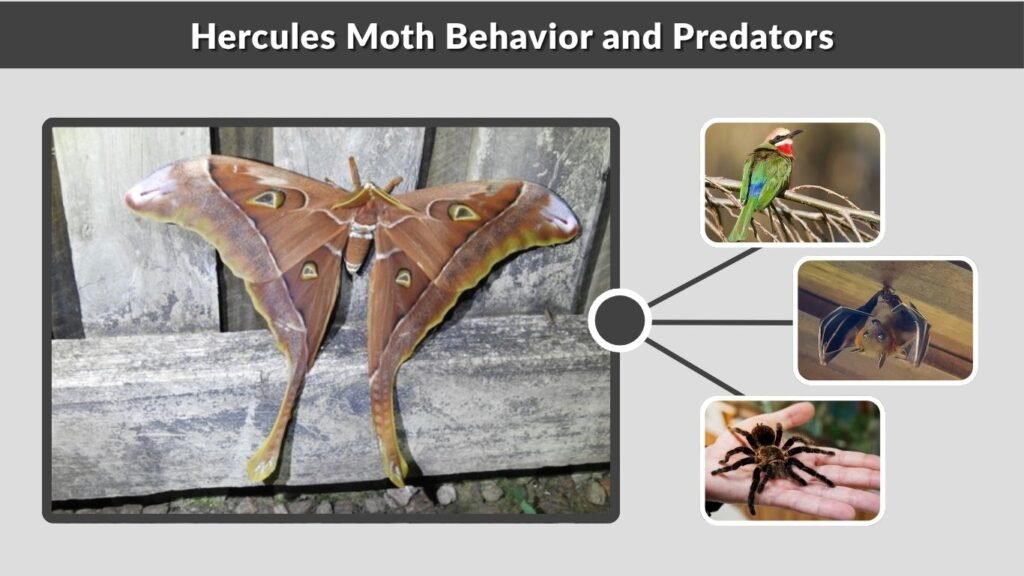
Hercules moths are generally inactive during daylight and become active after dark. Their brown wings provide camouflage when resting against bark, leaves, or wooden surfaces.
Reproductive Behavior
Females release pheromones to attract males. A male follows the chemical trail using his feathered antennae. After mating, the female searches for suitable food plants on which to deposit her eggs.
Adults may also be drawn to artificial lights. Bright lights can disrupt their movement, waste their limited energy, and expose them to predators.
Natural Predators
Potential predators include:
- Insect-eating birds
- Bats
- Lizards and other reptiles
- Large spiders
- Parasitic flies
- Parasitic wasps
- Ants attacking eggs or young larvae
Caterpillar coloration, body size, fleshy spines, and false eyes may discourage some attackers. Cocoons provide physical protection during the vulnerable pupal stage.
Hercules Moth vs. Atlas Moth
The Hercules and Atlas moths are closely related members of the Saturniidae family, but they occur in different regions and have distinct wing patterns.
| Feature | Hercules Moth | Atlas Moth |
| Scientific name | Coscinocera hercules | Attacus atlas |
| Native range | Northern Australia and New Guinea | South and Southeast Asia |
| Maximum wingspan | About 28 cm | About 30 cm |
| Record | Largest wing surface area | Often called largest overall moth |
| Male hindwings | Extremely long tails | Shorter extensions |
| Wing pattern | Transparent windows and pale edges | Snake-like tips and larger windows |
| Adult diet | Does not eat | Does not eat |
| Adult lifespan | Approximately 10–14 days | Usually only several days |
The Hercules moth generally has longer hindwing tails, especially in males. Atlas moth wings are broader near the tips and have markings that resemble snake heads.
Hercules Moths for Sale
Preserved Hercules moths are sometimes available as framed displays. Live eggs, caterpillars, and cocoons may also be advertised, but their ownership and transport can be regulated.
Responsible Purchasing
Before purchasing:
- Verify that the specimen was legally and ethically obtained.
- Request its origin and collection documentation.
- Check wildlife and biosecurity regulations.
- Never release a captive moth outside its native range.
- Avoid sellers offering undocumented wild specimens.
- Confirm that international shipping is legally permitted.
- Consider replicas or photographs as alternatives.
Transporting live insects or plant-eating caterpillars across state and national borders can threaten agriculture and native ecosystems.
FAQs
What is the scientific name of the Hercules moth?
Its scientific name is Coscinocera hercules. It belongs to the giant silk moth family Saturniidae.
Can a Hercules moth bite or sting?
No. Adults have no functional mouthparts and cannot bite. They also lack a stinger and are harmless to people.
What does a Hercules moth eat?
Caterpillars eat leaves from several tropical rainforest trees. Adult moths do not eat and survive on stored larval energy.
Is the male or female Hercules moth bigger?
The female is generally larger by body size and wing area. The male appears longer because of the impressive tails extending from his hindwings.
Where can Hercules moths be found in Australia?
They occur primarily in tropical northeastern Queensland, from the Townsville region north through the Wet Tropics and Cape York Peninsula.
