
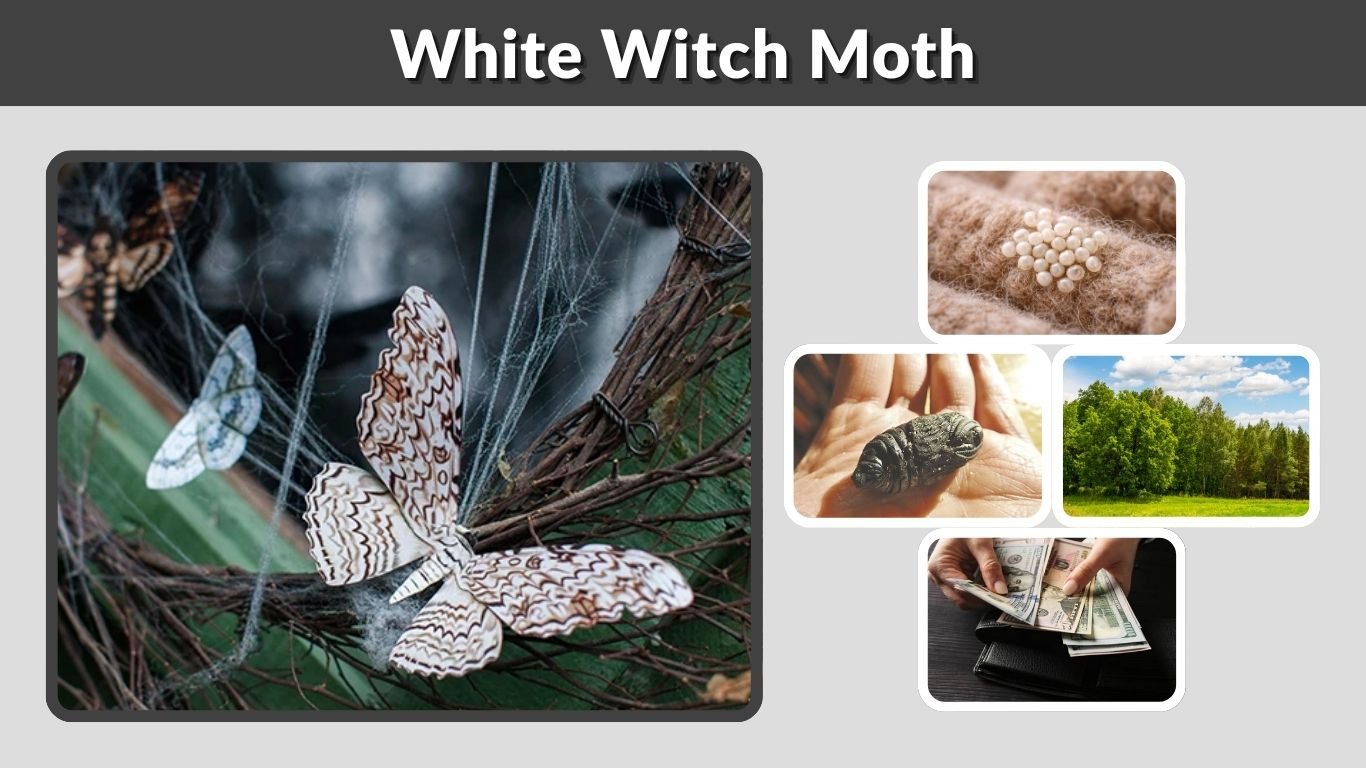
The white witch moth (Thysania agrippina) is a giant tropical moth famous for having the greatest verified wingspan of any moth. Its broad white-to-grey wings are covered with intricate brown lines that resemble tree bark, allowing this enormous insect to disappear against a trunk during daylight. Native to Mexico, Central America, and South America, it is rarely observed despite its extraordinary dimensions. Several parts of its life cycle, especially its caterpillar, food plants, pupa, and lifespan, remain surprisingly poorly documented.
What Is a White Witch Moth?
The white witch belongs to the family Erebidae, which includes underwing, tiger, tussock, and witch moths. Its scientific name is Thysania agrippina. Other names include the great grey witch, great owlet moth, ghost moth, birdwing moth, and giant Agrippina.
Identification
Important white witch moth identification features include:
- Extremely long, broad wings
- A white, cream, or pale grey base color
- Numerous wavy brown and black lines
- Irregular markings that resemble bark or lichen
- A relatively small body compared with the wings
- Darker brown, grey, or slightly iridescent undersides
- Large legs with noticeable spurs
- Long antennae extending from the head
Individual moths vary considerably. Some appear almost white, while others have dense brown markings that make them look darker.
White Witch Moth Face
The moth’s face is small compared with its enormous wings. It has two large compound eyes, a covering of pale or brownish scales, and a pair of antennae. Close-up photographs can make the face look unusual or owl-like, but the moth is harmless.
The common name “great owlet moth” reflects its classification among owlet moths rather than a close relationship with owls.
Is the White Witch Moth Dangerous?
White witch moths are neither poisonous nor venomous. They do not possess a stinger and are not aggressive toward people or pets. An adult may flutter suddenly when disturbed, but its primary defenses are camouflage and flight.
Handling is discouraged because moth wings and scales are easily damaged. If one enters a building, turn off indoor lights, open an outside door or window, and allow it to leave independently.
White Witch Moth Size and Wingspan
The white witch is one of the world’s largest flying insects. Its wings are unusually long, producing an impressive span even though other giant moths may have heavier bodies or a larger total wing surface.
How Large Is a White Witch Moth?
Large specimens commonly cited in scientific and museum discussions have wingspans approaching 28–30 cm, or approximately 11–12 inches. Smaller individuals also occur, so not every white witch will reach record dimensions.
A female specimen collected in Brazil in 1934 measured 30.8 cm. Guinness World Records recognizes it as the moth specimen with the greatest verified wingspan.
Claims of 35–36 cm moths appear online, but these measurements are not as firmly documented. Differences in measurement techniques and specimen positioning may also produce conflicting figures.
Is It the Largest Moth in the World?
The answer depends on how “largest” is measured:
- Greatest verified wingspan: White witch moth
- Overall size: Often credited to the Atlas moth
- Greatest wing area: Commonly associated with the Hercules moth
- Heaviest adult moth: Giant wood moth
The white witch’s narrow, elongated wings give it a greater tip-to-tip measurement. Atlas and Hercules moths have broader wings with more total surface area.
White Witch Moth vs. Atlas Moth
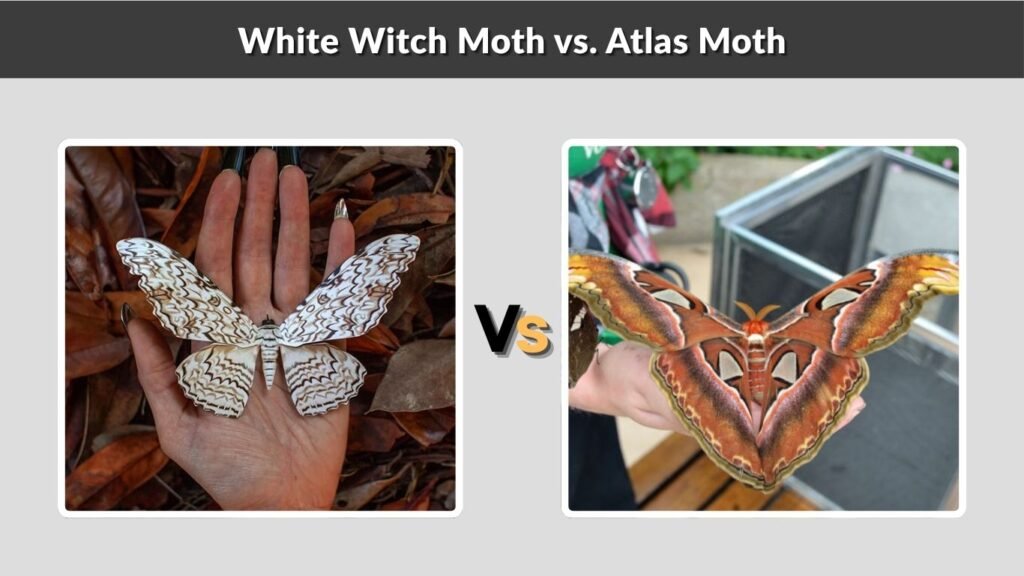
Both species are enormous, but they live on different continents and belong to different moth families. Their wing shapes, colors, and known life histories are also noticeably different.
| Feature | White Witch Moth | Atlas Moth |
| Scientific name | Thysania agrippina | Attacus atlas |
| Family | Erebidae | Saturniidae |
| Native range | Central and South America | South and Southeast Asia |
| Main color | White, grey, and brown | Reddish-brown and orange |
| Wing pattern | Fine, bark-like lines | Snake-like tips and transparent spots |
| Record distinction | Greatest verified wingspan | Often called largest by overall size |
| Caterpillar knowledge | Still limited | Well documented |
| Adult feeding | Insufficiently documented | Adults do not feed |
An Atlas moth has a thick body and broad triangular wings. A white witch has a comparatively slender body and long, pale wings that create a wider linear span.
White Witch Moth Habitat and Geographic Range
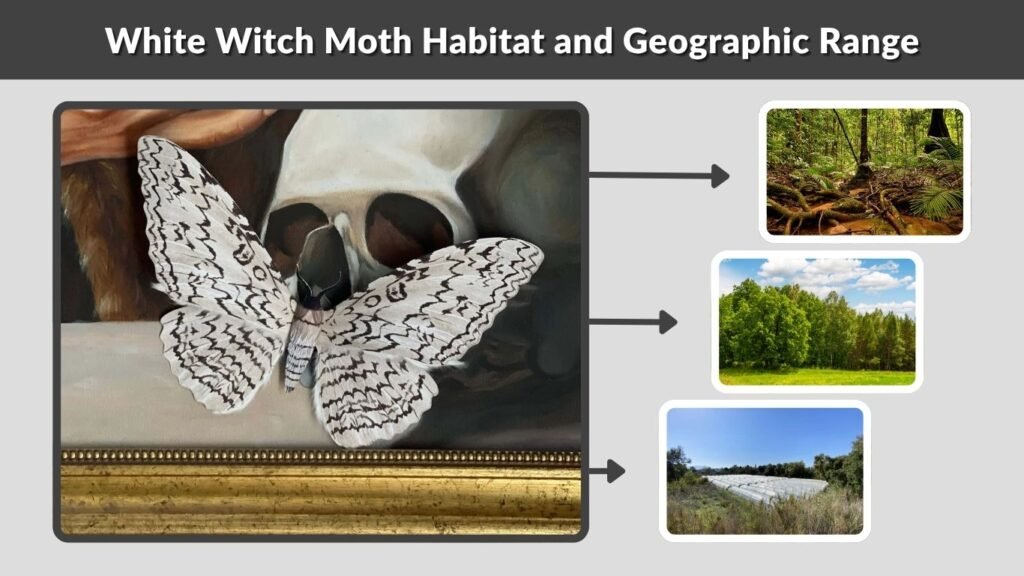
White witch moths inhabit the tropical and subtropical Americas. They are associated primarily with forested landscapes, but adults occasionally reach settlements, botanical gardens, and buildings near suitable habitat.
Where Do White Witch Moths Live?
Their range extends from Mexico through Central America and across much of South America. Records include:
- Mexico
- Costa Rica
- Panama
- Nicaragua
- Suriname
- French Guiana
- Brazil
- Colombia
- Ecuador
- Peru
- Bolivia
- Uruguay
Individuals are occasionally reported as far north as southern Texas. These are considered rare wanderers rather than evidence of a widespread resident population in the United States.
White Witch Moths in Costa Rica
Costa Rica offers suitable humid forests and warm temperatures for this species. Adults are occasionally found resting on buildings, vegetation, or tree trunks near forest edges. They may also visit artificial lights during the night.
Their pale patterned wings provide excellent camouflage against lichen-covered bark. A resting moth can remain unnoticed even when it is directly in front of an observer.
Habitat and Temperature
White witch moths are associated with warm tropical or subtropical conditions. Suitable habitats may include:
- Lowland rainforest
- Humid tropical forest
- Forest edges and clearings
- Wooded foothills
- Gardens near natural forest
- Buildings surrounded by dense vegetation
There is no well-established captive temperature range for this poorly studied species. Its presence across different elevations and regions suggests some climatic flexibility, but it should not be treated as a conventional pet moth.
White Witch Moth Behavior and Diet
The white witch is primarily nocturnal. During daylight, it rests flat against tree trunks, walls, or other broad surfaces. Its lines and patches visually break up the outline of its wings, helping it avoid birds and other predators.
Nighttime Behavior
At night, adults may:
- Fly through and above the forest canopy
- Travel considerable distances
- Search for mates
- Visit illuminated buildings
- Rest near streetlights or moth sheets
- Fly rapidly when disturbed
Its size can cause it to be mistaken for a bird or bat in low light. Although adults are attracted to some artificial lights, they may remain high in the canopy and can be difficult to locate.
What Does a White Witch Moth Eat?
The caterpillar must consume plant material and store energy for metamorphosis. However, the confirmed natural host plants of Thysania agrippina remain uncertain. Woody legumes, possibly plants related to Senna or Cassia, have been proposed because close relatives use them.
The adult diet is also insufficiently documented. Claims that adults definitely drink nectar, sap, or fruit juices—or do not feed at all—should be treated cautiously until the mouthparts and feeding behavior are better studied.
Caterpillar, Pupa and Life Cycle
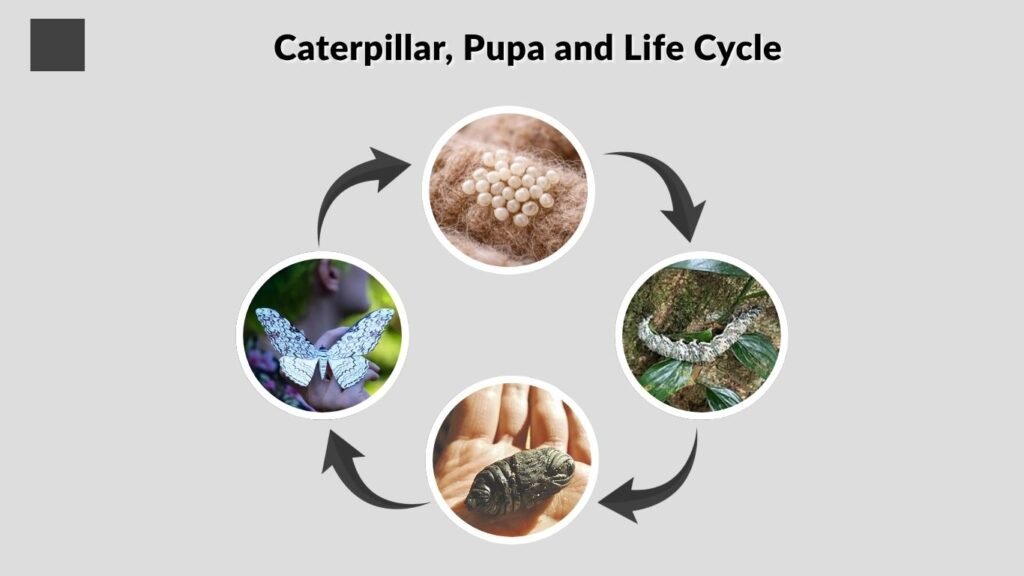
The white witch undergoes complete metamorphosis through egg, caterpillar, pupa, and adult stages. Remarkably, the immature stages have remained mysterious for centuries despite the adult moth’s fame and extensive range.
White Witch Moth Caterpillar
For many years, published images claiming to show the white witch caterpillar were unreliable. A famous illustration created by naturalist Maria Sibylla Merian in the early 1700s paired the adult with what researchers later recognized as an unrelated hawk moth caterpillar.
A caterpillar found in Panama in 2025 was reportedly reared and linked to the white witch, representing an important step toward documenting the real larval stage. Nevertheless, peer-reviewed descriptions of its appearance, behavior, and host plant remain limited. Images online should therefore be checked carefully before being labeled as T. agrippina.
White Witch Moth Pupa
The caterpillar eventually stops feeding and transforms into a pupa. Details about the natural pupation site, cocoon construction, duration, and seasonal timing remain poorly established.
Related large erebid moths may pupate among leaves or near the ground, but their behavior should not automatically be attributed to the white witch. More field observations are needed to document this stage accurately.
Lifespan
The complete lifespan of the white witch moth has not been firmly determined. Temperature, rainfall, elevation, food quality, and seasonal conditions would all affect its development.
It is reasonable to expect the caterpillar stage to occupy much of the life cycle, but frequently repeated claims that the adult lives for a particular number of days lack strong species-specific evidence.
White Witch Moth Meaning and Symbolism
The name, nocturnal behavior, enormous size, and ghostlike coloration have inspired modern symbolic interpretations. However, the species does not have one universal meaning across every culture.
Common Modern Meanings
The white witch moth may symbolize:
- Personal transformation
- Mystery and hidden knowledge
- Intuition
- Spiritual change
- Beauty within darkness
- Adaptability and camouflage
- Quiet strength
- New beginnings
Some meanings associated with the black witch moth are incorrectly transferred to the white witch. Folklore varies considerably by country, community, and individual belief.
White Witch Moth Tattoo Meaning
A white witch moth tattoo may represent transformation, spiritual growth, survival, or attraction to the unknown. Its patterned wings also work well in symmetrical tattoo designs.
The meaning is personal rather than fixed. Moon phases, flowers, eyes, stars, or forest imagery can alter the symbolism of the design.
Framed White Witch Moths for Sale
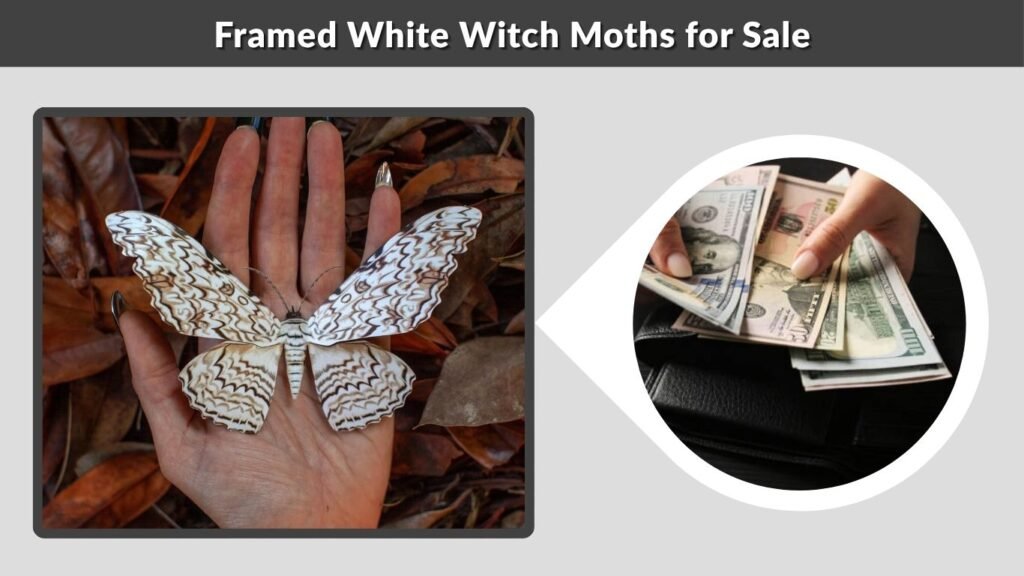
White witch specimens are sometimes sold framed or mounted as decorative taxidermy. Their size and pale patterns make them desirable to collectors, but buyers should consider legality and sourcing.
Buying Responsibly
Before purchasing a specimen:
- Ask whether it was captive-bred or legally collected.
- Request clear species and origin information.
- Check wildlife import and export requirements.
- Avoid sellers unable to explain their sourcing.
- Inspect photographs for broken wings or incorrect identification.
- Confirm that the frame protects against moisture and pests.
- Consider high-quality replicas or artwork instead of a real specimen.
The availability of a moth online does not guarantee that shipping or importing it is legal in every country.
FAQs
What is the scientific name of the white witch moth?
Its scientific name is Thysania agrippina. It belongs to the family Erebidae and order Lepidoptera.
How big is a giant white witch moth?
The largest verified specimen measured 30.8 cm, or slightly more than 12 inches, across its extended wings.
Is a white witch moth bigger than an Atlas moth?
It can have a greater wingspan. However, the Atlas moth has broader wings and is often considered larger by overall size.
Where can you find white witch moths?
They occur from Mexico through Central America and much of South America. Rare wandering individuals have reached southern Texas.
How long does a white witch moth live?
Its exact larval, pupal, and adult lifespans have not been established reliably. Specific lifespan figures found online are generally estimates rather than well-documented biological data.
