
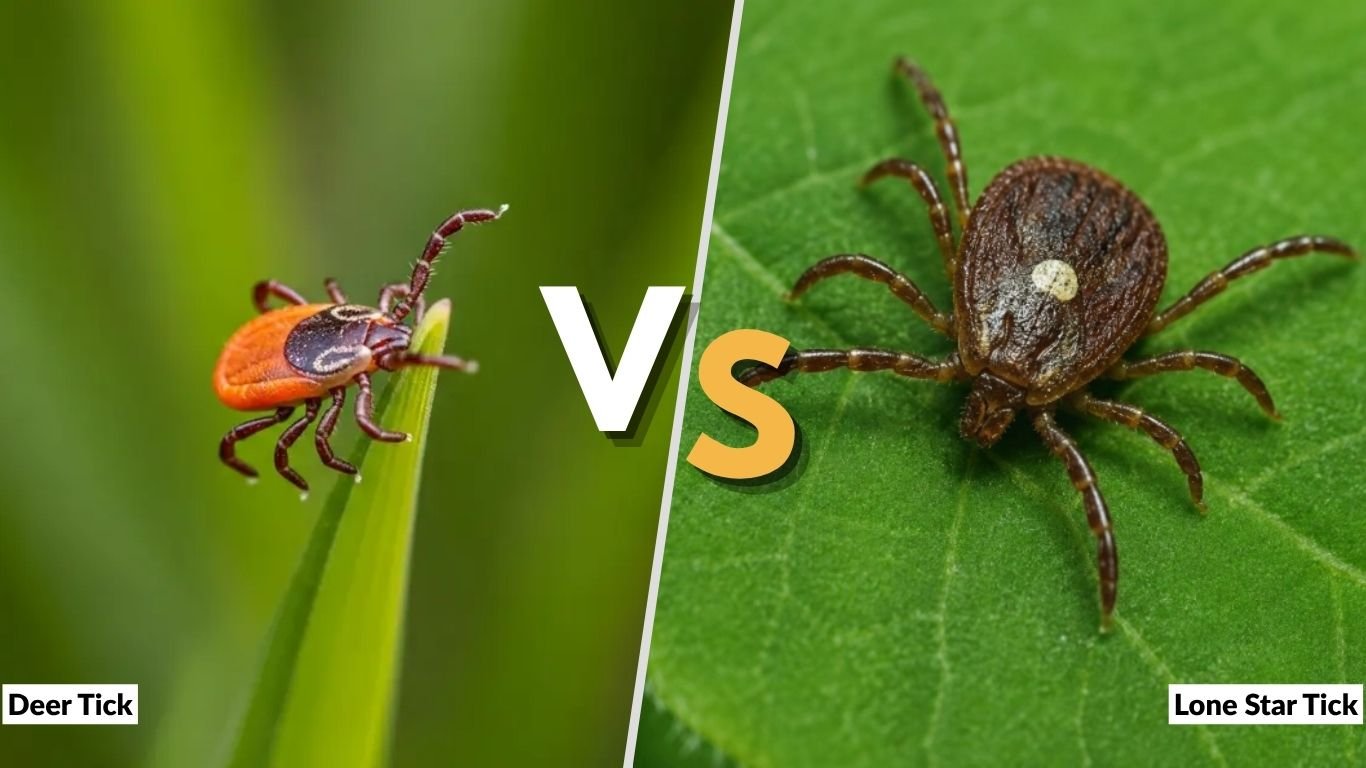
The deer tick vs lone star tick comparison is important because both species bite humans but differ in appearance, geographic range, behavior, and the illnesses associated with them. Deer ticks, more commonly called blacklegged ticks, are major vectors of Lyme disease. Lone star ticks do not transmit Lyme disease bacteria but can spread ehrlichiosis and other infections, and their bites are associated with alpha-gal syndrome. Learning their markings, size, and habitat can help you identify a tick after outdoor exposure.
Deer Tick vs Lone Star Tick: Quick Comparison
The deer tick and lone star tick are both hard ticks, but they belong to different genera. The eastern blacklegged tick is Ixodes scapularis, while the lone star tick is Amblyomma americanum. Adult females are relatively easy to distinguish, but nymphs can be much more difficult because both are very small.
| Feature | Deer Tick | Lone Star Tick |
| Scientific name | Ixodes scapularis | Amblyomma americanum |
| Other name | Blacklegged tick | Lone star tick |
| Adult female marking | Dark shield with reddish-brown abdomen | Single white dot on back |
| Legs | Very dark/black | Brown |
| Main range | Eastern U.S., especially Northeast and Upper Midwest | Eastern U.S., especially the South |
| Lyme disease | Yes, important vector | No |
| Ehrlichiosis | Some species/agents possible | Important vector |
| Alpha-gal association | Not primary U.S. association | Strongly associated |
| Behavior | Often waits for passing hosts | Particularly aggressive host seeker |
CDC identifies both among the tick species that commonly bite people in the United States.
How to Identify a Deer Tick
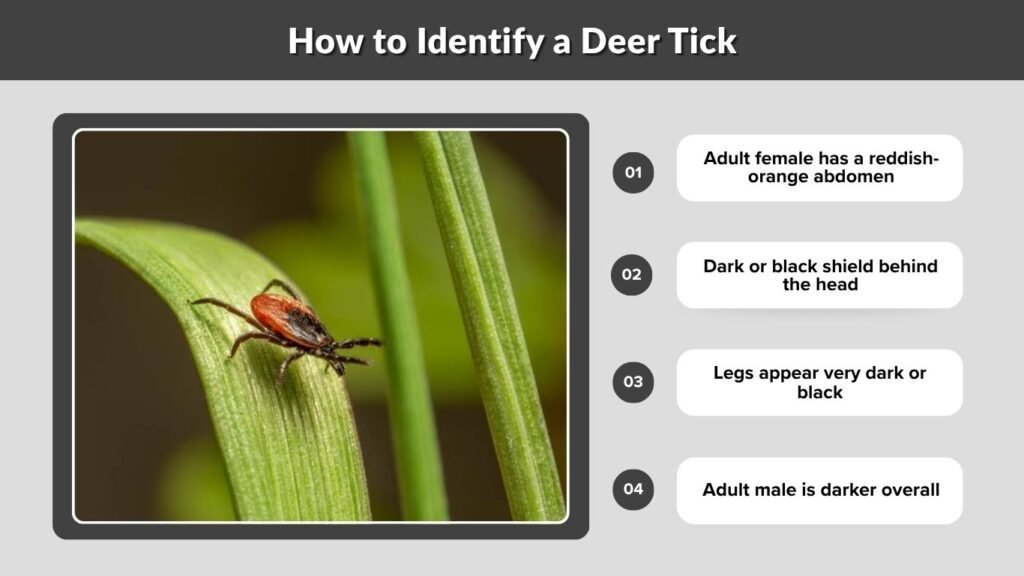
The term deer tick usually refers to the eastern blacklegged tick, Ixodes scapularis. It is widely distributed across the eastern United States and is particularly important medically because it transmits the bacteria responsible for Lyme disease.
Deer Tick Identification
- Adult female has a reddish-orange abdomen
- Dark or black shield behind the head
- Legs appear very dark or black
- Adult male is darker overall
- Nymphs are extremely small
- Body expands considerably after feeding
- Does not have a white central dot
Deer tick nymphs are especially difficult to notice because they are very small. Nymphs and adult females are the stages most commonly found biting people.
Where Are Deer Ticks Found?
Blacklegged ticks occur across much of the eastern United States. Human exposure is particularly important in the Northeast, mid-Atlantic, and Upper Midwest.
They commonly inhabit wooded environments, leaf litter, forest edges, brush, and yards located near suitable wildlife habitat.
How to Identify a Lone Star Tick
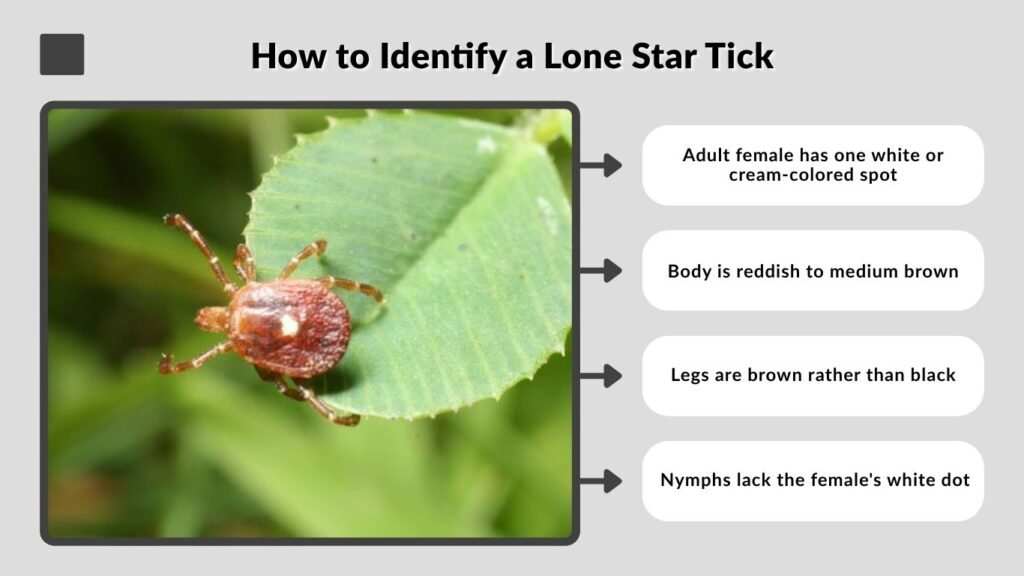
The lone star tick is also an important human-biting tick. Adult females are among the easiest North American ticks to recognize because of the distinct pale spot in the middle of the back.
Lone star ticks occur throughout much of the eastern United States but are especially common in southern regions.
Lone Star Tick Identification
- Adult female has one white or cream-colored spot
- Body is reddish to medium brown
- Legs are brown rather than black
- Adult male has pale markings around the body margin
- Nymphs lack the female’s white dot
- Larvae are extremely tiny and have six legs
- Nymphs and adults have eight legs
Lone star ticks are considered particularly aggressive human biters and may actively move toward a potential host rather than simply remaining stationary.
Lone Star Tick Male vs Female
Male and female lone star ticks can look surprisingly different. The familiar white “lone star” marking belongs specifically to the adult female.
Male vs Female Identification
Female: The adult female has a distinct single white or pale spot near the center of her back. Before feeding, much of the rest of her body is reddish brown.
Male: The adult male lacks one central white dot. Instead, he has pale or whitish markings positioned around portions of the outer body.
Therefore, finding a brown tick without a white central spot does not automatically mean it is not a lone star tick.
Lone Star Tick vs Deer Tick Size
Both species are small, and size alone is not a reliable identification method. Their size also changes dramatically after feeding.
Size Differences
Adult lone star ticks generally appear somewhat larger and broader than blacklegged ticks. However, their nymphs can be tiny and difficult to distinguish without magnification.
An unfed tick may look only a few millimeters across, while an engorged female becomes much larger after taking a blood meal.
For identification, markings, leg coloration, body shape, location, and life stage are more useful than size alone.
Deer Tick vs Lone Star Tick Diseases
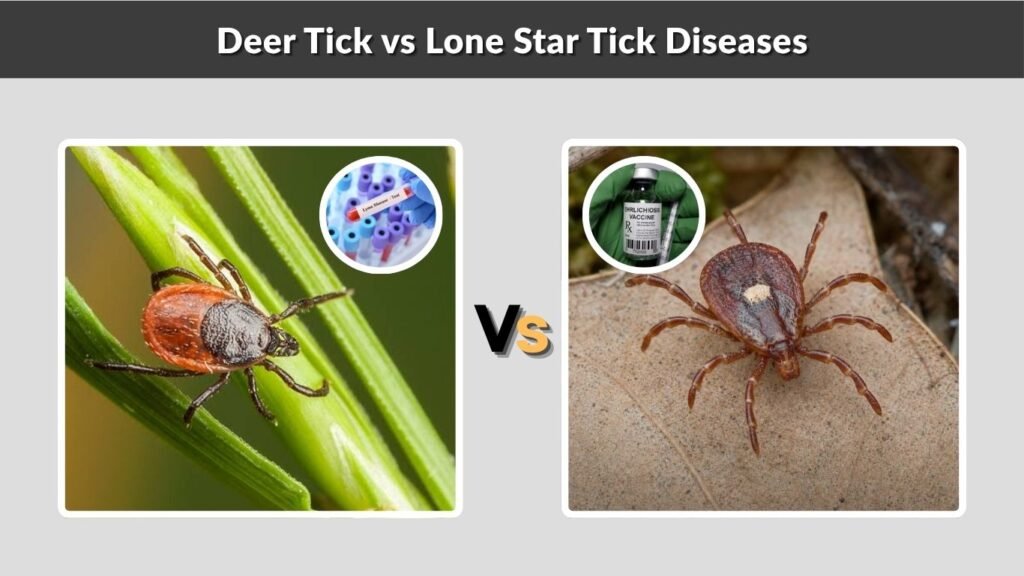
The medical differences between these ticks are particularly important. Although both can transmit disease, they are associated with different pathogens.
Diseases Associated With Deer Ticks
Blacklegged ticks can transmit pathogens that cause:
- Lyme disease
- Anaplasmosis
- Babesiosis
- Powassan virus disease
- Borrelia miyamotoi disease
- Certain forms of ehrlichiosis
The blacklegged tick is an important vector of the bacteria that cause Lyme disease.
Diseases Associated With Lone Star Ticks
Lone star ticks are associated with:
- Ehrlichiosis
- Tularemia
- Heartland virus disease
- Bourbon virus disease
- Southern tick-associated rash illness (STARI)
- Alpha-gal syndrome following some bites
Importantly, lone star ticks are not considered vectors of the bacteria responsible for Lyme disease.
Lone Star Tick vs Dog Tick
The American dog tick (Dermacentor variabilis) is another common species that can be confused with lone star ticks. It is also frequently called a wood tick in some regions.
Main Differences
- Lone star female: one central white spot
- Dog tick female: larger pale or silvery pattern behind the head
- Lone star male: pale markings around the outer edge
- Dog tick male: extensive cream and brown mottling
- Lone star tick: associated strongly with ehrlichiosis
- American dog tick: can transmit Rocky Mountain spotted fever and tularemia
American dog ticks occur widely east of the Rocky Mountains. CDC notes that adult females are the stage most likely to bite humans.
Lone Star Tick vs Wood Tick
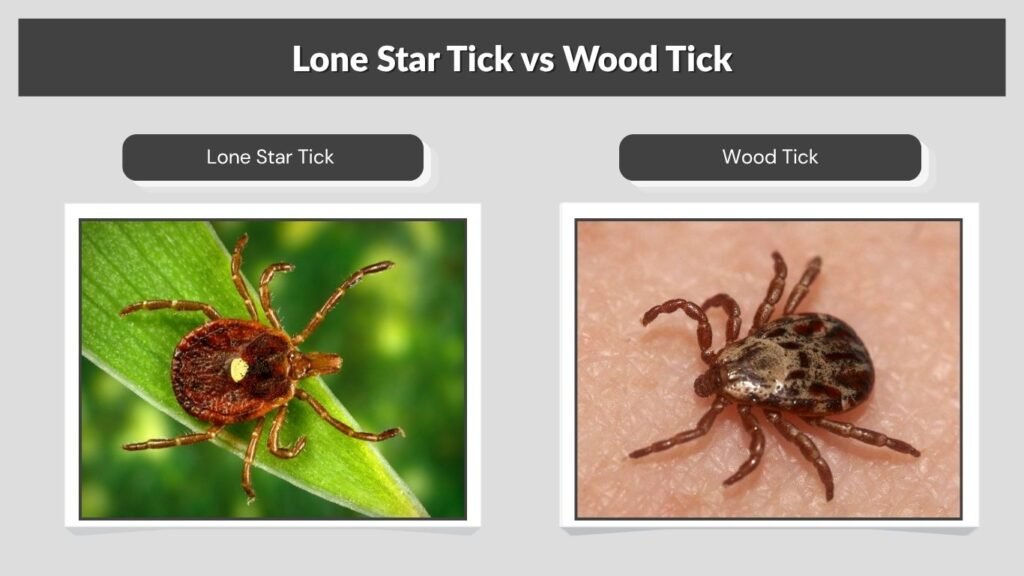
“Wood tick” is a common name rather than one precise species. In many eastern parts of the United States, people use it for the American dog tick. In western areas, the term may refer to the Rocky Mountain wood tick (Dermacentor andersoni).
The Rocky Mountain wood tick occurs mainly in western regions and is a vector of Colorado tick fever virus.
How to Tell Them Apart
A female lone star tick has one clean white spot. Wood ticks in the genus Dermacentor generally show larger cream, gray, or whitish ornamental patterns.
Knowing where the tick was encountered can also help narrow down the identification.
Lone Star Tick vs Asian Longhorned Tick
The Asian longhorned tick (Haemaphysalis longicornis) is an invasive species now found in parts of the United States. It is generally brown without the lone star female’s distinctive white dot.
Another major difference is reproductive biology: some populations of Asian longhorned ticks can reproduce without mating, allowing populations to grow quickly.
CDC notes that Asian longhorned ticks are known to bite people in the United States, although their role in transmitting human pathogens in the U.S. differs from that of established vectors such as blacklegged and lone star ticks.
Lone Star Tick vs “Regular Tick”
There is no scientific species called a regular tick. North America contains numerous tick species, each with different markings, ranges, hosts, and disease risks.
If you find an attached tick, useful identification features include its body pattern, leg color, size, location where it was encountered, and whether it appears engorged.
Common Human-Biting Ticks Include
- Lone star tick
- Blacklegged/deer tick
- American dog tick
- Rocky Mountain wood tick
- Brown dog tick
- Gulf Coast tick
- Western blacklegged tick
- Asian longhorned tick
Correct identification can be useful because different species are associated with different health risks.
Which Tick Is More Dangerous?
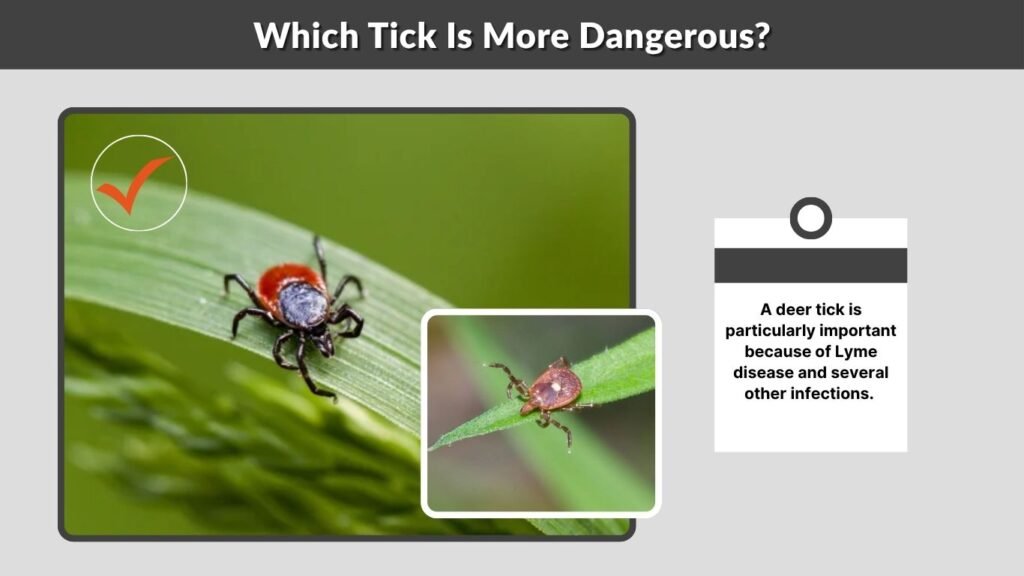
There is no single answer because risk depends on location, whether the tick carries a pathogen, how long it remains attached, and the individual who is bitten.
A deer tick is particularly important because of Lyme disease and several other infections. Lone star ticks are important because they can transmit ehrlichiosis and other pathogens and are associated with alpha-gal syndrome.
The safest approach is to prevent bites from all tick species rather than focusing on only one.
FAQs
Is a deer tick the same as a blacklegged tick?
Yes. “Deer tick” is a commonly used name for the eastern blacklegged tick, Ixodes scapularis.
Which has a white dot, deer tick or lone star tick?
The adult female lone star tick has the distinctive single white dot. Female deer ticks do not.
Does a lone star tick cause Lyme disease?
No. Lone star ticks are not considered vectors of the bacteria that cause Lyme disease. Blacklegged ticks are the important Lyme disease vectors in the eastern United States.
Is a dog tick bigger than a lone star tick?
Adult American dog ticks can appear larger and broader, but size varies with sex, life stage, and whether the tick has fed. Markings are more useful for identification.
Is a lone star tick the same as a wood tick?
No. “Wood tick” commonly refers to an American dog tick or Rocky Mountain wood tick depending on the region. Lone star ticks belong to a different genus and have different markings and disease associations.
