
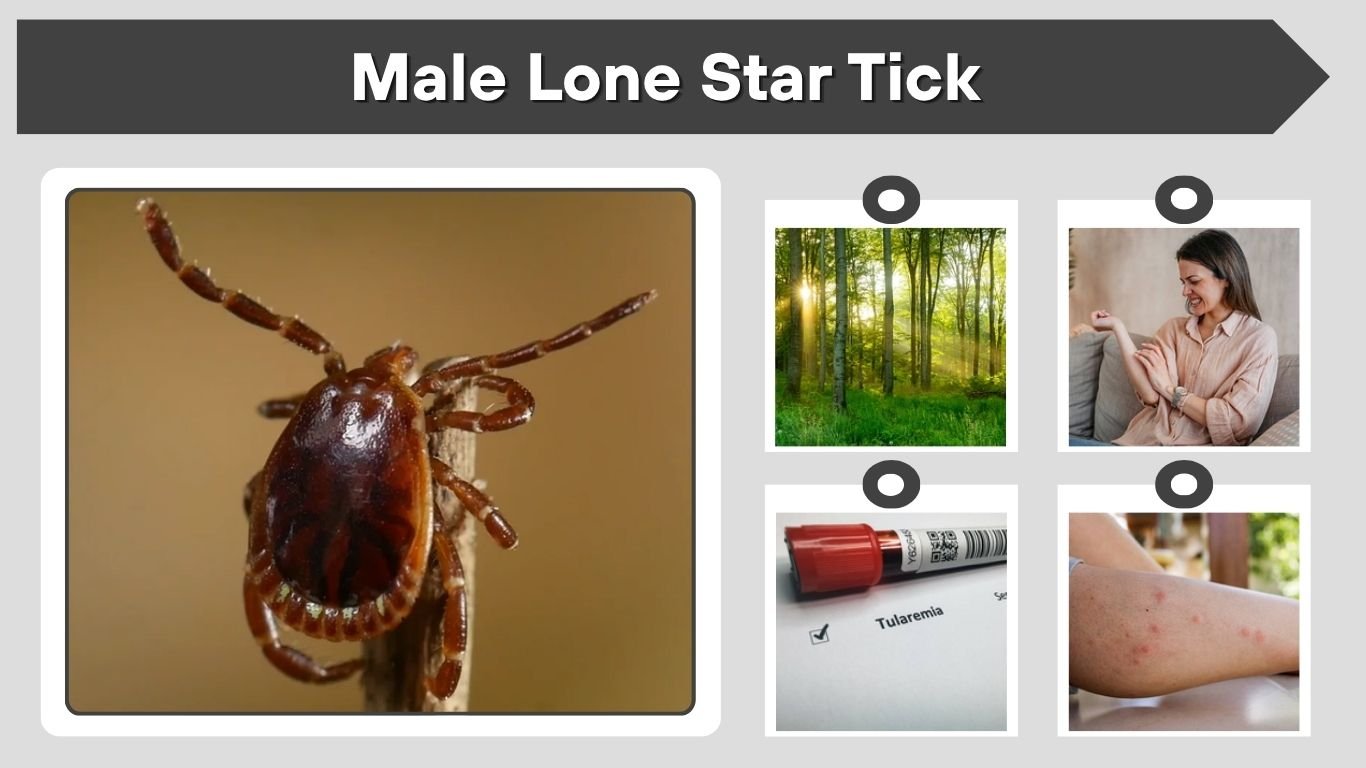
The male lone star tick (Amblyomma americanum) is a reddish-brown hard tick found across much of the eastern United States. Unlike the adult female, the male does not have one obvious white “lone star” dot in the center of its back. Instead, males often display pale streaks or markings around the edges of the body. Male lone star ticks can attach to hosts and take blood meals, although they feed differently from females and do not become dramatically engorged. Understanding these differences can make identification much easier.
What Does a Male Lone Star Tick Look Like?
Adult male lone star ticks are generally dark reddish-brown with a flattened, oval body. Their appearance is less distinctive than that of females, which is why males can easily be mistaken for other brown tick species.
The male’s hard dorsal shield, called the scutum, covers almost the entire upper surface of its body. In females, this shield covers only the front portion, allowing the abdomen to expand dramatically during feeding.
Male Lone Star Tick Identification
- Scientific name: Amblyomma americanum
- Color: Dark reddish-brown
- Body: Oval and relatively flat when unfed
- Legs: Eight as an adult
- Scutum: Covers almost the entire back
- White markings: Often several pale or whitish streaks near the margins
- Central white dot: Usually absent
- Mouthparts: Relatively long compared with some other common ticks
- Festoons: Small divisions visible along the rear edge of the body
Penn State notes that males commonly have about four whitish or off-white markings toward the corners of the scutum, although these markings can sometimes be faint or absent.
Male vs Female Lone Star Tick
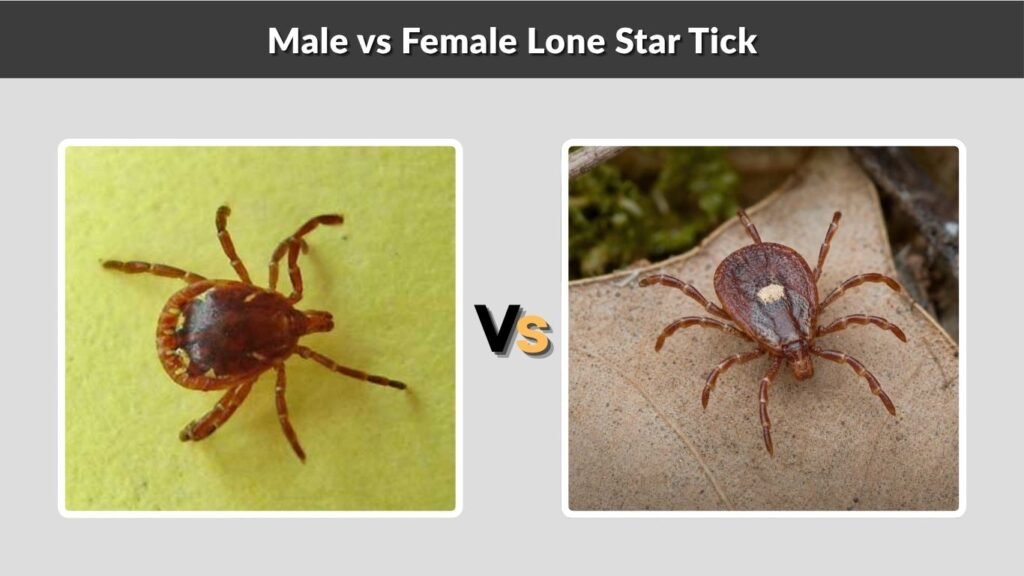
Male and female lone star ticks belong to the same species but look noticeably different once they reach adulthood.
The female is much easier to recognize because she carries the famous white spot that gives the species its common name. The male has more subtle pale markings instead.
Male and Female Differences
Male lone star tick: Usually reddish-brown with pale markings around the back. The hard scutum covers nearly the entire upper body.
Female lone star tick: Usually reddish-brown with one distinctive white or cream-colored spot near the center of the scutum.
The female’s smaller scutum allows her abdomen to expand enormously while taking a blood meal. The male’s much larger scutum limits this expansion.
Does the Male Have a Lone Star Spot?
Usually, no.
The characteristic single white star belongs to the adult female. A male instead may have several small cream or white streaks around the outer portions of his back.
This is one reason people sometimes overlook male lone star ticks when checking themselves after outdoor activities.
Can Male Lone Star Ticks Bite?
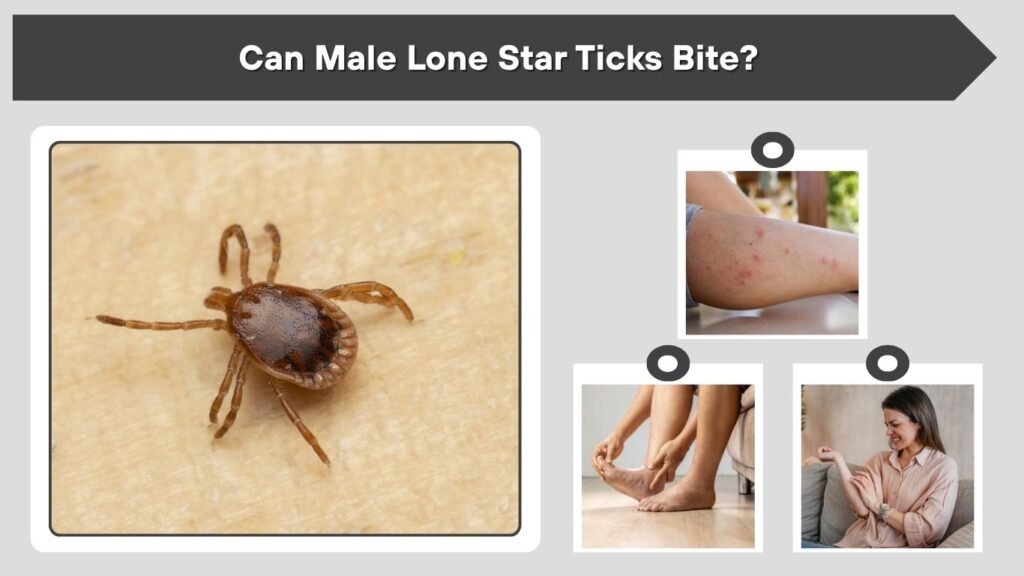
Yes. Male lone star ticks can attach to hosts and feed on blood.
Research on lone star ticks confirms that males take blood meals, typically feeding multiple times for shorter periods than females. Females remain attached much longer while preparing for egg production.
Male Lone Star Tick Bite
A bite may cause:
- Small red area
- Local itching
- Tenderness
- Mild swelling
- Skin irritation
- A small bump after removal
Lone star tick saliva itself can irritate the skin, so mild redness around the attachment site does not automatically mean an infection has occurred.
CDC notes that nymphs and adult females bite humans most frequently, but males can also attach and bite.
Does a Male Lone Star Tick Get Engorged?
Male lone star ticks feed, but they generally do not become large and balloon-like the way females do.
The difference is mainly structural. A male’s scutum covers almost the entire back, preventing extensive expansion. The female’s smaller scutum leaves most of her abdomen free to stretch as she consumes a large blood meal.
Engorged Male vs Female
- Male takes relatively small blood meals.
- Male may become somewhat fuller after feeding.
- Male usually remains recognizable as a flattened tick.
- Females can enlarge dramatically.
- Females may remain attached for many days while feeding.
- A fully fed female can become many times larger than when unfed.
Therefore, a small reddish-brown tick that remains relatively flat despite being attached could still be an adult male lone star tick.
Male Lone Star Tick Size
Male lone star ticks are small enough to be overlooked on clothing or skin. Adults are only several millimeters long when unfed.
Size should not be used as the only identification feature because individual ticks vary and feeding affects their appearance.
What to Look for Instead of Size
Look for the combination of a reddish-brown body, long mouthparts, festoons, eyes, and pale markings along the edges of the scutum.
Adult males can also be confused with small American dog ticks or other Amblyomma ticks, making close examination useful.
Where Are Male Lone Star Ticks Found?
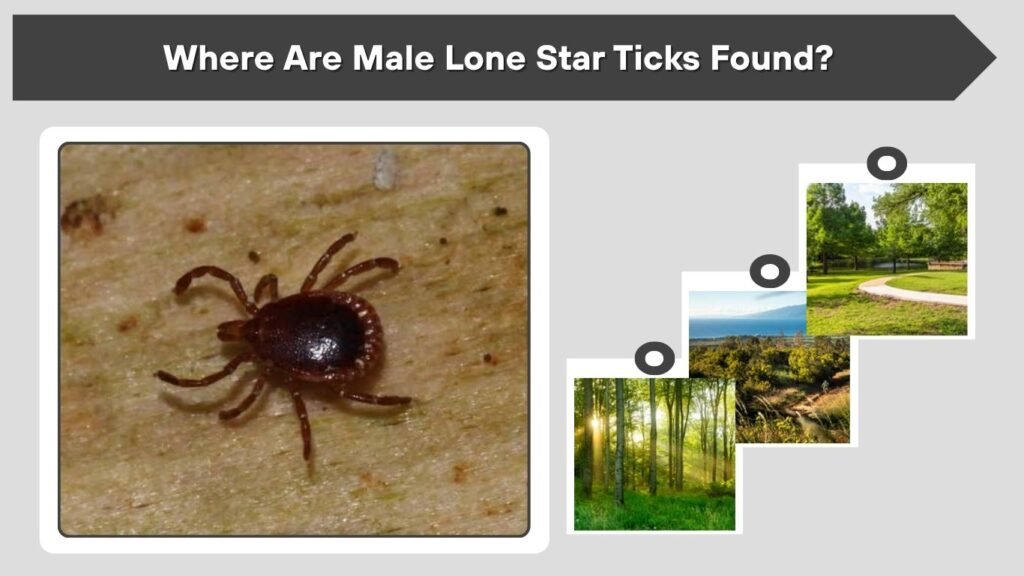
Male and female lone star ticks share the same general range. CDC reports that the species is widely distributed across the Northeast, South, and Midwest United States, with established populations documented across a growing geographic area.
Common Habitats
Male lone star ticks may occur in:
- Deciduous forests
- Forest edges
- Brushy areas
- Tall vegetation
- Hiking trails
- Parks
- Overgrown yards
- Hunting areas
- Areas with abundant deer
- Woodland paths used by mammals
Adult lone star ticks commonly feed on medium and large mammals, particularly deer and other wildlife. People and companion animals can become accidental hosts.
Are Male Lone Star Ticks Dangerous?
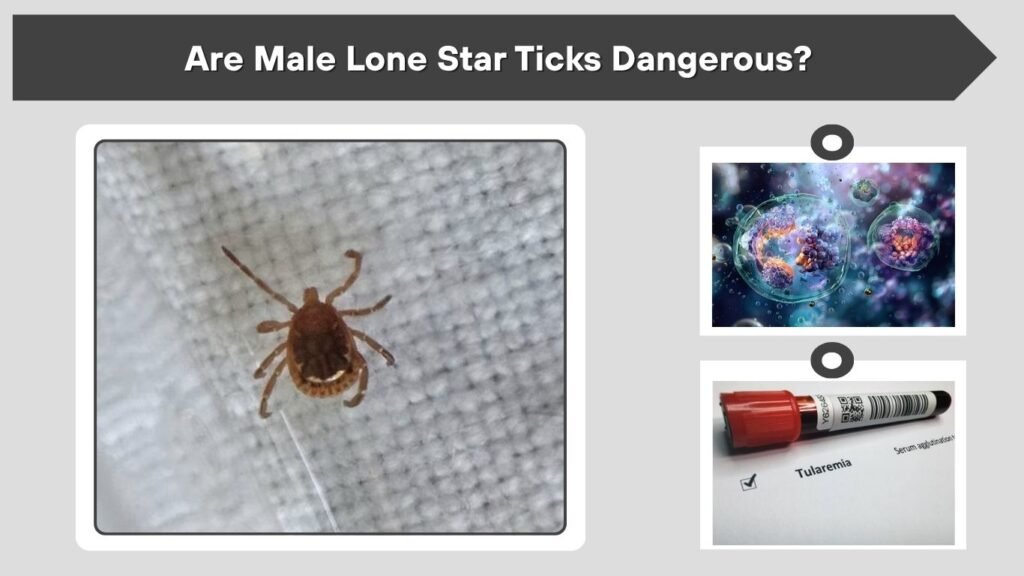
A male lone star tick should not be ignored simply because males feed less dramatically than females.
Lone star ticks are associated with several medically important pathogens. The species can transmit bacteria that cause ehrlichiosis, along with agents associated with tularemia, Heartland virus disease, and Bourbon virus disease.
Diseases Associated With Lone Star Ticks
- Ehrlichiosis
- Tularemia
- Heartland virus disease
- Bourbon virus disease
- Southern tick-associated rash illness (STARI)
A recent CDC-published report documented STARI-like illness after an adult male lone star tick was removed from a patient, confirming that males can attach to and bite humans.
The presence of a tick does not mean disease transmission occurred. Risk depends on factors such as whether the tick carried a pathogen and details of the feeding event.
Can Male Lone Star Ticks Cause Alpha-Gal Syndrome?
In the United States, bites from lone star ticks are strongly associated with alpha-gal syndrome (AGS), an allergy to alpha-gal, a sugar found in most mammals.
CDC does not limit this association specifically to female lone star ticks. Because male lone star ticks do bite and use saliva while feeding, a male bite should not be assumed to carry zero alpha-gal risk.
However, not everyone bitten by a lone star tick develops AGS, and researchers are still studying exactly why the condition develops in some people and not others.
Male Lone Star Tick vs Nymph
A tiny lone star tick without a central white spot is not necessarily a male. It could also be a nymph.
How They Differ
Adult males are larger, sexually mature ticks with a hardened scutum covering nearly the entire back. Nymphs are smaller immature ticks without the adult male’s typical marginal pattern.
Both have eight legs, unlike larvae, which have six.
Because lone star nymphs are very small and frequently bite humans, identification can be difficult without magnification.
What to Do If a Male Lone Star Tick Is Attached
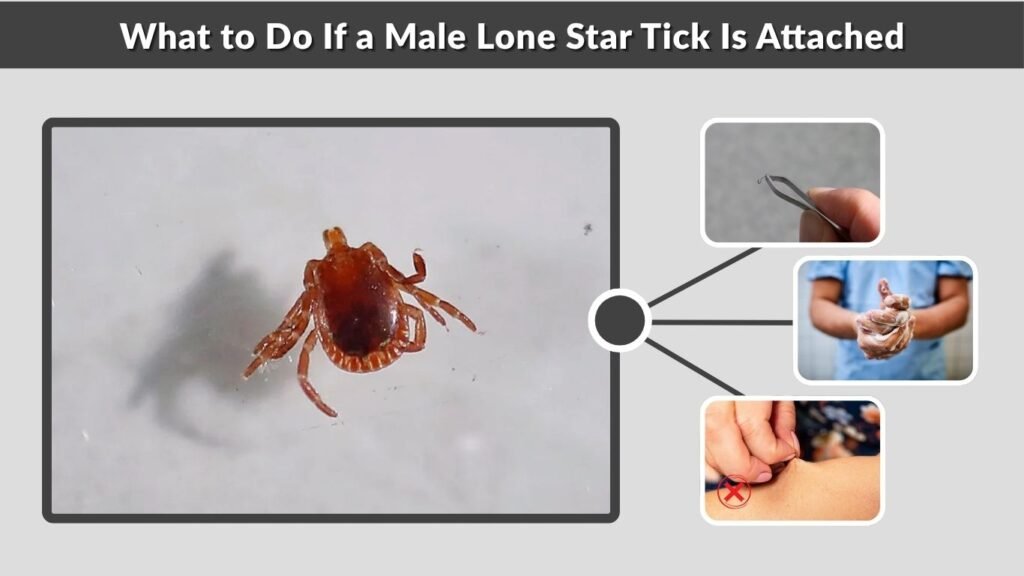
Remove an attached tick as soon as you discover it.
Safe Removal Steps
- Use clean, fine-tipped tweezers.
- Grasp the tick close to the skin.
- Pull upward with steady, even pressure.
- Avoid twisting or crushing the tick.
- Clean your hands and the bite area afterward.
- Record the date of the bite.
- Watch for fever, rash, headache, muscle aches, or other unusual symptoms.
If symptoms develop after the bite, tell a healthcare provider when the tick exposure occurred and, if known, that it appeared to be a lone star tick.
FAQs
Do male lone star ticks bite humans?
Yes. Adult males can attach and take blood meals, although nymphs and adult females are reported to bite people more frequently.
What does a male lone star tick look like?
It is usually reddish-brown and lacks the female’s single central white dot. Instead, it may have several pale or whitish streaks around the outer portions of the back.
Can male lone star ticks become engorged?
They feed on blood but do not expand dramatically like females because their large scutum covers most of the abdomen.
Can a male lone star tick cause meat allergy?
Lone star tick bites are strongly associated with alpha-gal syndrome in the United States. CDC does not describe the risk as limited only to female ticks, so male bites should not be considered risk-free.
What is the easiest way to tell male and female lone star ticks apart?
Look at the back. An adult female normally has one obvious white dot, while an adult male generally has several smaller pale markings around the margins rather than a single central spot.
