
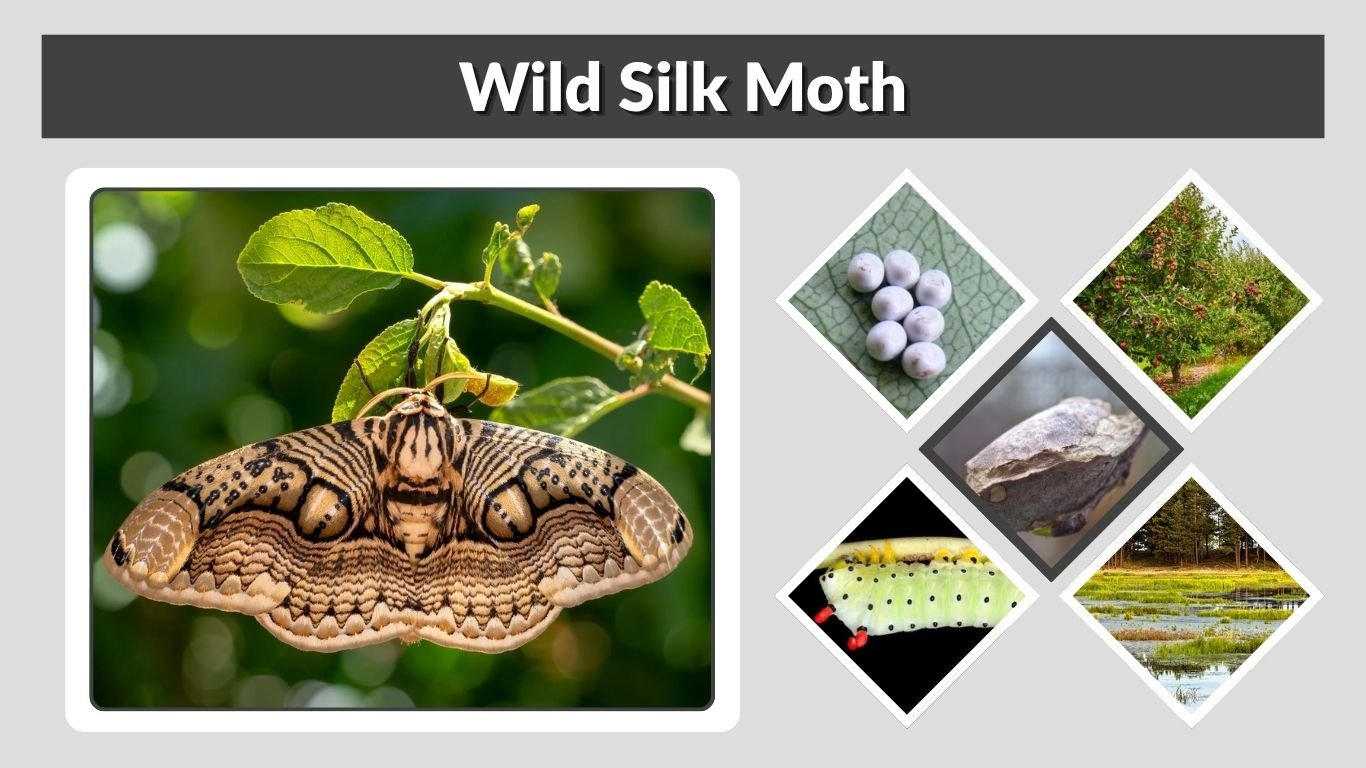
Wild silk moths are large, beautiful insects known for their colorful wings and silk-producing caterpillars. Unlike domesticated silkworm moths, they survive independently in forests, grasslands, and other natural habitats. The name commonly includes giant moths in the Saturniidae family, although certain unrelated moths also produce commercially useful wild silk. Their fascinating transformation involves leaf-eating caterpillars, protective cocoons, and short-lived adults whose primary purpose is reproduction. Species occur throughout North America, Africa, Asia, and other regions.
What Is a Wild Silk Moth?
A wild silk moth is a moth whose caterpillar produces silk and completes its life cycle without depending on human care. The term is most often associated with giant saturniid moths, including luna, cecropia, atlas, and polyphemus moths. However, some commercially harvested wild silks come from moths belonging to other families.
Wild Silk Moth Identification
Wild silk moth species vary considerably, but many share the following characteristics:
- Large or exceptionally broad wings
- Thick, hairy-looking bodies
- Feathered antennae, especially in males
- Colorful lines, patches, or transparent eyespots
- Strong-flying males that search for females
- Large caterpillars that feed on trees or shrubs
- Tough silk cocoons surrounding their pupae
- Adults that are mostly active after dark
The eyespots found on many species may startle predators or direct attacks away from the moth’s body. Males generally have broader antennae that detect the chemical signals released by females.
Are There Still Wild Silk Moths?
Wild silk moths still exist on several continents. Some can be locally common, although adults are not always easy to find because they are nocturnal and live for only a short time. Caterpillars and cocoons may remain hidden in vegetation, leaf litter, or tree branches.
Populations can vary between seasons according to weather, food availability, predators, parasites, artificial lighting, and habitat conditions. Consequently, failing to see them does not necessarily mean they have disappeared from an area.
Types of Wild Silk Moths
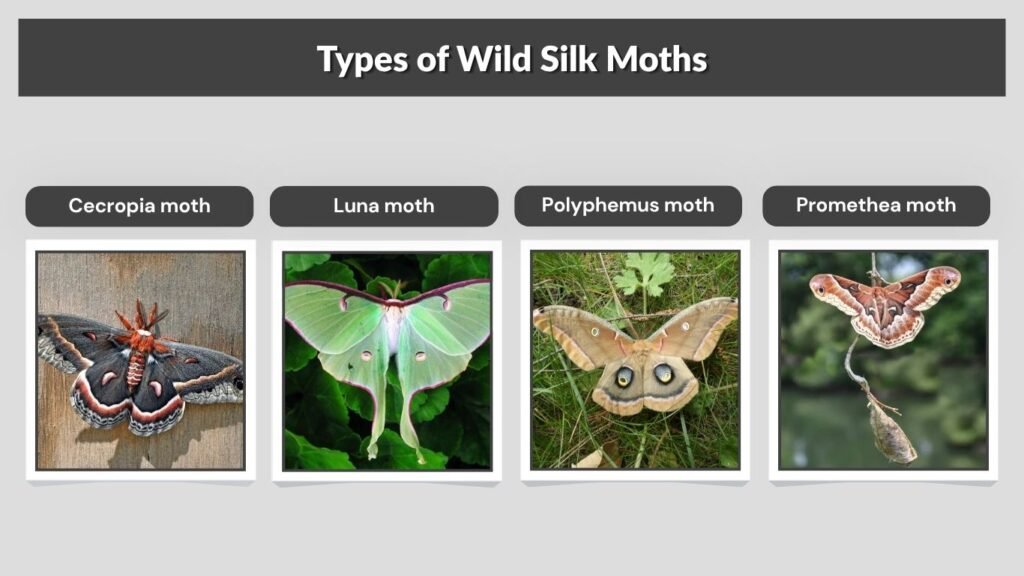
Wild silk moth diversity extends far beyond the familiar domesticated silkworm. Giant saturniids include some of the world’s largest moths, while other wild silk producers are valued for their durable or naturally colored fibers. Their appearance, host plants, flight season, and geographic distribution depend on the species and surrounding climate.
Wild Silk Moths of North America
Notable North American species include:
- Cecropia moth: North America’s largest native moth, with red, white, black, and brown markings
- Luna moth: A pale-green species recognized by its long hindwing tails
- Polyphemus moth: A brown moth with large eyespots on its hindwings
- Promethea moth: A strongly dimorphic species in which males and females look noticeably different
- Io moth: A yellow or brown species with prominent black-and-blue eyespots
- Imperial moth: A large yellow moth covered with pinkish-brown or purple markings
- Royal walnut moth: The adult form of the large caterpillar called the hickory horned devil
- Rosy maple moth: A smaller saturniid with distinctive pink and yellow coloring
These species occupy forests, woodlands, suburban landscapes, and areas containing suitable host trees.
Giant Wild Silk Moths
The term “giant wild silk moth” generally refers to large members of Saturniidae. Some species have impressive wingspans, but their large size does not make them dangerous. Adults cannot sting, and they pose no threat to people, pets, furniture, or stored food.
Famous examples include the atlas moth of Asia, the cecropia moth of North America, and the African moon moth. Their wing patterns frequently provide camouflage or mimic features that may discourage predators.
African Wild Silk Moths
Africa supports numerous silk-producing moths, including Gonometa species and giant saturniids. The caterpillars of Gonometa postica feed on trees such as acacias and produce tough cocoons from which naturally colored silk can be collected.
Wild-silk production may provide supplementary income for rural communities when moth populations and host trees are managed responsibly. The caterpillars of some African species possess defensive spines, so they should be observed without being handled directly.
Wild Silk Moth Life Cycle
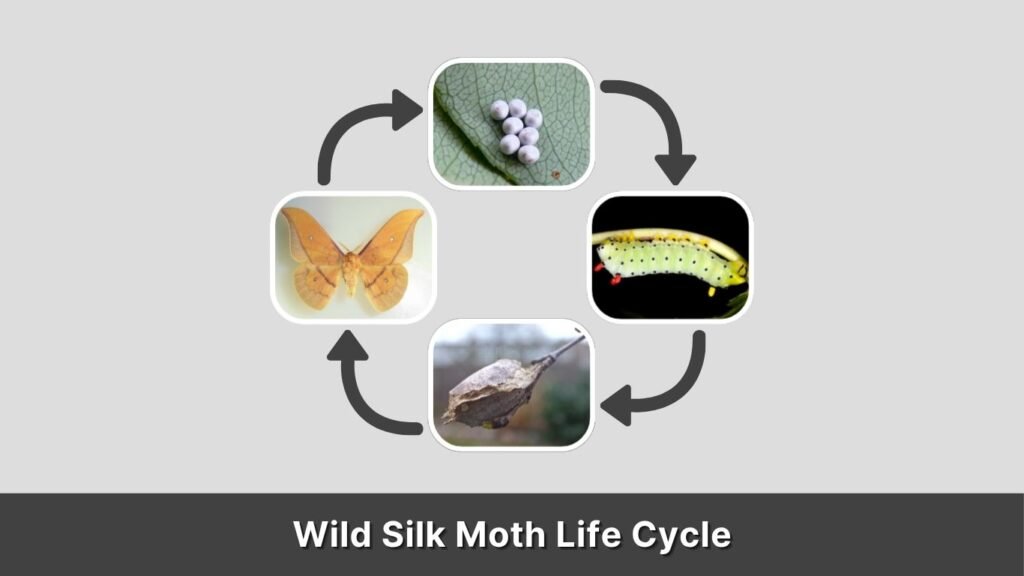
Wild silk moths experience complete metamorphosis consisting of four distinct stages: egg, larva, pupa, and adult. Most feeding and physical growth occur during the caterpillar stage. Seasonal timing differs among species, with some producing one generation annually and others completing multiple generations in warmer climates.
Eggs and Caterpillars
After mating, the female deposits eggs on or near an appropriate host plant. The young caterpillars hatch and begin consuming leaves. They pass through several growth stages called instars, shedding their skin each time their expanding bodies become too large for it.
Wild silk moth caterpillars can become surprisingly large. Many are green and blend with foliage, while others possess colorful knobs, hairs, or spines. Their appearance may discourage predators or help them remain concealed among leaves.
Wild Silk Moth Cocoon
When fully grown, the caterpillar produces silk from specialized glands and spins a protective cocoon. Depending on the species, the cocoon may be attached to a twig, wrapped inside a leaf, formed among vegetation, or concealed in leaf litter.
Inside, the caterpillar becomes a pupa and undergoes a dramatic transformation. A species living in a seasonal climate may remain inside its cocoon throughout winter before emerging when temperatures and daylight become favorable.
Adult Moth and Lifespan
After emerging, the adult expands and hardens its wings before flying. Many giant silk moths have reduced or nonfunctional mouthparts and therefore cannot eat as adults. They survive using energy stored during their caterpillar stage.
Adult life may last only several days to approximately two weeks, depending on species and conditions. Finding a mate and reproducing are the adult moth’s principal tasks. Some exceptionally short-lived giant silk moths survive for only four or five days as adults, according to the Smithsonian’s National Museum of Natural History.
Habitat and Diet of Wild Silk Moths
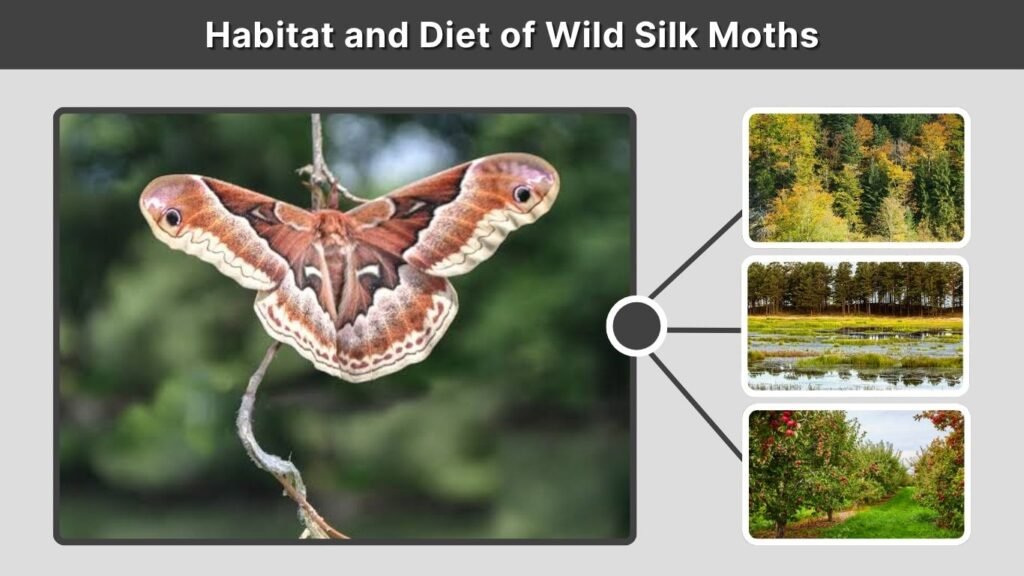
Wild silk moths need habitats containing the correct larval food plants, protected pupation sites, and suitable seasonal conditions. Because different caterpillars accept different plants, moth distribution often follows the availability of particular trees and shrubs. Adults may fly beyond the immediate habitat while searching for mates, but females return to suitable plants for laying eggs.
Common Wild Silk Moth Habitats
Depending on the species, they may inhabit:
- Deciduous and mixed forests
- Tropical and subtropical woodlands
- Savannas containing suitable host trees
- Wetlands and forest edges
- Orchards and wooded farms
- Parks and suburban gardens
- Shrublands and mountain valleys
- Areas surrounding ponds, streams, or marshes
These moths do not live permanently inside houses. An adult attracted to a porch light usually leaves once given access to the outdoors.
What Do the Caterpillars Eat?
Caterpillars consume the leaves of species-specific host plants. North American polyphemus caterpillars, for example, may feed on oak, hickory, maple, birch, willow, elm, and several other trees. Other wild silk moths specialize more narrowly.
A female normally selects a plant that will provide food immediately after her eggs hatch. Adult giant silk moths often eat nothing, so they do not damage clothing or stored food. Their caterpillars feed outdoors on living vegetation rather than household materials.
Can Wild Silk Moths Fly?
Most wild silk moths can fly effectively. Males may cover considerable distances while following female pheromones, whereas females are generally heavier and may remain closer to where they emerged. Their nighttime flights help them locate mates while avoiding some daytime predators.
Flight and Mating Behavior
Male moths use their large, feathered antennae to detect tiny amounts of female pheromone carried by the air. After locating a female and mating, the female flies to suitable host plants and distributes her eggs.
Species vary in their attraction to artificial light. Some frequently arrive at porch lights, while others remain high in the forest canopy. A moth resting during daylight is not necessarily injured; it may simply be conserving energy until evening.
Defense Against Predators
Wild silk moths rely primarily on camouflage, warning colors, eyespots, sudden wing movements, and irregular flight. They do not possess stingers and are not aggressive toward humans.
Caterpillar defenses differ more widely. Some species have smooth bodies, while others carry irritating or venomous spines. The Io moth caterpillar is one example that can cause a painful skin reaction. Unidentified caterpillars should therefore never be handled with bare hands.
Domestic Silk Moth vs. Wild Silk Moth
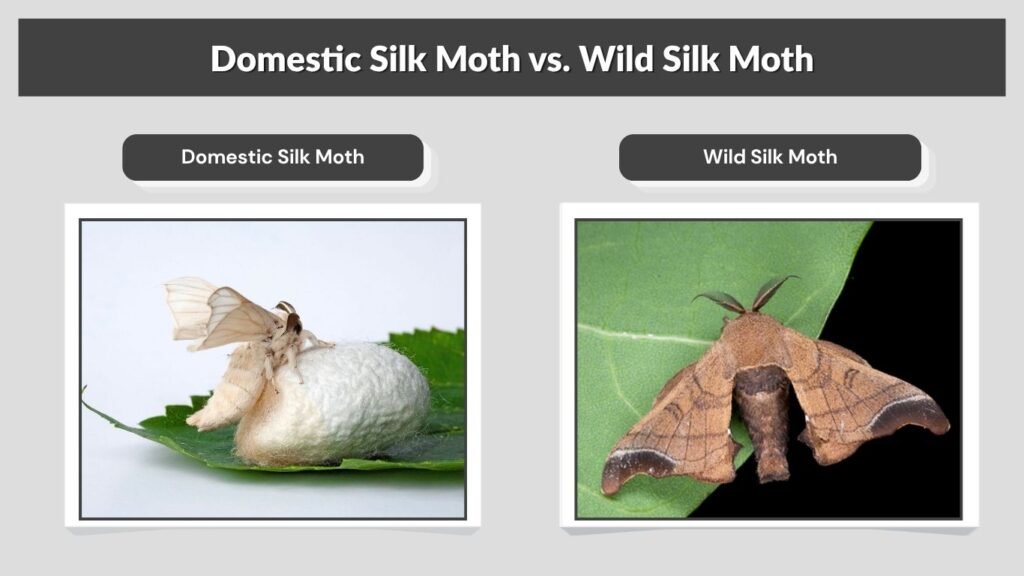
The domestic silkworm moth, Bombyx mori, has been selectively bred by humans for thousands of years. Its caterpillars are raised mainly on mulberry leaves to produce consistent silk. Wild silk moths retain the physical and behavioral adaptations needed to locate food, avoid predators, reproduce, and survive changing outdoor conditions.
Key Differences
- Dependency: Domestic silkworms require human care; wild species survive independently.
- Flight: Domestic adults are effectively flightless; most wild adults can fly.
- Food: Domestic caterpillars primarily receive mulberry leaves; wild species use numerous host plants.
- Silk: Domestic silk is generally uniform and easy to process; wild silk varies in texture and color.
- Appearance: Domestic moths are usually pale and modestly sized; many wild species are large and colorful.
- Cocoon harvesting: Domestic cocoons come from controlled rearing; wild cocoons are gathered or produced through semi-managed systems.
- Genetics: Domesticated silkworms have been shaped by prolonged selective breeding; wild moths remain adapted to natural ecological pressures.
Importance of Wild Silk
Wild silk fibers can have naturally golden, brown, copper, or cream tones. Different species produce fibers with distinctive strength, texture, and surface characteristics. Examples include tussar, eri, and muga silk from Asian moths and Gonometa silk from Africa.
Sustainable production can create economic value while encouraging communities to protect host trees and moth habitats. Poorly managed collection, however, can remove developing pupae and reduce future populations.
Conservation of Wild Silk Moths
Wild silk moths contribute to forest food webs as herbivores, prey, and hosts for parasitoids. Their populations may be affected by disappearing habitat, pesticide exposure, invasive organisms, artificial nighttime lighting, and the removal of native host plants. Protecting ecological diversity is more effective than focusing only on the adult moth.
How to Protect Wild Silk Moths
Gardeners can support these insects by growing native trees, preserving some natural leaf litter, and reducing unnecessary pesticide use. Outdoor lights can be switched off when not required or replaced with warmer, less disruptive lighting.
Cocoons should remain undisturbed unless they are in immediate danger. Avoid collecting adult moths or caterpillars from small populations. Maintaining connected habitats gives adults more opportunities to locate mates and allows females to find suitable plants.
FAQs
Wild silk moths inspire many questions because adults are rarely seen for long and look dramatically different from their caterpillars. Their brief adult stage, large size, silk cocoons, and relationship with domesticated silkworms can create confusion. The following answers address the most common questions about their behavior and biology.
What is a wild silk moth?
It is a naturally living moth whose caterpillar produces silk. The name commonly describes giant saturniid moths but can also include other moth families used for wild-silk production.
Can wild silk moths fly?
Yes. Most wild adults can fly, although heavy females may travel less than males. This differs from the domesticated silk moth, which has largely lost its ability to fly.
How long does a wild silk moth live?
The complete life cycle may last several months or longer, particularly when the pupa overwinters. The adult stage usually lasts only several days to approximately two weeks.
Do wild silk moth adults eat?
Many adult giant silk moths cannot eat because their mouthparts are reduced or nonfunctional. They depend on energy accumulated while they were caterpillars.
Are wild silk moths dangerous?
Adult wild silk moths are harmless and cannot sting. However, caterpillars of certain species possess irritating or venomous spines and should not be touched.
