
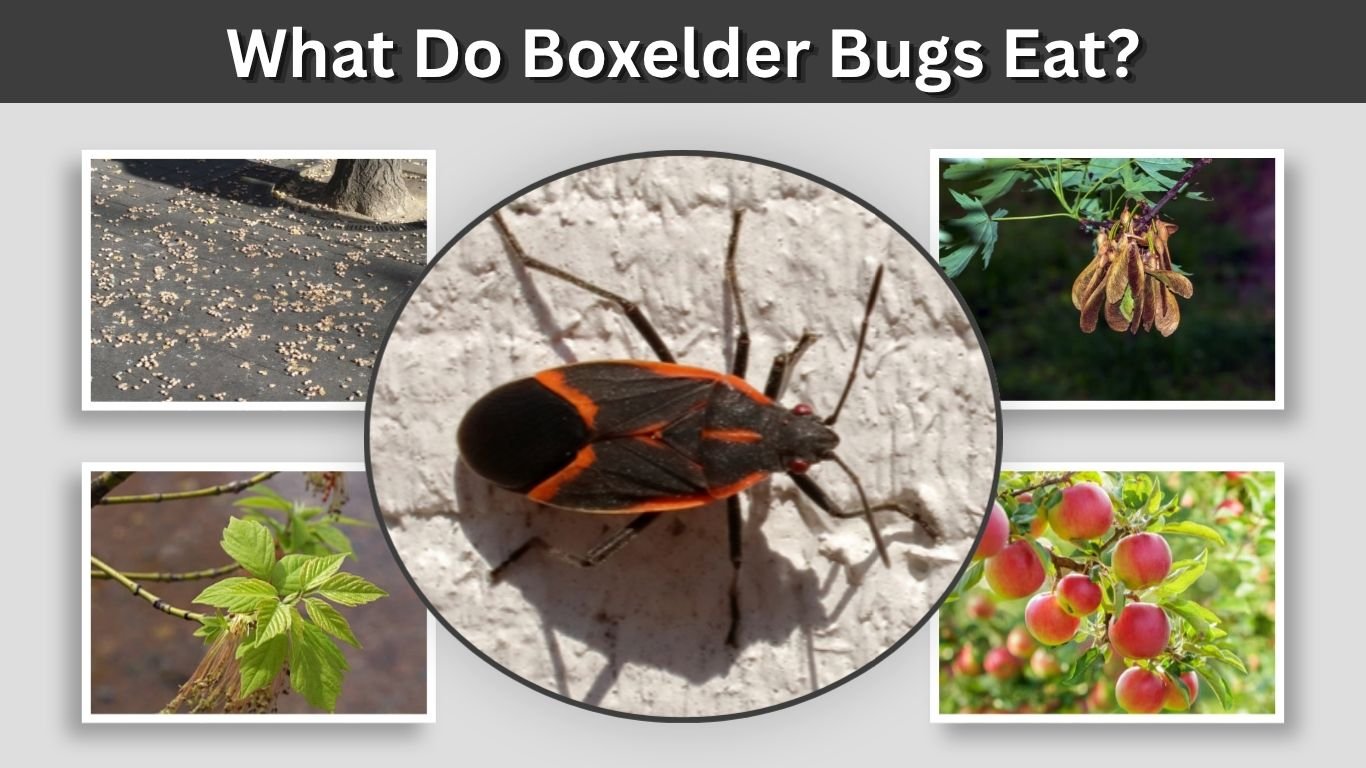
Boxelder bugs mainly eat seeds and soft tissues from boxelder trees. They use piercing, sucking mouthparts to draw liquid from seeds, leaves, flowers, and developing fruit rather than chewing plants. Female boxelder trees are their most important food source because they produce large numbers of winged seeds. Boxelder bugs may also feed on maple trees, ash trees, and several fruits, but these secondary foods are less important. They generally eat very little while sheltering inside homes during winter.
Boxelder Bug Diet at a Glance
| Life stage or season | Typical food |
| Young nymphs | Fallen seeds and low-growing vegetation |
| Older nymphs | Developing boxelder seeds and plant fluids |
| Adults in spring | Seeds and plant material on the ground |
| Adults in summer | Boxelder seedpods, leaves, and flowers |
| Bugs in winter | Usually little or nothing |
| Bugs inside homes | Generally do not feed; may seek water |
Boxelder bugs strongly prefer seedpods from female boxelder trees. They occasionally use other maples, ash trees, fruit trees, and grapevines, but they rarely cause serious plant damage.
10 Foods Boxelder Bugs Eat
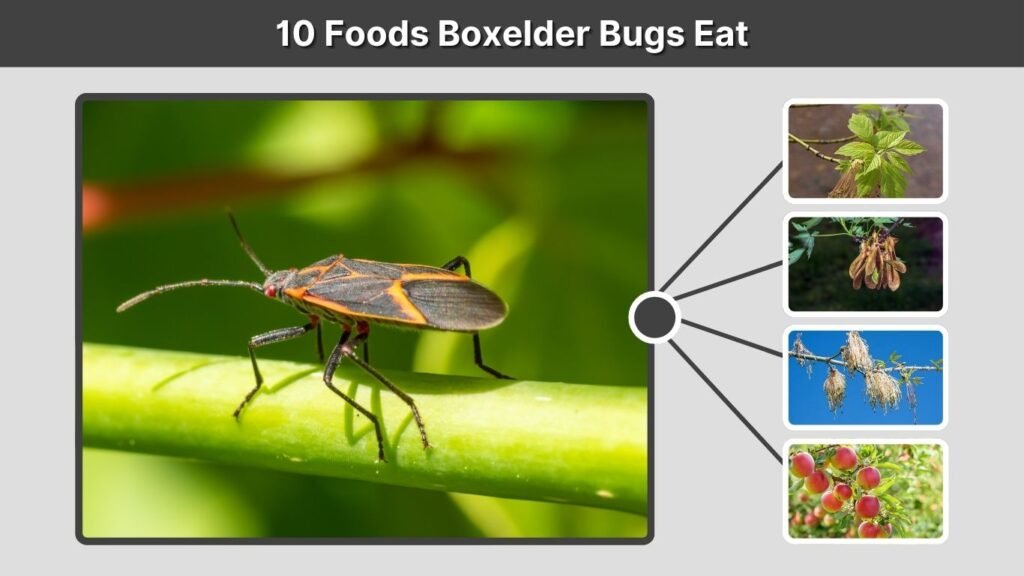
The foods below include their normal diet and secondary plant materials they may use when available. Fruit feeding is occasional and is more commonly reported in areas where western boxelder bugs occur.
1. Boxelder Seeds
Boxelder seeds are the primary food of boxelder bugs. The insects gather on female boxelder trees because these trees produce the paired, winged seeds sometimes called “helicopters” or samaras.
Adults and nymphs insert their mouthparts into the seeds and extract liquid nutrients. Fallen seeds also provide food during spring and early summer before new seeds fully develop on the trees. Large bug populations are therefore more common where mature, seed-bearing boxelder trees grow nearby.
2. Boxelder Leaves
Boxelder bugs occasionally pierce soft leaves to drink plant fluids. They are most likely to feed on young or tender growth rather than tough, mature foliage.
This feeding may produce minor spots, yellowing, or distortion when unusually large numbers gather on one tree. However, healthy boxelder trees normally tolerate the feeding without lasting harm. Boxelder bugs are considered household nuisance pests more often than serious tree pests.
3. Boxelder Flowers
The flowers of female boxelder trees provide another seasonal food source. Boxelder bugs may feed on the tender tissues and fluids within flowers before seedpods mature.
Flower feeding is usually limited and does not normally prevent a healthy tree from producing seeds. Once seedpods become available, the insects concentrate more heavily on them because seeds are their preferred food.
4. Almond Fruit
Western boxelder bugs sometimes feed on developing almond fruit. Their piercing mouthparts puncture the surface and remove plant fluids.
Almonds are not their preferred or essential food, and significant damage is uncommon. A boxelder or maple tree nearby is generally a more likely reason the bugs are present. Occasional fruit feeding is more noticeable when bug numbers are high or preferred seeds are limited.
5. Apples
Boxelder bugs may occasionally pierce apples to consume juice from developing or damaged fruit. Feeding punctures can sometimes produce small marks or cause localized deformity.
They do not consume an entire apple or chew large holes through it. Bugs found on fallen apples may also be attracted to accessible moisture and soft plant tissues rather than healthy, undamaged fruit. Serious orchard damage from boxelder bugs is rare.
6. Cherries
Cherries are another occasional food, particularly for western boxelder bugs. The insects may puncture ripe, overripe, damaged, or developing cherries to obtain juice.
Their presence on a cherry tree does not necessarily mean they are causing significant damage. Boxelder bugs may simply be resting on the plant or moving between nearby feeding locations. Persistent fruit injury should be examined carefully because other insects are usually more destructive orchard pests.
7. Peaches
Boxelder bugs can feed on peach fruit by inserting their slender mouthparts into the skin. This feeding may create minor dimpling or distortion, especially when it occurs while the fruit is still developing.
Peaches remain a secondary food source. The bugs normally depend more heavily on boxelder seeds and other plant material. A small number of peach trees rarely requires treatment unless clear fruit damage is occurring.
8. Pears
Pear fruit may occasionally attract feeding boxelder bugs. Their punctures can sometimes cause puckered or misshapen areas as young pears grow.
University of California IPM notes that fruit distortion can occur in orchards, but it is rarely a significant problem. Finding boxelder bugs on a pear tree should not automatically be treated as a damaging infestation. Confirm that the insects are actively feeding before considering control.
9. Plums
Boxelder bugs may drink fluids from plums, particularly when fruit is soft, damaged, or beginning to ripen. They use their piercing mouthparts instead of biting away pieces of fruit.
Feeding is usually superficial and limited to small areas. Large gatherings on plums may be more noticeable when boxelder seeds are scarce, but these insects seldom cause enough damage to threaten the health of the tree.
10. Grapes
Grapes can provide juice and moisture for boxelder bugs. The insects may puncture individual grapes and occasionally contribute to deformed or damaged fruit.
Grapes are a supplemental food rather than a central part of the boxelder bug diet. Bugs may also gather on grapevines simply because the plants provide warmth, shade, or shelter. Their presence should be evaluated alongside visible feeding marks before control is attempted.
What Other Trees Do Boxelder Bugs Feed On?
Boxelder bugs may also feed on other maple species and occasionally on ash trees. Maple seeds are one of their better-known alternative foods, especially when female boxelder trees are unavailable. Their feeding usually produces no noticeable injury to either maple or ash trees.
The insects may be seen on many unrelated garden plants, but this does not always mean they are eating them. They frequently rest on vegetation, tree trunks, fences, stones, and sunny exterior walls.
What Do Baby Boxelder Bugs Eat?
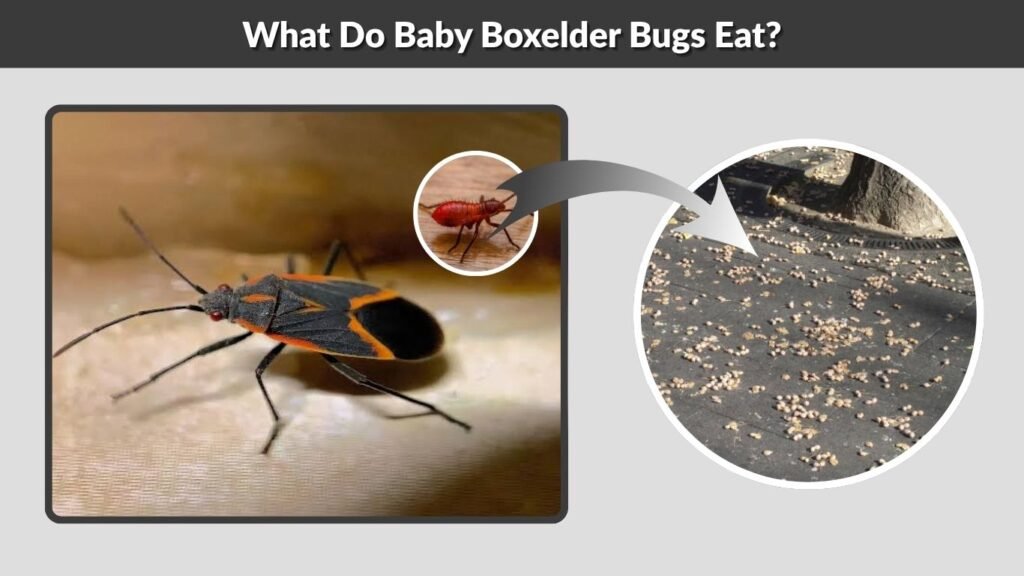
Baby boxelder bugs are called nymphs. Newly hatched nymphs are small, wingless, and bright red. They initially remain on low vegetation or the ground near female boxelder trees, where they feed on fallen seeds and available plant fluids.
As new seeds develop, the nymphs move onto the host trees and feed more heavily on the seedpods. They pass through several growth stages before developing fully formed wings and becoming adults.
What Do Boxelder Bugs Eat in Spring?
Adults that survive winter become active when temperatures rise. During spring and early summer, they feed on seeds and other plant material found on the ground. They begin mating after feeding for several weeks.
Later, the adults move toward female boxelder trees as leaves, flowers, and new seedpods develop. The exact timing varies with local climate and temperature.
What Do Boxelder Bugs Eat in Winter?
Boxelder bugs generally eat very little during winter. Adult bugs spend the cold months in a mostly inactive state inside bark crevices, wall voids, attics, foundations, sheds, and other protected shelters.
Warm, sunny weather can temporarily awaken them. Active bugs may crawl toward windows or living areas, but they usually cannot find suitable food and survive for only a limited time once active indoors.
What Do Boxelder Bugs Eat Inside the House?
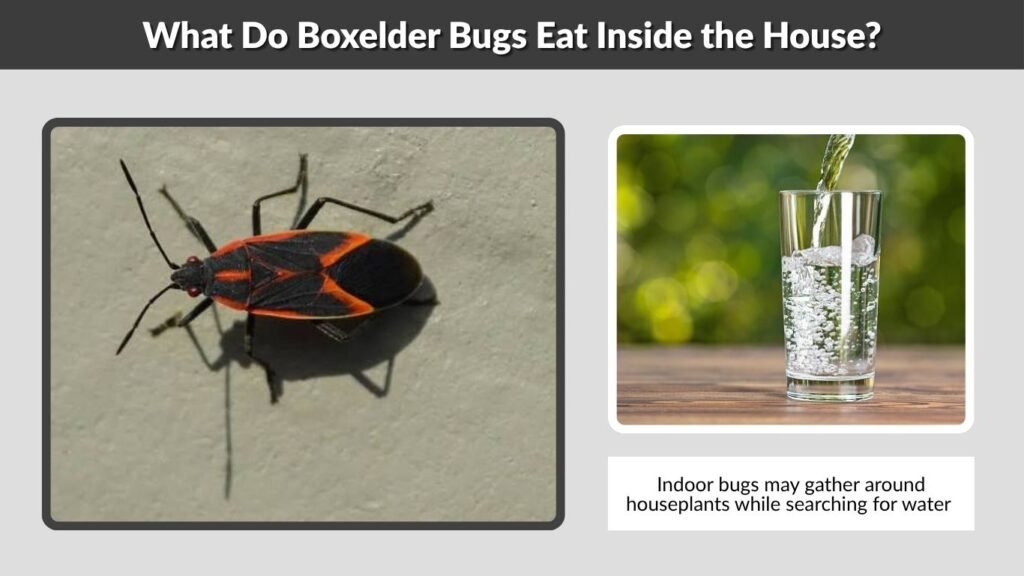
Boxelder bugs do not normally eat household food, clothing, carpets, furniture, paper, or structural wood. They enter buildings to find winter shelter, not to establish a feeding or breeding colony.
Indoor bugs may gather around houseplants while searching for water and could attempt to pierce plant tissue, but they rarely cause noticeable damage. They also do not reproduce inside homes. Vacuuming is usually the easiest way to remove them.
Do Boxelder Bugs Damage Plants?
Most boxelder bug feeding causes little or no lasting plant injury. Large populations can occasionally produce yellow leaves, distorted fruit, or minor damage to flowers and tender shoots, but severe infestations are unusual.
Because they are primarily nuisance insects, control should generally focus on keeping adults out of buildings rather than spraying trees or garden plants.
FAQs
Do boxelder bugs eat wood?
No. Boxelder bugs do not eat structural wood, furniture, cabinets, or firewood. They may hide beneath bark or enter cracks around wooden structures, but these locations provide shelter rather than food. They cannot cause termite-like structural damage.
Do boxelder bugs eat other insects?
Boxelder bugs mainly consume seeds and plant fluids. Unusual scavenging behavior has occasionally been observed, but insects are not considered a normal or important part of their diet. Their piercing mouthparts are primarily adapted for feeding on plants and seeds.
Do boxelder bugs eat houseplants?
They may gather around houseplants while searching for moisture and occasionally attempt to feed. However, indoor boxelder bugs rarely cause noticeable plant damage. Their presence on a plant does not mean they are establishing a reproducing infestation.
Can boxelder bugs survive without food?
Overwintering adults can remain inactive for extended periods while using stored energy. Once warmth makes them active indoors, their energy reserves are depleted more quickly. Without suitable food and water, active bugs usually survive only briefly.
Why are boxelder bugs attracted to my house?
They are not entering because of indoor food. In autumn, adults gather on warm south- and west-facing walls and enter small cracks to obtain protected winter shelter. Buildings near seed-bearing boxelder trees may experience especially large seasonal invasions.
