
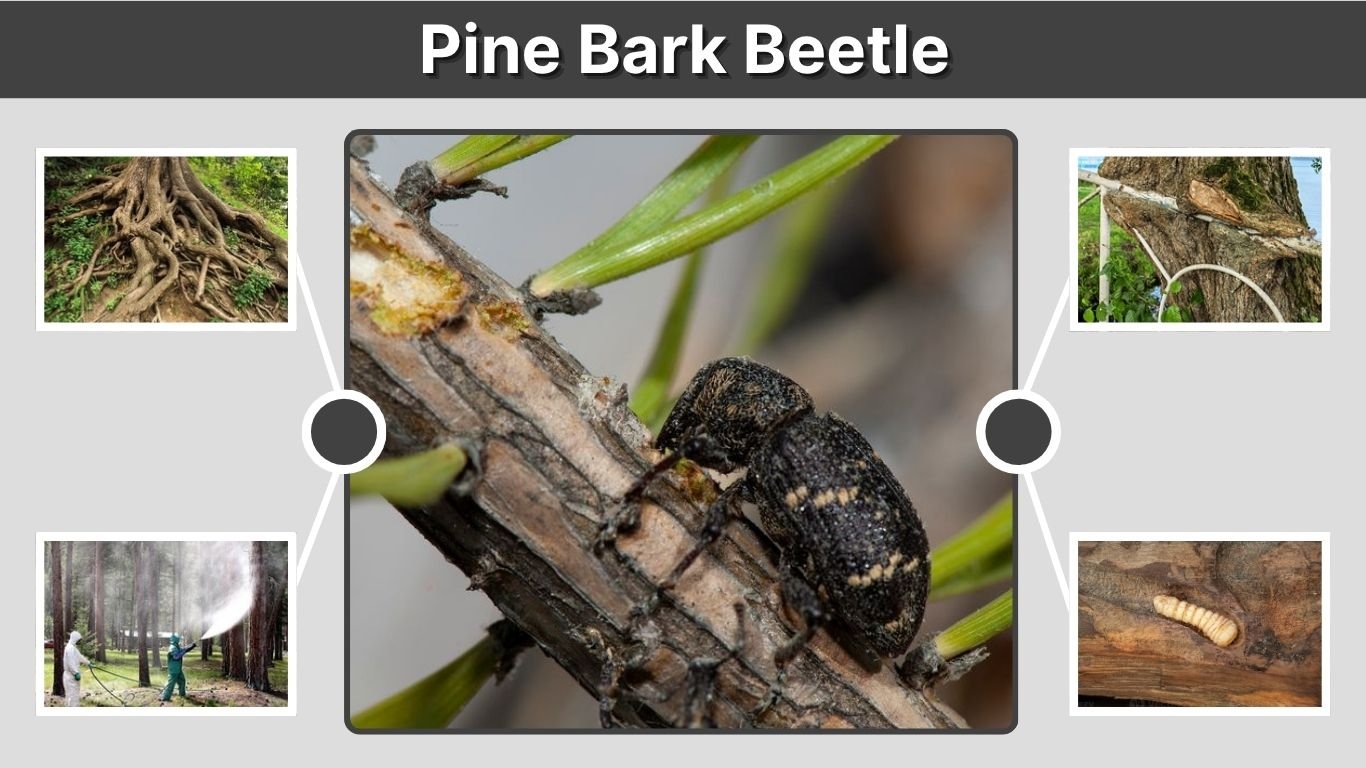
Pine bark beetles are small insects that live and reproduce beneath the bark of pine trees. Although individual beetles are tiny, heavy infestations can weaken or kill mature trees by damaging the tissues that carry water and nutrients. Several species are commonly called pine bark beetles, including mountain pine beetles, southern pine beetles, western pine beetles, and engraver beetles. Knowing what pine bark beetles look like, recognizing early symptoms, and understanding available treatment and prevention methods can help protect valuable pine trees.
What Is a Pine Bark Beetle?
The term pine bark beetle refers to several closely related beetles that primarily attack pine trees. Most belong to the bark beetle group within the subfamily Scolytinae.
Adults tunnel through the outer bark and create galleries in the inner bark. Females lay eggs inside these tunnels, and the developing larvae feed on tissues beneath the bark.
Many bark beetles prefer stressed, injured, or drought-weakened trees. However, some aggressive species can attack apparently healthy pines when beetle populations become high.
Common examples include:
- Mountain pine beetle
- Southern pine beetle
- Western pine beetle
- Ips engraver beetles
- Red turpentine beetle
- Pine engraver beetles
The exact species present varies depending on location and pine species.
What Do Pine Bark Beetles Look Like?
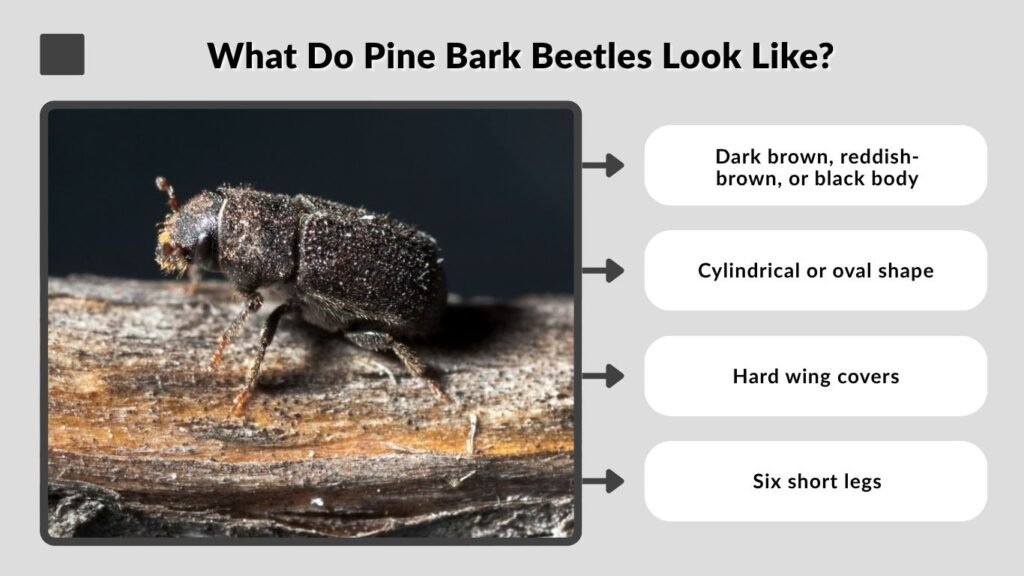
Adult pine bark beetles are small, cylindrical insects that may be difficult to notice without close inspection.
Most are approximately 1/16 to 1/4 inch long, although exact size depends on species.
Pine Bark Beetle Identification
Typical characteristics include:
- Dark brown, reddish-brown, or black body
- Cylindrical or oval shape
- Hard wing covers
- Six short legs
- Clubbed or bent antennae
- Compact head and thorax
- Very small overall size
Because adults are so small, identifying an infestation through tree symptoms is often easier than finding the beetles themselves.
Pine Bark Beetle Signs
Early detection is important because bark beetle damage is often difficult to reverse once large numbers of beetles become established.
Several signs can indicate activity beneath the bark.
Common Symptoms of Pine Bark Beetles
Watch for:
- Small holes in the bark
- Resin or pitch tubes
- Reddish boring dust
- Sawdust around bark cracks
- Yellowing needles
- Reddish-brown foliage
- Loose or peeling bark
- Galleries underneath bark
- Increased woodpecker activity
- Dead branches
- Sudden tree decline
A combination of these symptoms is a stronger indication of infestation than any single sign alone.
Pine Bark Beetle Holes
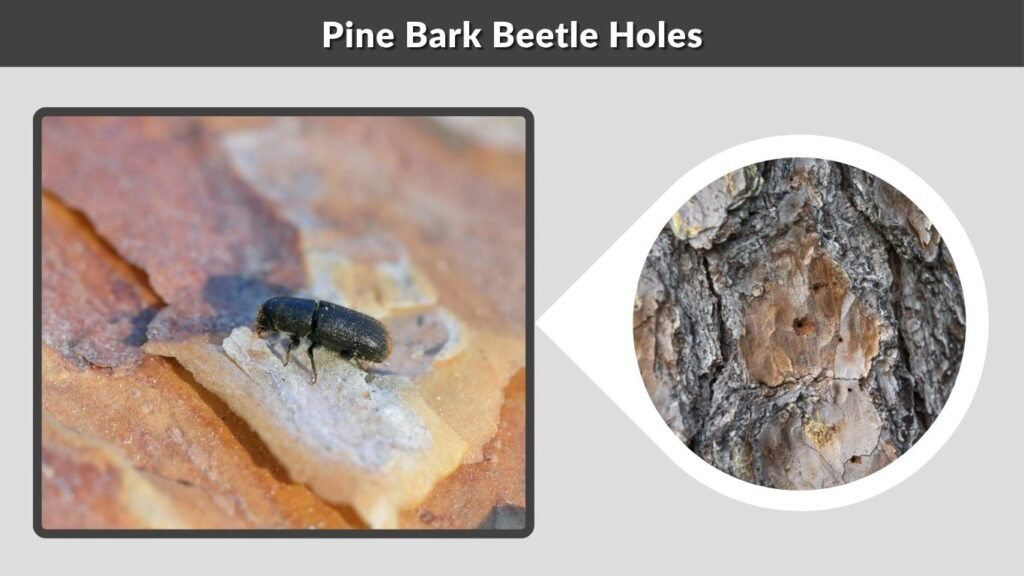
Pine bark beetle holes are usually very small and round.
Adult beetles make entrance holes when boring into trees and exit holes when newly developed adults emerge.
The holes may be only a few millimeters across.
Fresh attacks are sometimes surrounded by resin because healthy pine trees naturally push sap toward the injury.
Small clumps of resin mixed with boring dust may form pitch tubes on the trunk.
Pine Bark Beetle Damage
Pine bark beetles damage trees mainly by tunneling through the inner bark and disrupting the movement of water and nutrients.
Larvae create additional galleries as they feed.
When enough beetles attack the same tree, their tunnels may surround large portions of the trunk and interrupt the tree’s vascular system.
What Does Pine Bark Beetle Damage Look Like?
Damage may include:
- Networks of tunnels under bark
- Brown or red needles
- Crown dieback
- Pitch tubes along the trunk
- Bark cracking or peeling
- Fine reddish dust around the tree
- Dead upper branches
- Entire tree death
In severe infestations, needle color may change from healthy green to pale green, yellow, red, and finally brown.
Pine Bark Beetle Larvae
Pine bark beetle larvae live almost completely hidden beneath the bark.
They are very different in appearance from adult beetles.
Larvae are usually:
- Creamy white
- Soft-bodied
- Legless or nearly legless
- Slightly curved
- Segmented
- Equipped with a darker brown head
After hatching, larvae tunnel away from the egg gallery while feeding.
These larval tunnels usually widen as the larvae grow.
Pine Bark Beetle Life Cycle
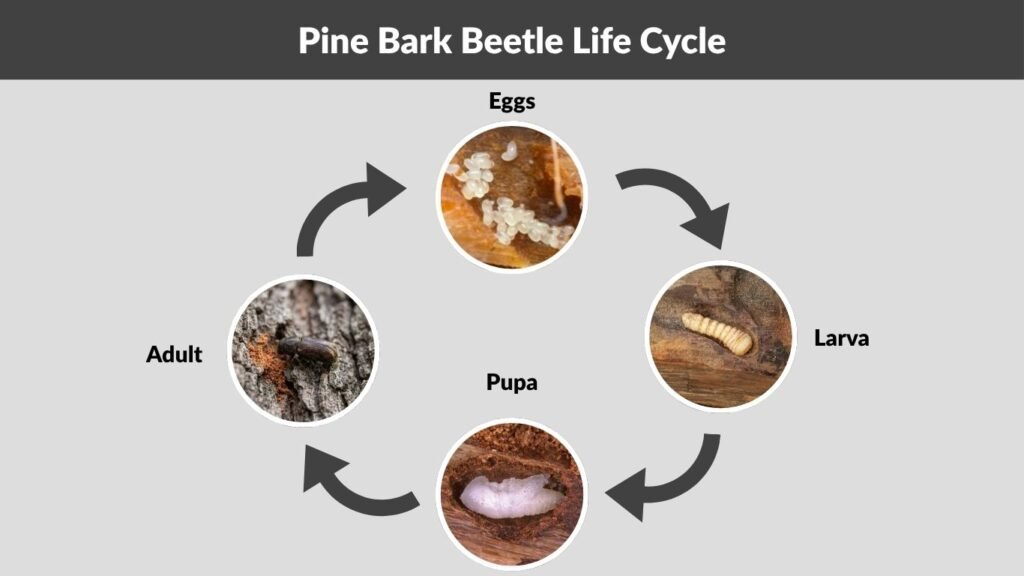
Pine bark beetles undergo complete metamorphosis with four developmental stages:
Egg → Larva → Pupa → Adult
The entire life cycle varies by species, temperature, and local climate.
Egg Stage
Female beetles enter suitable pine trees and construct galleries underneath the bark.
Eggs are deposited along these galleries.
Larval Stage
Larvae hatch and begin feeding on inner bark and phloem.
Each larva normally creates an individual feeding tunnel branching away from the parent gallery.
Pupal Stage
Fully developed larvae form small chambers underneath the bark and transform into pupae.
Adult structures develop during this stage.
Adult Stage
New adults emerge and eventually leave the tree through exit holes.
They then fly to another suitable host and begin a new generation.
Some species produce one generation annually, while others may have multiple generations when temperatures remain favorable.
What Do Pine Bark Beetles Eat?
Pine bark beetles primarily consume tissues located immediately underneath tree bark.
Their diet includes:
- Phloem
- Inner bark
- Cambium-associated tissues
- Plant fluids
- Fungi growing inside galleries
Larvae cause much of the feeding damage.
Some pine bark beetles also carry fungi into trees. These fungi may help weaken the tree’s defenses and can discolor the wood.
Why Do Pine Bark Beetles Attack Pine Trees?
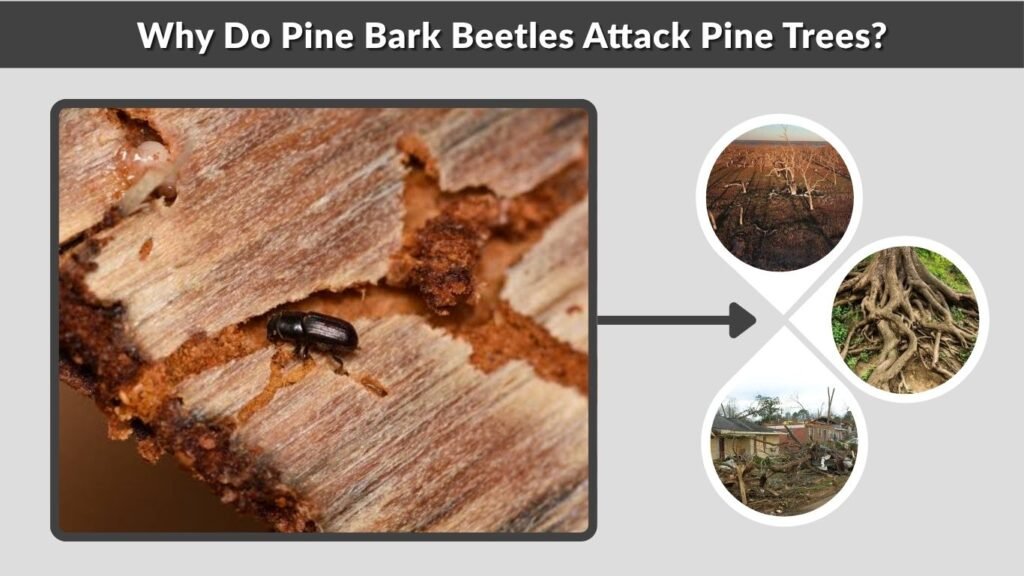
Stressed trees are generally more vulnerable to bark beetles because they produce fewer defensive chemicals and less resin.
Common stress factors include:
- Prolonged drought
- Extreme heat
- Wildfire injury
- Lightning damage
- Root damage
- Construction injury
- Poor soil conditions
- Overcrowding
- Disease
- Storm damage
- Improper pruning
Healthy pines can sometimes defend themselves by flooding beetle tunnels with resin.
When trees are severely stressed or beetle populations are exceptionally high, this defense may not be sufficient.
Pine Bark Beetle Treatment
Treatment depends heavily on whether a tree has already been successfully colonized.
Once numerous larvae are developing beneath the bark and the crown is dying, saving the tree can be extremely difficult.
For valuable trees, early professional diagnosis is important.
Treatment Options
Management may include:
- Removing heavily infested trees
- Properly disposing of infested wood
- Protecting nearby healthy trees
- Improving tree watering during drought
- Reducing root and trunk damage
- Using preventive insecticide treatments when appropriate
- Monitoring nearby pines for new attacks
Treatment works best before beetles successfully establish extensive galleries.
Pine Bark Beetle Control
Effective pine bark beetle control combines tree care, sanitation, and preventive measures.
Remove Severely Infested Trees
Trees containing large populations of developing beetles can become sources of future infestations.
Removing heavily infested trees may reduce the number of beetles that emerge and attack nearby pines.
Infested logs should be handled appropriately rather than simply stacked close to healthy trees.
Reduce Tree Stress
Maintaining vigorous trees improves their natural ability to resist beetles.
During prolonged dry periods, appropriate deep watering can be especially important for landscape pines.
Avoid damaging roots, trunks, and branches with lawn equipment or construction activities.
Thin Overcrowded Pine Stands
Trees growing too closely compete for water, nutrients, and sunlight.
Selective thinning can sometimes improve tree vigor and reduce susceptibility to bark beetles.
Pine Bark Beetle Insecticide
Insecticides are usually most useful as preventive treatments rather than cures for severely infested trees.
Certain bark-applied insecticides can protect healthy pine trunks by killing beetles before they successfully enter the tree.
Products used for bark beetle management may contain active ingredients such as certain pyrethroids, depending on local regulations and tree species.
Does Systemic Insecticide Kill Pine Bark Beetles?
Systemic treatments are available for some tree pests, but bark beetle control can be challenging because beetles quickly penetrate beneath the bark.
The effectiveness of systemic products varies according to:
- Beetle species
- Active ingredient
- Application method
- Tree health
- Treatment timing
- Local environmental conditions
A certified arborist or local extension service can help determine whether chemical treatment is appropriate.
Pine Bark Beetle Spray
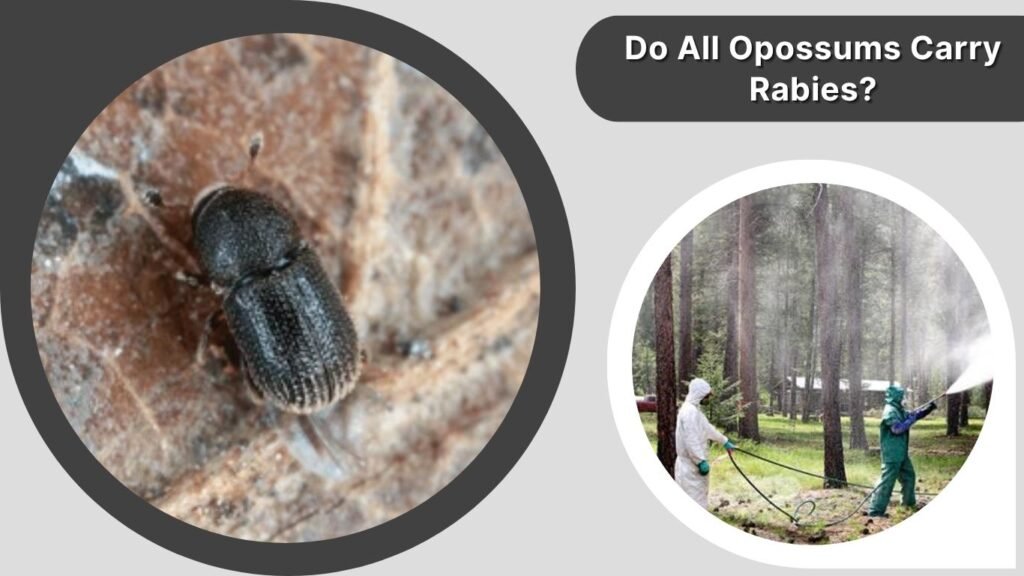
Preventive bark sprays are generally applied to the trunk before beetles begin their main flight period.
Complete coverage is important because untreated sections of bark can remain vulnerable.
Insecticides should always be applied according to the product label.
Chemical treatment is generally unnecessary for dead trees because beetles have already completed much of their damaging activity.
How to Get Rid of Pine Bark Beetles
There is rarely a simple way to eliminate beetles from a tree once a severe infestation has developed.
A practical management approach includes:
- Confirm that bark beetles are responsible.
- Inspect neighboring pine trees.
- Remove trees that are beyond recovery.
- Dispose of beetle-infested wood properly.
- Reduce drought and environmental stress.
- Protect valuable nearby trees before beetle attacks occur.
- Continue monitoring for new pitch tubes and boring dust.
Early action offers the best chance of limiting spread.
Pine Bark Beetle Prevention
Preventing infestation is usually easier than treating a heavily attacked tree.
Keep pine trees vigorous by providing appropriate growing conditions.
Prevention Tips
- Water valuable pines during severe drought
- Avoid root disturbance
- Prevent trunk injuries
- Remove storm-damaged trees
- Prune appropriately
- Avoid leaving fresh pine logs near healthy trees
- Maintain proper tree spacing
- Monitor trees during beetle season
- Remove severely infested material promptly
- Consider preventive treatment for high-value trees in high-risk areas
Avoid unnecessary pruning during periods when local bark beetles are especially active if freshly cut pine material could attract beetles.
Pine Bark Beetles and Wildfires
The relationship between pine bark beetles and wildfire is complicated.
Large bark beetle outbreaks can kill many trees, changing the amount and type of combustible material present in a forest.
Recently dead trees may retain dry needles for a period, while older dead trees eventually lose needles and branches and may fall.
However, wildfire risk also depends on weather, drought, wind, vegetation, fuel moisture, and forest structure.
Bark beetle outbreaks are therefore only one factor affecting wildfire behavior.
Mountain Pine Bark Beetle
The mountain pine beetle is one of the best-known bark beetles in western North America.
It attacks several pine species, including:
- Lodgepole pine
- Ponderosa pine
- Whitebark pine
- Limber pine
Adult mountain pine beetles are small, dark insects that tunnel beneath bark.
Large outbreaks can kill extensive numbers of mature pine trees, particularly when environmental conditions favor beetle survival.
Southern Pine Bark Beetle
The southern pine beetle is an important forest pest in parts of the southeastern United States.
It attacks several pine species and can spread rapidly during outbreaks.
One characteristic sign is winding or S-shaped galleries underneath the bark.
Management may require quickly identifying and removing actively infested trees to reduce beetle spread.
Pine Bark Beetle vs Pine Borer
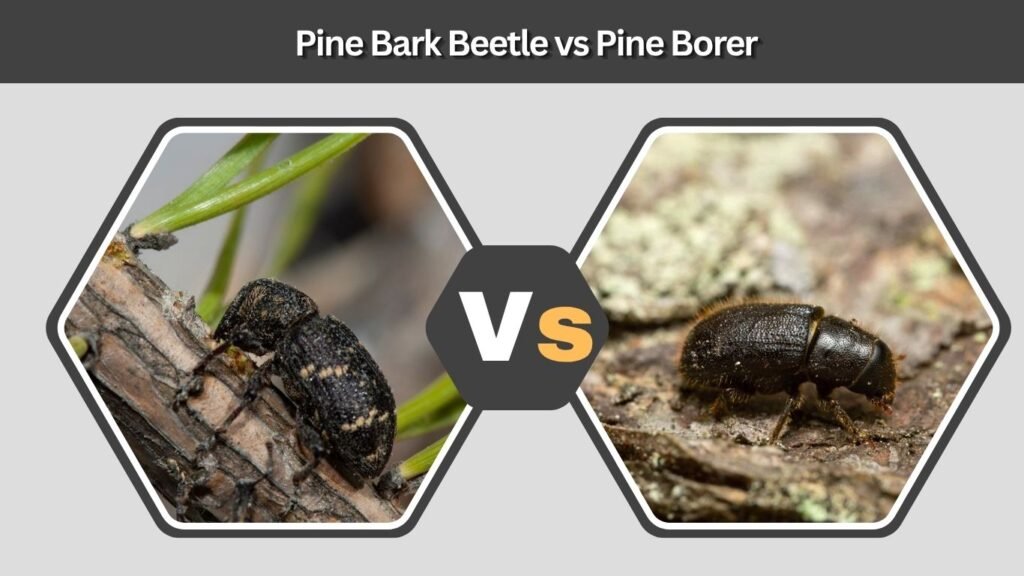
Pine bark beetles and pine borers can both damage trees, but they are not always the same type of insect.
| Feature | Pine Bark Beetle | Pine Borer |
|---|---|---|
| Main feeding area | Beneath bark | Bark or deeper wood |
| Adult size | Usually very small | Often larger |
| Larvae | Small, white grubs | Often larger borers |
| Galleries | Inner bark | May extend into wood |
| Exit holes | Usually tiny | Often larger |
| Major effect | Interrupts vascular tissues | Weakens wood and tissues |
Examining the larvae, galleries, and exit holes can help determine which insect is responsible.
Are Pine Bark Beetles Dangerous to Humans?
Pine bark beetles are not considered dangerous to people.
They do not seek humans for food and are not blood-feeding insects.
Their primary impact is on pine trees and forest ecosystems.
The main indirect hazard occurs when bark beetles kill large trees. Dead branches and trunks can eventually become unstable and may fall.
FAQs
1. What are the first signs of pine bark beetles?
Early signs include small pitch tubes, reddish boring dust, tiny holes in the bark, and galleries beneath loose bark. Later symptoms can include yellowing or reddish needles, crown decline, peeling bark, and increased woodpecker activity.
2. Can a pine tree recover from bark beetles?
A lightly attacked tree may survive if it successfully produces enough resin to repel beetles. However, a tree containing extensive galleries, developing larvae, and widespread crown discoloration is unlikely to recover. Early identification is therefore important.
3. What kills pine bark beetles?
Preventive bark insecticides can kill attacking beetles before they successfully enter protected trees. Heavily infested trees are usually managed through removal and proper disposal because beetles and larvae are protected beneath the bark.
4. What do pine bark beetle larvae look like?
Larvae are small, white or cream-colored, soft-bodied grubs with darker heads. They live beneath pine bark and create feeding tunnels extending from galleries made by adult beetles.
5. How do you prevent pine bark beetles?
Maintain healthy trees, reduce drought stress, prevent root and trunk injuries, remove severely infested trees, properly manage fresh pine wood, and monitor trees for pitch tubes and boring dust. Preventive insecticide treatments may also be appropriate for high-value trees in areas with active beetle populations.
