
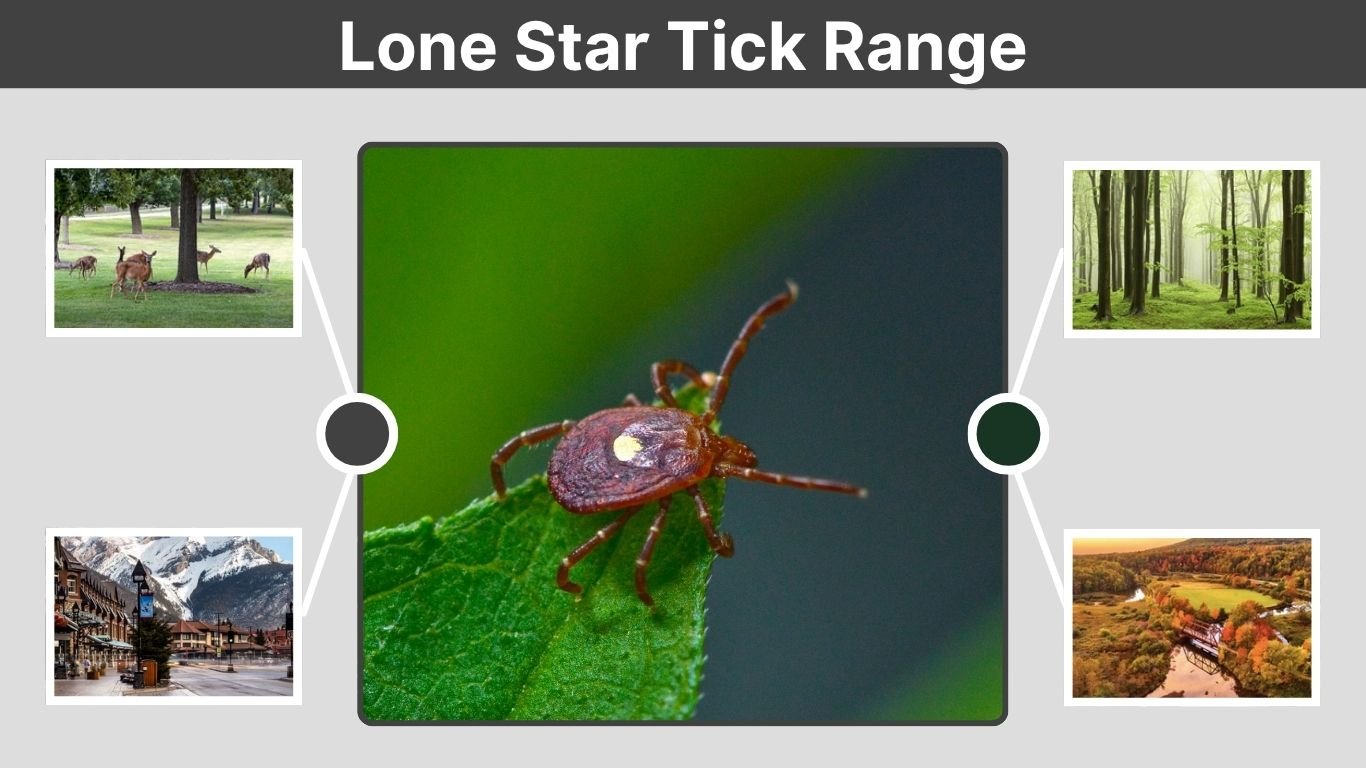
The lone star tick range covers a large portion of the eastern United States, particularly the Southeast, South, Midwest, and increasingly parts of the Northeast. In 2026, the latest CDC surveillance map shows established populations through 2025, with the species continuing to appear near the northern edges of its recognized range. Lone star ticks have also been detected in southern Canada, although detection does not always mean a permanent population exists. Their expanding presence matters because these aggressive ticks can spread several diseases and are associated with alpha-gal syndrome.
What Is the Current Lone Star Tick Range?
The lone star tick (Amblyomma americanum) is widely distributed across the Northeast, South, and Midwest United States. Its strongest populations remain concentrated through the southeastern and south-central regions, but established populations now extend considerably farther north than many older range maps suggest.
Main U.S. Range
Lone star ticks occur across parts of:
- Texas and the south-central states
- The Gulf Coast region
- The Southeast
- Tennessee and Kentucky
- Missouri and neighboring Midwest states
- Virginia and the Mid-Atlantic
- Pennsylvania and New Jersey
- Parts of New York and southern New England
- Increasing portions of the central Midwest
Their abundance is not equal throughout this enormous area. A state can fall within the general geographic range while individual counties have few records or no confirmed established population.
Lone Star Tick Range Map for 2026
The most current CDC surveillance page available in 2026 was updated May 26, 2026. Its map displays the estimated U.S. distribution along with counties where established populations had been documented through 2025.
What Does “Established” Mean?
CDC classifies a county as established when surveillance finds:
- Six or more lone star ticks of one life stage within 12 months, or
- More than one life stage within a 12-month period.
An unmarked county does not necessarily mean lone star ticks are absent. Surveillance effort differs by location, and ticks can be found at the edges of their established range without yet maintaining a stable population.
This distinction is important when comparing lone star tick range maps from 2023, 2024, 2025, and 2026. Some apparent expansion can reflect new surveillance and documentation rather than ticks arriving in that county for the first time.
Where Are Lone Star Ticks Most Common?
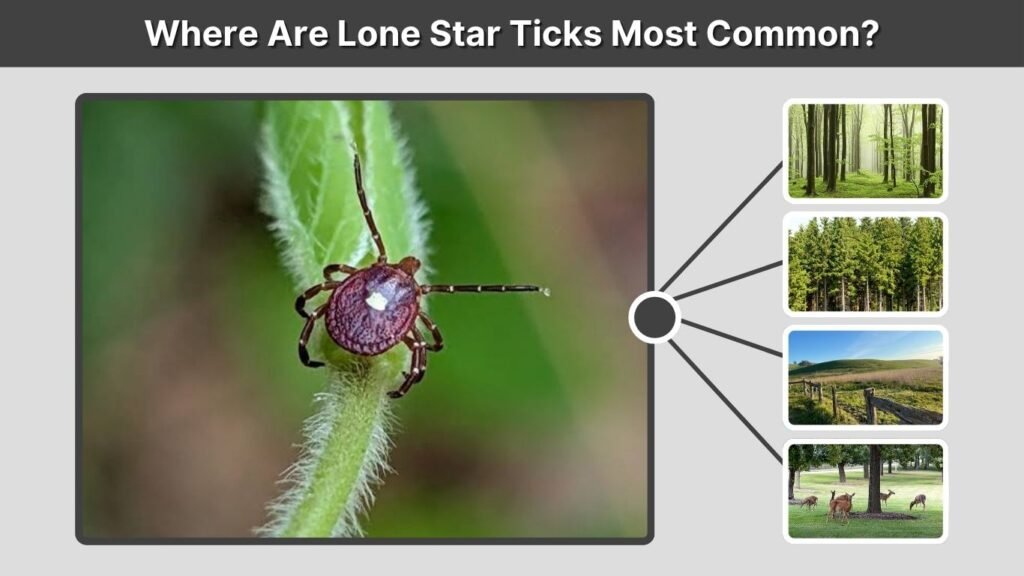
Although their range has become extensive, lone star ticks remain especially associated with the southern and southeastern United States. They thrive in warm, humid environments containing wooded habitat and abundant wildlife.
White-tailed deer are particularly important hosts for adult lone star ticks and have played a major role in supporting the species’ distribution.
Typical Habitat
- Hardwood forests
- Woodland edges
- Dense underbrush
- Brushy fields
- Tall vegetation
- River and creek corridors
- Forest-meadow transition zones
- Hiking and wildlife trails
- Parks with deer populations
- Overgrown suburban landscapes
Lone star ticks are aggressive host seekers, making encounters relatively common where people and wildlife use the same trails or wooded areas.
Why Is the Lone Star Tick Range Expanding?
The story of lone star tick expansion is more complicated than simply moving into completely new territory.
CDC notes that the species occurred broadly across the eastern United States in the 1700s. Its distribution later declined as forests were cleared and white-tailed deer populations decreased. Since the 1940s, recovering deer populations and conservation measures have helped lone star ticks repopulate portions of their historical range.
Factors Affecting the Range
Several conditions can support expansion or recolonization:
- Increasing white-tailed deer populations
- Movement of wildlife between habitats
- Suitable wooded and brushy landscapes
- Warmer seasonal temperatures
- Longer periods of tick activity
- Expanding forest-edge habitat
- Improved surveillance detecting previously undocumented populations
Climate conditions can influence where ticks survive, but habitat and host availability are also major factors.
Lone Star Tick Range in Illinois

Illinois lies well within the current lone star tick range. The species is particularly abundant in southern and central Illinois, while populations have also been increasing northward. University of Illinois information published in 2026 describes the tick as most dense in southern and central portions of the state and expected to become increasingly common farther north.
Where Are They Most Common in Illinois?
Illinois research has identified particularly high concentrations in southern counties. A recent study highlighted clusters including Union, Johnson, Hardin, Jackson, Williamson, Saline, Franklin, Hamilton, Jefferson, and Perry counties.
Illinois public health guidance also describes the lone star tick as primarily found in the southern half of the state, although individuals occur farther north.
Lone Star Tick Range in Maine
Maine is near the northern leading edge of lone star tick expansion.
Maine CDC says lone star ticks are moving north but are not fully established in Maine. A 2026 CDC report also described Maine as being on the leading edge of the species’ northward expansion.
Are Lone Star Ticks in Maine?
Individual ticks can be encountered, but their status is very different from areas such as Missouri, Tennessee, Virginia, or southern Illinois, where established populations are widespread.
Finding one lone star tick in a location does not prove that a self-sustaining local population exists.
Lone Star Tick Range in Canada
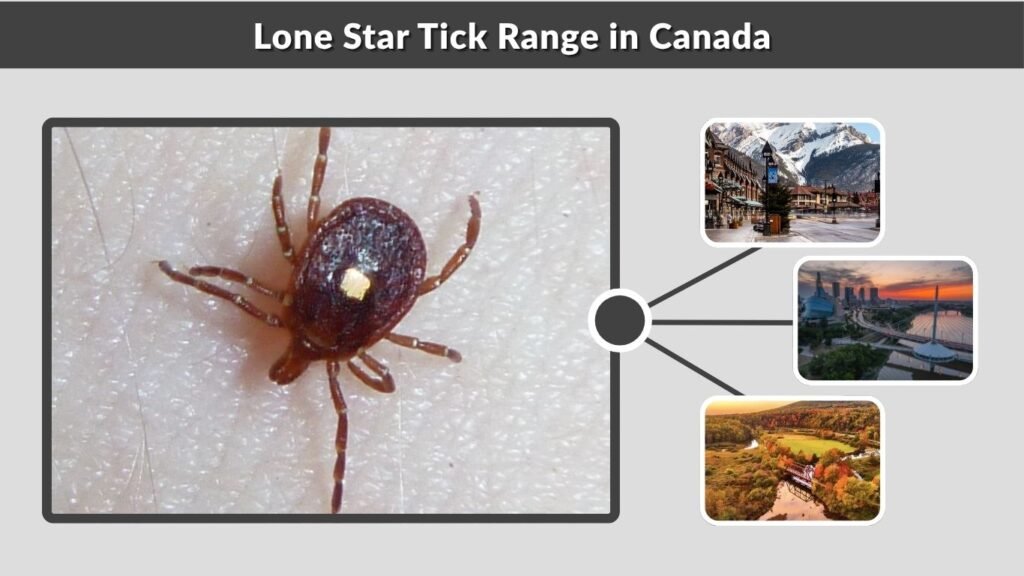
The lone star tick has also been detected in Canada, especially in southern parts of several provinces.
Canada’s current public-health information reports lone star ticks from southern regions of:
- Alberta
- Manitoba
- Nova Scotia
- Ontario
- Québec
- Saskatchewan
Are Lone Star Ticks Established in Canada?
A detection should not automatically be interpreted as a widespread established population.
Ticks can be transported north by migratory birds, wildlife, domestic animals, or people traveling from the United States. Canada’s changing climate can also make additional areas more suitable for ticks over time. Canadian surveillance specifically recognizes range expansion of ticks as an emerging public-health issue.
Continued monitoring will determine where permanent populations become established.
Lone Star Tick Range in the Pacific Northwest
The Pacific Northwest is outside the normal established lone star tick range.
Oregon Health Authority specifically states that the lone star tick is not found in Oregon as an established local tick species.
Washington State likewise reports that lone star ticks are not native to Washington, and the state has not detected the bacteria responsible for ehrlichiosis in locally collected ticks.
What About Washington and Oregon Sightings?
An occasional tick can potentially appear outside its normal geographic range through travel or animal movement. Such a discovery is different from an established breeding population.
In the Pacific Northwest, western blacklegged ticks and several other western tick species are more relevant than lone star ticks.
Native Range vs Expanding Range
Calling the lone star tick simply a “southern tick moving north” does not tell the entire story. Historical evidence indicates that its range was once broader across the eastern United States before major changes in forests and deer populations reduced its distribution.
The current pattern therefore represents both northward expansion and recolonization of portions of an older geographic range.
Why the Lone Star Tick Range Matters
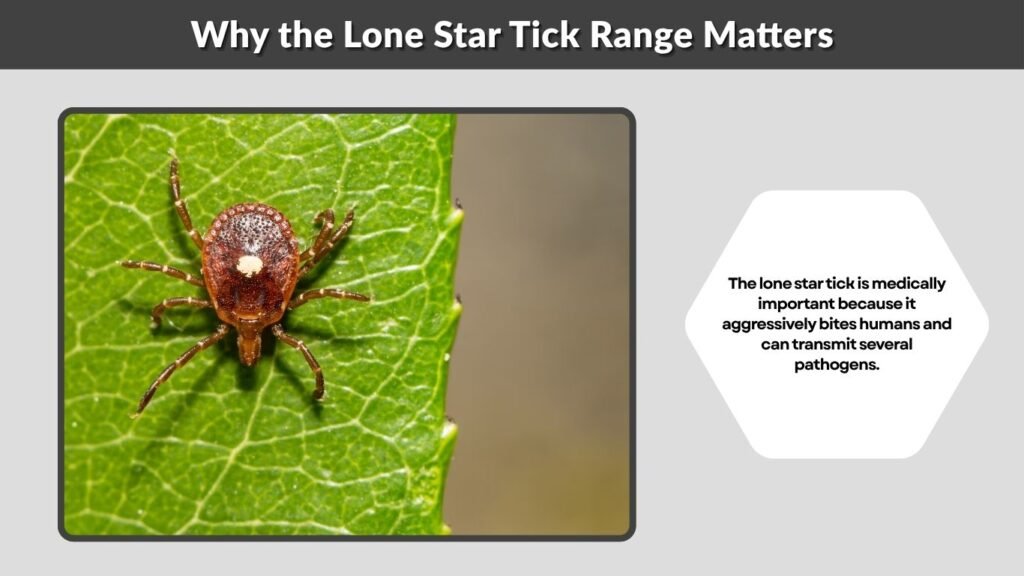
The lone star tick is medically important because it aggressively bites humans and can transmit several pathogens.
It is associated with:
- Ehrlichiosis
- Tularemia
- Heartland virus disease
- Bourbon virus disease
- Southern tick-associated rash illness (STARI)
- Alpha-gal syndrome
CDC emphasizes that a range map shows where a tick may occur; it does not directly show a person’s risk of developing a specific tick-borne disease. Local tick abundance, pathogen prevalence, habitat, and human exposure all affect actual risk.
FAQs
What is the lone star tick range in 2026?
The current range includes much of the eastern United States, particularly the South, Southeast, Midwest, and portions of the Northeast. CDC’s 2026 surveillance page maps established populations documented through 2025.
Are lone star ticks moving north?
Yes. Their documented populations have expanded northward, although some of this represents recolonization of historical range and improved surveillance.
Are lone star ticks found in Canada?
Yes. They have been detected in southern Alberta, Manitoba, Nova Scotia, Ontario, Québec, and Saskatchewan, but detection does not necessarily mean widespread established populations.
Are lone star ticks in Maine?
They can be encountered in Maine, but Maine CDC describes them as moving north and not yet fully established statewide.
Are lone star ticks found in Washington or Oregon?
They are not considered native or established ticks in Washington or Oregon. Oregon specifically reports that the species is not found there, while Washington states that it is not native to the state.
