
The luna moth is one of North America’s most beautiful and recognizable moth species. Known for its pale green wings and long tail-like extensions, this giant silk moth has a surprisingly short adult life. Many people are amazed to learn that although the adult luna moth survives for only a brief period, its complete lifespan includes several developmental stages that can last many months. Understanding the luna moth lifespan helps reveal the remarkable process of metamorphosis that transforms a tiny egg into one of nature’s most stunning insects.
What Is the Lifespan of a Luna Moth?
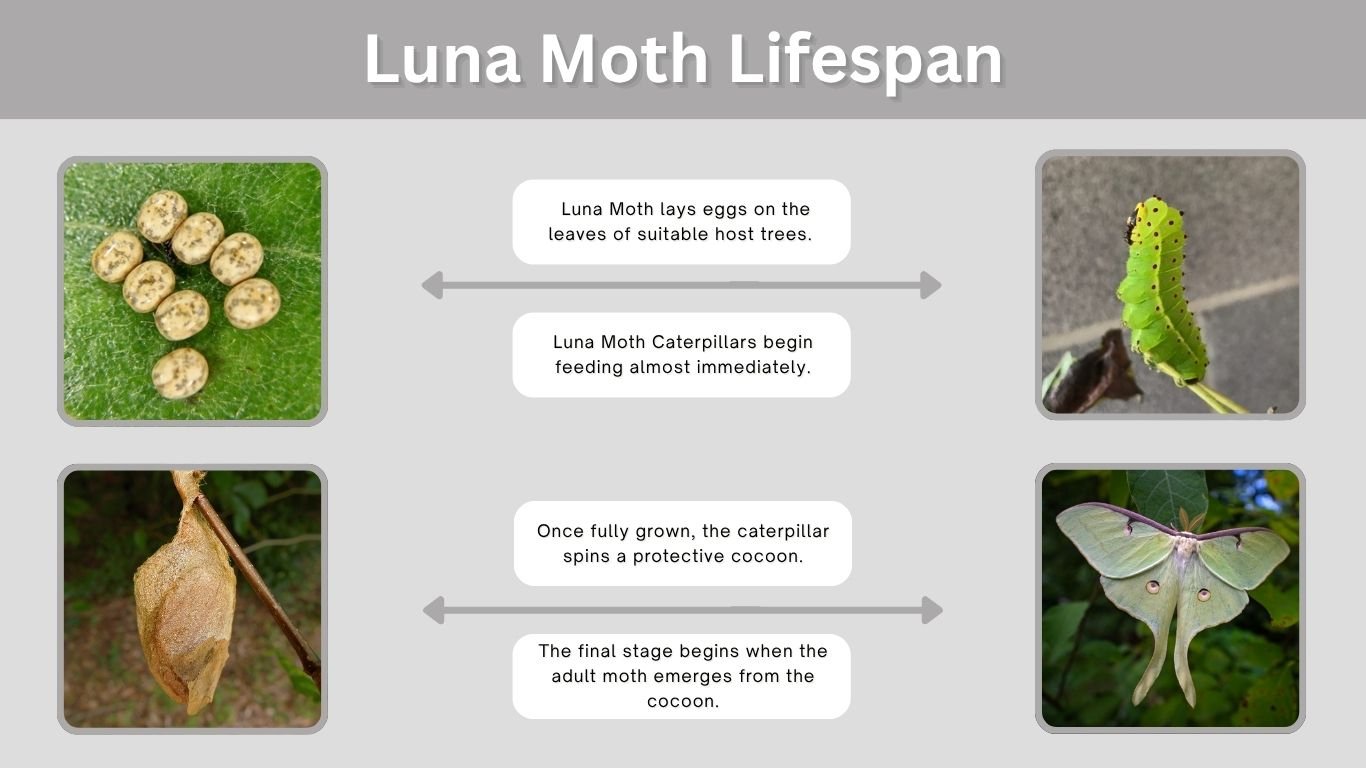
The lifespan of a luna moth varies depending on which stage of development is being considered. While adults live only a short time, the complete life cycle includes the egg, caterpillar, cocoon, and adult stages. Together, these phases make up the entire lifespan of the species.
Average Luna Moth Lifespan
Most adult luna moths live for approximately one week after emerging from their cocoon. During this short period, their primary purpose is reproduction rather than feeding or long-term survival.
Entire Lifespan of a Luna Moth
The complete lifespan can range from several months to nearly a year depending on climate and seasonal conditions. Development slows during colder periods, especially when the insect overwinters inside its cocoon.
Factors Affecting Lifespan
Several factors influence how long a luna moth survives:
- Temperature
- Food availability during the caterpillar stage
- Predators
- Weather conditions
- Habitat quality
These environmental influences affect survival rates throughout the moth’s life cycle.
Luna Moth Life Cycle Explained
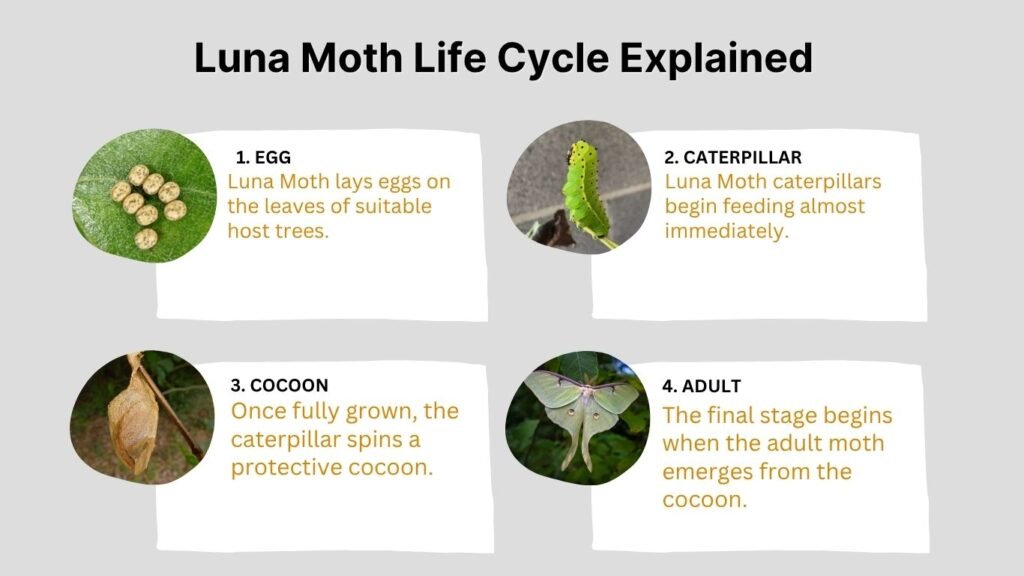
Luna moths undergo complete metamorphosis, one of the most dramatic transformations in the insect world. Each stage serves a unique purpose and contributes to the insect’s development from egg to reproductive adult.
Egg Stage
The lifecycle begins when a female luna moth lays eggs on the leaves of suitable host trees. These eggs are typically attached to foliage where future caterpillars will have immediate access to food after hatching.
Caterpillar Stage
After hatching, luna moth caterpillars begin feeding almost immediately. This stage focuses on growth and energy storage, preparing the insect for its eventual transformation into an adult moth.
Cocoon Stage
Once fully grown, the caterpillar spins a protective cocoon. Inside this structure, it undergoes major physical changes as it transitions into the adult form.
Adult Moth Stage
The final stage begins when the adult moth emerges from the cocoon. At this point, reproduction becomes the primary objective, as the moth has only a short time to find a mate and continue the lifecycle.
Luna Moth Caterpillar Lifespan
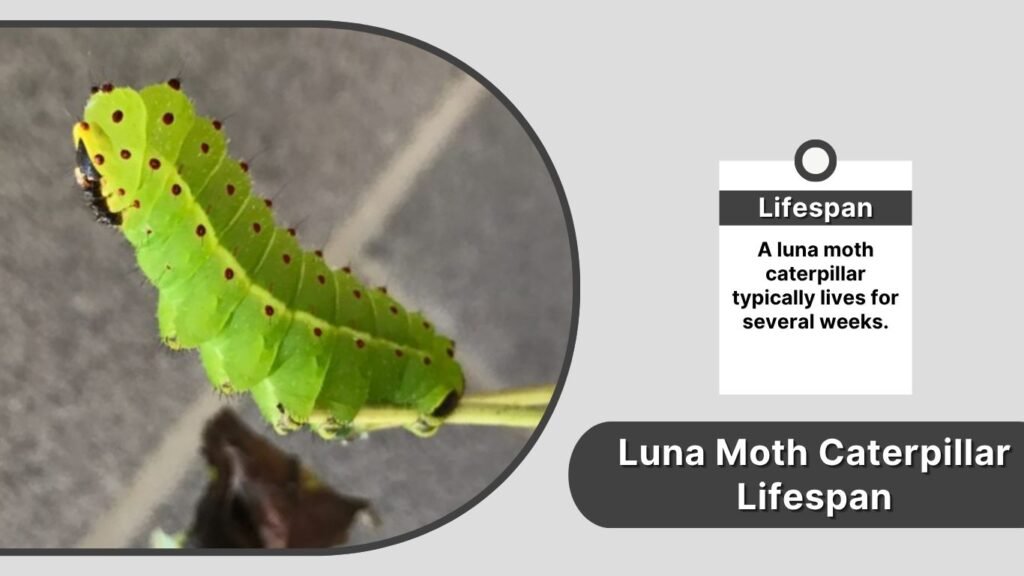
The caterpillar stage is one of the longest and most important periods in a luna moth’s development. During this phase, the insect consumes large amounts of plant material and grows rapidly through several molts.
How Long Does a Luna Moth Caterpillar Live?
A luna moth caterpillar typically lives for several weeks. During this time, it increases dramatically in size and stores the energy necessary for later stages of development.
Caterpillar Growth Stages
The caterpillar passes through multiple growth phases known as instars. After each molt, it becomes larger and better prepared for pupation.
Feeding Habits During This Stage
Common host plants include:
- Walnut trees
- Hickory trees
- Sweetgum trees
- Birch trees
- Persimmon trees
Healthy food sources are essential because adult luna moths do not eat and must rely on energy accumulated during the caterpillar stage.
Predators and Survival Challenges
Caterpillars face numerous threats including birds, spiders, parasitic insects, and environmental hazards. Their bright green coloration helps camouflage them among leaves and reduce the risk of predation.
Luna Moth Cocoon Stage
The cocoon stage represents one of the most fascinating parts of the luna moth lifecycle. Although the insect appears inactive from the outside, dramatic biological changes occur within the protective silk enclosure.
How Long Does the Cocoon Stage Last?
The duration of the cocoon stage varies depending on environmental conditions. In warmer months, development may take only a few weeks. In colder regions, the moth may remain inside the cocoon throughout winter.
What Happens Inside the Cocoon?
During pupation, the caterpillar’s body is reorganized into the structure of an adult moth. Wings, antennae, reproductive organs, and other adult features develop inside the cocoon.
Winter Dormancy and Overwintering
Many luna moths spend winter in their cocoons. This period of dormancy helps synchronize emergence with favorable spring conditions when host plants begin producing fresh leaves.
Adult Luna Moth Lifespan
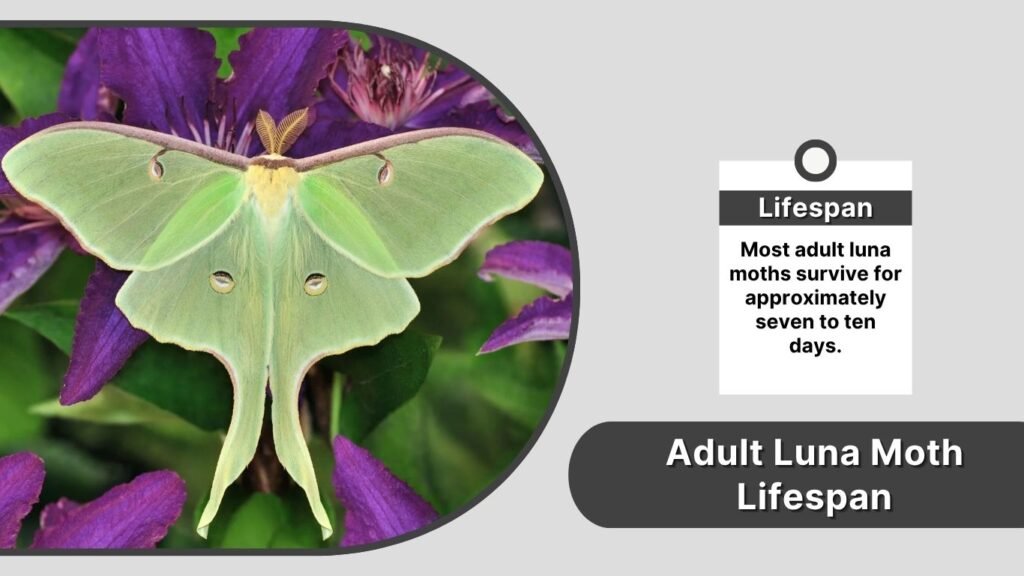
The adult stage is the most visually striking but also the shortest phase of the luna moth’s life. Despite their impressive appearance, adult luna moths are remarkably short-lived and spend their final days focused almost entirely on reproduction.
How Long Does an Adult Luna Moth Live?
Most adult luna moths survive for approximately seven to ten days. This brief lifespan is enough time to locate a mate, reproduce, and complete their biological purpose.
Why Adult Luna Moths Do Not Eat
Unlike many other insects, adult luna moths lack functional mouthparts. Because they cannot eat, they rely entirely on energy reserves accumulated during their caterpillar stage. This adaptation contributes to their short lifespan and makes efficient reproduction essential for survival.
Luna Moth Lifespan in Captivity
Luna moth lifespan in captivity is often similar to lifespan in the wild, especially during the adult stage. Captive conditions may protect moths from predators and harsh weather, but they do not change the fact that adult luna moths cannot eat. Their short adult life is a natural part of their biology.
Average Captive Lifespan
Adult luna moths in captivity usually live about seven to ten days. Good conditions may help them avoid injury or stress, but captivity does not greatly extend their adult lifespan.
Captive vs Wild Luna Moths
Wild luna moths face more dangers, including predators, storms, and habitat loss. Captive moths may be safer, but they still depend on stored energy from the caterpillar stage.
Factors Affecting Survival
Important survival factors include:
- Proper humidity
- Safe enclosure space
- Gentle handling
- Stable temperature
- Access to suitable host plants for caterpillars
These conditions are especially important when raising luna moths from eggs or caterpillars.
Chinese Luna Moth Lifespan
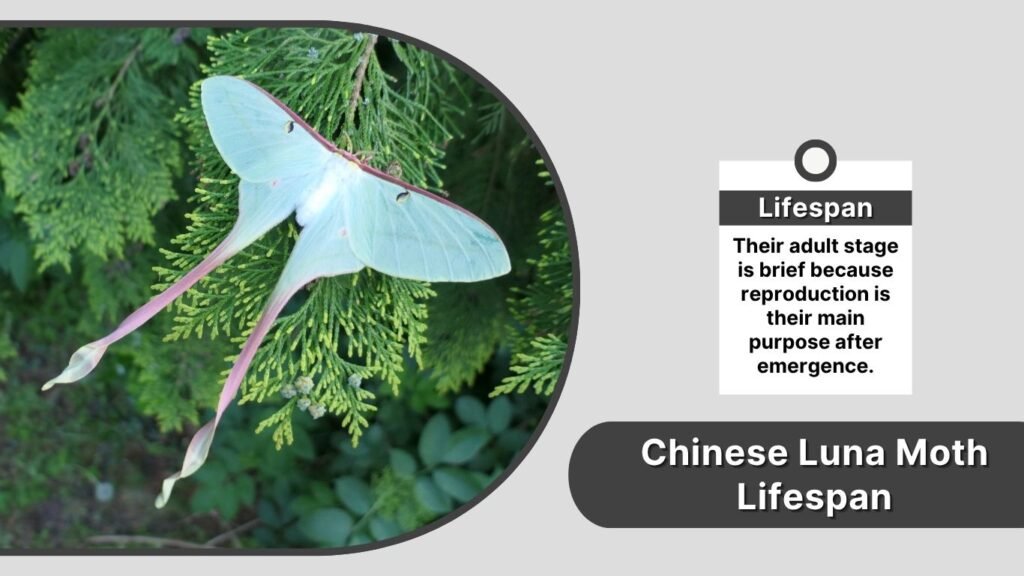
The Chinese luna moth is related to the North American luna moth and shares a similar life cycle. Although species may differ in size, habitat, and development time, both follow the same basic pattern of egg, caterpillar, cocoon, and adult stages.
What Is a Chinese Luna Moth?
The Chinese luna moth is a large silk moth known for its pale green wings and long tails. Like other giant silk moths, it is admired for its beauty and short adult life.
Lifespan Comparison
Chinese luna moths also spend more time developing as caterpillars and pupae than they do as adults. Their adult stage is brief because reproduction is their main purpose after emergence.
Habitat Differences
Chinese luna moths occur in different regions than North American luna moths. Local climate, host plants, and seasonal patterns can affect how long each stage lasts.
What Affects a Luna Moth’s Lifespan?
Several natural factors influence how long a luna moth survives. Some affect the caterpillar stage, while others influence cocoon development or adult survival. Because adult luna moths cannot feed, the success of earlier life stages is especially important.
Temperature and Weather
Warm temperatures often speed development, while cold weather can slow it down. In cooler climates, luna moths may remain in the cocoon for months before emerging.
Food Availability
Caterpillars need suitable host plants to grow properly. Without enough food, they may develop slowly or fail to reach the energy level needed for adulthood.
Predators and Habitat Quality
Birds, bats, spiders, and parasitic insects may reduce survival. Healthy forests and native host plants improve the chances of successful development.
Luna Moth Lifespan Compared to Other Moths
Comparing luna moths with other large silk moths helps explain why their adult lives seem so short. Many giant silk moths share the same strategy: grow as caterpillars, store energy, emerge as adults, mate quickly, and die soon after reproduction.
Luna Moth vs Cecropia Moth
Both luna moths and cecropia moths are giant silk moths with short adult lives. Their caterpillar and cocoon stages last much longer than their adult stage.
Luna Moth vs Polyphemus Moth
Polyphemus moths follow a similar lifecycle. Like luna moths, adults do not feed and survive on energy stored during the caterpillar stage.
Which Moth Lives Longer?
The total lifespan depends on climate, overwintering, and species. However, among many giant silk moths, the adult stage is usually brief, often lasting only days to about two weeks.
Fascinating Luna Moth Lifespan Facts
Luna moths are not long-lived as adults, but their lifecycle is full of remarkable adaptations. Their short adult stage, silent flight, pale green color, and long tails all support survival and reproduction in different ways.
Surprising Lifespan Facts
Interesting facts include:
- Adults usually live about one week
- Adult luna moths do not eat
- Caterpillars do most of the growing
- Cocoons may overwinter for months
- Females lay eggs soon after mating
These facts explain why the full lifecycle is much longer than the adult lifespan.
Why Their Short Life Matters
The short adult life of a luna moth is not a failure. It is a specialized survival strategy. By using stored energy for mating and egg-laying, the adult moth focuses entirely on continuing the next generation.
FAQs
What Is the Lifespan of a Luna Moth?
The complete lifespan of a luna moth typically ranges from several months to about one year, depending on climate and environmental conditions. However, the adult luna moth usually lives for only 7 to 10 days after emerging from its cocoon.
Why Do Adult Luna Moths Live Such a Short Time?
Adult luna moths do not have functional mouthparts and cannot eat. They survive entirely on energy stored during the caterpillar stage. Their primary purpose as adults is to mate and reproduce before their energy reserves are exhausted.
How Long Does a Luna Moth Stay in Its Cocoon?
The cocoon stage can last from a few weeks to several months. In colder regions, luna moths often overwinter inside their cocoons and emerge the following spring when temperatures become favorable.
Can Luna Moths Live Longer in Captivity?
Captivity may protect luna moths from predators and harsh weather, but it does not significantly extend their adult lifespan. Most captive adults still live only about 7 to 10 days because they cannot feed.
Which Stage of the Luna Moth Lifecycle Lasts the Longest?
The caterpillar and cocoon stages are generally the longest parts of the luna moth lifecycle. Together, these stages can last several weeks or even months, depending on environmental conditions and seasonal timing.
