
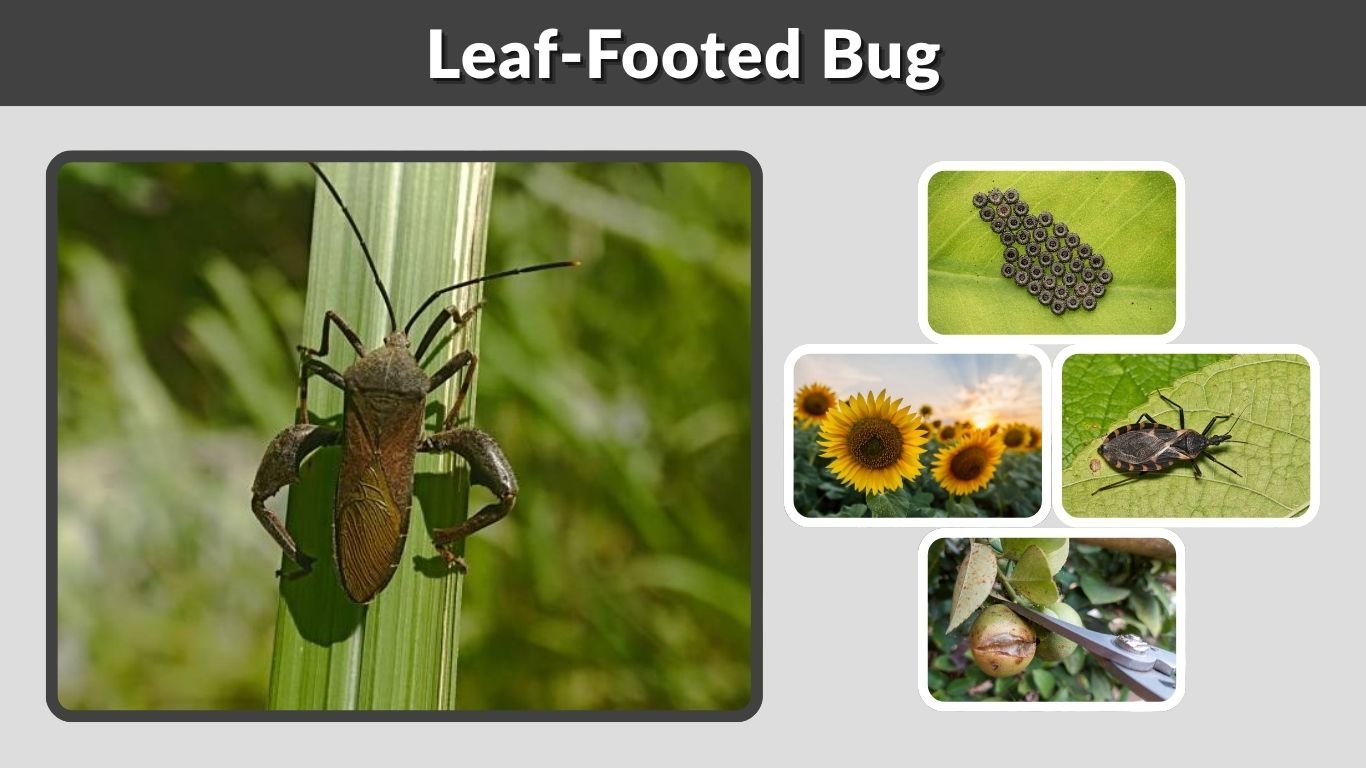
Leaf-footed bugs are large plant-feeding insects recognized by the flattened, leaf-shaped sections on their hind legs. Adults are commonly found on tomatoes, pomegranates, citrus, nuts, and ornamental plants. Their red or orange nymphs are frequently confused with assassin bug nymphs, while adults may be mistaken for stink bugs or kissing bugs. This guide explains how to identify leaf-footed bugs, recognize their eggs and nymphs, understand the damage they cause, and control them naturally.
What Is a Leaf-Footed Bug?
Leaf-footed bugs are true bugs belonging to the family Coreidae. Many species have flattened expansions on their hind legs that resemble small leaves, although these structures are not equally noticeable in every species.
They are related to stink bugs but have longer, narrower bodies. Leaf-footed bugs use piercing-sucking mouthparts to extract fluids from fruit, seeds, stems, and other plant tissue. They do not chew holes in leaves.
Leaf-Footed Bug Identification
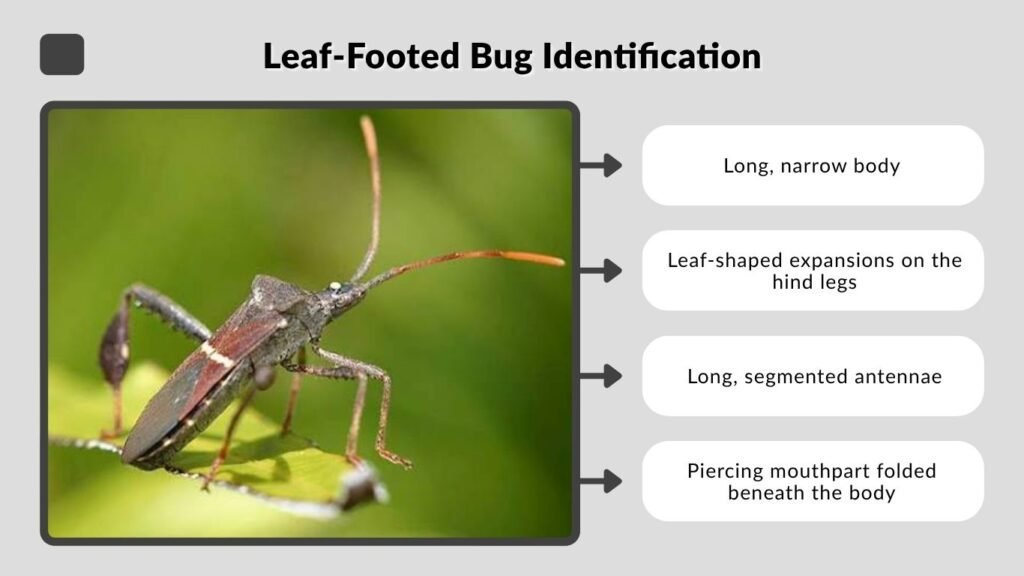
Adult leaf-footed bugs are usually brown, gray, reddish-brown, or nearly black. Most common species measure approximately ¾–1 inch long, while giant species may exceed an inch.
Key Identification Features
- Long, narrow body
- Leaf-shaped expansions on the hind legs
- Long, segmented antennae
- Piercing mouthpart folded beneath the body
- Brown, gray or black coloration
- White or pale zigzag band across the wings
- Ability to fly when disturbed
- Strong odor when handled or crushed
The western conifer seed bug and several Leptoglossus species display a white zigzag marking across their folded wings. Other species, particularly giant leaf-footed bugs, have broad shoulders and heavily developed hind legs.
Leaf-Footed Bug Nymphs
Young leaf-footed bugs look noticeably different from adults. Newly hatched nymphs are usually orange, red, reddish-brown, or dark blue-black. They have long black legs and antennae but lack developed wings.
Nymphs commonly remain grouped near the eggs immediately after hatching. As they mature, they separate, grow wing pads, and develop noticeable leaf-shaped expansions on their hind legs.
How to Identify a Nymph
- Bright red, orange or reddish-brown abdomen
- Dark head, antennae and legs
- Long, narrow body
- No functional wings
- Found in groups on fruit or stems
- Hind-leg expansions become visible in later stages
Some nymphs appear blue or metallic black because of their species, age, recent molt, or lighting. Color alone is not sufficient for identification.
Leaf-Footed Bug Eggs
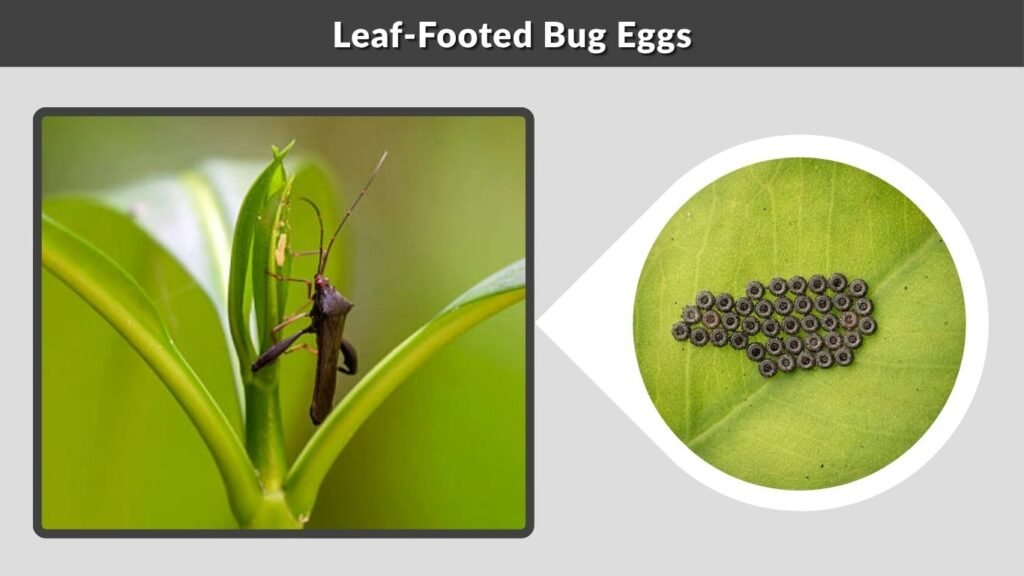
Females lay brown, bronze, or copper-colored cylindrical eggs end-to-end in straight chains. Egg rows are commonly attached along stems, leaf veins, tendrils, or fruit.
A typical row contains approximately 10–15 eggs, although much larger groups are possible. Eggs usually hatch in about a week during warm weather. Empty eggs have open tops where the nymphs emerged.
Removing egg rows is one of the easiest and most effective ways to prevent an infestation.
Common Types of Leaf-Footed Bugs
Numerous species occur across North America. Their abundance varies by climate and available host plants.
| Type | Identification and range |
| Eastern leaf-footed bug | White band across wings; common in eastern and southern states |
| Western conifer seed bug | Feeds on conifer seeds and often enters buildings |
| Banded leaf-footed bug | White zigzag marking and two yellow spots behind the head |
| Giant leaf-footed bug | Broad shoulders, powerful hind legs and body exceeding one inch |
| Magnolia leaf-footed bug | Associated primarily with magnolia trees |
The giant leaf-footed bug (Acanthocephala declivis) occurs in parts of the southeastern United States, including Florida and Texas. It is one of the largest true bugs in the region. Its intimidating size does not make it dangerous to humans.
Male vs Female Leaf-Footed Bugs
Males and females usually have similar body colors and wing patterns, making sex difficult to determine without examining the abdomen. Females often have broader, more rounded abdominal tips, while males tend to be narrower.
In some giant leaf-footed bug species, males possess thicker, more heavily spined hind legs. They use these enlarged legs when competing with other males. However, leg size is not a reliable sexing method for every species.
Life Cycle
Leaf-footed bugs undergo incomplete metamorphosis with three main stages: egg, nymph, and adult. Nymphs pass through several developmental stages and gradually acquire adult features.
Adults often overwinter in woodpiles, under loose bark, inside sheds, among palm fronds, or in other protected locations. They become active during warm spring weather and move to weeds, gardens, orchards, and fruiting plants.
Females may produce more than 200 eggs over an extended period. Nymphs can become adults within approximately five to eight weeks. Depending on the region and climate, two or three generations may develop annually.
What Do Leaf-Footed Bugs Eat?
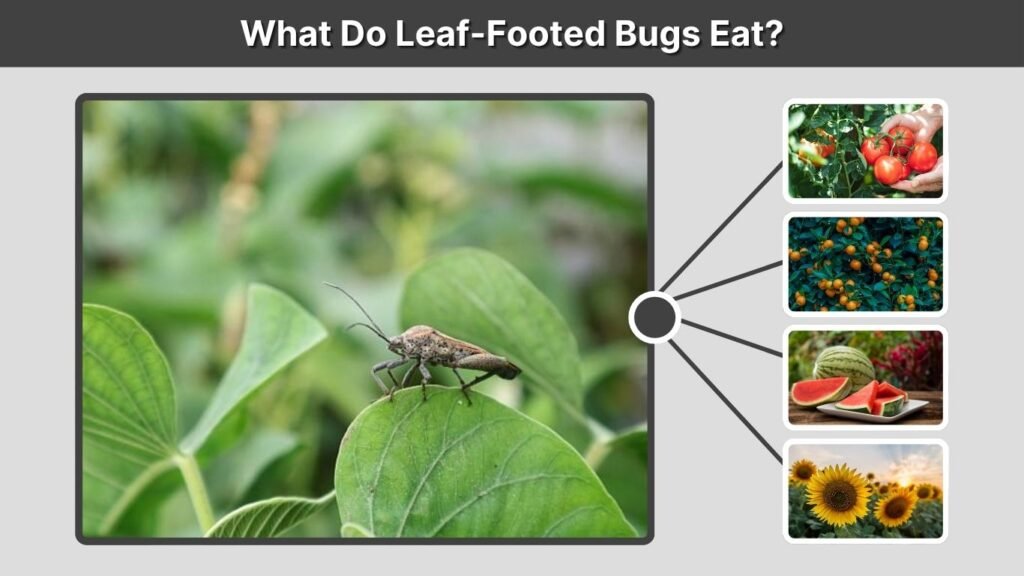
Leaf-footed bugs feed on a wide selection of plants but are especially attracted to developing fruit and seeds.
Common host plants include:
- Tomatoes
- Pomegranates
- Citrus
- Peaches
- Watermelons
- Squash
- Beans
- Almonds and pistachios
- Sunflowers
- Magnolia trees
- Conifers
- Thistles and weeds
They insert their long mouthparts into plant tissue and inject digestive saliva. Liquefied plant material is then drawn into the insect’s body.
Leaf-Footed Bug Damage
A few bugs may cause only cosmetic damage, but large groups can reduce fruit quality and production. Feeding on young tomatoes may cause fruit to drop. Older tomatoes can develop pale spots, depressions, yellow discoloration, or hardened areas beneath the skin.
Pomegranates may look healthy externally while developing darkened or withered seeds inside. Feeding wounds can also provide entry points for microorganisms that cause internal discoloration or rot.
Damage is generally most serious on:
- Young or ripening fruit
- Developing nuts and seeds
- Plants carrying large groups of nymphs
- Fruit already cracked or injured
- Crops repeatedly attacked throughout the season
Leaf-Footed Bug vs Similar Insects
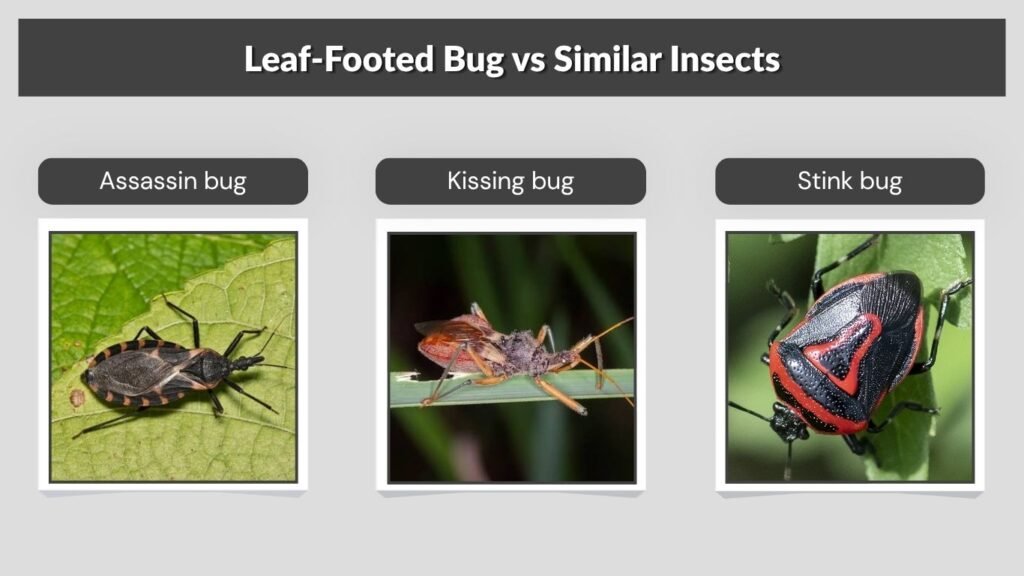
| Insect | Main difference |
| Assassin bug | Predator with a shorter, curved beak and narrow neck |
| Kissing bug | Dark body with colored abdominal edges; may feed on blood |
| Stink bug | Broad, shield-shaped body without leaf-like hind legs |
| Squash bug | Flatter body and no enlarged leaf-shaped hind legs |
| Western conifer seed bug | A type of leaf-footed bug associated with conifers |
Assassin bugs are beneficial predators that eat caterpillars and other pests. Their nymphs can resemble red leaf-footed bug nymphs. Assassin bug nymphs commonly have lighter-colored legs, a distinct narrow neck, and a more prominent curved beak.
Are Leaf-Footed Bugs Dangerous?
Leaf-footed bugs are not considered dangerous to humans or pets. They do not feed on blood or spread Chagas disease. Their mouthparts are designed for piercing plants.
A bug may produce a painful defensive jab if trapped against the skin or handled roughly, but bites are uncommon. Wash the affected area with soap and water if one occurs.
Leaf-footed bugs can also release an unpleasant defensive smell. This is why they are sometimes incorrectly called leaf-footed stink bugs.
How to Get Rid of Leaf-Footed Bugs
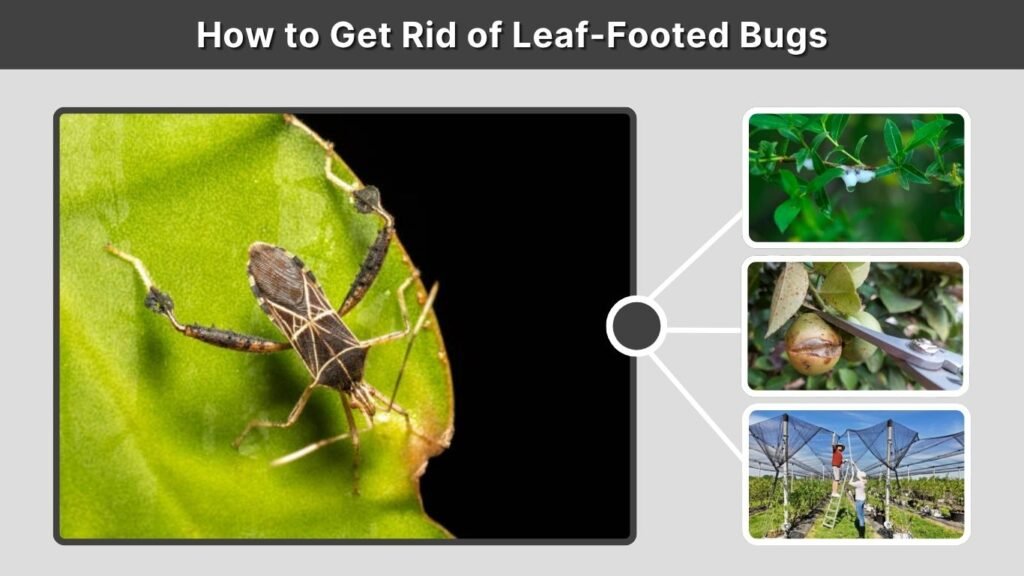
Control is most successful when eggs and young nymphs are removed before they become flying adults.
Natural and Physical Control
- Inspect fruit, stems and leaf veins for egg chains.
- Crush or remove eggs with tape.
- Handpick adults while wearing gloves.
- Drop captured bugs into soapy water.
- Spray clustered nymphs from plants with a strong stream of water.
- Remove severely infested fruit.
- Keep nearby weeds cut short.
- Clear unnecessary woodpiles and plant debris.
- Use insect netting before adults arrive.
- Check plants several times each week.
Morning is the best time to collect them because cool temperatures make adults slower and less likely to fly.
Birds, spiders, assassin bugs, tachinid flies, and tiny parasitic wasps help control populations. Avoid unnecessary broad-spectrum insecticides that kill these natural enemies.
Sprays and Insecticides
Insecticidal soap, neem oil, or pyrethrin may reduce young nymphs when the spray contacts them directly. These treatments are much less effective against mature adults.
Stronger insecticides should be reserved for severe infestations. Always select a product labeled for both the target crop and leaf-footed bugs. Follow pollinator warnings, application rates, and the required waiting period before harvesting edible produce.
FAQs
Do leaf-footed bugs bite humans?
Leaf-footed bugs rarely bite people because they feed primarily on plants. A defensive jab may occur when one is squeezed or handled roughly. It can be painful but is not normally dangerous and does not transmit Chagas disease.
Can leaf-footed bugs fly?
Adult leaf-footed bugs have functional wings and are strong flyers. They quickly move between weeds, gardens, fruit trees, and orchards. Nymphs cannot fly because their wings remain undeveloped until they reach adulthood.
Are leaf-footed bugs harmful to plants?
Large populations can damage tomatoes, pomegranates, citrus, nuts, seeds, and other fruiting crops. Feeding may cause discoloration, sunken spots, fruit drop, internal damage, or rot. A single insect usually causes little noticeable harm.
What kills leaf-footed bugs naturally?
Handpicking, soapy-water traps, strong water sprays, egg removal, and exclusion netting can reduce populations. Birds, spiders, assassin bugs, tachinid flies, and parasitic wasps also kill leaf-footed bugs or their eggs naturally.
How can I remove leaf-footed bugs from tomatoes?
Inspect tomato plants regularly and destroy egg chains. Knock clustered nymphs into soapy water or remove them with a strong stream of water. Pick adults during cool mornings and protect developing fruit with properly secured insect netting.
