
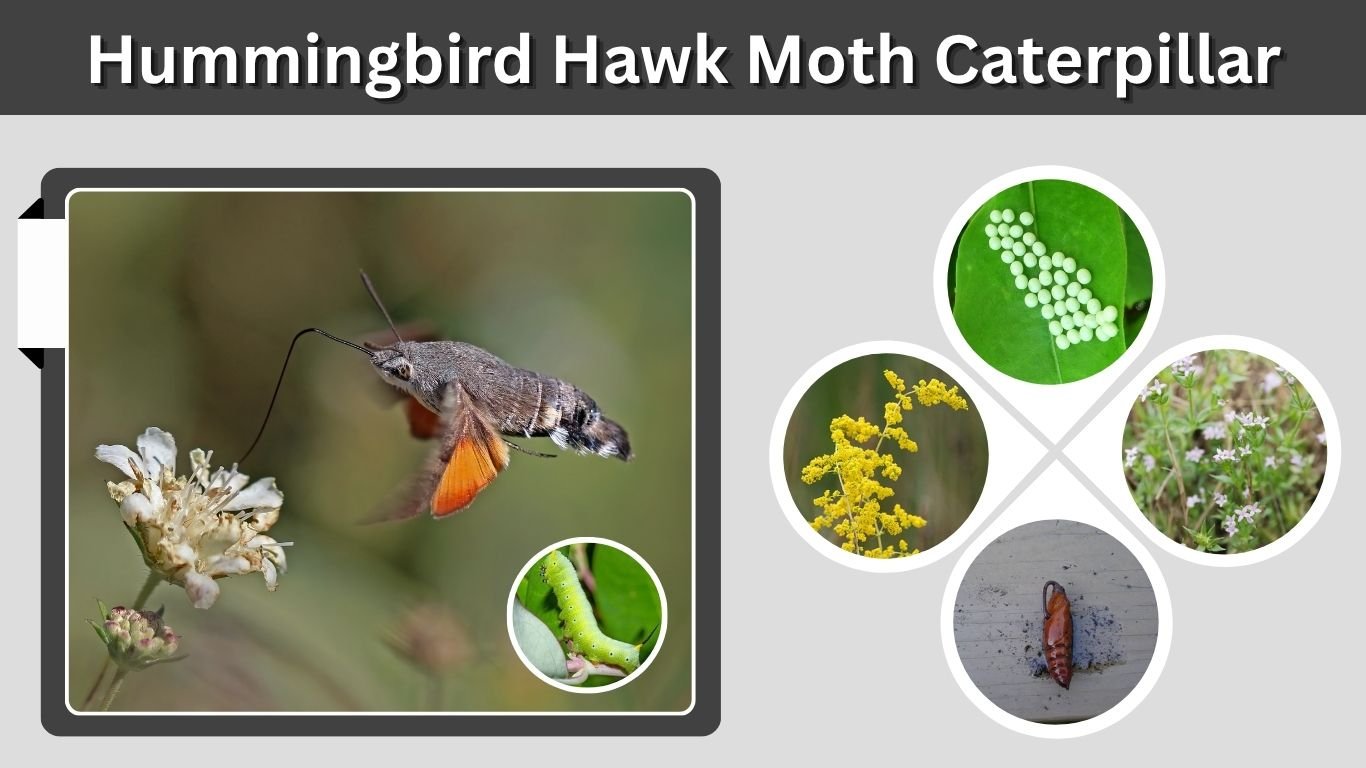
The hummingbird hawk moth caterpillar is the larval stage of Macroglossum stellatarum, a remarkable hawk moth famous for hovering like a tiny hummingbird. The caterpillar looks very different from the adult, typically displaying a green body, pale side stripes, small white spots, and a distinctive tail horn. It feeds mainly on bedstraws and related plants before pupating near ground level. This guide explains hummingbird hawk moth caterpillar identification, size, food plants, life cycle, UK occurrence, safety, and how to distinguish it from similar North American caterpillars.
What Does a Hummingbird Hawk Moth Caterpillar Look Like?
Hummingbird hawk moth larvae belong to the hawk moth family Sphingidae, whose caterpillars are commonly called hornworms because many have a conspicuous projection at the rear of the body. Young larvae are tiny and pale, but their colors and markings become much clearer as they grow. Fully developed caterpillars are usually green, although some individuals become brownish before pupation.
Identification
A mature hummingbird hawk moth caterpillar usually has:
- A smooth green or occasionally reddish-brown body
- Numerous tiny pale or whitish dots
- Pale longitudinal stripes along each side
- A relatively small, rounded green head
- Several pairs of gripping prolegs underneath
- A straight horn projecting from the rear
- A blue, purplish, or reddish horn that may have an orange tip
The tail horn is one of the most noticeable features. Despite its sharp appearance, it is not a stinger and is harmless to people.
Mature larvae can vary considerably in color. Green individuals blend exceptionally well with their food plants, while caterpillars approaching pupation may become darker or acquire reddish-brown or plum coloration.
Hummingbird Hawk Moth Caterpillar Size
The caterpillar grows rapidly because the larval stage is primarily devoted to eating and storing energy. Newly hatched larvae are only a few millimeters long, but each molt allows the body to expand significantly. By the final stage, the caterpillar is surprisingly large compared with the tiny egg from which it emerged.
How Big Does the Caterpillar Get?
A newly hatched caterpillar may measure only about 2–3 mm long. A fully fed hummingbird hawk moth caterpillar usually reaches approximately 45–50 mm, or roughly 1.8–2 inches, before pupating.
Growth occurs through several larval stages known as instars. Because a caterpillar’s outer skin cannot continuously stretch as the animal grows, it periodically molts and replaces the old exoskeleton.
The mature caterpillar becomes thick-bodied but remains more streamlined than some larger hawk moth larvae.
What Do Hummingbird Hawk Moth Caterpillars Eat?
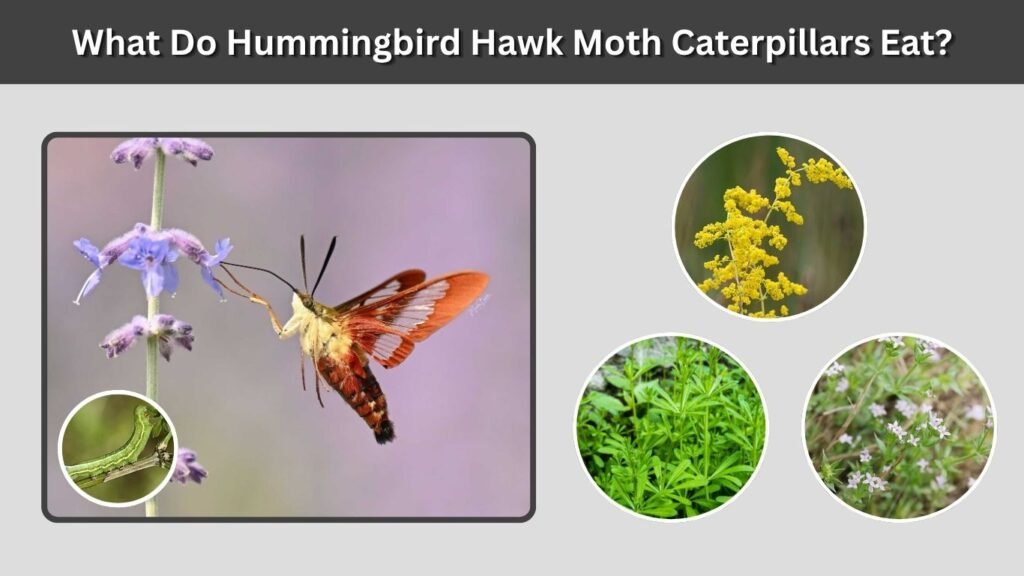
Food plants are extremely important because female moths normally place their eggs where newly hatched larvae can immediately begin feeding. Hummingbird hawk moth caterpillars are strongly associated with plants in the bedstraw family. Rather than wandering widely in search of food, young larvae usually remain on or close to suitable host vegetation.
Caterpillar Food Plants
The principal food plants include bedstraws (Galium), with UK records also including hedge bedstraw, lady’s bedstraw, cleavers, and wild madder. Other related members of the Rubiaceae family can sometimes be used.
Bedstraws are often found along roadsides, field margins, grasslands, hedgerows, woodland edges, and gardens.
The caterpillar eats the leaves using strong chewing mouthparts. Feeding becomes especially intensive during the later stages because the larva must accumulate enough energy to complete pupation and emerge as an adult moth.
What Should You Feed a Found Caterpillar?
If a caterpillar must temporarily be kept for observation, the safest food is the same plant on which it was found. Fresh bedstraw is preferable when the caterpillar has already been identified as Macroglossum stellatarum.
Avoid offering pesticide-treated garden plants. Fresh foliage should be replaced regularly, and wilted or moldy leaves should be removed.
For a healthy wild caterpillar, however, leaving it on its natural food plant is generally better than bringing it indoors.
Hummingbird Hawk Moth Caterpillar Life Cycle
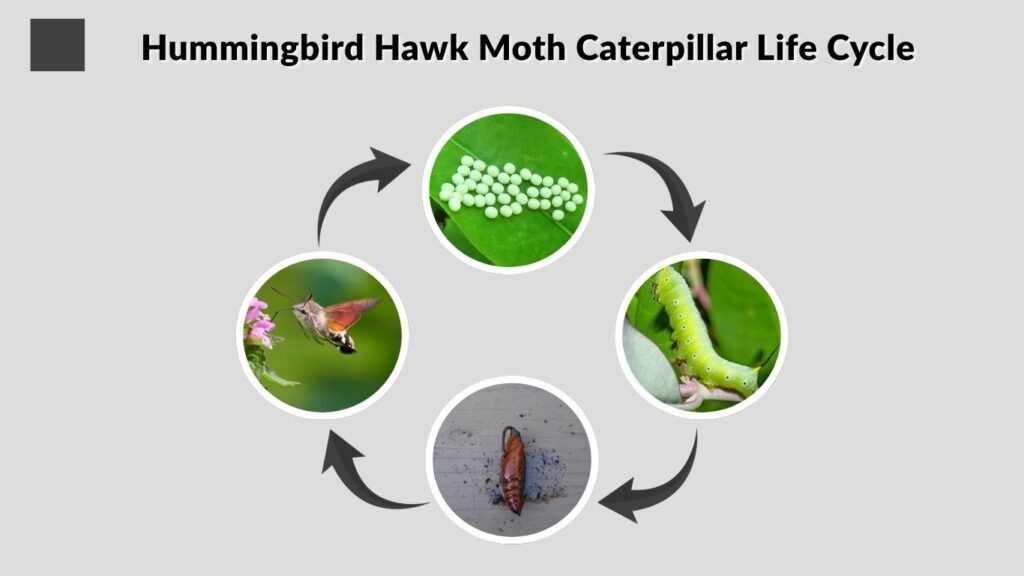
The hummingbird hawk moth undergoes complete metamorphosis, passing through four stages: egg, caterpillar, pupa, and adult. Temperature has a strong influence on development, and warm conditions can allow a generation to progress relatively quickly. Like other moth caterpillars, its main role during the larval stage is to eat, grow, and prepare for pupation.
Egg to Caterpillar
A female places small pale-green eggs on suitable host plants. The eggs are roughly spherical and can resemble tiny plant buds.
After hatching, the very small larva begins eating. Young caterpillars are initially pale but later develop the characteristic green body, pale stripes, spots, and rear horn.
The caterpillar passes through several molts as it increases dramatically in size.
Caterpillar to Pupa
A mature caterpillar eventually stops eating and begins wandering away from its feeding position. This behavior can make people think something is wrong, but it often means the insect is searching for a suitable pupation site.
Pupation generally occurs close to the soil surface in a loose cocoon among leaves, vegetation, or other plant debris.
Inside the pupa, the larval body undergoes a remarkable transformation before the adult hummingbird hawk moth emerges.
Adult Moth
The adult bears little resemblance to its caterpillar. It has gray-brown forewings, bright orange hindwings, a broad abdomen, and a long proboscis.
Adults hover in front of flowers while drinking nectar, creating their famous hummingbird-like appearance. UKMoths reports a wingspan of about 40–50 mm.
Hummingbird Hawk Moth Caterpillars in the UK
The hummingbird hawk moth is a well-known migrant in Britain. Numbers vary substantially between years, with warm weather and favorable southerly airflow sometimes bringing large arrivals. Some migrants reproduce after reaching Britain, which means caterpillars can be found on local bedstraw plants during suitable summers.
Where to Find Caterpillars in the UK
Suitable places include grasslands, gardens, field edges, roadsides, coastal habitats, and other areas containing bedstraw or wild madder.
Adults are recorded in greatest numbers in Britain from roughly June through October, and larvae produced by arriving moths can develop into later-season adults.
Finding a caterpillar is usually more difficult than spotting an adult moth because its green coloration provides excellent camouflage among stems and leaves.
Are Hummingbird Hawk Moth Caterpillars Dangerous?
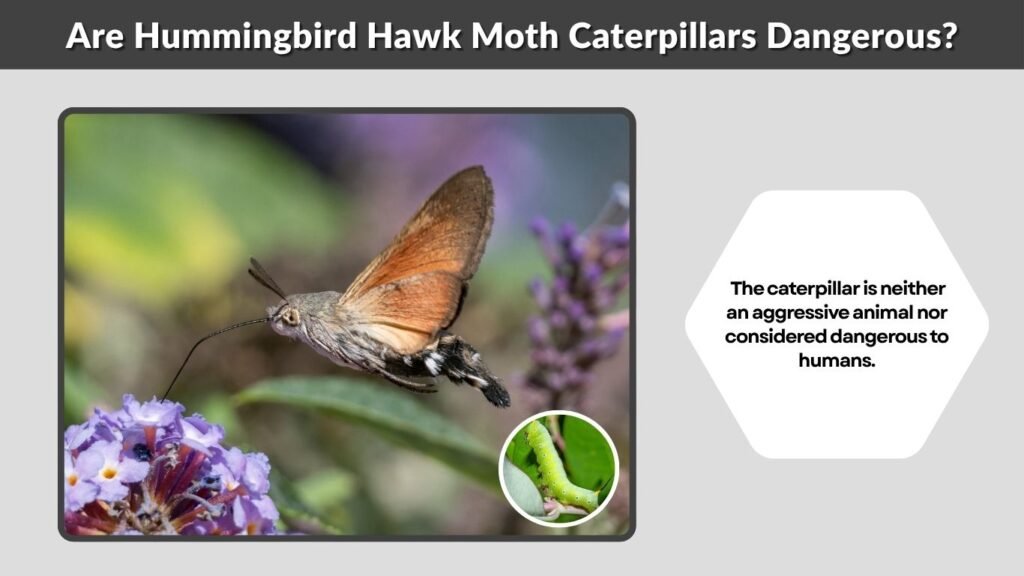
The prominent horn often causes concern because it resembles a defensive spike. In reality, the structure is not connected to venom and cannot sting. The caterpillar is neither an aggressive animal nor considered dangerous to humans.
Can the Caterpillar Sting or Bite?
A hummingbird hawk moth caterpillar does not have a venomous sting. Its rear horn is simply part of its body and serves no stinging function.
Like most caterpillars, it has chewing mouthparts for eating leaves, but it does not normally bite people defensively.
Handling is still unnecessary. Caterpillars are delicate, and repeated touching can injure them. If one needs to be moved, encouraging it onto a leaf or stem is better than squeezing or pulling it.
Pennsylvania Hummingbird Hawk Moth Caterpillar
A caterpillar described as a “hummingbird hawk moth” in Pennsylvania requires careful identification. The true hummingbird hawk moth, Macroglossum stellatarum, is primarily an Old World species found across Europe, Africa, and Asia. It is regarded as a rare vagrant rather than a normally established North American moth.
Similar North American Caterpillars
North America has several native sphinx moths whose adults are commonly called hummingbird moths. Species in genera such as Hemaris can easily create confusion because the adults also hover around flowers and feed with long proboscises.
Therefore, finding a green horned caterpillar in Pennsylvania does not automatically mean it is Macroglossum stellatarum. Location, markings, host plant, horn color, and photographs should all be considered when making an identification.
FAQs
Hummingbird hawk moth caterpillars attract attention because their striking tail horn contrasts with an otherwise well-camouflaged green body. Their unusual appearance also leads to questions about what they eat, how large they become, whether they are dangerous, and where they can be found.
What does a hummingbird hawk moth caterpillar eat?
It primarily eats bedstraws in the genus Galium. Recorded food plants also include wild madder and other related plants in the Rubiaceae family.
How big is a hummingbird hawk moth caterpillar?
A mature caterpillar generally reaches about 45–50 mm, or approximately 1.8–2 inches, in length.
Is the horn on a hummingbird hawk moth caterpillar dangerous?
No. The rear horn is not a stinger and does not inject venom. It may look threatening, but the caterpillar is harmless to humans.
Where can I find hummingbird hawk moth caterpillars in the UK?
Look for them on bedstraws and wild madder in gardens, grasslands, roadsides, hedgerows, field margins, and other sunny areas where adult moths have been active.
What does the caterpillar turn into?
It becomes the hummingbird hawk moth, Macroglossum stellatarum. The adult is a fast-flying moth with orange hindwings that hovers in front of flowers while drinking nectar through its long proboscis.
