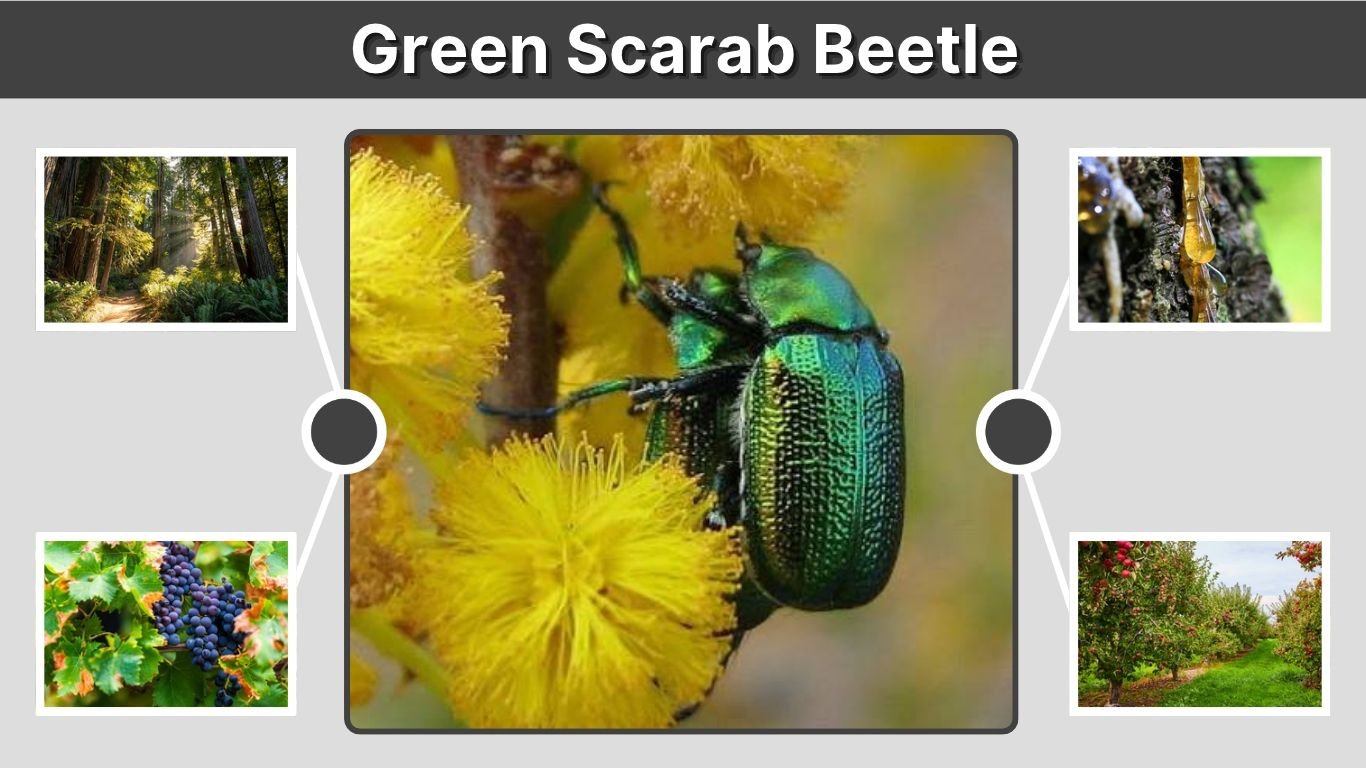
Green scarab beetles are among the most striking insects found in gardens, forests, and grasslands. Their shiny bodies can appear emerald green, bronze, or gold depending on the species and lighting. Although often called a green scarab beetle, this name refers to several species rather than one particular insect. Some feed on ripe fruit, while others visit flowers or eat leaves. Learning how to identify these beetles, where they live, what they eat, and their life cycle helps explain their ecological roles and symbolism in ancient cultures.
What Is a Green Scarab Beetle?
A green scarab beetle is a member of the family Scarabaeidae with a predominantly green body. This large beetle family includes June beetles, flower chafers, dung beetles, and jewel scarabs.
Green scarabs are recognized for their sturdy bodies, hardened wing covers, and antennae with expandable, leaflike tips.
Their coloration varies considerably. Some appear dull green, while others have a brilliant metallic finish that reflects light.
Not all green scarabs are closely related, and their feeding habits and habitats differ by species.
What Does a Green Scarab Beetle Look Like?
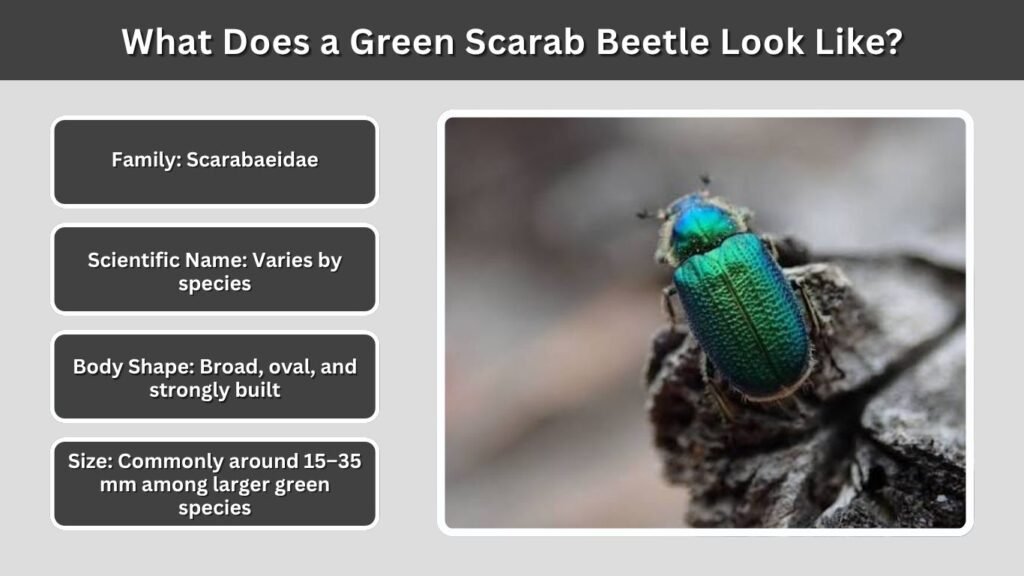
Green scarab beetles usually have oval, robust bodies with shiny or velvety green surfaces. Their appearance varies according to species, age, and environmental conditions.
Some display golden or copper-colored markings, while others have silver stripes or contrasting brown wing margins.
Green Scarab Beetle Identification
- Family: Scarabaeidae
- Scientific Name: Varies by species
- Body Color: Emerald green, metallic green, bronze, or copper-green
- Body Shape: Broad, oval, and strongly built
- Size: Commonly around 15–35 mm among larger green species
- Antennae: Short with expandable, leaflike clubs
- Wings: Hardened outer wing covers protecting functional flight wings
- Legs: Strong, often equipped with spines for gripping or digging
Many green scarabs have iridescent bodies that appear to change color when viewed from different angles.
Types of Green Scarab Beetles
Several scarab beetles have green coloration, but their appearance, distribution, and feeding habits differ.
Green June Beetle
The green June beetle (Cotinis nitida) is a large scarab found primarily in the eastern and southern United States.
Adults have velvety green upper bodies with bronze or yellowish margins. Their undersides often appear shiny metallic green.
These beetles frequently visit ripe fruit and are especially active during summer.
Figeater Beetle
The figeater beetle (Cotinis mutabilis) is common in California, Arizona, and other parts of the southwestern United States.
It has a metallic green body with brownish wing margins and is often seen flying around gardens and fruit trees.
Adults feed on soft, ripe fruit, including figs, peaches, and grapes.
Green Jewel Scarab
Green jewel scarabs belong mainly to the genus Chrysina. One striking example is Chrysina gloriosa, also called the glorious scarab.
This beetle has metallic green wing covers decorated with silvery stripes. It inhabits mountain environments in the southwestern United States and northern Mexico.
Green Rose Chafer
The green rose chafer (Cetonia aurata) occurs in Europe, including the United Kingdom.
It has a brilliant emerald-green body, sometimes showing golden or bronze reflections.
Adults commonly visit flowers, while their larvae feed on decomposing plant material.
Where Do Green Scarab Beetles Live?
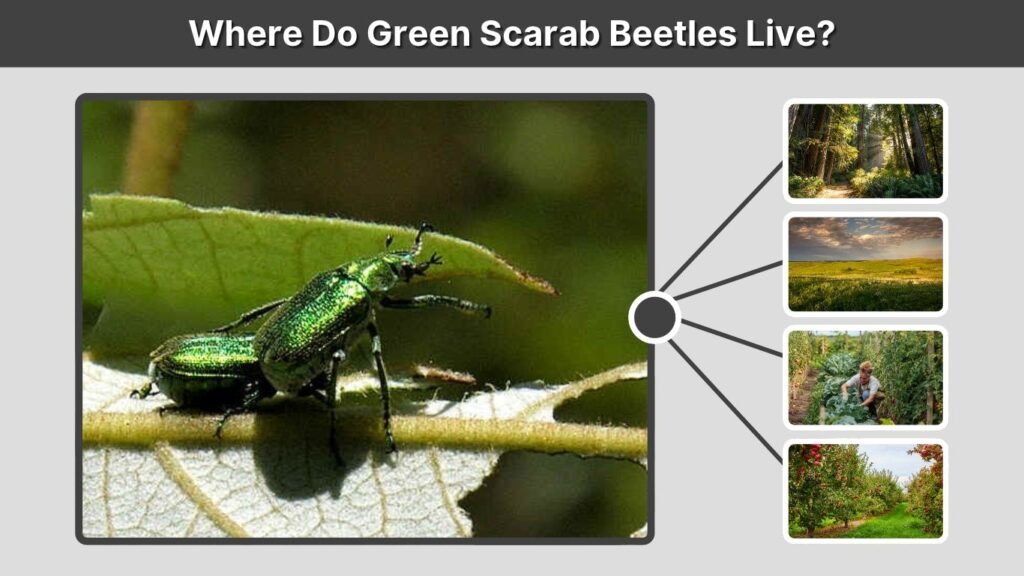
Green scarab beetles inhabit diverse environments worldwide. Their distribution depends on the particular species, climate, vegetation, and available food.
Green Scarab Beetle Habitat
- Forests: Jewel scarabs inhabit wooded environments, particularly areas containing suitable host trees.
- Grasslands: Green June beetles occur around lawns, pastures, and open grassy areas.
- Gardens: Flowering plants and fruit trees attract several green scarab species.
- Orchards: Figeater beetles and green June beetles frequently visit ripening fruit.
- Mountain Woodlands: Some jewel scarabs inhabit juniper and other mountain forests.
- Compost Areas: Organic-rich soil and decomposing vegetation support the larvae of certain species.
Green scarabs occur in North America, Europe, Asia, Australia, and other regions, although the species differ geographically.
What Do Green Scarab Beetles Eat?
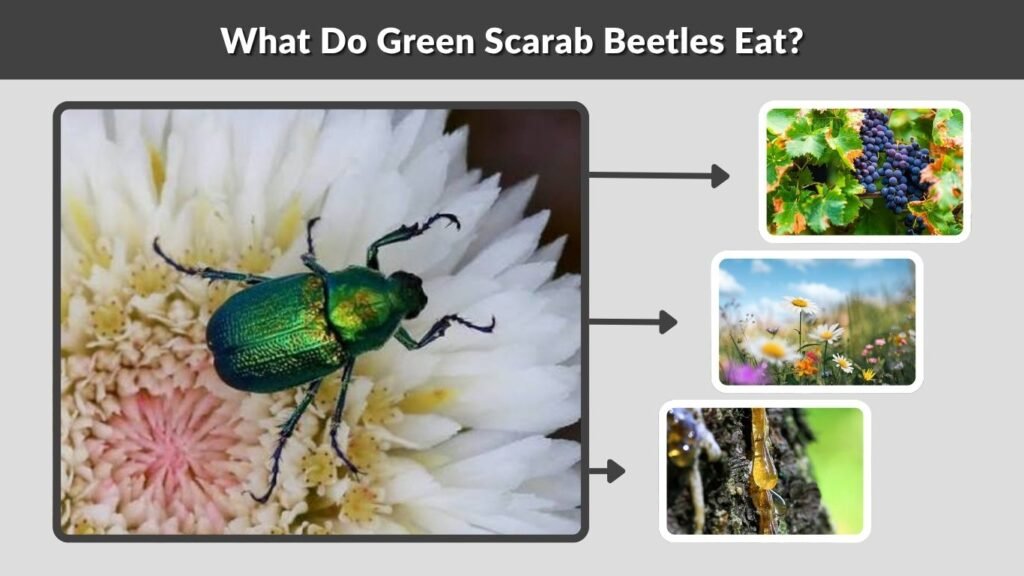
Green scarab beetles consume different foods depending on their species and developmental stage.
Adult beetles may feed on flowers, leaves, fruit, or plant sap. Larvae commonly feed underground or inside decomposing organic material.
Common Green Scarab Beetle Foods
- Ripe Fruit: Green June beetles and figeaters consume figs, peaches, grapes, and other soft fruits.
- Flower Parts: Rose chafers feed on flowers, including pollen and nectar.
- Tree Leaves: Some jewel scarabs consume foliage from specific host trees.
- Plant Sap: Certain green June beetles visit damaged trees to obtain sap.
- Decaying Matter: Many larvae consume decomposing plant material.
- Organic-Rich Soil: Some grubs feed on organic matter and may disturb grass roots.
Their feeding activities can contribute to nutrient recycling, although some species damage crops and ornamental plants.
Green Scarab Beetle Life Cycle
Green scarab beetles undergo complete metamorphosis, developing through four stages: egg, larva, pupa, and adult.
Their development varies by species and environmental conditions.
Four Stages of Development
- Egg Stage: Female beetles deposit eggs in soil, decomposing wood, or other suitable materials.
- Larval Stage: The eggs hatch into whitish grubs that feed on organic matter, roots, or decaying wood, depending on the species.
- Pupal Stage: Mature larvae transform into pupae inside protected chambers, usually underground or within decaying material.
- Adult Stage: Fully developed beetles emerge, feed, mate, and eventually reproduce.
Green June beetles generally complete their life cycle in approximately one year. Other green scarab species may take longer to reach adulthood.
Why Are Green Scarab Beetles Metallic and Shiny?
The brilliant coloration of many green scarab beetles results partly from microscopic structures in their outer shells.
These structures interact with incoming light, producing metallic reflections and iridescent colors.
Unlike ordinary pigments, structural coloration can change appearance depending on viewing angle and lighting.
The metallic green jewel scarab Chrysina gloriosa is a notable example of this optical phenomenon.
Such coloration may contribute to camouflage, particularly when beetles rest among reflective leaves and vegetation.
Do Green Scarab Beetles Bite?
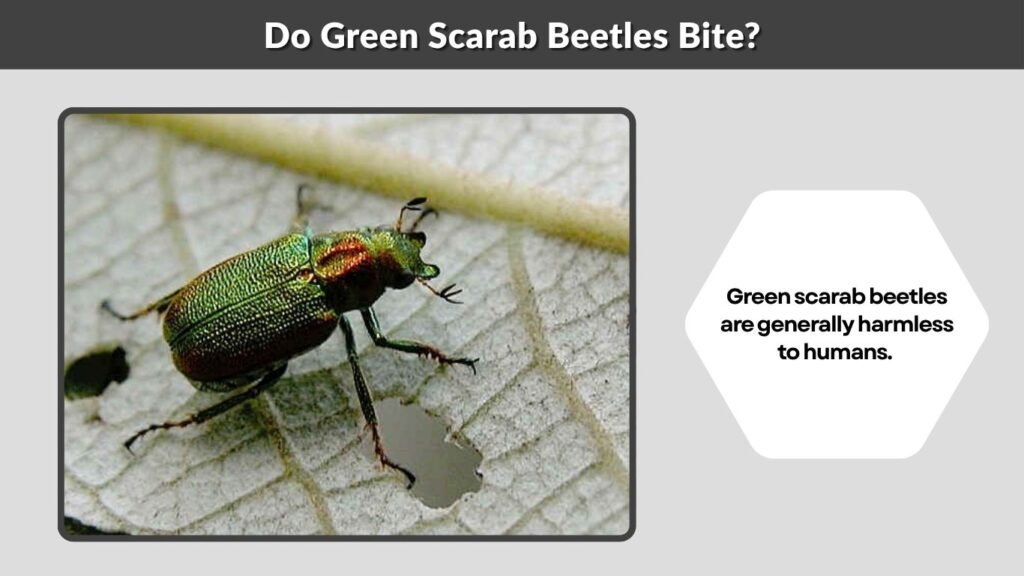
Green scarab beetles are generally harmless to humans. They do not possess venomous stingers and are not known for aggressive biting behavior.
Some large scarabs have strong mouthparts and spiny legs, which can cause minor discomfort if handled roughly.
However, accidental contact rarely causes significant injury.
Green June beetles may fly noisily and occasionally collide with people, but this behavior is not an attack.
Are Green Scarab Beetles Harmful to Plants?
Some green scarab beetles are agricultural pests, while others play beneficial roles in ecosystems.
Adult green June beetles and figeaters sometimes damage ripe fruit by feeding on the soft flesh.
Certain scarab larvae can also disturb lawns or plant roots. However, many grubs primarily consume decomposing organic matter.
Rose chafer larvae, for example, contribute to decomposition in compost and soil.
Correct species identification is important before deciding whether control measures are necessary.
Green Scarab Beetle Spiritual Meaning and Symbolism
Scarab beetles held great importance in ancient Egyptian religious traditions. They represented rebirth, renewal, transformation, and the movement of the sun.
The scarab was associated with Khepri, a deity connected to the rising sun and creation.
Ancient Egyptians frequently produced scarab-shaped amulets from stone, glazed ceramics, and other materials. Some were colored green or blue-green.
Green scarab amulets were associated with renewal and protection, although these symbolic objects did not necessarily represent naturally green beetle species.
Today, some people interpret seeing a green scarab as a symbol of personal growth, good fortune, or transformation. These are cultural and spiritual interpretations rather than scientific meanings.
FAQs
1. Are Green Scarab Beetles Rare?
Some green scarab beetles are common, including green June beetles and figeaters in suitable habitats. Others, such as certain jewel scarabs, have limited geographic distributions. Their abundance varies according to species, climate, habitat conditions, and seasonal activity.
2. What Does a Green Scarab Beetle Symbolize?
Green scarab beetles are sometimes associated with renewal, transformation, protection, and good fortune. These interpretations are influenced by ancient Egyptian scarab symbolism and modern spiritual beliefs. There is no scientifically established spiritual meaning associated with encountering a green beetle.
3. Are Green Scarab Beetles Found in California?
Yes, California is home to green scarab beetles, particularly the figeater beetle (Cotinis mutabilis). These large metallic-green insects commonly appear around gardens, orchards, and ripe fruit during warmer months. Their larvae develop in decomposing organic material.
4. Can Green Scarab Beetles Fly?
Yes, adult green scarab beetles can generally fly. They use their functional hindwings while their hardened forewings provide protection. Green June beetles and figeaters are particularly noticeable because they fly with a loud buzzing sound during warm weather.
5. Is a Green June Beetle a Scarab Beetle?
Yes, the green June beetle (Cotinis nitida) belongs to the family Scarabaeidae. It is recognized by its robust body, green coloration, metallic underside, and clubbed antennae. Adults primarily feed on ripe fruits, while larvae develop in organic-rich soil.