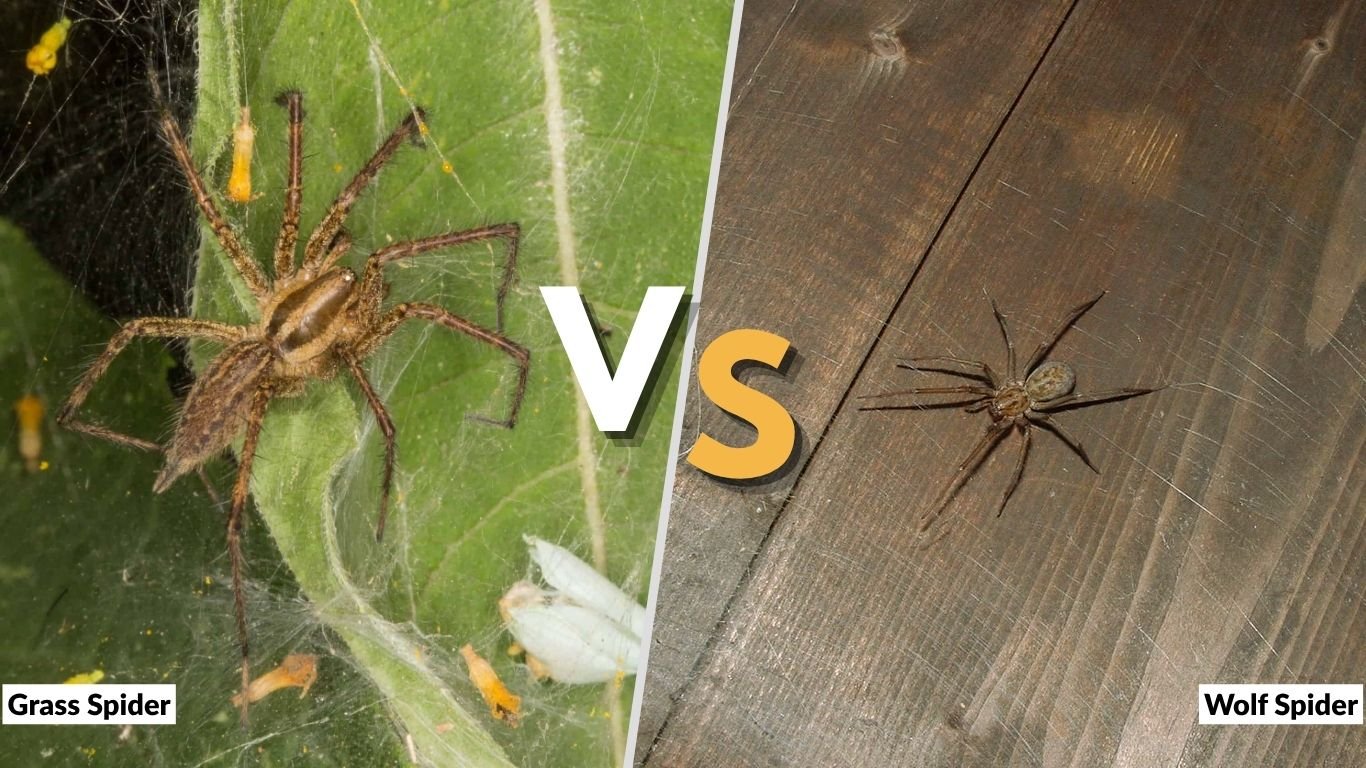
A grass spider vs wolf spider comparison can be confusing because both are usually brown, fast-moving, and commonly found around lawns, gardens, and homes. However, they differ significantly in their webs, body shape, eyes, hunting behavior, and spinnerets. Grass spiders typically build funnel-shaped sheet webs and wait for prey, while wolf spiders roam across the ground and actively hunt insects. Learning a few distinctive features makes identification much easier and can also help determine whether either spider poses a significant risk to people.
Grass Spider vs Wolf Spider: Key Differences
Grass spiders and wolf spiders may look similar at first glance, especially when seen quickly outdoors. Both can have brown bodies with stripes, long legs, and camouflage patterns. The easiest way to separate them is to examine their behavior and body structure. Grass spiders usually remain close to funnel webs, while wolf spiders actively wander in search of prey.
Main Identification Differences
Look for these characteristics:
- Grass spider: Usually has visibly long spinnerets extending from the rear.
- Wolf spider: Spinnerets are much less noticeable.
- Grass spider: Builds a flat sheet web with a funnel-shaped retreat.
- Wolf spider: Does not normally build a web for catching prey.
- Grass spider: Usually has a slimmer, more elongated body.
- Wolf spider: Often appears thicker and more robust.
- Grass spider: Common around shrubs, grass, foundations, and low vegetation.
- Wolf spider: Common on soil, lawns, leaf litter, fields, and forest floors.
- Grass spider: Relies heavily on vibrations from its web.
- Wolf spider: Uses strong eyesight to locate and chase prey.
Long Spinnerets Are an Important Clue
One of the easiest ways to identify a grass spider is to look at the rear of its abdomen. Grass spiders often have two long spinnerets that project backward and may resemble tiny tails.
Wolf spiders also have spinnerets because all spiders produce silk, but theirs do not normally extend so prominently beyond the abdomen.
Grass Spider vs Wolf Spider Size
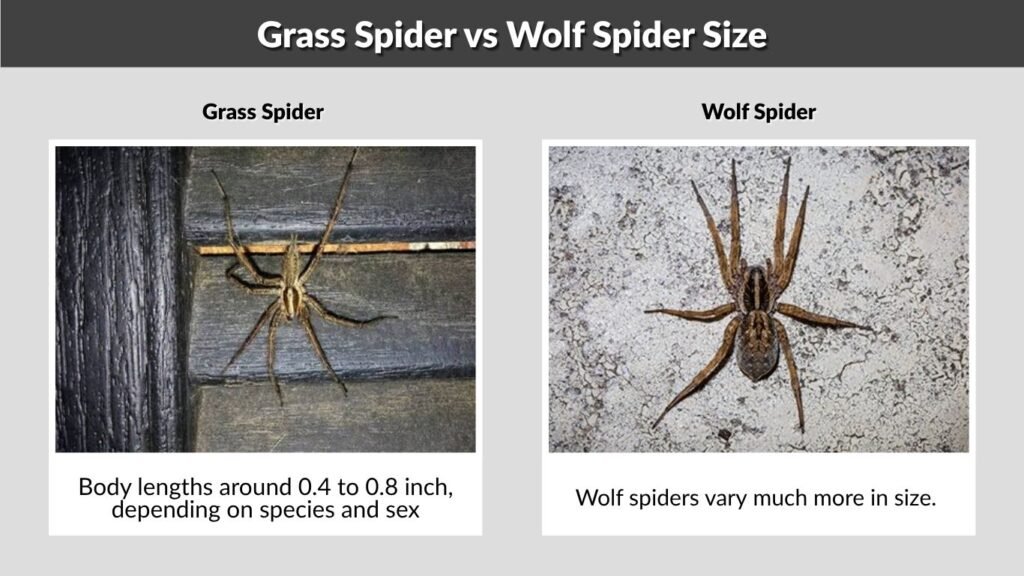
Size alone is not a dependable way to separate these spiders because both groups contain species of different dimensions. An average grass spider may overlap in size with a medium wolf spider. However, the largest wolf spiders generally become considerably heavier and more robust than common American grass spiders.
How Big Are Grass Spiders?
Typical grass spiders have:
- Body lengths around 0.4 to 0.8 inch, depending on species and sex
- Long, slender legs that increase their apparent size
- Relatively narrow abdomens
- Females that are usually larger than males
With their legs extended, some grass spiders can appear much larger than their actual body length.
How Big Are Wolf Spiders?
Wolf spiders vary much more in size. Depending on species, they can range from small spiders less than half an inch long to large individuals with bodies exceeding an inch.
Large species such as the Carolina wolf spider can appear several inches across with their legs extended.
Wolf spiders also tend to look heavier because their legs and bodies are usually thicker than those of grass spiders.
Grass Spider vs Wolf Spider Eyes
Eye arrangement is one of the most reliable anatomical differences between these spider groups. Wolf spiders are famous for their strong eyesight because they actively chase prey. Grass spiders have eight eyes as well, but none dominate the face in the same dramatic way as the large central eyes of a wolf spider.
Wolf Spider Eyes
Wolf spiders have eight eyes arranged in three rows.
Their most noticeable characteristics include:
- Four small eyes along the lower row
- Two very large eyes in the middle
- Two additional eyes higher on the head
- Strong night vision
- Eye shine when illuminated with a flashlight
The two enlarged central eyes are particularly useful for distinguishing wolf spiders from many other brown spiders.
Grass Spider Eyes
Grass spiders also possess eight eyes, but they are relatively similar in size and arranged differently.
They depend less heavily on vision because their web serves as an early warning system. When an insect touches the sheet web, vibrations alert the grass spider, which rushes from its funnel retreat to capture the prey.
Grass Spider Web vs Wolf Spider Hunting
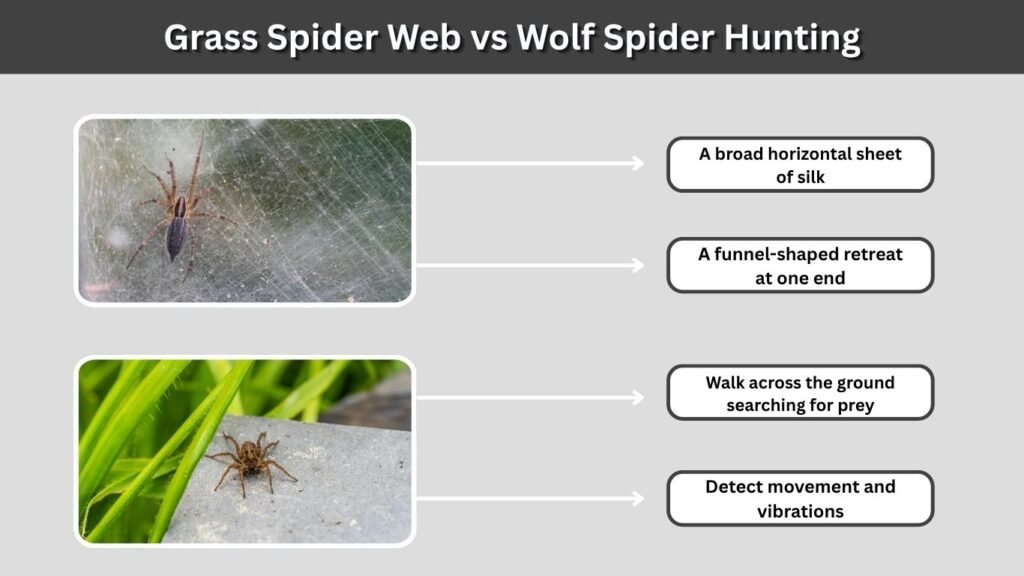
Behavior may be the simplest identification method if the spider has not been disturbed. Grass spiders and wolf spiders use completely different strategies to obtain food. Grass spiders construct permanent prey-catching structures, whereas wolf spiders behave more like roaming hunters.
Grass Spider Funnel Web
A grass spider typically builds:
- A broad horizontal sheet of silk
- A funnel-shaped retreat at one end
- Webs near grass, shrubs, decks, or foundations
- A non-sticky surface that transmits vibrations
- A hidden retreat where the spider waits
When prey lands on the web, the grass spider rushes out, bites it, and usually drags it back toward the funnel.
How Wolf Spiders Hunt
Wolf spiders do not normally use capture webs.
Instead, they:
- Walk across the ground searching for prey
- Detect movement and vibrations
- Use excellent eyesight
- Chase insects over short distances
- Ambush prey from hiding places
- Sometimes wait near burrows
Some wolf spiders use silk for shelters, burrows, egg sacs, and safety lines, but not for a typical grass-spider-style catching web.
Grass Spider vs Wolf Spider Bite
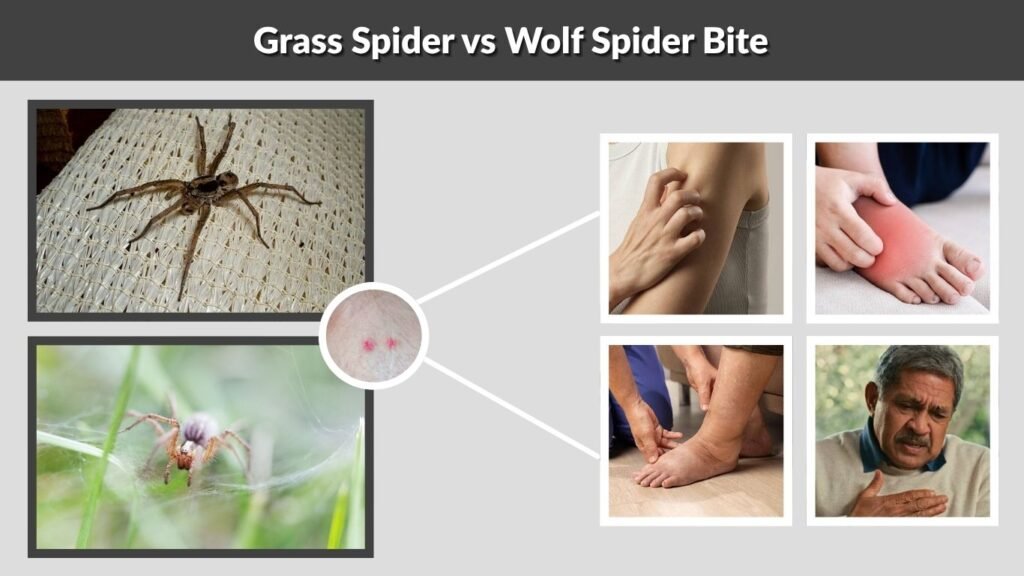
Both grass spiders and wolf spiders possess venom because they need it to immobilize prey. However, neither group is generally considered among the medically important spiders commonly associated with serious human envenomation. Bites are uncommon because these spiders usually flee when disturbed.
Grass Spider Bite
Grass spiders are not aggressive toward humans. A bite is most likely to occur if one becomes trapped against the skin or is deliberately handled.
A bite may cause:
- Mild pain
- Redness
- Minor swelling
- Local itching
- Temporary tenderness
Most encounters never involve a bite at all.
Wolf Spider Bite
Wolf spider bites can also cause localized pain, redness, and swelling.
Larger wolf spiders have stronger fangs and may produce a more noticeable initial bite, but serious reactions are uncommon. Wash the area with soap and water and monitor it.
Seek medical attention if severe swelling, breathing difficulty, worsening pain, or signs of infection develop.
Grass Spider vs Rabid Wolf Spider
The rabid wolf spider is frequently confused with American grass spiders because both can have brown bodies with pale stripes. Despite its name, the rabid wolf spider does not have rabies. Looking at spinnerets, body shape, web use, and eyes provides much more reliable identification than color alone.
How to Tell Them Apart
A grass spider usually has:
- Long visible spinnerets
- A slender body
- A funnel web nearby
- Relatively long, thin legs
- A tendency to retreat into webbing
A rabid wolf spider generally has:
- A more robust body
- Large central eyes
- Shorter, less obvious spinnerets
- No prey-catching funnel web
- Active ground-hunting behavior
The rabid wolf spider may also run rapidly when disturbed.
Grass Spider vs Wolf Spider vs Hobo Spider
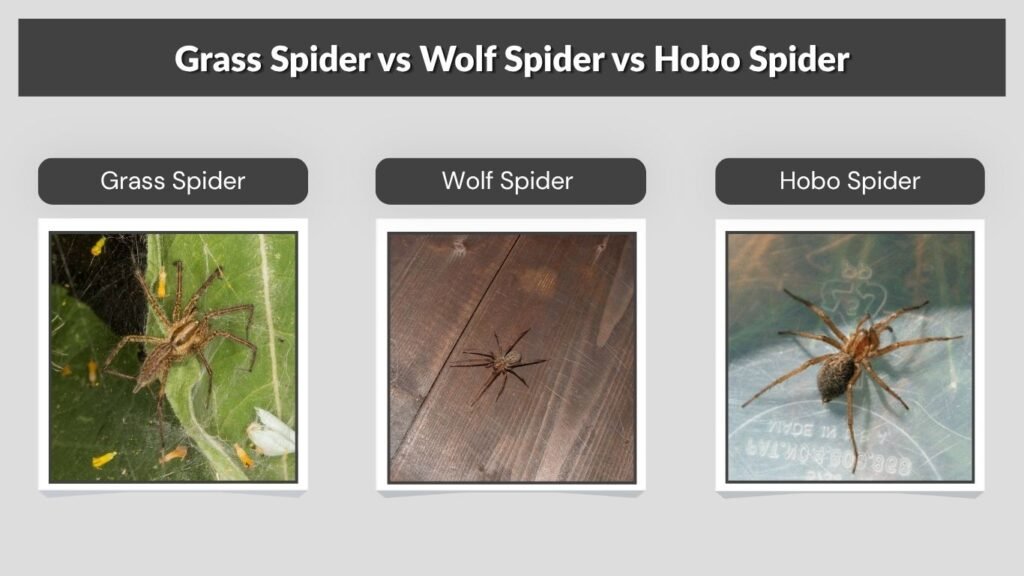
Grass spiders and hobo spiders both belong to the funnel-weaver family Agelenidae, making them more closely related to each other than either is to wolf spiders. Their similar body shapes and funnel webs can make identification difficult without examining specific anatomical details.
Basic Comparison
The three groups can generally be separated this way:
- Grass spider: Long spinnerets, funnel-sheet web, commonly found in vegetation.
- Wolf spider: Large central eyes, active hunter, no capture web.
- Hobo spider: Funnel-web builder with a body shape similar to other funnel weavers.
- Grass and hobo spiders: Usually depend on web vibrations.
- Wolf spiders: Depend more heavily on vision and active hunting.
Geographic location also matters because hobo spiders do not occur everywhere that grass spiders and wolf spiders are found.
Grass Spider vs Wolf Spider vs Brown Recluse
Brown recluse spiders are sometimes confused with many brown house and garden spiders. However, grass spiders and wolf spiders usually have stronger striping, hairier appearances, and different eye arrangements. A spider should never be identified as a brown recluse simply because it is brown.
Key Differences
Remember these clues:
- Wolf spiders have eight eyes, including two very large central eyes.
- Grass spiders have eight eyes and prominent spinnerets.
- Brown recluse spiders have six eyes arranged in three pairs.
- Wolf spiders often have bold stripes and mottling.
- Grass spiders usually live around funnel-shaped sheet webs.
- Brown recluse spiders prefer secluded hiding places.
- Grass and wolf spiders typically appear hairier or more patterned.
Correct identification is especially important before assuming a spider poses a medical threat.
Where Grass Spiders and Wolf Spiders Live
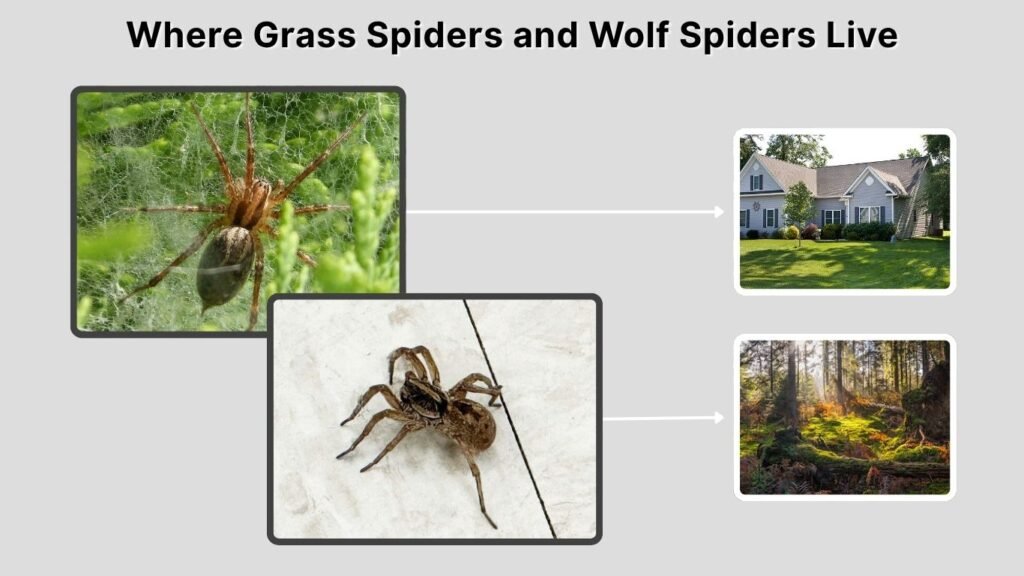
These spiders often occur in the same general environments, which explains why people confuse them. Both benefit from areas with abundant insect prey, vegetation, and places to hide. Their microhabitats differ, however: grass spiders favor locations where they can anchor webs, while wolf spiders need open surfaces for hunting.
Common Habitats
You may find grass spiders around:
- Lawns
- Shrubs
- Bushes
- Foundations
- Low vegetation
- Decks
- Window wells
Wolf spiders commonly live in:
- Lawns
- Gardens
- Forest floors
- Fields
- Leaf litter
- Under rocks
- Garages and sheds
Both occasionally enter homes, although neither typically wants to live around people.
FAQs
Grass spiders and wolf spiders are frequently mistaken for each other because they overlap in color, habitat, and general size. Their spinnerets, webs, eyes, and hunting methods provide much more dependable identification clues.
How can you tell a grass spider from a wolf spider?
Look for the web and spinnerets. Grass spiders usually have long spinnerets and live near funnel-shaped sheet webs. Wolf spiders have two noticeably large central eyes and usually roam across the ground rather than constructing webs to capture prey.
Which is bigger, a wolf spider or grass spider?
Wolf spiders have a broader size range and include species considerably larger than typical grass spiders. Large wolf spiders can exceed an inch in body length, while most common grass spiders have smaller, slimmer bodies even though their long legs make them appear large.
Are grass spiders dangerous?
Grass spiders are not generally considered dangerous to humans. They possess venom for catching prey but rarely bite people. When defensive bites occur, they typically cause mild localized symptoms such as temporary pain, redness, or swelling.
Are wolf spiders more dangerous than grass spiders?
Neither is considered a major medical threat to most people. A large wolf spider may deliver a more noticeable bite because of its stronger fangs, but it normally bites only defensively. Serious reactions to either spider are uncommon.
Do grass spiders and wolf spiders make the same webs?
No. Grass spiders build distinctive flat sheet webs that lead into funnel-shaped retreats. Wolf spiders generally do not construct webs for catching prey. Instead, they actively hunt insects by running after or ambushing them on the ground.