
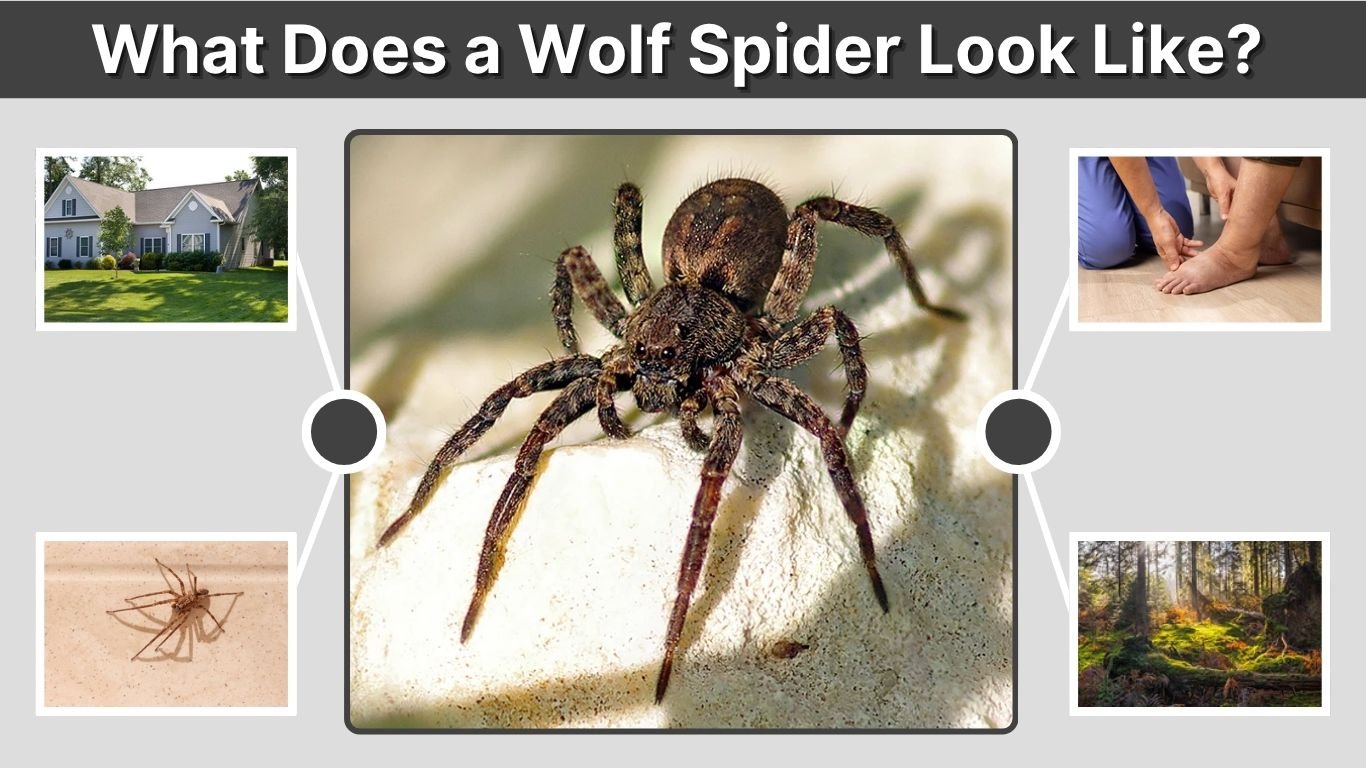
What does a wolf spider look like? Most wolf spiders have sturdy, hairy bodies, long powerful legs, and brown, gray, black, or tan coloring that helps them blend into the ground. Their most distinctive feature is their eight-eye arrangement, including two unusually large forward-facing eyes. Unlike many spiders, wolf spiders usually hunt prey instead of trapping insects in webs. Their appearance varies by species, age, and sex, but several characteristics can help you identify adults, babies, females carrying eggs, and similar-looking spiders.
What Does a Wolf Spider Look Like?
Wolf spiders belong to the family Lycosidae, which contains many species of different sizes and colors. Most are ground-dwelling hunters with camouflage patterns suited to soil, leaf litter, grass, and rocks. They usually appear more robust than delicate house spiders and often move rapidly when disturbed rather than remaining motionless in a web.
Wolf Spider Identification
Common characteristics include:
- Brown, gray, tan, or dark coloration
- Hairy body and legs
- Eight strong walking legs
- Thick, athletic-looking body
- Dark stripes or mottled markings
- Eight eyes arranged in three rows
- Two very large central eyes
- Fast running movement
- No permanent prey-catching web
- Females sometimes carrying egg sacs or babies
Patterns vary considerably, so color alone is not enough for reliable identification.
What Does a Wolf Spider Look Like Up Close?
Viewed closely, the wolf spider’s eyes are particularly noticeable. Four small eyes form a lower row, two much larger eyes sit above them, and two additional eyes are positioned farther back.
These large eyes give wolf spiders excellent eyesight for hunting.
Their bodies are usually covered with short hairs, and the legs may have bands, spots, or darker joints. The abdomen commonly displays stripes or irregular markings that provide camouflage.
What Do Brown and Black Wolf Spiders Look Like?
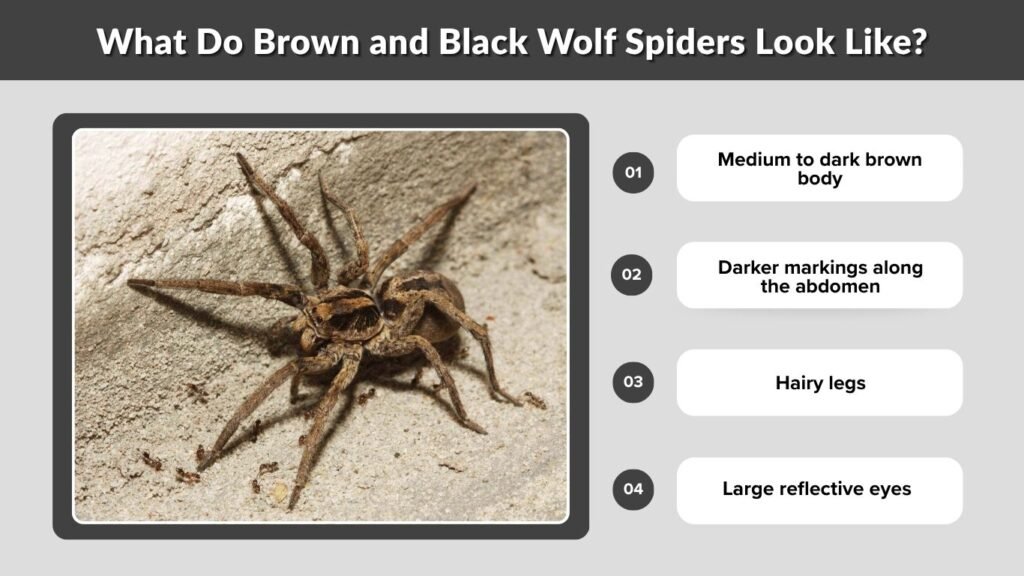
Wolf spiders occur in many shades, so descriptions such as “brown wolf spider” or “black wolf spider” do not necessarily refer to one species. Lighting also changes their appearance dramatically. A dark brown spider seen indoors at night may appear nearly black, while the same animal can show clear stripes when viewed in daylight.
Brown Wolf Spider
A brown wolf spider may have:
- Medium to dark brown body
- Pale stripe down the center of the cephalothorax
- Darker markings along the abdomen
- Hairy legs
- Brown and tan bands
- Large reflective eyes
Brown coloration provides excellent camouflage among soil, dry grass, and dead leaves.
Black Wolf Spider
Some wolf spiders appear very dark gray, dark brown, or almost black.
Dark individuals may still show lighter stripes or markings when viewed closely. Their eye arrangement and hunting behavior are more useful for identification than body color alone.
A black-looking spider should also not automatically be assumed to be a black widow; wolf spiders have very different body proportions and lack the widow’s smooth, rounded abdomen.
What Does a Male vs. Female Wolf Spider Look Like?
Male and female wolf spiders share the same basic body structure, but females tend to be larger and heavier. Males may look slimmer and have more noticeable reproductive structures near their mouthparts. Females become particularly easy to recognize when they are carrying eggs or newly hatched spiderlings.
Female Wolf Spider
Female wolf spiders commonly have:
- Larger, broader abdomen
- Heavier overall body
- Thick legs
- Round egg sac attached to the rear during reproduction
- Spiderlings riding on the abdomen after hatching
The habit of carrying babies is especially distinctive among wolf spiders.
Male Wolf Spider
Males are often:
- Smaller than mature females
- More slender through the abdomen
- Relatively long-legged
- Equipped with enlarged pedipalps near the mouth when mature
- More likely to wander while searching for females
Exact differences vary by species, so sex cannot always be identified from size alone.
What Does a Pregnant Wolf Spider Look Like?
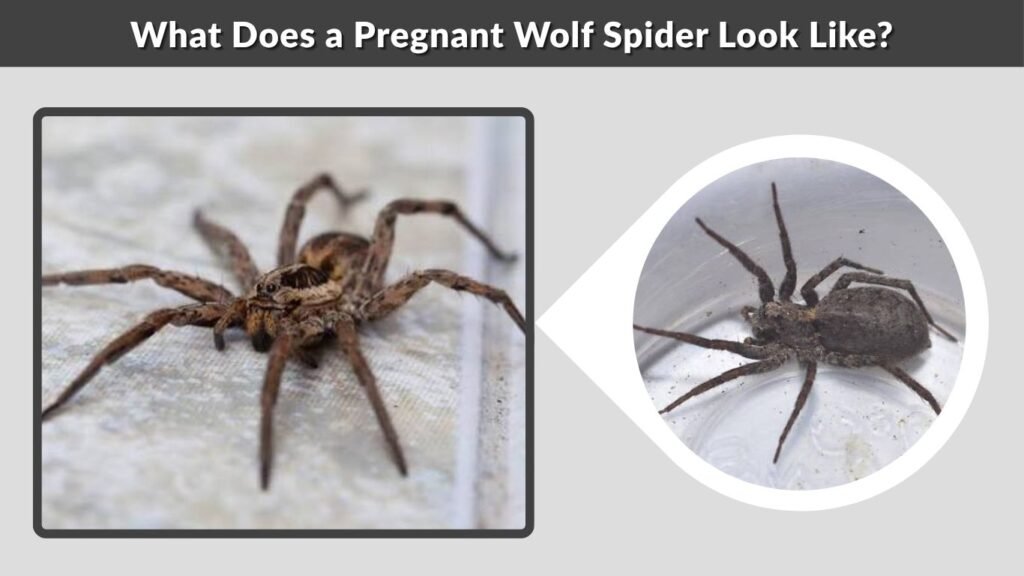
People often describe a female carrying eggs as a “pregnant wolf spider,” although spiders technically produce eggs rather than experiencing pregnancy like mammals. Female wolf spiders are unusual because they actively carry their egg sac instead of leaving it attached to a web or hidden surface.
Wolf Spider Egg Sac
A wolf spider egg sac generally looks like:
- A round or slightly flattened silk ball
- White, cream, gray, or pale tan coloration
- Attached directly to the female’s spinnerets
- Carried behind the abdomen
- Roughly pea-sized or larger depending on species
The female continues walking and hunting while carrying the sac.
Wolf Spider With Babies
Once the eggs hatch, dozens of tiny spiderlings climb onto their mother’s abdomen.
This can make the spider appear covered with small moving spots. Under bright light, the babies’ eyes may reflect, creating multiple sparkling points.
They remain with their mother temporarily before dispersing to live independently.
What Does a Baby Wolf Spider Look Like?
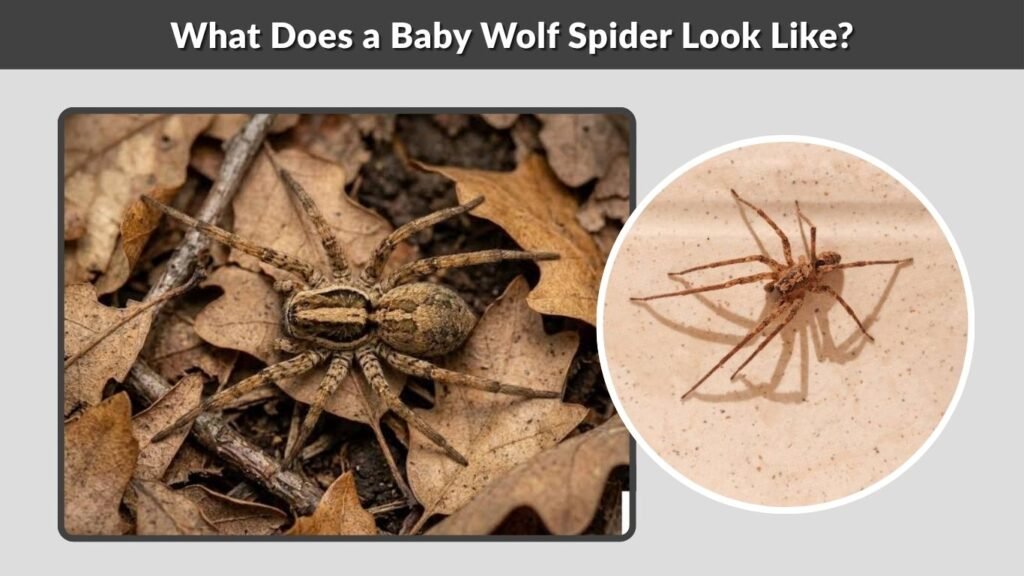
Young wolf spiders resemble miniature adults rather than completely different-looking larvae. They begin life extremely small and gradually increase in size through repeated molts. Their markings may become clearer as they mature.
Baby Wolf Spider Identification
Baby wolf spiders typically have:
- Eight legs
- Small brown or gray bodies
- Developing stripes or mottled patterns
- Relatively large eyes
- Fast ground movement
- Adult-like body proportions
- No large capture web
Newly hatched spiderlings may initially be seen clustered on their mother’s abdomen before separating.
What Does a Wolf Spider Web Look Like?
Wolf spiders are often searched alongside spider webs, but most wolf spiders do not construct traditional webs to catch flying insects. Instead, they chase or ambush prey. They still produce silk, however, and use it for egg sacs, retreats, safety lines, and sometimes burrow entrances.
Wolf Spider Burrow and Silk
Depending on the species, a wolf spider may:
- Dig a small vertical burrow
- Line the burrow with silk
- Hide beneath rocks or logs
- Use silk around a retreat entrance
- Carry a silk egg sac
- Leave draglines while moving
A broad funnel-shaped sheet web is more likely to belong to a grass spider or another funnel weaver than a typical wolf spider.
What Does a Wolf Spider Bite Look Like?
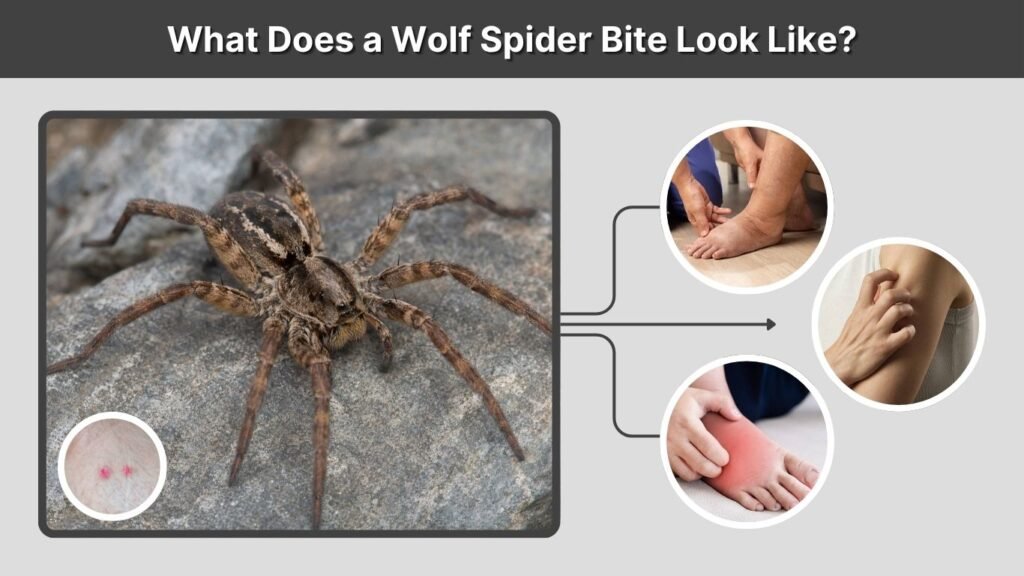
A suspected wolf spider bite may resemble many other minor insect or spider bites. There is no unique skin pattern that can reliably prove a wolf spider caused the injury. Unless the spider was actually observed biting and identified, determining the species from the skin lesion alone is difficult.
Possible Bite Appearance
A mild bite may involve:
- Small red area
- Local swelling
- Tenderness
- Mild itching
- A small raised bump
- Temporary pain around the site
Symptoms are usually localized. Wolf spiders are not generally associated with severe tissue destruction.
What Does a Wolf Spider Bite Look Like at First?
Initially, a bite might look like a small red mark or slightly swollen bump. Some people may feel immediate stinging or discomfort, while others notice irritation later.
Wash the area with soap and water and monitor it. Seek medical care for severe pain, rapidly spreading redness, major swelling, difficulty breathing, fever, or signs of infection.
Wolf Spider vs. Brown Recluse Appearance
Wolf spiders are frequently mistaken for brown recluse spiders because both can be brown. However, they have very different eye arrangements, patterns, and overall builds. A brown spider should never be labeled a brown recluse based only on its color.
Key Visual Differences
A wolf spider typically has:
- Eight eyes
- Two especially large central eyes
- Hairy body
- Bold stripes or mottling
- Robust legs
- Active running behavior
A brown recluse generally has six eyes arranged in three pairs and a smoother, less hairy appearance. Some have a violin-shaped marking, but markings alone should not be relied upon for identification.
Wolf Spider vs. Grass Spider Appearance
Grass spiders are another common source of confusion because they can have similar brown stripes and long legs. Their web-building behavior and prominent spinnerets provide useful clues.
How to Tell Them Apart
Grass spiders usually have:
- Long spinnerets extending from the rear
- A slimmer body
- Long, thin legs
- Funnel-shaped sheet webs nearby
Wolf spiders usually have:
- Shorter, less noticeable spinnerets
- A heavier body
- Large central eyes
- No permanent prey-catching web
- Active ground-hunting behavior
Behavior is often easier to observe than subtle markings.
Where You May See Wolf Spiders
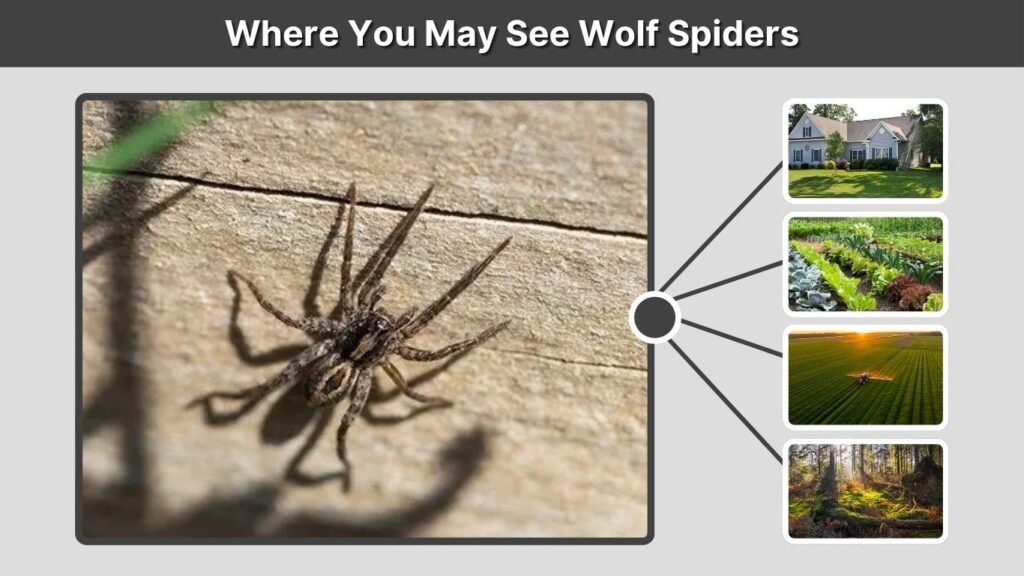
Wolf spiders occupy an enormous variety of environments. Their camouflage makes them difficult to notice until they move. Many encounters occur at night when spiders emerge to hunt, although some species are active during daylight.
Common Places to Find Them
Wolf spiders may appear in:
- Lawns
- Gardens
- Fields
- Forest floors
- Leaf litter
- Under rocks and logs
- Around ponds
- Garages
- Basements
- Sheds
- Patios
- Occasionally inside houses
Indoor individuals generally wandered inside accidentally rather than deliberately establishing a web-based infestation.
FAQs
Wolf spiders vary considerably in size and color, which is why identifying them from one feature can be difficult. Their large eyes, sturdy bodies, ground-hunting behavior, and unusual maternal care provide some of the most useful clues.
What is the easiest way to identify a wolf spider?
Look at the eyes and behavior. Wolf spiders have eight eyes, including two unusually large central eyes, and usually run across the ground while hunting. They also have sturdy, hairy bodies and generally do not construct prey-catching webs.
What does a wolf spider look like in a house?
An indoor wolf spider usually appears as a fast-moving brown, gray, or dark spider with a hairy body and strong legs. It may run across floors, garages, basements, or walls while searching for shelter or insect prey.
What does a female wolf spider look like?
Females usually have heavier bodies and broader abdomens than males. During reproduction, a female may carry a round silk egg sac attached behind her abdomen. After the eggs hatch, dozens of spiderlings may ride on her back.
What does a wolf spider bite look like?
A suspected bite may produce a small red bump, mild swelling, pain, or itching. These symptoms are not unique to wolf spiders, so identifying the spider from the bite mark alone is unreliable.
What does a young wolf spider look like?
Young wolf spiders resemble miniature adults. They have eight legs, small brown or gray bodies, developing stripes, and fast movements. Newly hatched spiderlings may initially remain clustered on their mother’s abdomen before dispersing.
