
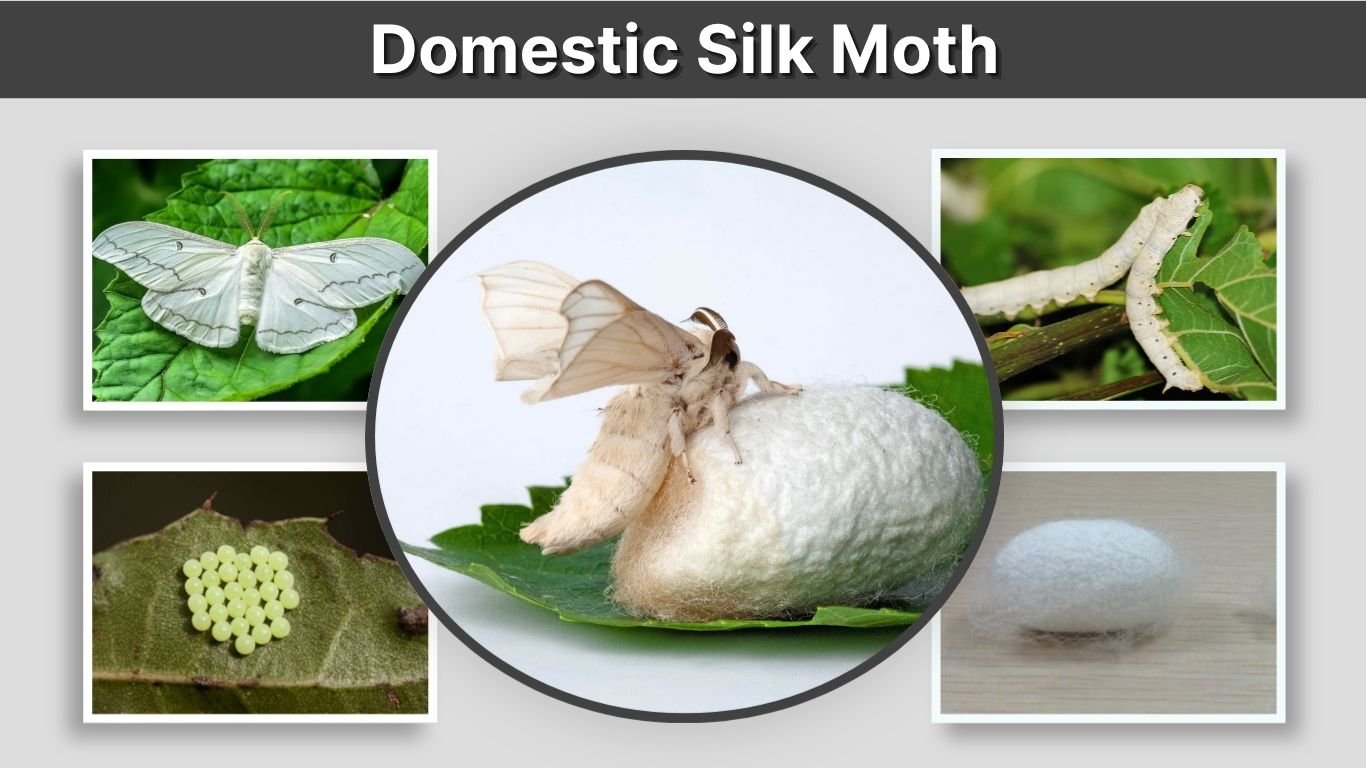
The domestic silk moth (Bombyx mori) is one of the world’s best-known domesticated insects and the source of most commercially produced mulberry silk. Its caterpillar, commonly called a silkworm, feeds mainly on mulberry leaves before spinning a dense silk cocoon around itself. After metamorphosis, a soft, cream-colored adult moth emerges. Thousands of years of selective breeding have changed this species dramatically: adults cannot sustain normal flight and depend heavily on humans. Domestic silk moths are harmless, easy to observe, and widely raised for silk, education, and research.
What Does a Domestic Silk Moth Look Like?
Adult domestic silk moths are pale, fuzzy insects with broad wings, thick bodies, and conspicuous feathery antennae. They look softer and heavier than many wild moths. Adults commonly have a wingspan of around 3–5 cm, although size varies among strains and sexes. Females tend to have larger abdomens because they carry numerous eggs.
Domestic Silk Moth Identification
Look for these characteristics:
- Scientific name: Bombyx mori
- Family: Bombycidae
- Cream, white, or buff-colored body
- Broad pale wings with faint brown lines
- Thick and noticeably furry appearance
- Large, feathery antennae, especially in males
- Six legs and two pairs of wings
- Wingspan usually around 3–5 cm
- Adults unable to perform sustained flight
- Reduced, nonfunctional feeding mouthparts
The moth is the reproductive adult stage of the same animal commonly called a silkworm during its caterpillar stage.
Male vs Female Silk Moths
Females usually have noticeably broader abdomens because their bodies contain developing eggs. Males are generally slimmer and have especially prominent antennae that help detect female sex pheromones.
After finding a female, a male mates with her, and the female subsequently lays hundreds of eggs. Adults have only a brief reproductive life and do not spend their time searching for food.
Domestic Silk Moth Caterpillar and Cocoon
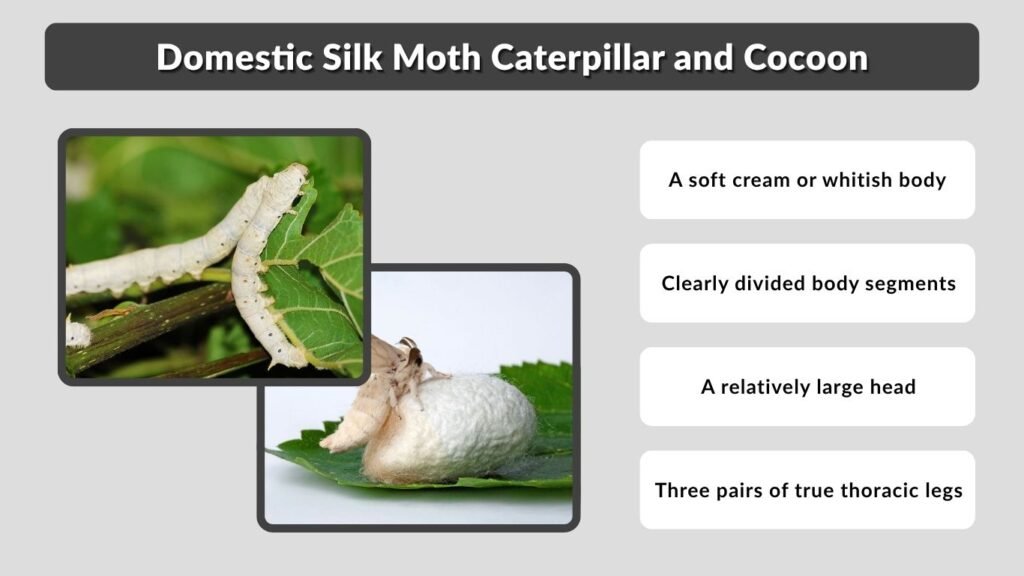
The caterpillar is the economically important stage because it produces the silk used to construct the cocoon. Silkworm larvae grow rapidly and repeatedly molt as they consume large quantities of leaves. At the end of the larval period, the caterpillar stops feeding and produces silk from specialized glands, wrapping a continuous filament around itself before becoming a pupa.
What Does the Caterpillar Look Like?
A domestic silkworm caterpillar usually has:
- A soft cream or whitish body
- Clearly divided body segments
- A relatively large head
- Three pairs of true thoracic legs
- Several pairs of fleshy abdominal prolegs
- Brownish or darker markings in some strains
- A small horn-like projection near the rear
- A plump body that becomes much larger before pupation
Mature larvae can reach several centimeters long, although size varies between domesticated strains and rearing conditions.
What Do Domestic Silk Moths Eat?
Only the larval stage feeds. Traditional Bombyx mori strains are highly specialized for mulberry and are normally raised on fresh mulberry leaves, especially Morus alba. Modern artificial diets formulated for silkworms are also available and often contain mulberry material or compounds designed to support normal development.
Adult moths do not eat. Their stored energy from the caterpillar stage supports mating and egg production during their short adult lives.
How Is the Silk Cocoon Made?
Near the end of larval development, the silkworm begins producing silk. The major structural protein is fibroin, while sericin helps bind the fibers together.
The caterpillar repeatedly moves its head while releasing silk, eventually enclosing itself in an oval cocoon. Inside, it molts into a pupa and undergoes metamorphosis.
Domestic Silk Moth Life Cycle and Lifespan
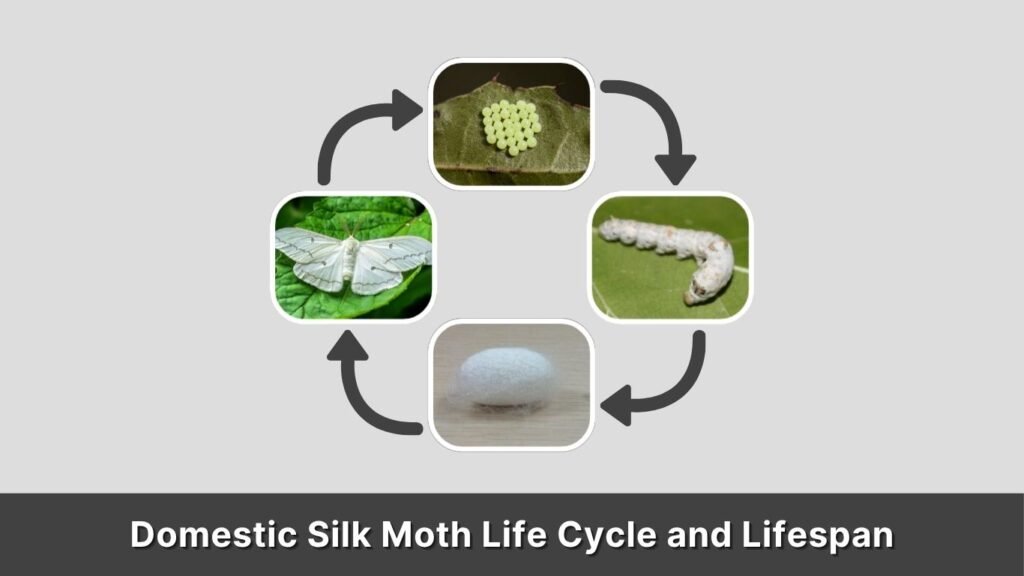
Bombyx mori undergoes complete metamorphosis, passing through egg, caterpillar, pupa, and adult stages. Under commonly used laboratory or rearing conditions, the entire cycle may take roughly 55 days, but temperature, strain, diet, and management can change the timing considerably. Most of the insect’s growth occurs during the caterpillar stage rather than as an adult moth.
Four Stages of the Life Cycle
The basic life cycle includes:
- Egg: Eggs develop for approximately 10 days under suitable conditions.
- Larva: The silkworm feeds heavily and passes through five larval instars.
- Pupa: The mature larva spins its cocoon and transforms inside it.
- Adult moth: The adult emerges, mates, lays eggs, and dies soon afterward.
Domestic silkworms typically molt four times during larval growth, producing five feeding instars before cocoon formation.
How Long Do Domestic Silk Moths Live?
The answer depends on whether “lifespan” means the entire life cycle or only adulthood.
A complete life cycle can take around seven to eight weeks under favorable conditions. The adult stage itself is extremely short. Experimental descriptions report adults living roughly five days after emergence, during which their main activities are mating and reproduction.
Because adults cannot feed, they survive using energy stored during the caterpillar stage.
Can Domestic Silk Moths Fly or Eat?
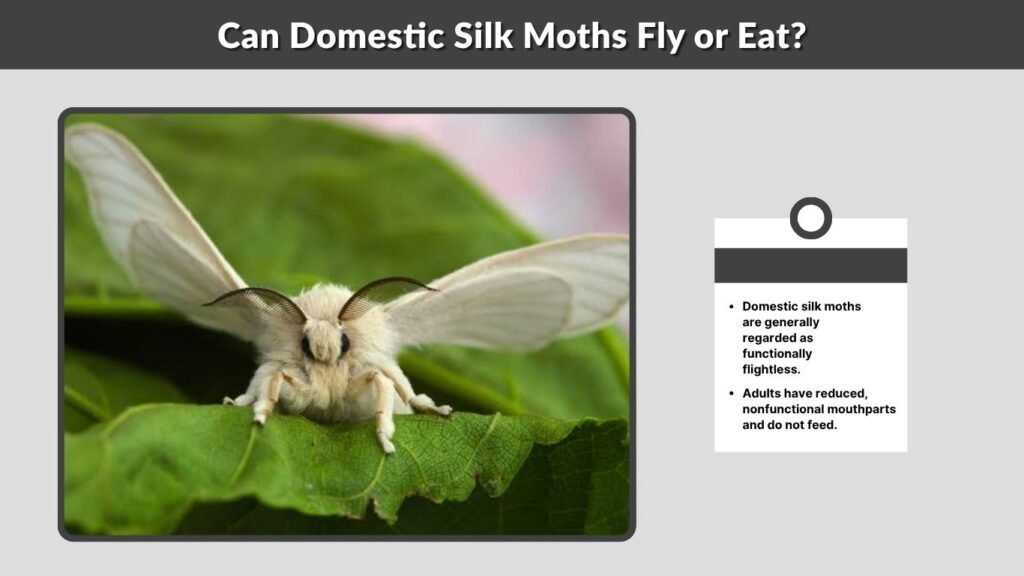
Domestication has changed Bombyx mori dramatically compared with its wild relatives. Humans selected silkworms primarily for traits useful in silk production rather than for survival in nature. Modern domestic adults have wings, but their bodies, flight muscles, wing characteristics, and wing loading are poorly suited to sustained flight. Adults also have greatly reduced feeding structures.
Why Can’t Domestic Silk Moths Fly?
Domestic silk moths are generally regarded as functionally flightless. They may flap their wings vigorously and occasionally make brief movements, but they cannot sustain the controlled flight performed by their wild relatives.
Research comparing B. mori with wild Bombyx mandarina found differences involving body weight, wing loading, wing properties, and flight musculature. These changes accumulated during thousands of years of domestication.
Flightlessness also makes the moths easier for humans to breed in controlled environments.
Do Domestic Silk Moths Have Mouths?
Adults have reduced, nonfunctional mouthparts and do not feed.
This means an adult domestic silk moth does not need nectar, water, mulberry leaves, or other food. Its short adult life is fueled by reserves accumulated while it was a caterpillar.
Silkworm caterpillars, in contrast, have functional chewing mouthparts and spend much of their time eating.
Domestic vs Wild Silk Moths
The domestic silk moth has been selectively bred for more than 5,000 years and differs considerably from its closest wild relatives. Genetic evidence links Bombyx mori closely with the wild silkmoth Bombyx mandarina, with research supporting Chinese populations as ancestral to the domesticated lineage. Domestication favored traits such as larger cocoons, handling tolerance, and controlled reproduction.
Major Differences
Domestic silk moth (Bombyx mori):
- Functionally flightless
- Usually pale cream or white
- Highly dependent on human care
- Selected for large, useful silk cocoons
- Tolerant of crowded captive conditions
- Poor ability to survive independently in nature
Wild silk moth (Bombyx mandarina):
- Capable of normal flight
- Usually darker and better camouflaged
- Lives independently outdoors
- Produces smaller, less domestically optimized cocoons
- Better able to avoid predators
- Retains stronger natural survival behaviors
The two represent a striking example of how artificial selection can reshape appearance, behavior, physiology, and reproduction.
Can You Keep Domestic Silk Moths as Pets?
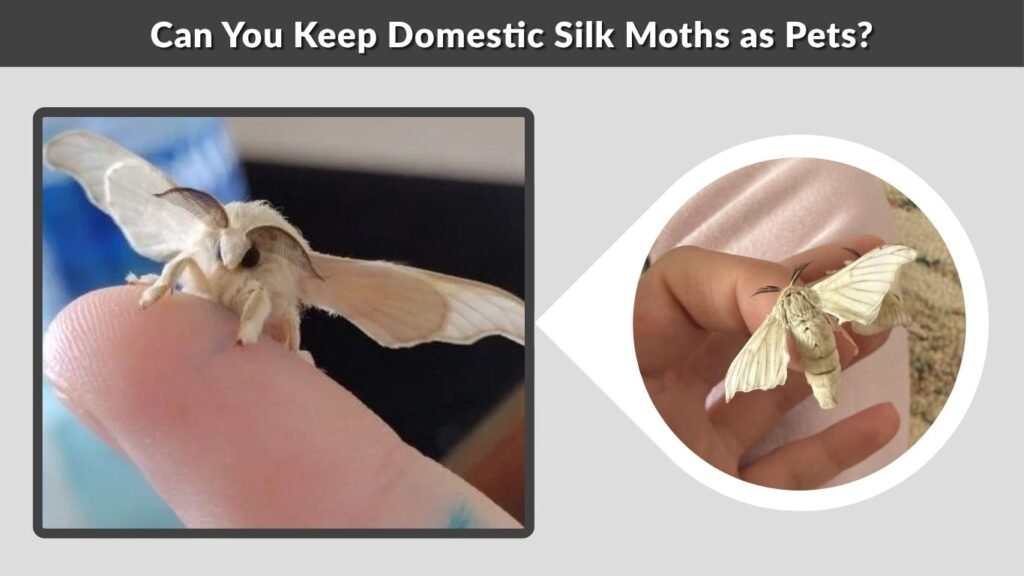
Domestic silkworms can be kept for education or as unusual short-lived pets, but most of the work occurs during the caterpillar stage. The larvae need a dependable food supply, appropriate temperature and ventilation, and a clean environment. Once the adults emerge, their care becomes simpler because they no longer eat and mainly focus on reproduction.
Raising Domestic Silk Moths
Provide fresh, appropriate mulberry leaves or a formulated silkworm diet and replace food regularly. Keep the rearing container clean and dry enough to discourage mold and disease.
As larvae mature, provide suitable structures where they can anchor silk and build cocoons. Adults need little space but should be protected from excessive handling.
Eggs or larvae should come from reputable educational, research, or sericulture suppliers rather than being released outdoors.
Are Domestic Silk Moths Dangerous?
No. Domestic silk moths are not considered dangerous to people.
Adults do not sting and cannot feed because their mouthparts are nonfunctional. Silkworm caterpillars are also not the stinging type of caterpillar and can generally be handled gently, although excessive handling can injure them.
Their defenseless nature is another reason they depend so strongly on human-managed environments.
FAQs
Domestic silk moths have an unusual relationship with humans because their biology has been shaped by thousands of years of selective breeding. Questions most often concern their inability to fly, brief adulthood, dependence on mulberry, and production of silk. Understanding the difference between the feeding caterpillar and non-feeding adult makes their life cycle much easier to understand.
1. What is the scientific name of the domestic silk moth?
The scientific name is Bombyx mori. It belongs to the moth family Bombycidae.
2. Can domestic silk moths fly?
They have wings but are functionally flightless and cannot perform sustained normal flight. Their wild relative Bombyx mandarina retains much stronger flight ability.
3. What do domestic silk moths eat?
The caterpillars primarily eat mulberry leaves or specialized artificial silkworm diets. Adult moths do not feed.
4. How long does an adult domestic silk moth live?
Adults typically survive only several days, often around five days under laboratory conditions. Their main purpose during this stage is mating and reproduction.
5. Are domestic silk moths completely domesticated?
Yes. Bombyx mori has undergone more than 5,000 years of artificial selection and is highly dependent on humans compared with its wild relatives.
