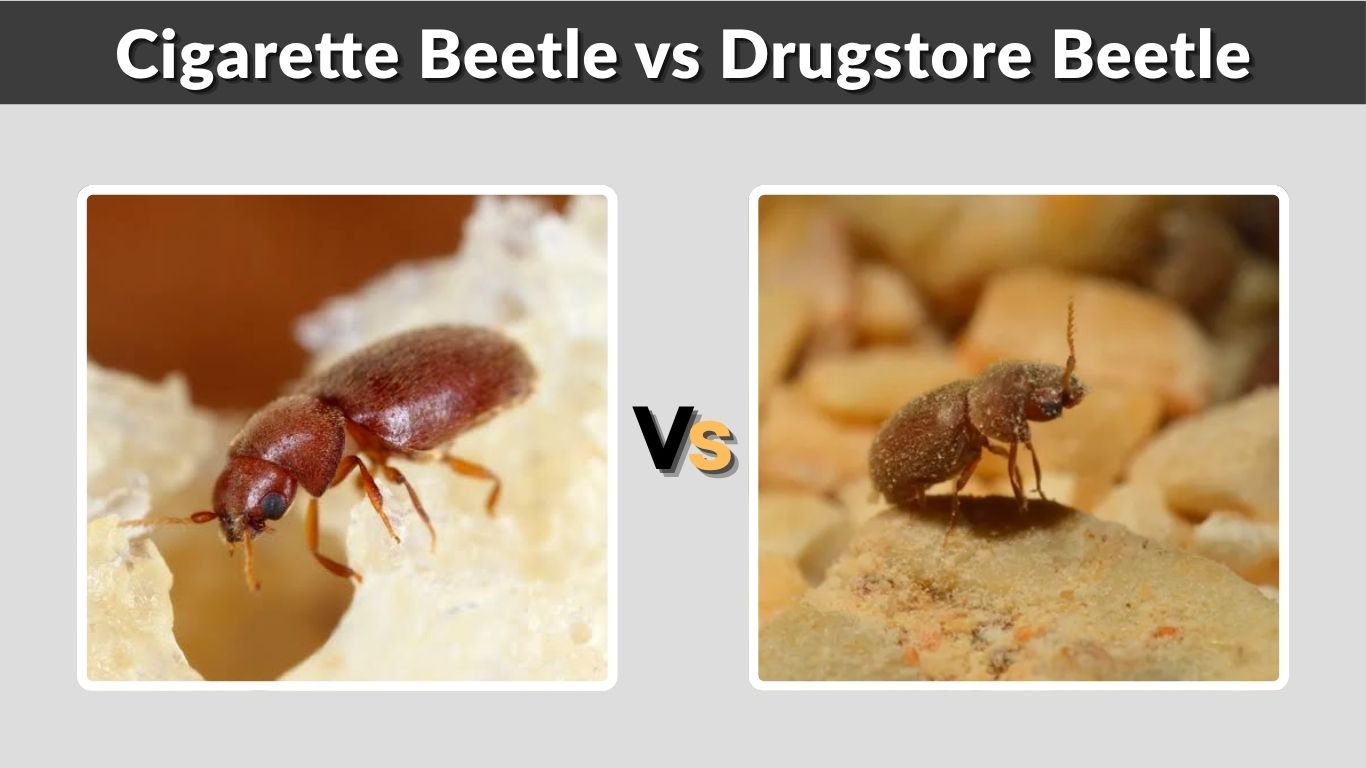
Cigarette beetles and drugstore beetles are two common pantry pests that look remarkably similar. Both have small, reddish-brown bodies, rounded backs, and a habit of infesting stored foods. However, cigarette beetles have smooth wing covers and sawlike antennae, while drugstore beetles have grooved wing covers and clubbed antennae. They also differ slightly in their preferred foods and environmental conditions. Understanding cigarette beetle vs drugstore beetle identification, behavior, damage, and control methods can help you recognize an infestation and protect your stored food products.
Cigarette Beetle vs Drugstore Beetle: Key Differences
Cigarette beetles (Lasioderma serricorne) and drugstore beetles (Stegobium paniceum) are small beetles belonging to the family Ptinidae. Both species are widespread household pests that infest dried foods and other stored materials.
Their physical similarities can make identification difficult without magnification. However, several distinctive features help separate them.
| Feature | Cigarette Beetle | Drugstore Beetle |
| Scientific name | Lasioderma serricorne | Stegobium paniceum |
| Size | Around 2–3 mm | Around 2.25–3.5 mm |
| Body shape | Rounded, compact | Slightly elongated |
| Color | Light to reddish brown | Brown to reddish brown |
| Antennae | Sawlike, serrated | Three-segmented club |
| Wing covers | Smooth, without grooves | Grooved with rows of pits |
| Flight | Capable of flying | Capable of flying |
| Main concern | Stored-product infestation | Stored-product infestation |
The most reliable identification differences are the antennae and wing-cover patterns.
How to Identify Cigarette and Drugstore Beetles
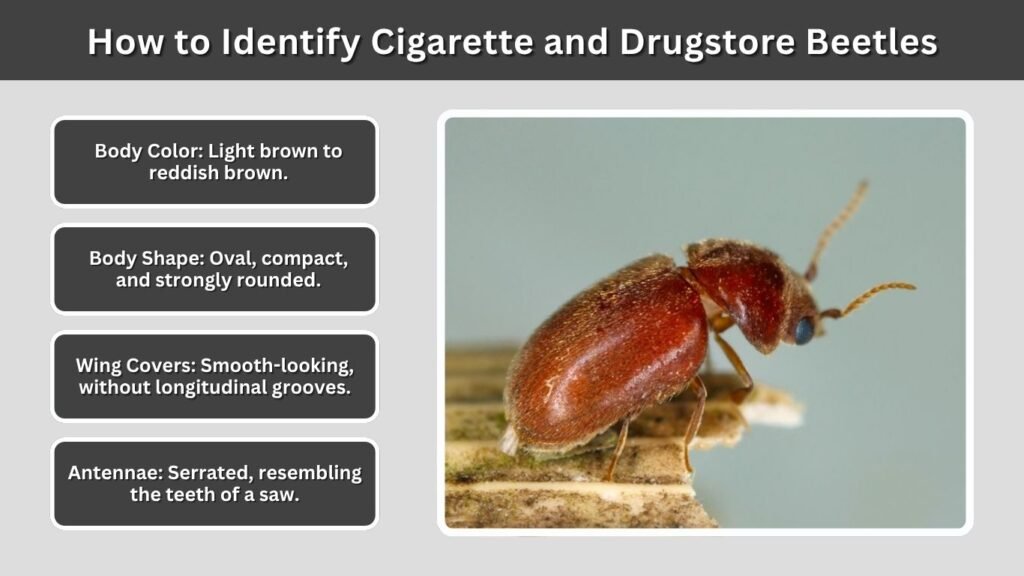
Both beetles have small, oval bodies with their heads tucked beneath a hoodlike thorax. Their similar coloration makes identification particularly challenging when they are moving.
Examining their antennae and wing covers with a magnifying glass provides better results than relying on body color.
Cigarette Beetle Appearance
- Body Color: Light brown to reddish brown.
- Body Shape: Oval, compact, and strongly rounded.
- Wing Covers: Smooth-looking, without longitudinal grooves.
- Antennae: Serrated, resembling the teeth of a saw.
- Head: Usually hidden beneath the thorax when viewed from above.
- Body Surface: Covered with fine hairs that create a silky appearance.
Drugstore Beetle Appearance
Drugstore beetles generally have a more elongated body than cigarette beetles. Their wing covers contain distinct longitudinal rows of small pits, creating a lined appearance.
Their antennae end in three enlarged segments that form an elongated club.
The combination of grooved wing covers and clubbed antennae makes drugstore beetles relatively easy to distinguish under magnification.
Cigarette Beetle vs Drugstore Beetle Diet
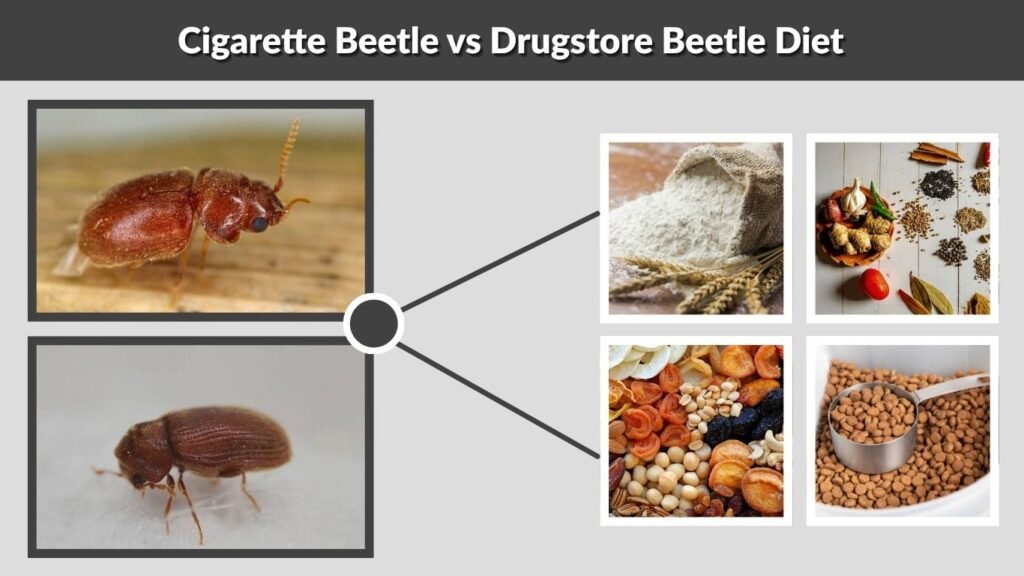
Both species feed on a wide range of dried plant materials. Their larvae cause most of the feeding damage because they develop inside stored products.
Although their diets overlap considerably, cigarette beetles are especially associated with tobacco, spices, and dried plant materials. Drugstore beetles are also well known for attacking starch-rich foods and unusual stored products.
| Food Source | Cigarette Beetle | Drugstore Beetle |
| Flour and grains | Common | Common |
| Dried spices | Common | Common |
| Tobacco products | Common | Also attacked |
| Dry pet food | Common | Common |
| Bread and crackers | Can infest | Frequently infested |
| Dried fruits | Common | Common |
| Books and paper materials | Occasionally damaged | Occasionally damaged |
| Dried flowers | Can infest | Can infest |
What Do Cigarette Beetles Eat?
Cigarette beetle larvae feed on tobacco, cereals, spices, dried fruits, seeds, and other stored materials.
Adults feed little or not at all. Their primary role is reproduction and dispersal to new food sources.
What Do Drugstore Beetles Eat?
Drugstore beetle larvae consume flour, bread, cereals, spices, dried herbs, pet food, and other dried materials.
They can also damage books, packaging, and certain pharmaceutical products. Adult beetles feed little or not at all.
Cigarette Beetle vs Drugstore Beetle Life Cycle
Both beetles undergo complete metamorphosis, developing through egg, larva, pupa, and adult stages.
Their development depends on temperature, humidity, and food availability. Warm environments usually allow faster development and more generations.
Life Cycle Comparison
| Development Stage | Cigarette Beetle | Drugstore Beetle |
| Eggs | Laid in or near food | Laid in food materials |
| Larvae | White, hairy, C-shaped | White, hairy, C-shaped |
| Feeding stage | Primarily larvae | Primarily larvae |
| Pupation | Within food material | Within food material |
| Adults | Small, reddish brown | Small, reddish brown |
| Development time | Often 1–3 months | Often 1–7 months |
These are approximate development periods. Both species may develop faster under favorable conditions.
Which Beetle Reproduces Faster?
Cigarette beetles can complete development in approximately one month under particularly favorable conditions, although longer periods are common.
Drugstore beetles also reproduce quickly in warm storage environments, but development may take several months when conditions are less favorable.
Neither species has a consistently faster life cycle under all conditions.
Where Do Cigarette and Drugstore Beetles Live?
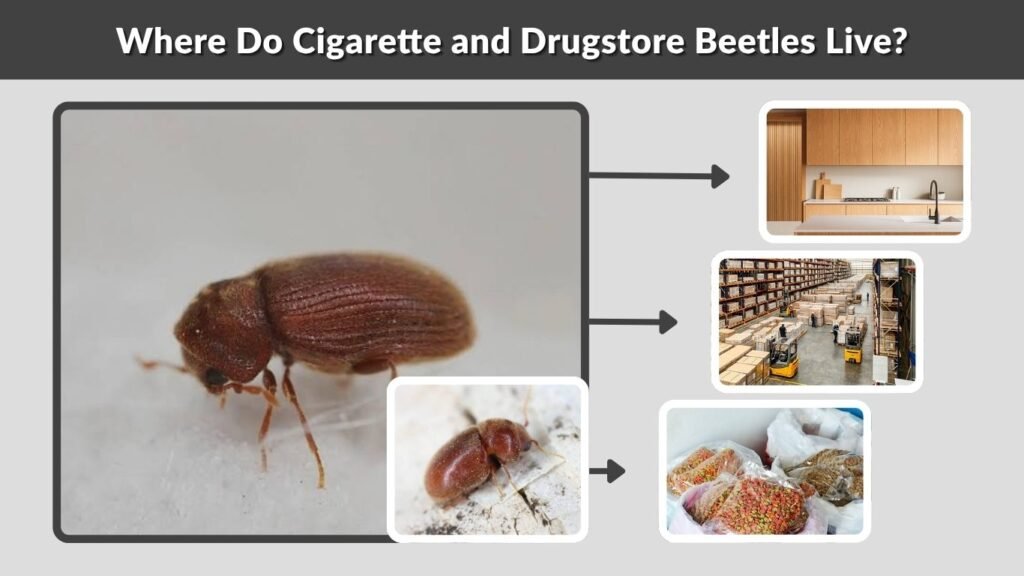
Both species occur worldwide and commonly inhabit kitchens, pantries, warehouses, grocery stores, and food-processing facilities.
They prefer places containing stored dried foods, particularly where packaging remains undisturbed.
Cigarette beetles are especially common in tropical and subtropical climates. Drugstore beetles are also widespread in temperate regions and can survive inside heated buildings.
Common Infestation Locations
- Kitchen Cabinets: Stored flour, rice, spices, and dried foods attract larvae.
- Pantries: Open or damaged packages provide food and breeding locations.
- Warehouses: Bulk dried products support larger infestations.
- Pet Food Storage: Dry pet food and animal feed provide suitable food.
- Food Packaging: Beetles may enter through small openings or chew through vulnerable packaging.
- Storage Rooms: Dried flowers, herbs, and other organic materials can support infestations.
Both adults can fly and may appear around windows or indoor lights.
Signs of Cigarette and Drugstore Beetle Infestations
Cigarette and drugstore beetles produce similar signs of infestation because their larvae feed within dried materials.
Finding adult beetles around windows does not necessarily identify the original food source. A thorough inspection of stored products is usually necessary.
Common Signs of Infestation
- Small Brown Beetles: Adults crawling around pantry shelves or windows.
- Damaged Packaging: Tiny holes in cardboard, paper, or thin plastic packages.
- Larvae: Small, whitish, C-shaped grubs inside stored food.
- Food Debris: Powdery material, insect droppings, and damaged food particles.
- Exit Holes: Small rounded openings where adult beetles emerge.
- Dead Beetles: Insect remains inside containers or storage areas.
Infested products should be discarded because they may contain larvae, eggs, insect fragments, and waste.
How to Get Rid of Cigarette and Drugstore Beetles
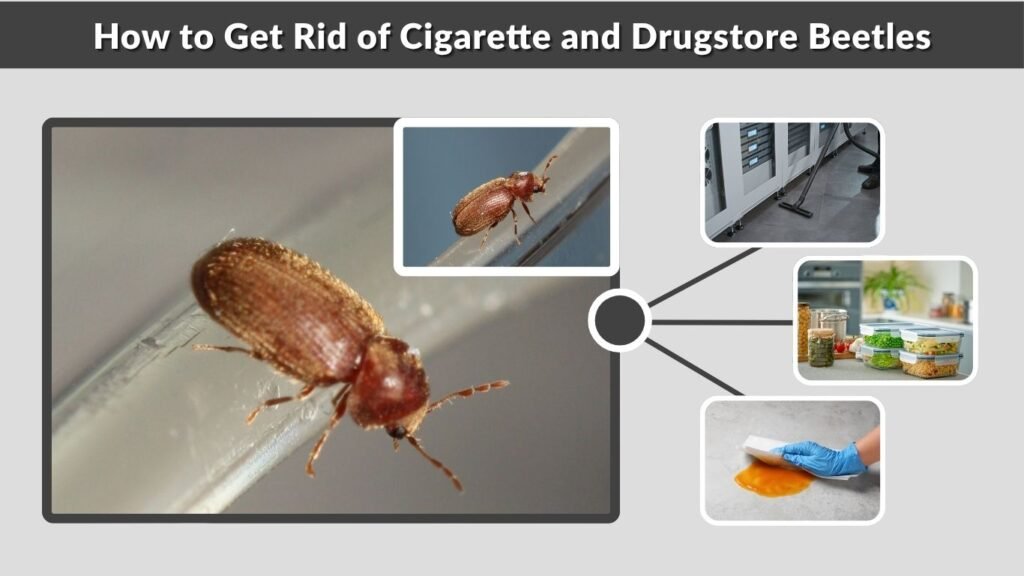
Removing cigarette and drugstore beetles requires identifying their food sources and eliminating infested materials.
Spraying visible adult beetles alone rarely solves the problem because developing larvae may remain hidden inside food packages.
Effective Beetle Control Methods
- Inspect Stored Foods: Examine flour, grains, spices, cereals, dried herbs, and pet food.
- Discard Infested Products: Seal contaminated materials in bags before disposal.
- Vacuum Storage Areas: Clean shelves, corners, cracks, and cabinet joints.
- Use Airtight Containers: Store vulnerable products in glass, metal, or sturdy sealed plastic containers.
- Clean Spilled Food: Remove crumbs, flour dust, and other food debris.
- Monitor Activity: Use appropriate pheromone traps to detect remaining adult beetles.
- Check New Products: Inspect purchased dry foods before placing them in storage.
Avoid applying household insecticides directly to food or food-contact surfaces. Persistent infestations may require professional pest management.
Cigarette Beetle vs Drugstore Beetle vs Flour Beetle
Flour beetles are another common group of pantry pests that homeowners may confuse with cigarette and drugstore beetles.
However, flour beetles generally have flatter, more elongated bodies, and their heads are clearly visible from above.
Cigarette and drugstore beetles have more rounded profiles with concealed heads.
Flour beetles also commonly infest flour and processed grain products, while cigarette and drugstore beetles consume a broader variety of dried materials.
Correct identification helps determine which products should be inspected first.
FAQs
1. Are Cigarette Beetles and Drugstore Beetles the Same?
No, cigarette beetles and drugstore beetles are different species. Cigarette beetles have smooth wing covers and serrated antennae, while drugstore beetles have grooved wing covers and three-segmented clubbed antennae. Both are common pests of stored foods.
2. Do Cigarette Beetles and Drugstore Beetles Bite?
Neither cigarette beetles nor drugstore beetles are known for biting humans. They do not sting or feed on human blood. Their main concern is contaminating stored food with larvae, insect fragments, and waste rather than causing physical injuries.
3. Which Is Worse, Cigarette Beetles or Drugstore Beetles?
Neither species is universally more damaging. Both can infest numerous stored products and multiply under favorable conditions. The severity of an infestation depends primarily on the available food, storage conditions, and how long the beetles remain undetected.
4. Can Cigarette and Drugstore Beetles Fly?
Yes, adult cigarette beetles and drugstore beetles can fly. They may be attracted to indoor lighting and frequently appear near windows. Finding flying beetles does not necessarily indicate where the infestation started, so stored products should be inspected.
5. How Do You Permanently Get Rid of Cigarette and Drugstore Beetles?
The most effective approach is locating and removing infested materials, thoroughly cleaning storage areas, and keeping susceptible foods inside airtight containers. Regular inspections help prevent reinfestation. Pheromone traps can monitor activity, but traps alone cannot eliminate developing larvae inside food.