
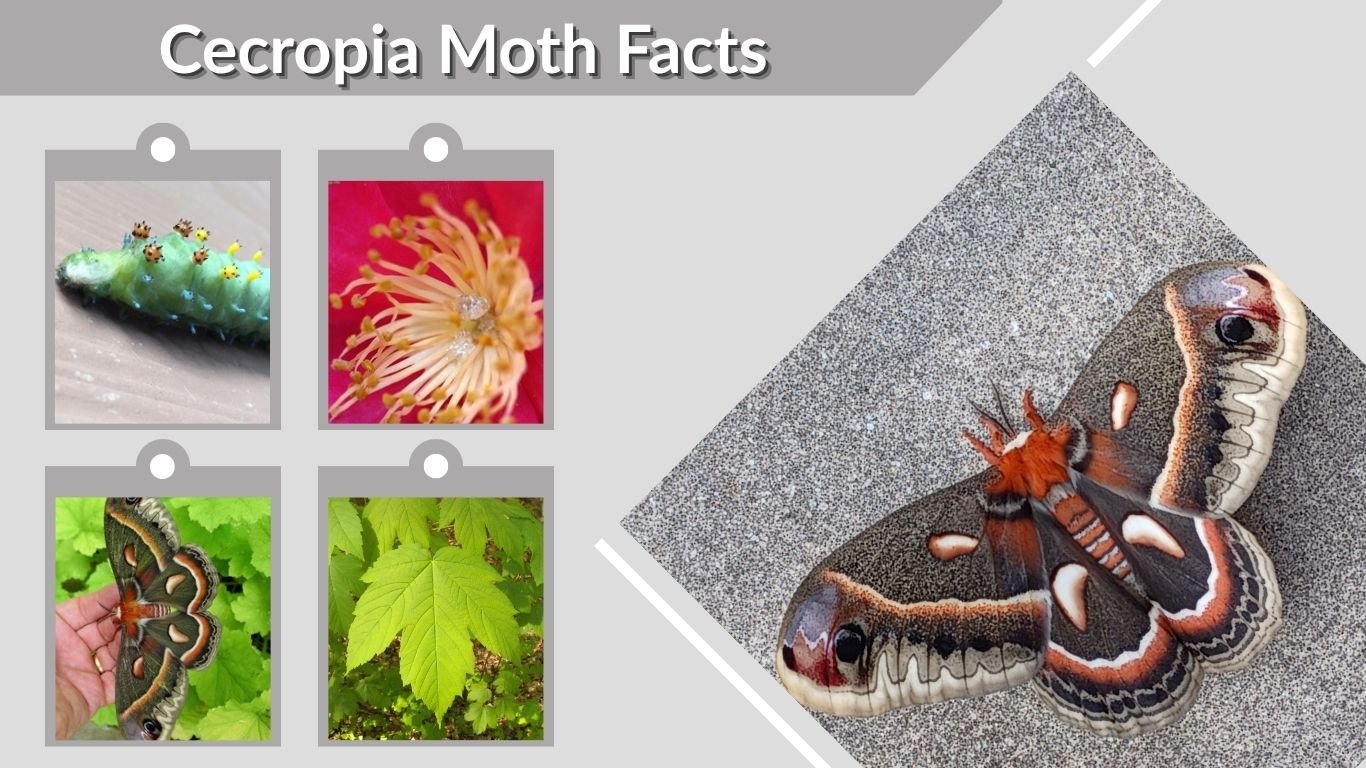
The cecropia moth is one of the most beautiful giant silk moths in North America. Known scientifically as Hyalophora cecropia, it is famous for its large wings, reddish body, bold markings, and colorful caterpillar stage. Many people search for this moth after finding a huge caterpillar, brown cocoon, or large moth near a light. This guide explains what cecropia moths are, what they eat, how big they get, where they live, and how their life cycle works.
What Is a Cecropia Moth?
The cecropia moth is a large native silk moth with a short adult life and a dramatic caterpillar stage. It belongs to the giant silk moth group, which includes other large moths such as luna moths and polyphemus moths. Adults are mostly active at night and are often seen near outdoor lights during their flight season.
Cecropia Moth Scientific Name
The scientific name of the cecropia moth is Hyalophora cecropia. It is also commonly called the cecropia silk moth or giant cecropia moth. These names all refer to the same species.
Is a Cecropia Moth a Butterfly?
A cecropia moth is not a butterfly. It is a moth. It has a thick, fuzzy body, large wings, and feathery antennae. Like many moths, it is mostly active at night rather than during the day.
Cecropia Moth Pronunciation
Cecropia is usually pronounced “seh-KROH-pee-uh.” Many people search for different spellings or say the word differently, but “cecropia moth” is the correct common name.
Cecropia Moth Size and Appearance
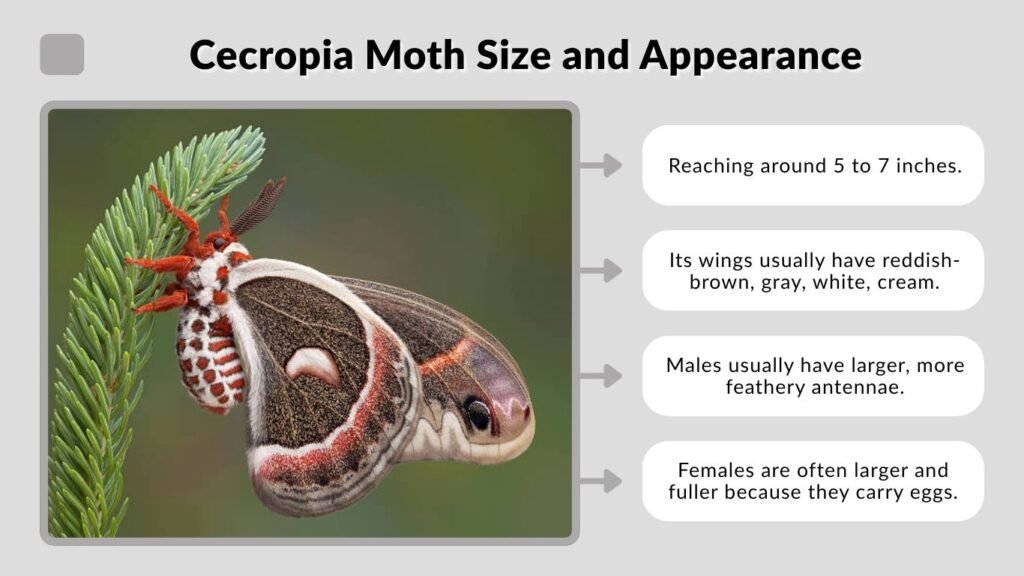
Cecropia moths are easy to notice because of their huge size and bold wing patterns. Their wings are usually reddish-brown with white, black, tan, and red markings. Their fuzzy body and large wings make them look impressive, but they are harmless. Males and females look similar, though females are often heavier-bodied.
Cecropia Moth Wingspan
The cecropia moth has a very large wingspan, often reaching around 5 to 7 inches. This size makes it one of the largest native moths in North America. When its wings are spread, it can look almost birdlike at first glance.
Cecropia Moth Wings and Colors
Its wings usually have reddish-brown, gray, white, cream, and black markings. Many individuals also have crescent-shaped spots on the wings. The body is thick and fuzzy, often with red and white banding.
Male vs Female Cecropia Moth
Male and female cecropia moths can be told apart by their body shape and antennae. Males usually have larger, more feathery antennae, which help them detect female pheromones. Females are often larger and fuller because they carry eggs.
Cecropia Moth Caterpillar
The cecropia moth caterpillar is one of the most interesting parts of the life cycle. It changes appearance as it grows through several stages called instars. Young caterpillars may look dark, but older caterpillars become large, greenish-blue, and covered with colorful bumps. Although they look unusual, they are not usually dangerous.
What Does a Cecropia Moth Caterpillar Look Like?
A mature cecropia moth caterpillar is large, thick, and bluish-green. It has colorful raised bumps called tubercles. These bumps may be yellow, blue, orange, or red depending on the caterpillar’s stage and position on the body.
Cecropia Moth Caterpillar Instars
Cecropia moth caterpillars grow through several instars. Each instar is a growth stage between molts. As the caterpillar becomes larger, its color and markings change. This is why young and mature cecropia caterpillars can look very different.
Is a Cecropia Moth Caterpillar Poisonous?
A cecropia moth caterpillar is not considered poisonous to people. It may look strange or scary because of its size and colorful bumps, but it is generally harmless. Still, it is best to avoid rough handling. If you need to move one, use a leaf or twig instead of squeezing it.
What Do Cecropia Moths Eat?
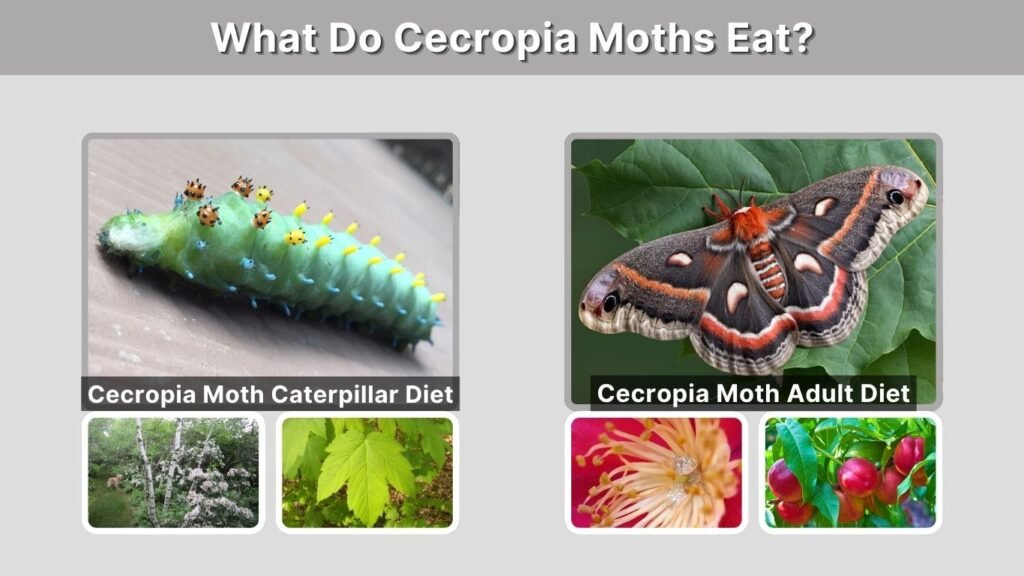
The eating habits of cecropia moths depend on their life stage. Adult cecropia moths do not eat because they do not have functional mouthparts. All real feeding happens during the caterpillar stage. Cecropia moth caterpillars eat leaves from host trees and shrubs, storing energy for their short adult life.
What Do Adult Cecropia Moths Eat?
Adult cecropia moths do not eat nectar, fruit, leaves, fabric, or stored food. They also do not bite or chew. Their adult stage is mainly for mating and egg-laying, so they live on energy stored from the caterpillar stage.
Cecropia Moth Caterpillar Diet
Cecropia moth caterpillars eat leaves from several host plants. Common food plants include:
- Maple
- Cherry
- Birch
- Apple
- Willow
- Alder
- Plum
- Poplar
- Elderberry
- Box elder
Cecropia Moth Host Plants
Host plants are the trees or shrubs where female moths lay eggs and where caterpillars feed after hatching. If you find a cecropia caterpillar, the best food is usually fresh leaves from the same plant where it was found.
Cecropia Moth Life Cycle
The cecropia moth life cycle includes four main stages: egg, caterpillar, pupa, and adult moth. In many areas, this moth has one generation each year. The caterpillar grows during the warm season, spins a cocoon, and then spends the colder months as a pupa before emerging as an adult moth.
Cecropia Moth Eggs
Female cecropia moths lay eggs on or near suitable host plants. These eggs are small and usually placed where the young caterpillars can find food after hatching. Once the eggs hatch, the tiny larvae begin feeding on fresh leaves.
Cecropia Moth Larvae and Pupa
The larva is the caterpillar stage. This is when the insect eats, grows, and stores energy. After reaching full size, the caterpillar spins a tough silk cocoon. Inside that cocoon, it becomes a pupa and slowly changes into an adult moth.
Cecropia Moth Cocoon
A cecropia moth cocoon is usually brown, firm, and made of silk. It is often attached lengthwise to a twig, branch, shrub, or small tree stem. People sometimes call it a chrysalis, but “pupa inside a cocoon” is the better term for moths.
Cecropia Moth Lifespan
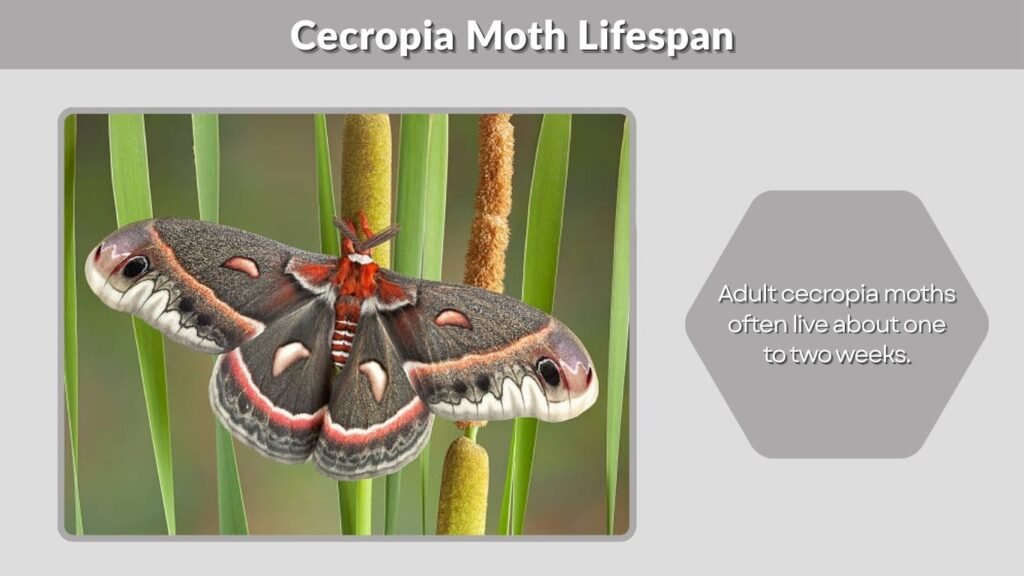
The full lifespan of a cecropia moth can be close to a year when all life stages are included. However, the adult moth stage is much shorter. Adult cecropia moths usually live only long enough to mate and lay eggs, because they do not eat or drink after emerging.
How Long Do Cecropia Moths Live?
Adult cecropia moths often live about one to two weeks. Their exact adult lifespan can vary depending on weather, predators, and whether they find a mate. Since adults cannot feed, they depend completely on stored energy from the caterpillar stage.
Why Is Adult Life So Short?
The adult cecropia moth is built for reproduction, not long-term survival. It emerges, finds a mate, reproduces, and then dies. This short adult life is common among giant silk moths.
Where Do Cecropia Moths Live?
Cecropia moths live across much of eastern North America. They are often found in places with suitable host plants for their caterpillars. Woodlands, forest edges, orchards, parks, gardens, and suburban yards can all provide habitat if enough food plants are nearby.
Cecropia Moth Range
The cecropia moth range includes much of the eastern United States and parts of Canada. It is commonly associated with regions where trees such as maple, cherry, birch, willow, apple, and box elder grow.
Cecropia Moth Habitat
Cecropia moths prefer habitats with trees and shrubs that support their caterpillars. They may be found near:
- Forest edges
- Wooded neighborhoods
- Orchards
- Parks
- Gardens
- Natural shrub areas
Cecropia Moth in Minnesota, Michigan, Wisconsin, and Ohio
Cecropia moths can be found in states such as Minnesota, Michigan, Wisconsin, and Ohio. In these areas, caterpillars may use local host plants like maple, cherry, birch, willow, apple, and box elder. Adults are most often noticed at night near lights.
Are Cecropia Moths Dangerous?
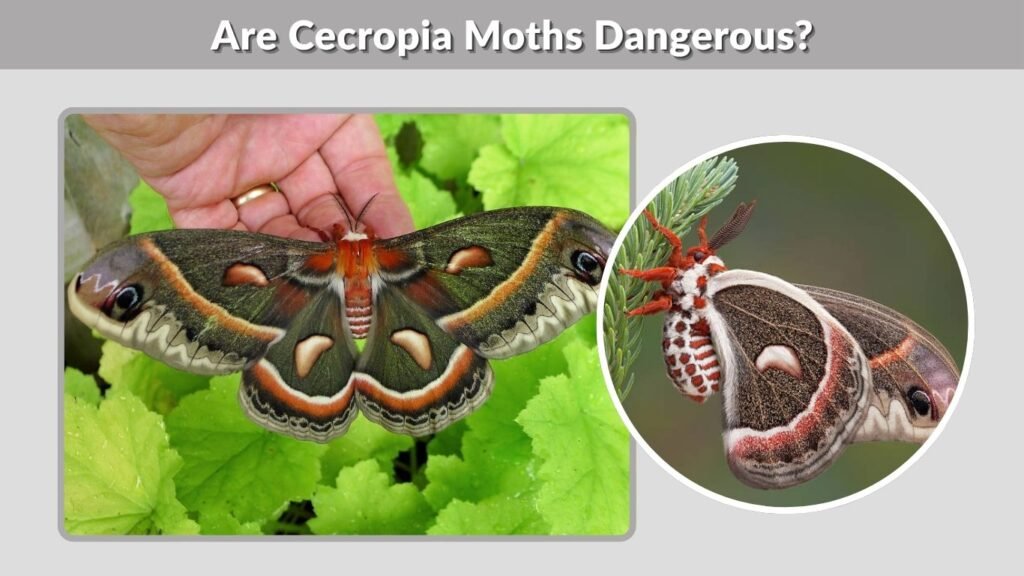
Cecropia moths are not dangerous to people. Their large size can be surprising, but they do not attack, sting, or bite. Adult moths cannot chew because they lack functional feeding mouthparts. Caterpillars may look strange because of their colorful bumps, but they are generally harmless when left alone.
Are Cecropia Moths Poisonous?
Cecropia moths are not considered poisonous to humans. Adult moths are harmless, and their caterpillars are not known as dangerous stinging caterpillars. It is still best to avoid unnecessary handling to protect the insect.
Do Cecropia Moths Bite?
Adult cecropia moths do not bite. They do not have the working mouthparts needed to bite or feed. If one lands on your hand, it is not trying to hurt you.
Cecropia Moth vs Luna Moth
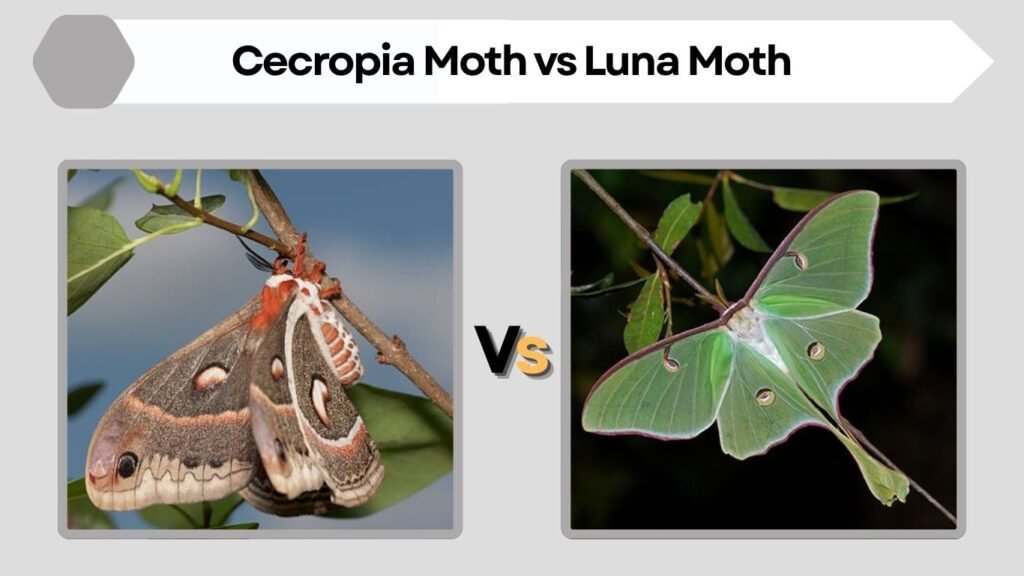
The cecropia moth and luna moth are both large native silk moths, but they look very different. Cecropia moths are reddish-brown with bold markings, while luna moths are pale green with long tails. Both species have caterpillars that eat leaves, and both adult moths do not eat.
Cecropia Moth Caterpillar vs Luna Moth Caterpillar
Cecropia moth caterpillars are usually large, bluish-green, and covered with colorful bumps. Luna moth caterpillars are also green but usually look smoother and less colorful. Both feed on leaves from specific host plants.
Adult Cecropia Moth vs Luna Moth
Adult cecropia moths have broad reddish-brown wings with cream, black, and red markings. Adult luna moths have soft green wings and long tail-like extensions. Both are beautiful, harmless, and short-lived.
FAQs
What do cecropia moths eat?
Adult cecropia moths do not eat or drink because they do not have functional mouthparts. All feeding happens during the caterpillar stage. Cecropia moth caterpillars eat fresh leaves from host plants such as maple, cherry, birch, apple, willow, plum, poplar, and box elder.
Are cecropia moths dangerous?
Cecropia moths are not dangerous to people. Adult moths do not bite, sting, or attack. Their large size may look surprising, but they are harmless. Cecropia caterpillars are also generally safe, though it is best to handle them gently or leave them alone.
How long do cecropia moths live?
The full life cycle can last close to a year, but the adult moth stage is short. Adult cecropia moths often live about one to two weeks. Since they do not eat or drink, they use stored energy from their caterpillar stage to mate and lay eggs.
What does a cecropia moth cocoon look like?
A cecropia moth cocoon is usually brown, tough, and made of silk. It is often attached lengthwise to a twig, branch, shrub, or small tree stem. Inside the cocoon, the pupa develops until the adult moth is ready to emerge.
What is the difference between a cecropia moth and a luna moth?
A cecropia moth is reddish-brown with cream, white, black, and red markings. A luna moth is pale green with long tail-like wings. Both are giant silk moths, both are harmless, and both adult moths do not eat. Their caterpillars feed on host plant leaves.
