
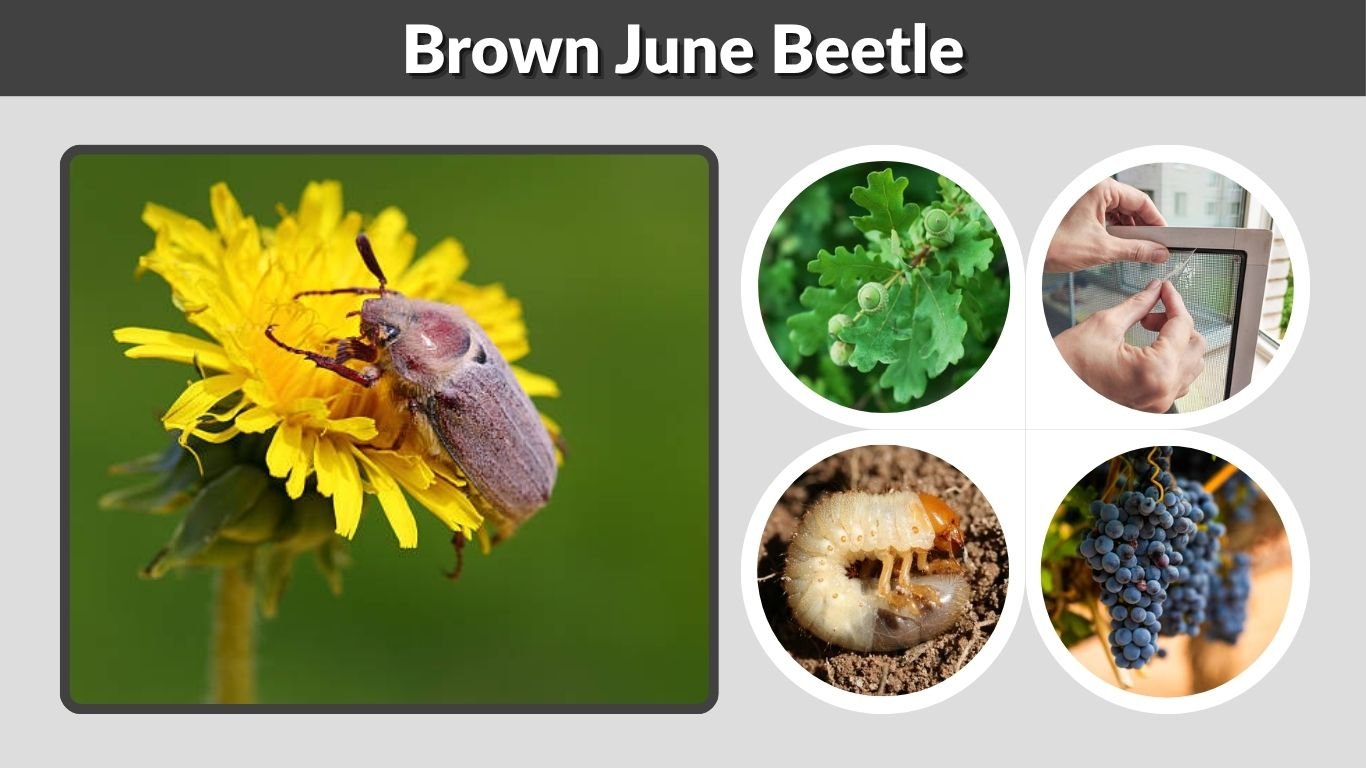
The brown June beetle, commonly called a June bug or May beetle, is a sturdy scarab beetle frequently seen around lawns, gardens, porches, and outdoor lights. Most brown June beetles belong to the genus Phyllophaga, although the name may describe several similar species. Adults mainly feed on plant foliage, while their white grubs develop underground and consume roots. These beetles do not pose a serious danger to humans, but large populations can damage grass, ornamental plants, and young trees.
What Is a Brown June Beetle?
“Brown June beetle” is a general name rather than the official name of one species. In North America, it most often refers to one of the numerous Phyllophaga species. These insects belong to the scarab beetle family, Scarabaeidae.
They are called June beetles because adults commonly emerge during late spring and early summer. Depending on the local climate and species, they may begin appearing in May or remain active into July.
Brown June Beetle Scientific Name
Most common brown June beetles are classified within:
- Genus: Phyllophaga
- Family: Scarabaeidae
- Order: Coleoptera
- Common names: June beetle, June bug, May beetle
The exact scientific name varies among species and regions. For example, a large brown June bug in Colorado may not be the same species as one found in New Jersey, California, Oklahoma, or South Carolina.
In the United Kingdom, “June bug” may refer to the summer chafer, Amphimallon solstitiale. The larger European cockchafer, Melolontha melolontha, is another brown scarab that can resemble a North American June beetle.
Brown June Beetle Identification
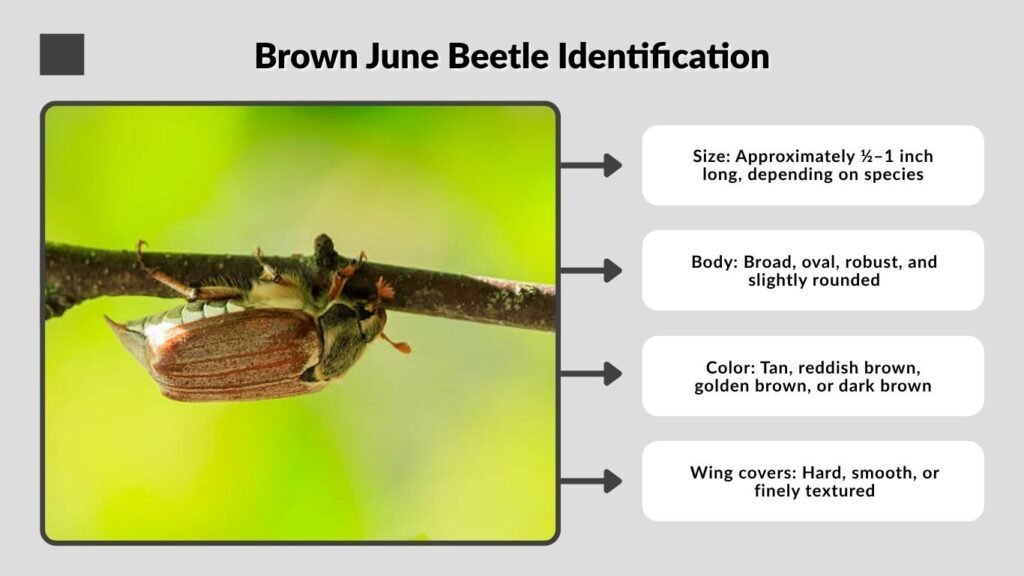
Brown June beetles have oval, heavily built bodies protected by hardened wing covers. Color can range from pale reddish brown to dark chocolate brown or nearly black.
Key Identification Features
- Size: Approximately ½–1 inch long, depending on species
- Body: Broad, oval, robust, and slightly rounded
- Color: Tan, reddish brown, golden brown, or dark brown
- Wing covers: Hard, smooth, or finely textured
- Legs: Thick and spiny, particularly the front legs
- Antennae: Clubbed tips made of movable, leaflike plates
- Underside: Often covered with fine pale hairs
- Activity: Usually flies after sunset and gathers around lights
- Flight: Loud, clumsy, and apparently poorly controlled
The antennae are especially useful for recognizing scarab beetles. When expanded, their tips resemble small fans. Males of some species have larger antennal plates that help them detect females.
Are Brown June Beetles Blind?
Brown June beetles are not blind. They have compound eyes and can detect light, movement, and surrounding objects. However, they are awkward nighttime fliers and frequently crash into windows, walls, people, and furniture.
Their attraction to artificial lights can interfere with natural navigation. This erratic behavior creates the mistaken impression that June bugs cannot see.
Brown June Beetle With Cream Spots
A beige or golden-brown beetle with dark spots may be a grapevine beetle rather than a typical Phyllophaga June beetle. The grapevine beetle, Pelidnota punctata, is yellowish, tan, or orange-brown and normally has several black spots.
A large beetle with alternating brown and cream-colored stripes may be a ten-lined June beetle, Polyphylla decemlineata. It has distinctive white stripes running along its brown wing covers.
Because colors and markings vary considerably, location, size, antennae, and stripe patterns should all be considered during identification.
Brown June Beetle Life Cycle
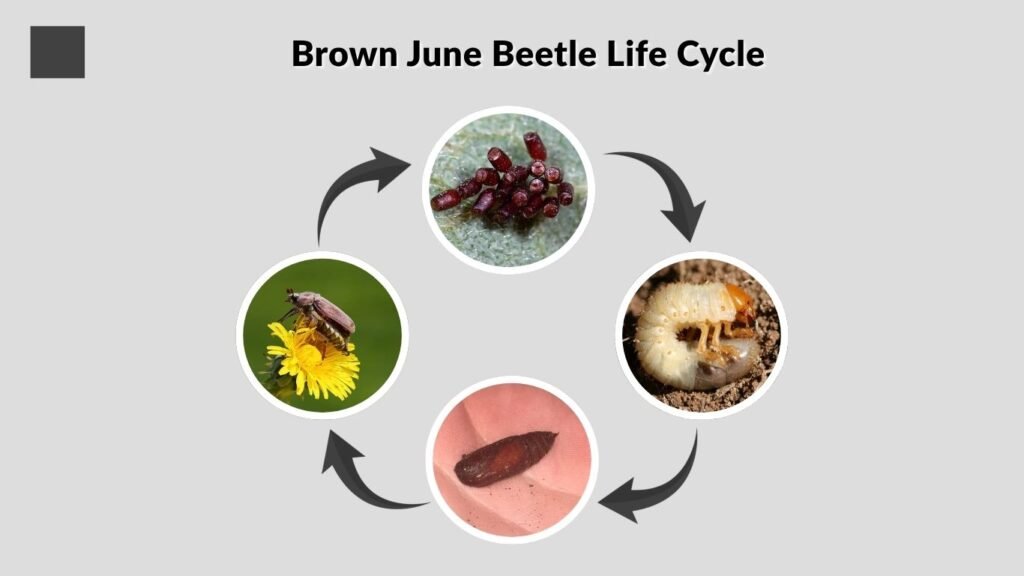
Brown June beetles undergo complete metamorphosis consisting of four stages: egg, larva, pupa, and adult. Much of their life is spent underground, and the complete cycle can require one to three years.
Egg Stage
After mating, the female burrows into the soil and deposits small, pearl-like eggs. Eggs are commonly laid in grass-covered soil where young larvae will have access to roots.
Moist soil supports egg survival, while extremely dry conditions can reduce hatching. The eggs usually hatch within several weeks.
Larval Stage
Brown June beetle larvae are called white grubs. They have creamy white bodies, brown heads, six small legs, and a characteristic C-shaped posture when disturbed.
Young grubs feed on decaying organic material and fine plant roots. As they grow, they may consume larger grass roots and cause visible lawn injury. Depending on the species, the larval period may last several months or more than two years.
Grubs usually move deeper into the soil when temperatures fall. They return toward the root zone when the ground warms.
Pupal and Adult Stages
A mature grub creates a small underground chamber and develops into a pupa. During this stage, its body transforms into the adult beetle.
The adult may remain underground until soil temperatures and moisture conditions encourage emergence. Adults become most noticeable during warm evenings in late spring or early summer.
Brown June Beetle Behavior and Diet
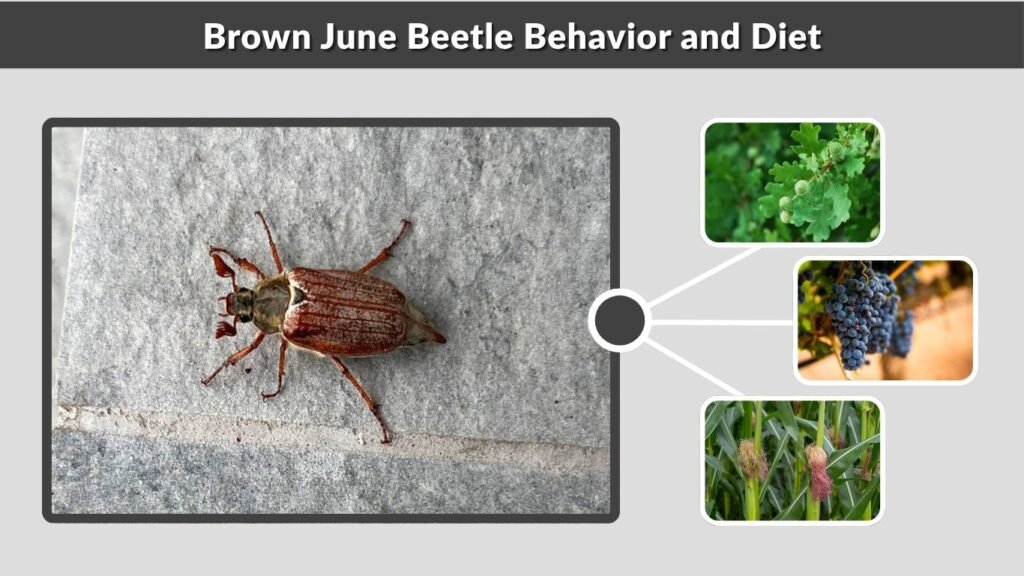
Adult brown June beetles generally hide during daylight and begin flying around dusk. Porch lights, illuminated windows, and landscape lighting may attract dozens of beetles during a major emergence.
What Do Adult June Beetles Eat?
Adults feed on leaves, flowers, and occasionally fruit. Common food sources include:
- Oak leaves
- Maple leaves
- Walnut foliage
- Rose leaves and flowers
- Grapes
- Corn silk
- Fruit-tree foliage
- Other ornamental and agricultural plants
Individual beetles rarely cause serious damage. However, large groups can strip foliage from young trees or leave leaves with irregular, ragged edges.
What Do Brown June Beetle Larvae Eat?
White grubs feed primarily on underground plant material, including turfgrass roots. Heavy feeding prevents grass from absorbing enough water and nutrients.
Infested turf may become yellow or brown, feel spongy, or lift away from the soil like loose carpet. Skunks, raccoons, birds, armadillos, and other animals may dig through the lawn while searching for grubs, creating additional damage.
Do Brown June Beetles Bite?
Brown June beetles do not normally bite people. They possess chewing mouthparts, but these are designed for eating plant material rather than attacking humans.
A beetle held tightly may scratch or pinch slightly with its legs or mouthparts, but it cannot inject venom and is not considered medically dangerous. Brown June beetles also do not sting.
Their spiny legs may cling firmly to clothing, hair, or skin, making the encounter feel uncomfortable. Gently place a container over the beetle and slide a piece of paper underneath instead of crushing or pulling it away forcefully.
Brown June Beetle vs. Similar Beetles
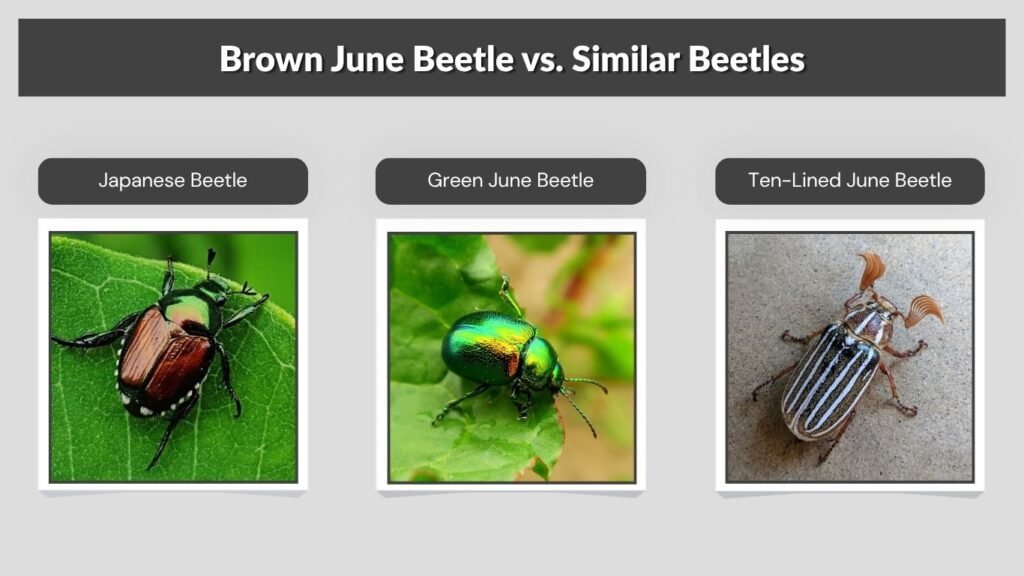
Several scarab beetles are active during the same season. Color, markings, size, and daytime behavior can help distinguish them.
Brown June Bug vs. Japanese Beetle
A typical brown June beetle is larger and uniformly tan, reddish brown, or dark brown. It is mainly active after dark.
The Japanese beetle, Popillia japonica, has a metallic green head, copper-colored wing covers, and small white hair patches along the sides of its abdomen. Japanese beetles are active during the day and often gather in large numbers on roses, grapes, and other plants.
Green June Beetle vs. Brown June Beetle
The green June beetle, Cotinis nitida, has a velvety green body with yellowish or bronze edges. It is frequently seen flying low over lawns during sunny summer days.
A brown Phyllophaga June beetle lacks the prominent green coloration and is generally nocturnal. Green June beetle larvae also tend to crawl on their backs when above ground, while Phyllophaga grubs normally remain C-shaped.
Some brown June beetles may display a faint green sheen under strong light, but they lack the extensive green coloration of a true green June beetle.
Brown June Beetle vs. Ten-Lined June Beetle
The ten-lined June beetle is a large brown or blackish scarab with several bold cream-white stripes. It may also produce a hissing sound when handled.
Typical brown June beetles have plain or subtly textured wing covers without strong longitudinal white stripes. Ten-lined June beetles are particularly common in western North America.
Why Are Brown June Beetles in the House?
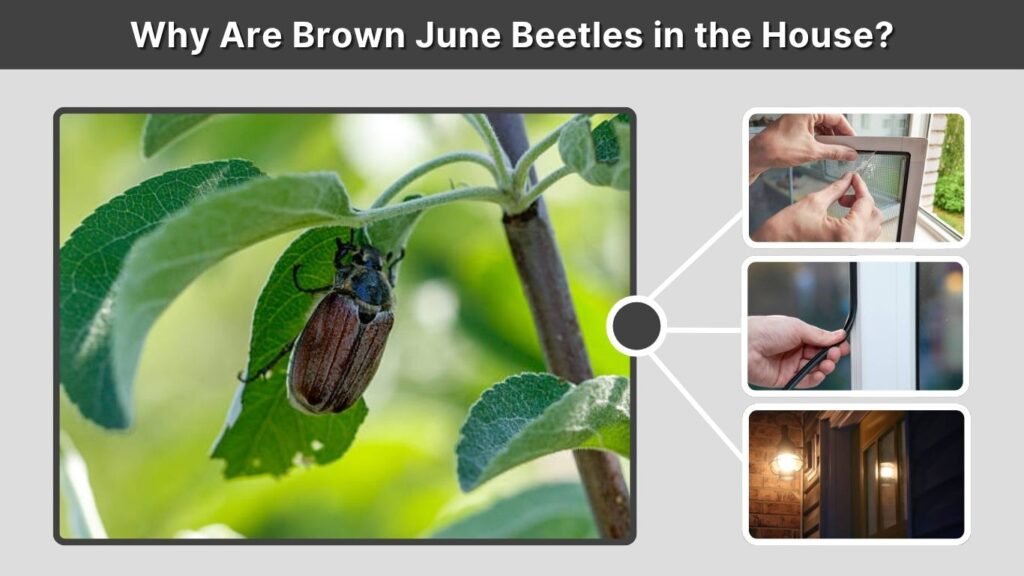
Brown June beetles do not normally infest houses or reproduce indoors. They usually enter accidentally through an open door, torn window screen, chimney, or gap around a lighted entrance.
Bright exterior and interior lights are the main attraction. A beetle that reaches the house may fly noisily around a lamp before resting on a curtain, wall, or floor.
To prevent indoor entry:
- Repair damaged window and door screens.
- Keep doors closed during peak evening activity.
- Seal gaps around windows and utility openings.
- Use curtains or blinds to reduce light visible outside.
- Replace unnecessary bright exterior bulbs with warmer, less attractive lighting.
- Move porch lights farther from frequently used entrances where possible.
Remove individual beetles with a cup and paper or collect them using a vacuum. Empty the vacuum promptly if the beetle is still alive.
How to Get Rid of Brown June Beetles
Control is usually unnecessary when only a few adult beetles visit outdoor lights. If they are damaging trees or their grubs are injuring turf, first determine which life stage is responsible.
Reduce Adult Beetles Around Lights
Turn off unnecessary exterior lights during peak flight periods. Shield fixtures so light points downward and consider warm-colored bulbs instead of bright white or bluish lighting.
Physical exclusion is more practical than repeatedly spraying adult beetles. Clean up dead insects so they do not attract ants or other scavengers.
Monitor the Lawn for White Grubs
Cut and lift a square section of damaged turf, then examine the upper few inches of soil. Finding an occasional grub does not necessarily justify treatment. Turf can tolerate a limited population when it is healthy and properly maintained.
Correct drought stress, poor drainage, nutrient problems, disease, and other possible causes before assuming grubs are responsible.
Use Biological Control Carefully
Beneficial nematodes may suppress white grubs when the correct species is selected and applied under suitable soil-temperature and moisture conditions. They require moist soil and protection from intense sunlight during application.
Milky spore is primarily intended for Japanese beetle grubs. It should not be expected to control every type of brown June beetle larva.
Apply Insecticides Only When Necessary
Preventive grub-control products are most effective when timed to target small, newly hatched larvae. Curative treatments may be less effective against mature grubs deeper in the soil.
Correct timing and product choice depend on the beetle species, season, and region. Follow the complete pesticide label and avoid treating flowering plants where bees and other pollinators are feeding. A local extension service or licensed pest professional can help confirm whether treatment is justified.
Frequently Asked Questions
Are brown June beetles harmful?
They are not dangerous to people or pets. However, adults can damage leaves, while large populations of white grubs may injure lawns by feeding on roots.
Can a brown June beetle bite or sting?
Brown June beetles do not sting and rarely attempt to bite. Their spiny legs can produce a mild scratching or pinching sensation when they cling to skin.
Why do brown June beetles fly into people?
They are clumsy nocturnal fliers attracted to artificial light. Collisions are accidental and are not attacks.
How long do brown June beetles live?
The adult stage generally lasts only several weeks. The complete life cycle may take one to three years because the beetle spends most of its life underground as a grub.
Should I kill brown June beetles in my yard?
A few beetles rarely require control and contribute to natural food webs. Treatment should be considered only when accurate identification and inspection confirm significant plant or turf damage.
