
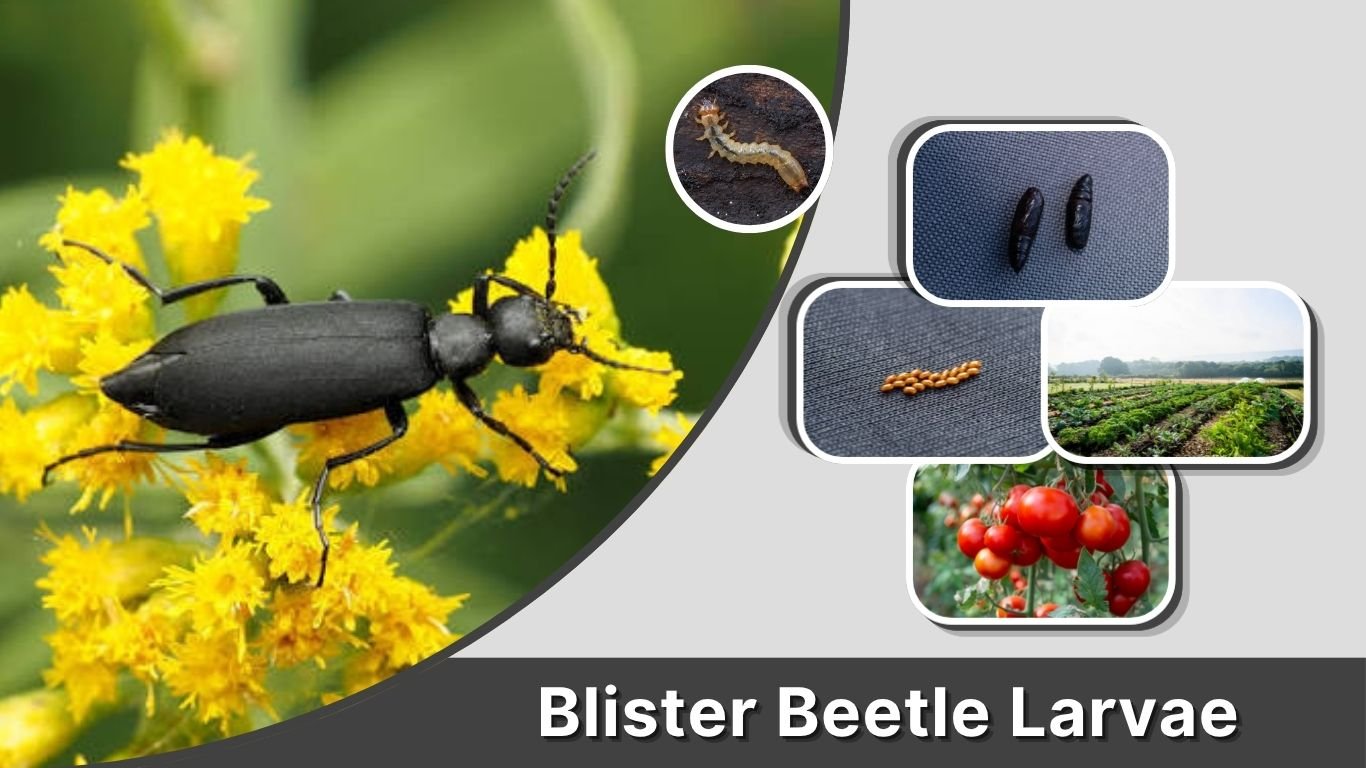
Blister beetle larvae are one of the most unusual immature stages found among beetles. Unlike many beetle larvae that remain relatively similar as they grow, blister beetles pass through several dramatically different larval forms before becoming adults. The first-stage larvae are tiny, active, and mobile, while later stages become softer and less active. Depending on the species, blister beetle larvae may feed on grasshopper eggs or develop inside bee nests. Understanding what these larvae look like, where they live, and what they eat can make blister beetles much easier to recognize.
What Are Blister Beetle Larvae?
Blister beetle larvae are the immature stages of beetles belonging to the family Meloidae. They eventually develop into the elongated adult beetles commonly called blister beetles.
Their development is unusual because blister beetles undergo a process called hypermetamorphosis. This means the beetle passes through several larval stages that differ noticeably in appearance and behavior.
The first larval stage is typically an active form called a triungulin. These tiny larvae move around searching for food or a suitable host. After successfully finding what they need, they molt into slower, softer-bodied forms.
Blister Beetle Larvae Identification
Young blister beetle larvae can be identified by several characteristics:
- Very small body, often only a few millimeters long
- Elongated or somewhat flattened shape
- Three pairs of well-developed legs
- Large, noticeable head compared with the body
- Yellowish, brown, orange, or dark coloration depending on species
- Active and fast-moving behavior
- Two small projections or structures near the end of the abdomen in some species
Later larval stages look very different. Their bodies become softer, thicker, and more grub-like, while their legs become reduced.
Because their appearance changes considerably during development, identifying blister beetle larvae solely by appearance can be difficult.
What Do Blister Beetle Larvae Look Like?
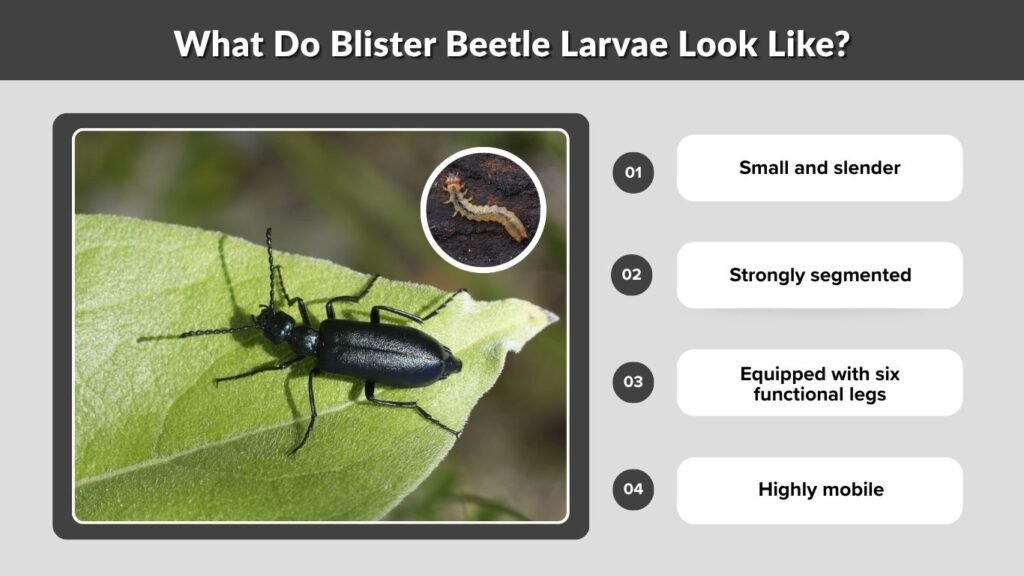
The appearance of a blister beetle larva depends heavily on its developmental stage.
Newly hatched larvae are typically narrow, flattened, and equipped for movement. Their legs are proportionally long compared with their bodies, allowing them to walk quickly through soil, plants, or flowers.
These first-stage larvae are known as triungulins.
After finding a food source, the larvae molt. Their later bodies become pale, soft, and relatively inactive.
Triungulin Stage
The triungulin is probably the most distinctive stage of blister beetle larval development.
It is generally:
- Small and slender
- Strongly segmented
- Equipped with six functional legs
- Highly mobile
- Yellow, brown, or dark in color
- Capable of climbing vegetation
Triungulins must actively locate suitable food or hosts. Their survival depends on successfully completing this search.
Once they begin feeding, mobility becomes much less important.
Later Larval Stages
Later blister beetle larvae usually become thicker and less active.
They may appear:
- Creamy white or yellowish
- Soft-bodied
- Slightly curved
- Grub-like
- Short-legged or nearly legless in appearance
At this point, larvae usually remain near their food source rather than actively searching the environment.
Blister Beetle Larvae Life Cycle
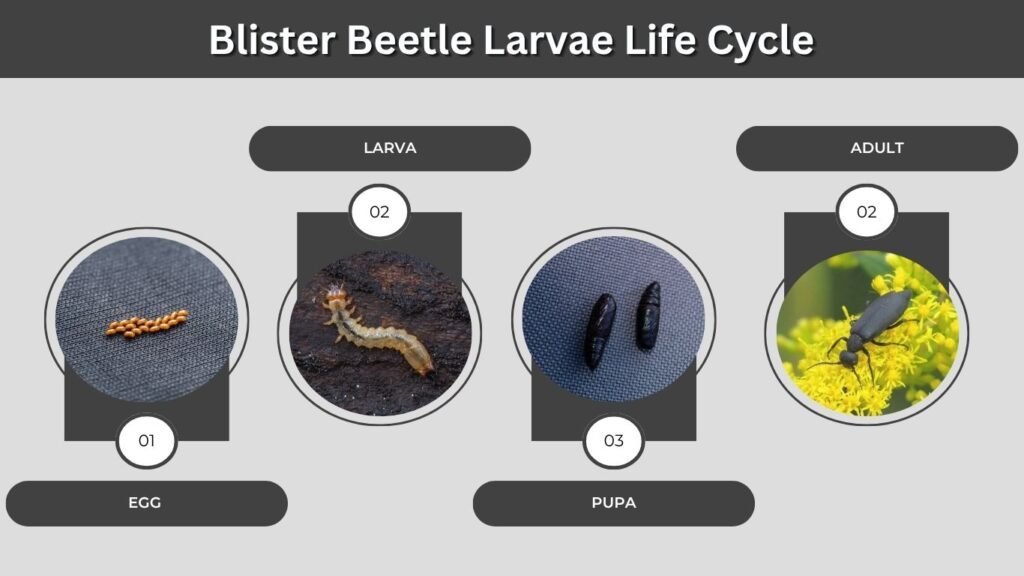
Blister beetles undergo complete metamorphosis consisting of four main stages:
Egg → Larva → Pupa → Adult
However, the larval period contains several specialized stages, making their development more complicated than that of many common beetles.
Egg Stage
Adult female blister beetles usually deposit clusters of eggs in the soil.
Depending on the species, a female may lay dozens or even hundreds of eggs during her lifetime.
Eggs generally hatch after several days or weeks depending on temperature, moisture, and species.
When the eggs hatch, highly active triungulin larvae emerge.
Active Larval Stage
The first-stage larva immediately begins searching for food.
Ground-dwelling species may move through the soil looking for grasshopper egg pods.
Other blister beetles use a completely different strategy. Their larvae climb flowers and attach themselves to visiting bees.
Once attached, the larvae are transported back to the bee’s nest.
Feeding Stages
After reaching a suitable food source, the larva begins feeding and molts into a less active form.
Several additional molts may follow.
As development continues, the larva stores nutrients needed to complete its transformation into a pupa and eventually an adult beetle.
Pupal Stage
The mature larva eventually forms a pupa, usually underground or inside a protected nesting area.
During this stage, the insect undergoes major internal changes.
The adult beetle later emerges from the pupal case and eventually reaches the surface.
What Do Blister Beetle Larvae Eat?
The diet of blister beetle larvae is dramatically different from that of adult blister beetles.
Adults mostly eat leaves, flowers, and other plant tissues. Larvae generally prey on insects or insect eggs.
Two important food sources are grasshopper eggs and bee nest provisions.
Grasshopper Eggs
Many blister beetle species are beneficial during their larval stage because they feed heavily on grasshopper eggs.
Female grasshoppers usually deposit groups of eggs inside soil.
Blister beetle larvae search through the soil until they locate these egg pods.
Once found, the larvae feed on the eggs and may destroy much of the grasshopper brood.
Because grasshoppers can cause serious agricultural damage, blister beetle larvae may provide some natural pest control.
Bee Eggs and Food Stores
Some blister beetle larvae develop inside nests belonging to solitary bees.
The triungulin larvae wait on flowers until a bee visits.
They then cling to the bee’s body and ride back to its nest.
Inside the nest, blister beetle larvae may eat:
- Bee eggs
- Bee larvae
- Stored pollen
- Nectar provisions
The blister beetle larva therefore uses the bee both as transportation and as a source of food.
Where Are Blister Beetle Larvae Found?
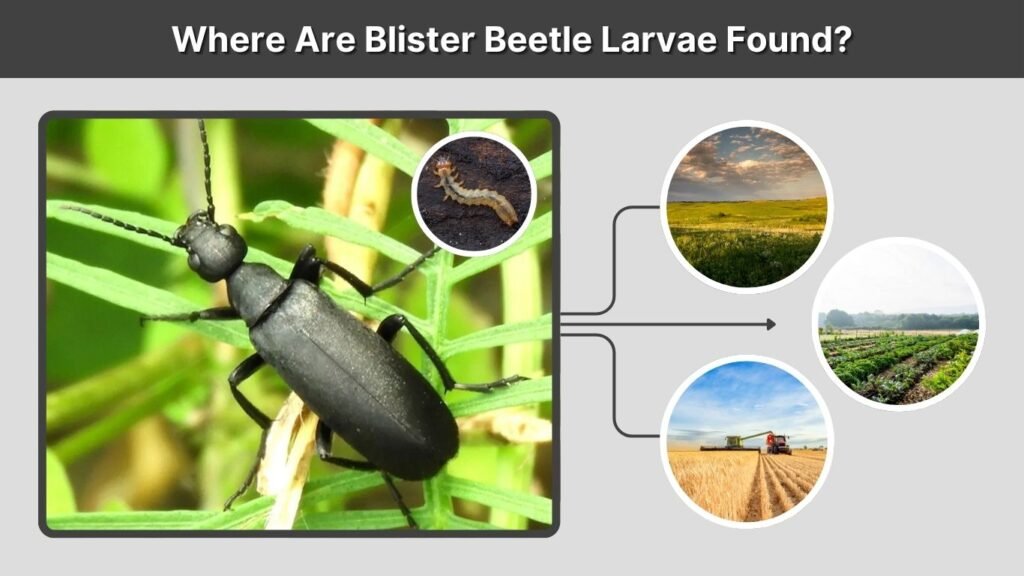
Finding blister beetle larvae is considerably more difficult than finding adults.
Adults are usually visible on flowers, weeds, vegetable plants, and agricultural crops. Larvae spend much of their development hidden underground or inside insect nests.
Blister Beetle Larvae in Soil
Species that prey on grasshopper eggs usually develop underground.
They are especially likely to occur in areas where grasshoppers lay eggs, including:
- Grasslands
- Agricultural fields
- Pastures
- Dry open ground
- Gardens
- Roadsides
The larvae may move through loose soil searching for grasshopper egg pods.
Larvae Around Flowers
Triungulins belonging to bee-associated species may temporarily appear on flowers.
Several larvae can sometimes gather together while waiting for bees to visit.
Because these larvae are extremely small, people rarely notice them.
After successfully attaching themselves to a bee, they are carried away from the flower.
Are Blister Beetle Larvae Dangerous?
Blister beetles are best known for producing cantharidin, a defensive chemical capable of irritating skin and causing blisters.
Adult blister beetles contain significant amounts of cantharidin.
Larvae are not normally considered a major biting or stinging threat to humans. However, unnecessary handling of blister beetles at any life stage should be avoided.
Do Blister Beetle Larvae Bite?
Blister beetle larvae are not known for deliberately biting people.
Their mouthparts are adapted primarily for feeding on insect eggs, bee provisions, or other biological material associated with their development.
If you find an unknown beetle larva, it is better to avoid handling it directly.
Use a container, gardening tool, or gloves if it needs to be moved.
Are Blister Beetle Larvae Harmful to Plants?
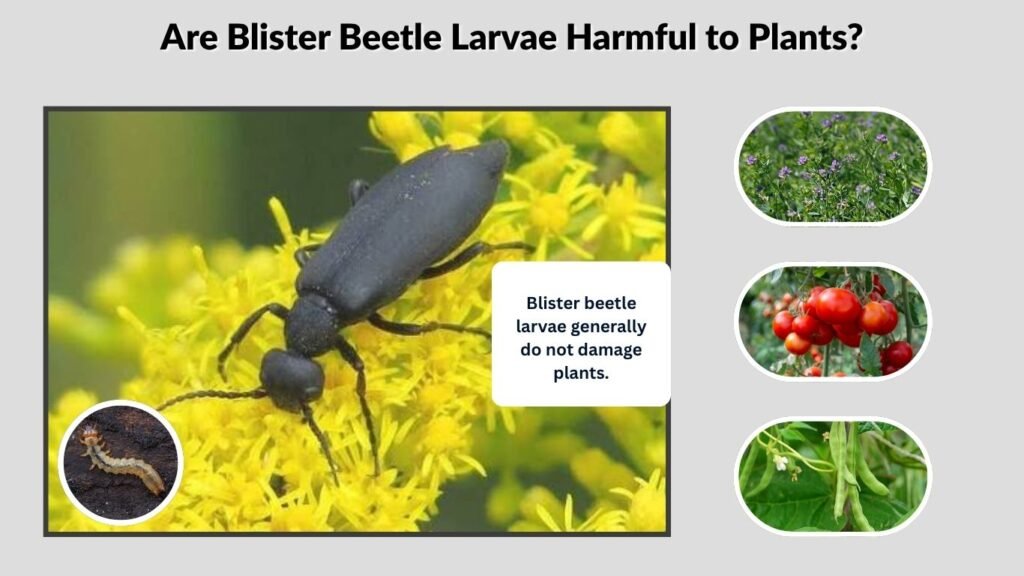
Blister beetle larvae generally do not damage plants.
In fact, their feeding behavior can sometimes be beneficial because larvae of many species consume grasshopper eggs.
Adult blister beetles are the stage responsible for most plant damage.
Adults may gather in large numbers and feed on:
- Alfalfa
- Tomatoes
- Potatoes
- Beans
- Beets
- Flowers
- Garden vegetables
- Various field crops
Large blister beetle groups can strip leaves and flowers rapidly.
Therefore, finding blister beetle adults in a garden may be more concerning than finding their larvae.
Blister Beetle Larvae vs Other Beetle Larvae
Many beetle larvae are pale, soft-bodied, and difficult to distinguish from one another.
However, young blister beetle larvae have some unusual characteristics that can help with identification.
| Feature | Blister Beetle Larvae | Typical Beetle Grubs |
|---|---|---|
| First-stage body | Slender and active | Usually thick or curved |
| Legs | Long and developed | Often short |
| Movement | Very active initially | Usually slower |
| Feeding | Insect eggs or bee nests | Roots, wood, organic matter, prey |
| Development | Hypermetamorphosis | More uniform larval stages |
| Location | Soil, flowers, bee nests | Soil, plants, wood, compost |
Later blister beetle larvae become more grub-like, making identification considerably harder.
Why Blister Beetle Larvae Are Unusual
Blister beetles are particularly interesting because of the extreme differences between their larval stages.
Most insects grow larger while maintaining approximately the same larval body structure. Blister beetles repeatedly change their form as their lifestyle changes.
Hypermetamorphosis
Hypermetamorphosis allows each larval stage to perform a specialized task.
The first stage needs:
- Speed
- Functional legs
- Strong sensory abilities
- The ability to locate hosts or food
Later stages no longer need these characteristics.
Once food has been located, the larva becomes adapted primarily for eating, growing, and storing energy.
This specialized development makes blister beetles an important example of complex insect metamorphosis.
Blister Beetle Larvae and Bees
The relationship between some blister beetles and solitary bees is particularly fascinating.
Triungulin larvae may gather on flowers frequented by bees. When a suitable bee lands, the tiny larvae attach themselves to its hairs.
The bee unknowingly carries them home.
Once inside the nest, the blister beetle larva detaches and begins exploiting the resources intended for the bee’s offspring.
Some species consume the bee egg before feeding on the stored pollen and nectar.
This strategy is known as phoresy, in which one organism uses another primarily for transportation.
Blister Beetle Larvae and Grasshoppers
Blister beetles associated with grasshopper eggs can play an important ecological role.
Grasshoppers deposit egg pods beneath the soil surface. After hatching, blister beetle triungulins actively search for these pods.
Once they locate one, they begin eating the developing grasshopper eggs.
A single larva may consume several eggs while developing.
Because outbreaks of grasshoppers can damage crops and pasture vegetation, blister beetle larvae are sometimes considered beneficial natural predators.
The relationship creates an interesting situation for farmers: blister beetle larvae can help reduce grasshopper populations, but adult blister beetles may themselves become crop pests.
How Long Do Blister Beetles Stay as Larvae?
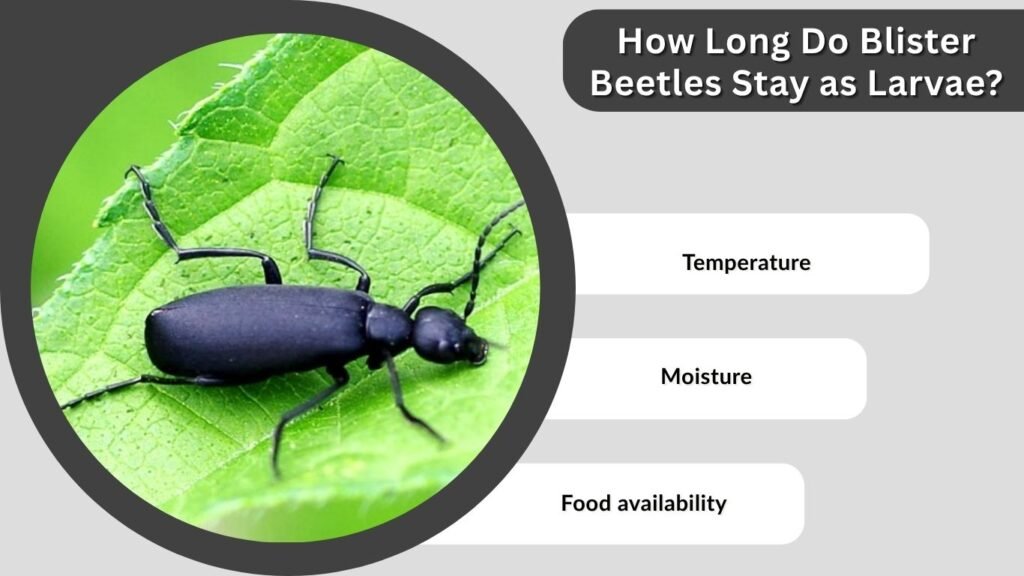
The length of the larval period varies between blister beetle species and environmental conditions.
Development is affected by:
- Temperature
- Moisture
- Food availability
- Host availability
- Seasonal conditions
Many blister beetles complete one generation each year.
Some species can remain in an inactive developmental stage for an extended period when environmental conditions are unfavorable.
This allows them to survive seasonal drought, cold weather, or temporary shortages of suitable hosts.
What to Do If You Find Blister Beetle Larvae
Finding blister beetle larvae usually does not require pest control.
Larvae living underground may actually be helping control grasshopper populations.
If you discover small unfamiliar larvae around flowers or soil, avoid crushing or handling them unnecessarily.
If adult blister beetles are also appearing in large numbers around crops or livestock areas, closer monitoring may be necessary.
Blister beetles are particularly important around hay intended for horses because crushed adult beetles can contaminate hay with cantharidin.
FAQs
What is a blister beetle larva called?
The highly active first larval stage of a blister beetle is commonly called a triungulin. It has a slender body and well-developed legs that help it search for grasshopper eggs or attach to bees. Later larval stages become softer and much less mobile.
Are blister beetle larvae beneficial?
Many blister beetle larvae can be beneficial because they prey on grasshopper eggs. By destroying grasshopper egg pods in the soil, the larvae may naturally reduce future grasshopper populations. However, adult blister beetles can become agricultural pests by feeding on crops and garden plants.
Where do blister beetles lay their eggs?
Many female blister beetles lay clusters of eggs in shallow soil. After hatching, the larvae move through the surrounding environment searching for food. Depending on the species, they may locate grasshopper eggs or climb flowers and attach themselves to solitary bees.
Do blister beetle larvae turn into blister beetles?
Yes. After passing through several specialized larval stages, the mature larva eventually pupates. Inside the pupal stage, it transforms into an adult blister beetle. The adult later emerges and begins feeding, mating, and eventually producing another generation of eggs.
Can blister beetle larvae hurt humans?
Blister beetle larvae generally do not attack humans and are not known as common biting pests. However, blister beetles produce cantharidin, the chemical responsible for their name. Avoid unnecessary direct handling of unidentified blister beetles or larvae, especially if you are unsure of the species.
