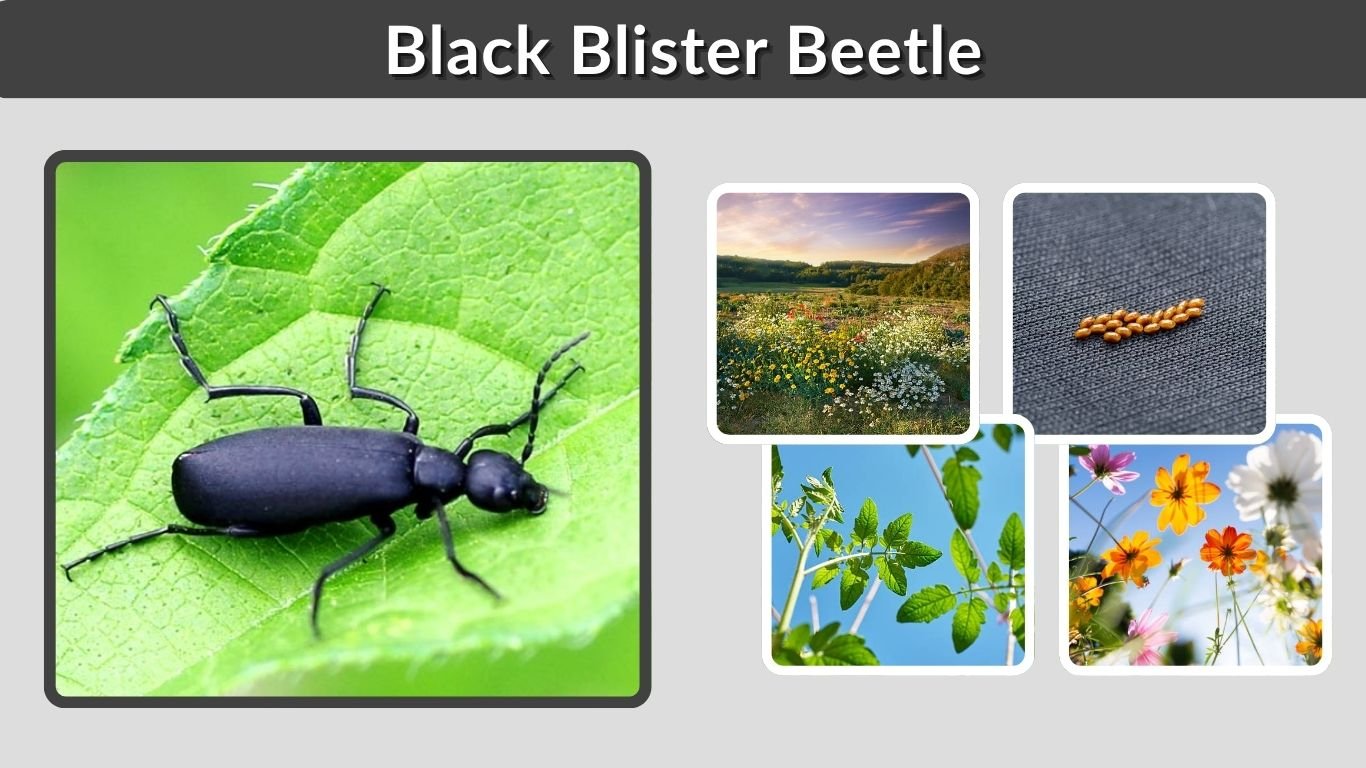
The black blister beetle is a dark-colored member of the blister beetle family, Meloidae. One of the best-known species in North America is Epicauta pennsylvanica, often called the black blister beetle. These insects are commonly found around gardens, fields, flowering plants, and crops such as tomatoes. Although they usually do not bite people, they contain cantharidin, a chemical that can cause painful skin blisters if the beetle is crushed against the body. Black blister beetles can also damage plants and may be dangerous to horses when accidentally consumed in contaminated hay.
What Is a Black Blister Beetle?
Black blister beetles are elongated, soft-bodied beetles that are usually dark brown to completely black.
They belong to the family Meloidae, a large group known for producing cantharidin. Adults commonly feed on leaves and flowers, while their larvae have a very different lifestyle.
One commonly encountered North American species is:
Scientific name: Epicauta pennsylvanica
However, not every dark blister beetle belongs to this species. Several blister beetles can appear black, gray-black, or dark brown.
Black Blister Beetle Identification
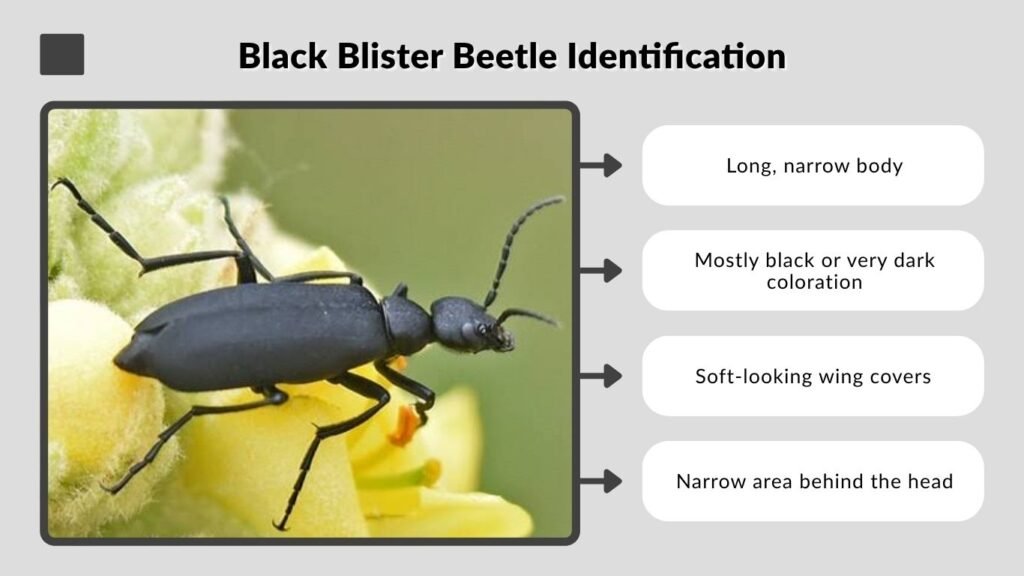
Correct identification is important because many harmless beetles can look somewhat similar.
Key Identification Features
Look for these characteristics:
- Long, narrow body
- Mostly black or very dark coloration
- Soft-looking wing covers
- Narrow area behind the head
- Head wider than the neck-like pronotum
- Long legs
- Long antennae
- Adults often found feeding in groups
- Usually seen on flowers, crops, and weeds
The unusual narrow section behind the head is one of the easiest ways to distinguish blister beetles from many other black beetles.
Black Blister Beetle Size
Black blister beetles are medium-sized insects.
Many adults are roughly 1/2 to 3/4 inch long, although size varies depending on species, sex, age, and environmental conditions.
Their narrow bodies often make them look longer than more compact beetles of similar overall size.
Do Black Blister Beetles Fly?
Yes, black blister beetles can fly.
Adults have functional wings beneath their outer wing covers and may move between:
- Flowering plants
- Gardens
- Agricultural fields
- Weedy areas
- Pastures
They may suddenly appear in relatively large numbers when suitable food plants become available.
Black Blister Beetle Habitat
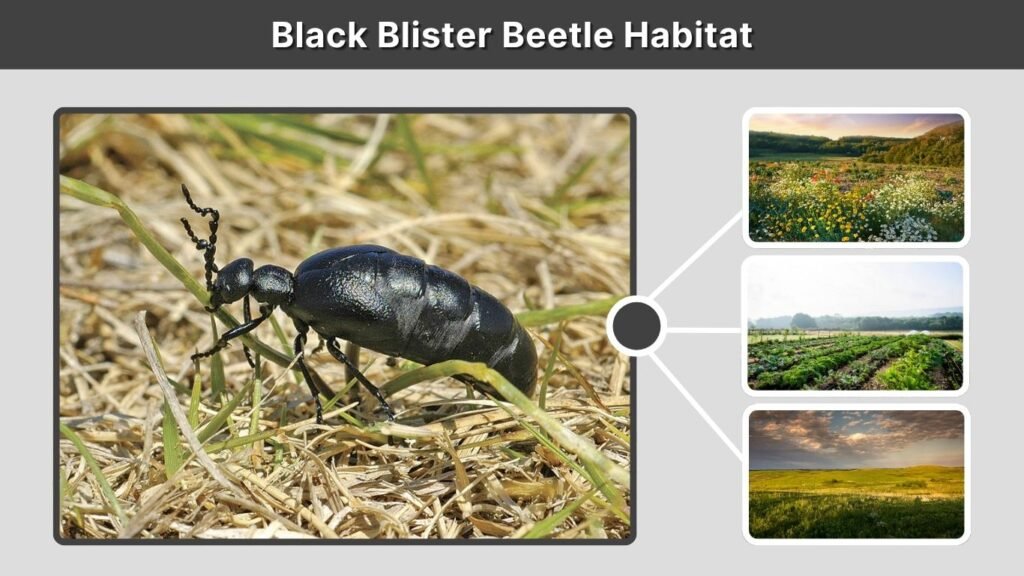
Black blister beetles are mainly outdoor insects.
They are commonly associated with:
- Meadows
- Prairies
- Gardens
- Farms
- Grasslands
- Roadsides
- Vegetable plots
- Flowering fields
Adults are often active during warm weather when plants are growing and blooming.
What Do Black Blister Beetles Eat?
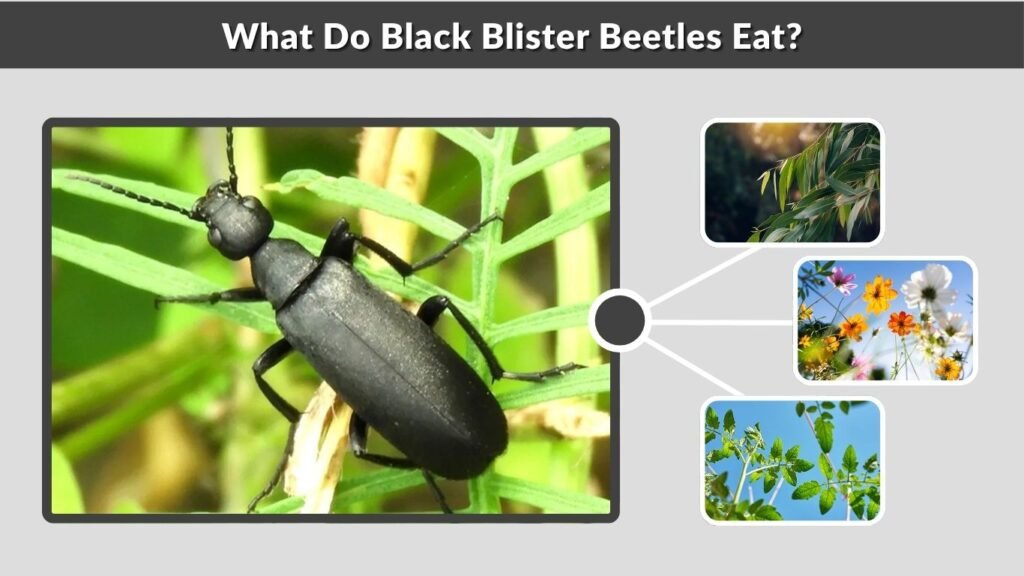
Adult black blister beetles mainly eat plant material.
Common foods include:
- Leaves
- Flowers
- Pollen
- Tender stems
- Crop foliage
They may feed on both wild plants and cultivated crops.
Black Blister Beetles on Tomatoes
Black blister beetles can sometimes become noticeable pests on tomato plants.
They may chew:
- Tomato leaves
- Young growth
- Flowers
Large groups can strip foliage relatively quickly.
A few beetles usually cause limited damage, but a large feeding group can seriously weaken young plants.
Black Blister Beetle Life Cycle
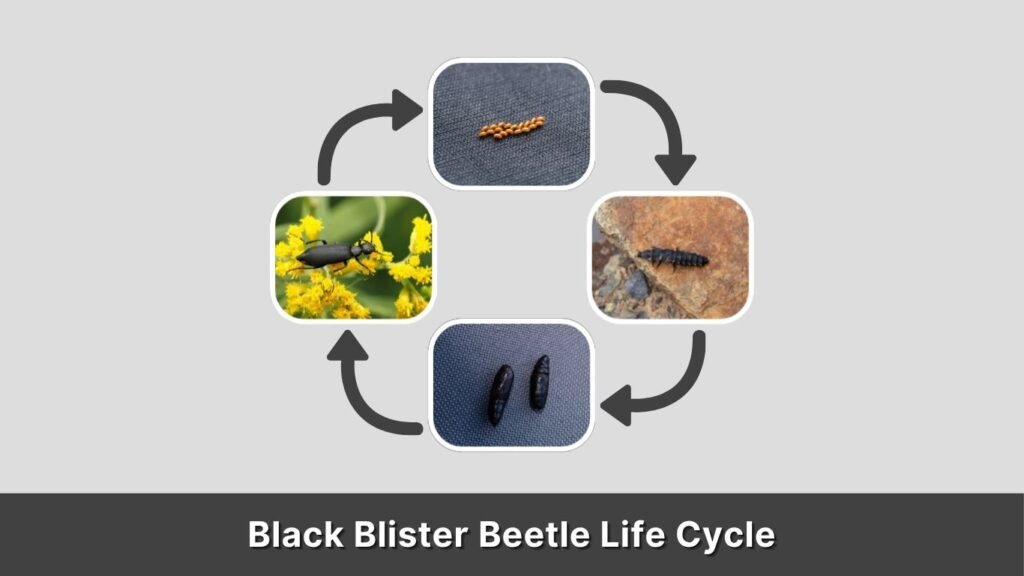
Blister beetles have an unusual life cycle.
They go through complete metamorphosis:
- Egg
- Larva
- Pupa
- Adult
Eggs
Female beetles usually lay eggs in the soil.
Larvae
The first larval stage is highly mobile and is sometimes called a triungulin.
Depending on the species, blister beetle larvae may feed on grasshopper eggs or develop in association with bees.
This larval behavior is very different from the plant-feeding habits of adults.
Pupae
After completing several larval stages, the insect eventually pupates in the soil.
Adults
Adults emerge and begin feeding on vegetation, flowers, and crops.
Do Black Blister Beetles Bite?
Black blister beetles generally do not bite humans in the way mosquitoes, fleas, or biting flies do.
The phrase “black blister beetle bite” is commonly used because contact with the beetle can cause a painful skin reaction.
The actual problem is cantharidin.
If the beetle is crushed or rubbed against your skin, this chemical may produce:
- Redness
- Burning
- Irritation
- Swelling
- Fluid-filled blisters
So, what looks like a bite is usually a form of chemical skin irritation.
Black Blister Beetle Bite Treatment
If a black blister beetle is crushed against your skin, wash the area as soon as possible.
Basic Care
- Wash with soap and water.
- Avoid rubbing the area.
- Apply a cool compress.
- Keep any blister clean.
- Avoid intentionally popping the blister.
- Cover broken skin with a clean dressing.
Mild reactions often heal with basic care.
Seek medical attention if blistering is severe, covers a large area, becomes infected, or involves the eyes, mouth, or other sensitive areas.
Are Black Blister Beetles Dangerous?
Black blister beetles can be dangerous under certain circumstances, but they are not aggressive insects.
Their main risks come from cantharidin.
Risk to Humans
Skin contact with crushed beetles can cause blistering.
Serious poisoning is much less common and is more likely if cantharidin is swallowed.
Risk to Animals
The greatest agricultural concern involves livestock, especially horses.
Cantharidin remains toxic even after blister beetles die.
Are Black Blister Beetles Poisonous?
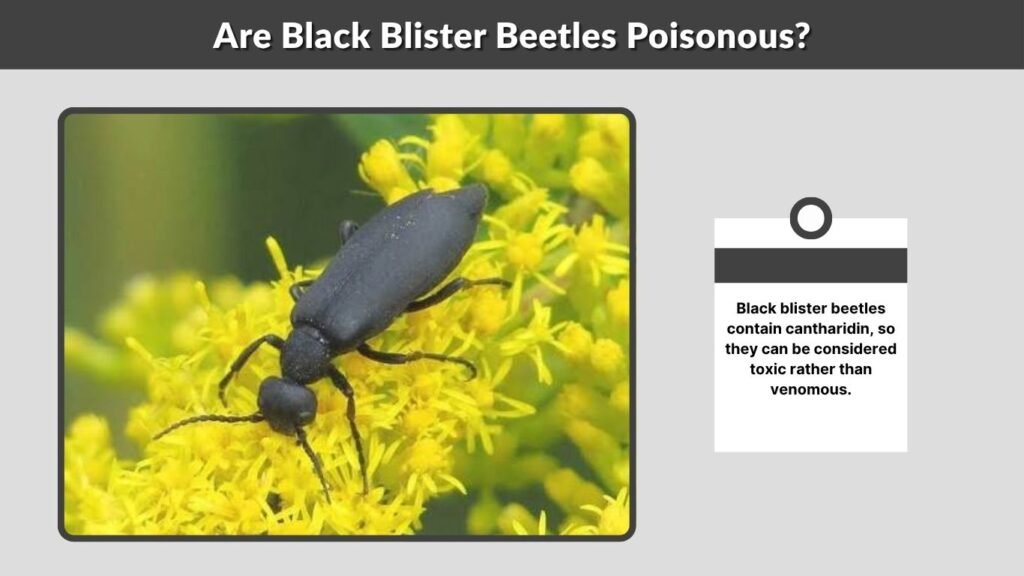
Black blister beetles contain cantharidin, so they can be considered toxic rather than venomous.
They do not inject venom.
Instead, the chemical can cause problems when it touches skin or is swallowed.
This difference is important because a person does not need to be bitten for a reaction to occur.
Black Blister Beetles and Horses
Black blister beetles can be especially dangerous to horses if the insects become trapped and crushed in harvested hay.
Horses may accidentally consume the beetles while eating.
Cantharidin poisoning can cause serious symptoms, including:
- Abdominal pain
- Reduced appetite
- Frequent attempts to urinate
- Diarrhea
- Depression
- Increased heart rate
- Weakness
- Severe digestive irritation
Veterinary attention is urgently needed if blister beetle poisoning is suspected.
Alfalfa hay is often associated with concern because blister beetles may gather in flowering fields and can become incorporated into mechanically harvested hay.
Black Blister Beetle in the House
Finding a black blister beetle indoors does not usually mean you have an indoor infestation.
They may enter accidentally through:
- Open doors
- Window screens
- Cracks
- Outdoor plants brought indoors
Blister beetles generally reproduce outdoors rather than establishing household colonies.
If you find one inside, avoid crushing it with your bare hand. Carefully collect or remove it and clean the area afterward.
How to Get Rid of Black Blister Beetles
Control depends on how many beetles are present and where they are feeding.
Hand Removal
For a small garden infestation, manually removing beetles may be effective.
Wear gloves and avoid crushing them against your skin.
Drop collected beetles into a container rather than handling them directly.
Remove Weeds
Some blister beetles feed on flowering weeds near gardens.
Reducing excessive weeds can make the area less attractive.
Protect Young Plants
Lightweight row covers can help protect young vegetables before flowering.
Remove covers when pollination becomes necessary.
Monitor Plants Frequently
Inspect tomato plants and other crops regularly.
Because blister beetles sometimes appear suddenly in groups, early detection can prevent serious leaf damage.
Insecticides
Some insecticides are labeled for blister beetle control on specific crops.
Always choose a product labeled for the particular plant and pest, and follow all directions concerning application, harvesting intervals, pollinators, and protective equipment.
Organic Control for Black Blister Beetles
Gardeners who prefer nonchemical methods can focus on physical control and monitoring.
Useful approaches include:
- Hand-picking while wearing gloves
- Using row covers
- Removing heavily infested weeds
- Checking plants early in the morning
- Removing groups before they spread
Large infestations may require additional control methods.
Red and Black Blister Beetle
Not all blister beetles are completely black.
Some species have combinations of:
- Black and red
- Black and orange
- Black and yellow
- Black and gray
- Black and white
Color alone is not enough for accurate identification.
The body shape, narrow pronotum, antennae, location, and species characteristics should also be considered.
Red and Black False Blister Beetle
A false blister beetle is not the same thing as a true blister beetle.
False blister beetles belong to a different beetle family.
Some red-and-black species may strongly resemble true blister beetles, which can create confusion.
The safest approach is to avoid crushing an unidentified beetle against your skin until you know what it is.
Black Blister Beetle vs Black Stink Bug
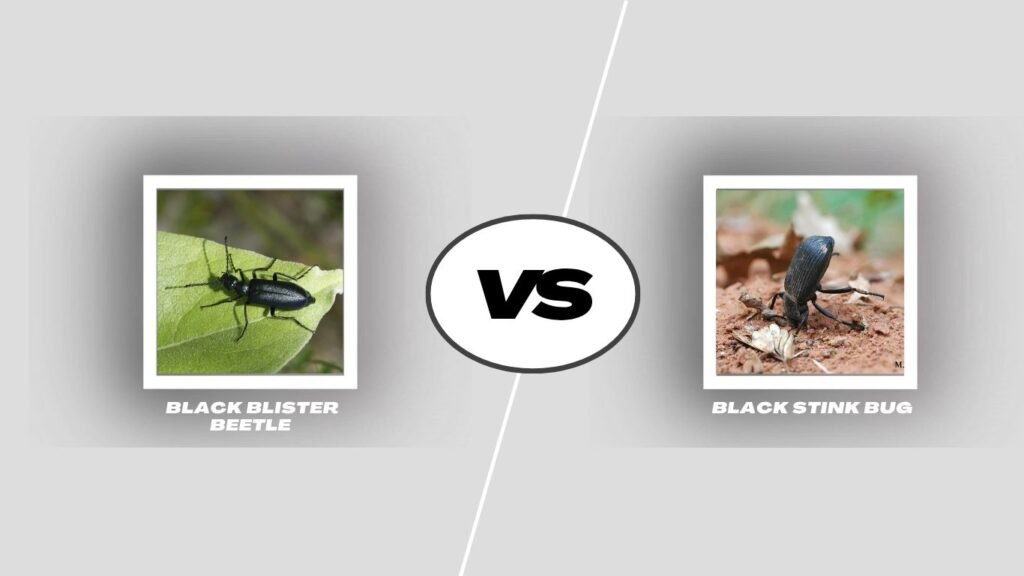
Black blister beetles and dark stink bugs can sometimes be confused from a distance, but their body shapes are quite different.
| Feature | Black Blister Beetle | Black Stink Bug |
|---|---|---|
| Body shape | Long and narrow | Broad and shield-shaped |
| Neck area | Distinctly narrow | Not strongly narrowed |
| Main defense | Cantharidin | Strong odor |
| Skin blister risk | Yes if crushed | Usually no |
| Plant feeding | Common | Common in many species |
| Wings | Present | Present |
A shield-shaped body strongly suggests a stink bug rather than a blister beetle.
Black Blister Beetle Look-Alikes
Several insects may be mistaken for a black blister beetle, including:
- Ground beetles
- Darkling beetles
- Soldier beetles
- Oil beetles
- False blister beetles
- Stink bugs
- Longhorn beetles
Look closely at the area behind the head. True blister beetles typically have a narrow pronotum that makes the head look unusually broad.
Black Blister Beetle Range
Black blister beetles occur across many parts of North America.
Reports commonly come from states including:
- Texas
- Colorado
- Oklahoma
- Arizona
- Utah
- Ohio
- Wisconsin
- Oregon
- California
Species distribution varies, so the exact blister beetle you encounter depends on location.
Are Black Blister Beetles Beneficial?
Black blister beetles can be both beneficial and harmful.
Adults may damage crops by feeding on foliage.
However, larvae of some species feed on grasshopper eggs. This can potentially reduce populations of plant-damaging grasshoppers.
For this reason, blister beetles have a complicated ecological role rather than being purely garden pests.
Should You Kill Black Blister Beetles?
A few beetles away from valuable plants usually do not need immediate control.
If they are heavily defoliating tomatoes or other crops, removal may be justified.
Avoid crushing them with bare hands because cantharidin can irritate your skin.
For gardens, careful removal is often preferable to unnecessary pesticide use when only a few insects are present.
FAQs
1. Are black blister beetles dangerous?
Black blister beetles are not aggressive, but their bodies contain cantharidin. Crushing one against your skin can cause painful blisters. They are potentially much more dangerous to horses if contaminated hay containing blister beetles is eaten.
2. Do black blister beetles bite humans?
Black blister beetles generally do not bite humans. Skin injuries usually occur when cantharidin from a crushed or damaged beetle contacts the skin, causing redness, burning, and sometimes fluid-filled blisters.
3. What do black blister beetles eat?
Adult black blister beetles primarily feed on vegetation, including flowers, leaves, and tender plant tissue. They can sometimes become agricultural or garden pests when large numbers gather on crops such as tomatoes.
4. How do you get rid of black blister beetles?
Wear gloves and manually remove small numbers, monitor affected plants frequently, reduce nearby weeds, and use row covers where appropriate. Severe crop infestations may require an insecticide specifically labeled for blister beetle control.
5. Are black blister beetles harmful to tomato plants?
Yes. Adult black blister beetles may feed heavily on tomato leaves and flowers. A few beetles usually cause limited damage, but large groups can quickly remove substantial foliage and weaken young or already stressed plants.