
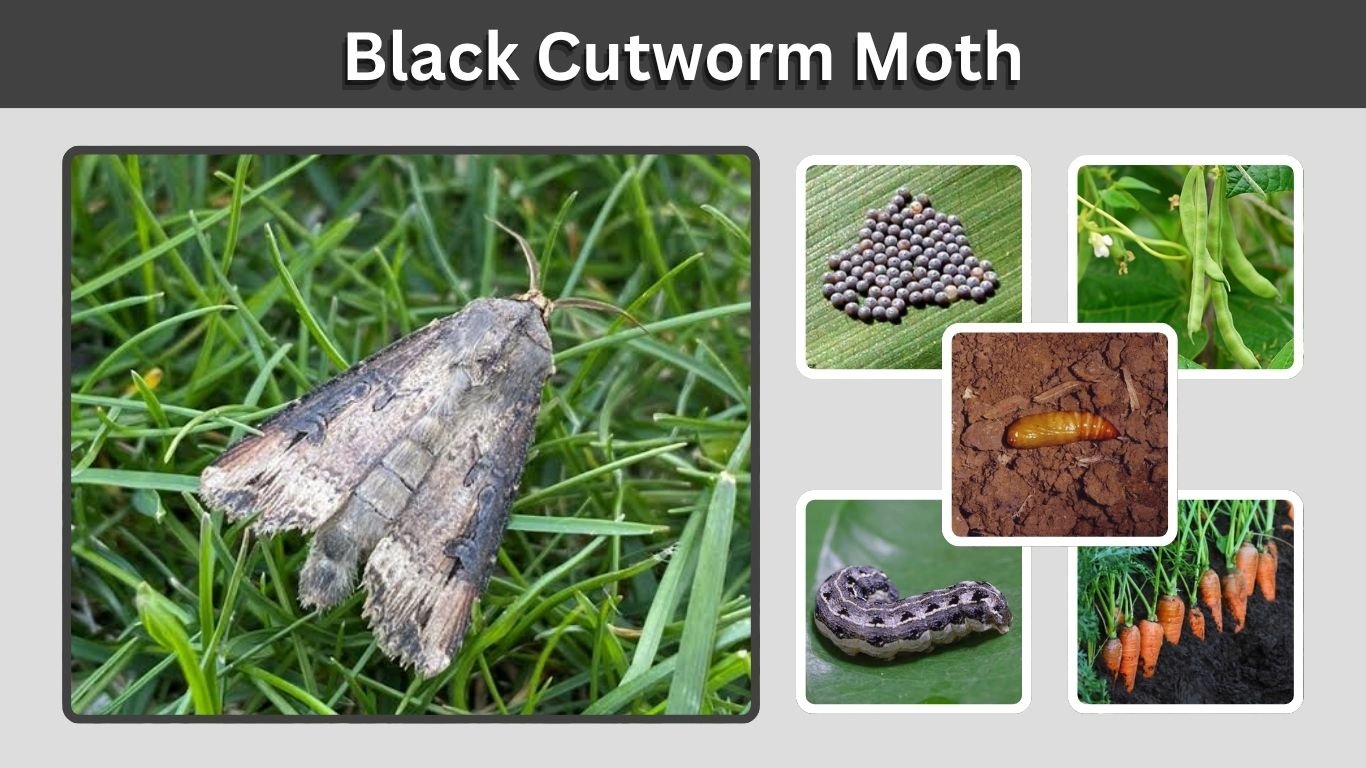
The black cutworm moth is a widespread nocturnal moth best known for the destructive caterpillar stage that attacks young crops and garden plants. Scientifically called Agrotis ipsilon, the adult is a mottled gray-brown moth that can be difficult to notice during the day. Its larvae, however, can cause serious damage by chewing through young plant stems near ground level. Understanding how to identify black cutworm moths, when they are active, where they migrate, and how their lifecycle works can help gardeners and growers detect problems before significant plant loss occurs.
What Is a Black Cutworm Moth?
The black cutworm moth, Agrotis ipsilon, belongs to the family Noctuidae, a large group commonly known as owlet moths. The name “black cutworm” is most often used for its caterpillar, because mature larvae frequently cut seedlings near the soil surface.
Adult moths themselves do not cut plants. The caterpillar is the damaging stage. Purdue Extension identifies Agrotis ipsilon as a pest of field crops, garden plants, and turfgrass.
Scientific Classification
Common name: Black cutworm moth
Scientific name: Agrotis ipsilon
Family: Noctuidae
Order: Lepidoptera
The species occurs over a broad geographic range and is particularly important in agricultural areas.
Black Cutworm Moth Identification
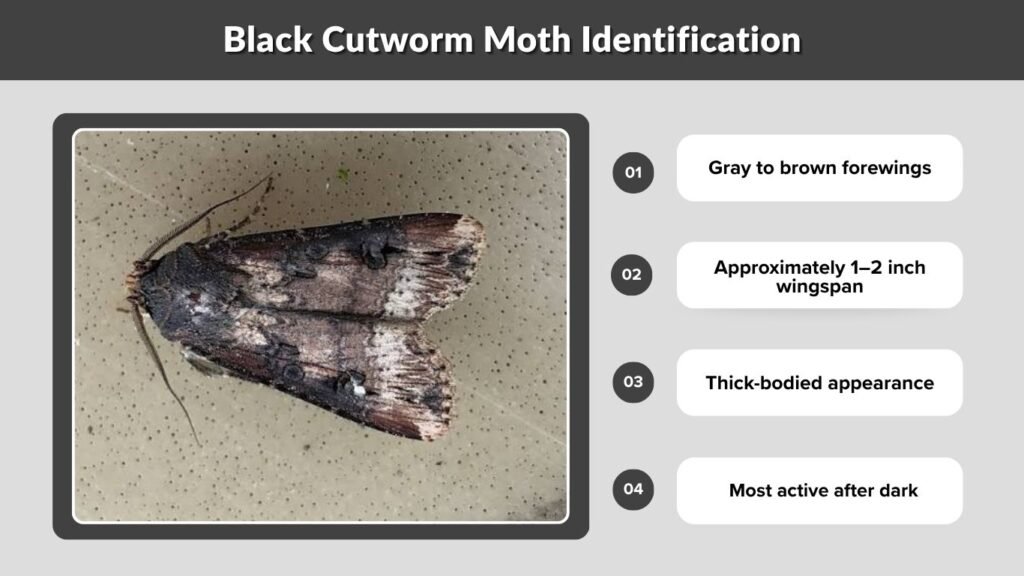
Adult black cutworm moths are relatively robust, grayish-brown moths with darker markings across the forewings.
Key Identification Features
- Gray to brown forewings
- Approximately 1–2 inch wingspan
- Small dark, dagger-like markings on the forewings
- Pale or whitish hindwings with darker borders
- Thick-bodied appearance
- Wings usually folded over the body when resting
- Most active after dark
University of Minnesota Extension describes adults as heavy-bodied, grayish-brown moths with small black markings on the forewings and pale hindwings bordered with tan.
The dark markings are useful for identification, although several noctuid moths look similar.
Black Cutworm Moth Caterpillar Identification
The caterpillar is far more important to gardeners and farmers than the adult moth because it causes the actual crop damage.
Black cutworm larvae range from gray to nearly black and often have a greasy-looking surface.
How to Recognize the Caterpillar
Fully grown caterpillars can reach roughly 1.5–2 inches long. They generally have a pale stripe along the back and paired bumps, called tubercles, along the body. When disturbed, cutworms commonly curl tightly into a C-shape.
Young larvae initially create small holes in foliage. Larger caterpillars become much more destructive and may cut seedlings at or close to soil level.
Black Cutworm Life Cycle
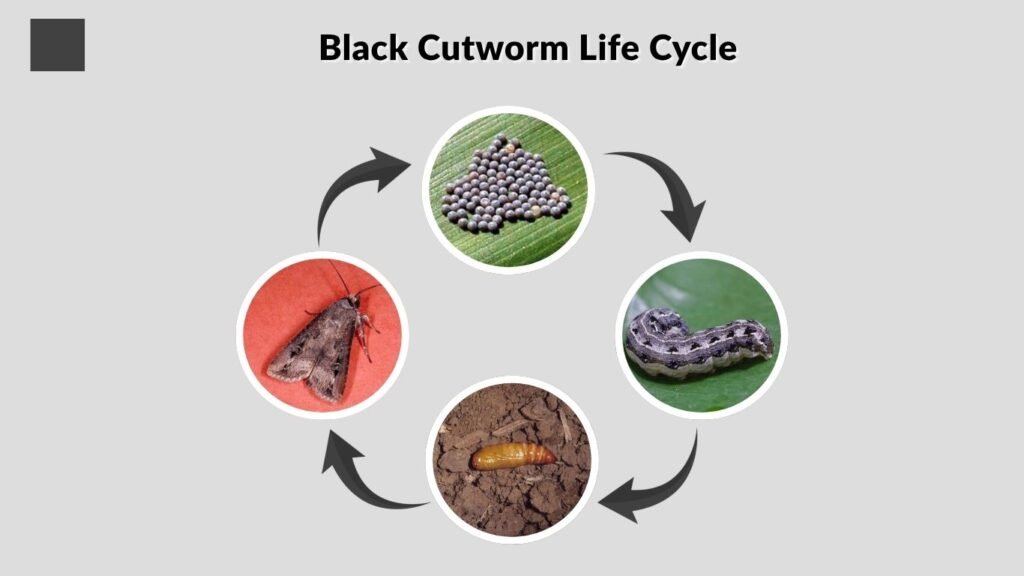
The black cutworm progresses through four main stages: egg, larva, pupa, and adult moth.
Eggs
Females lay small eggs on vegetation, weeds, plant debris, or areas suitable for larval development. Eggs may occur individually or in groups and change color as they mature.
Caterpillar
After hatching, young larvae begin feeding on plant tissue. They pass through several growth stages, becoming increasingly capable of damaging plants.
Larger larvae hide in or near the soil during daylight and commonly emerge at night to feed.
Pupa
Mature larvae enter the soil and transform into dark-brown pupae. This protected stage eventually produces the adult moth.
Adult
Adults emerge, mate, and females begin laying eggs, continuing the cycle. Multiple generations can occur during favorable conditions. Purdue notes several generations can occur in warmer parts of the species’ range.
What Do Black Cutworms Eat?
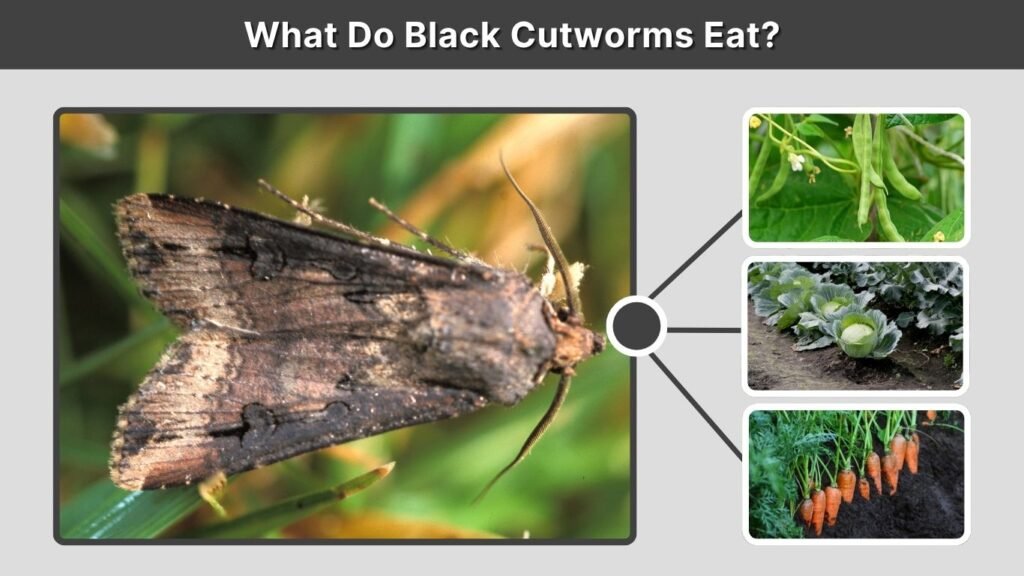
Black cutworm caterpillars feed on many different plants.
They can damage corn, beans, cabbage, carrots, celery, lettuce, peas, peppers, potatoes, tomatoes, and numerous other vegetables and field crops.
Why Are They Called Cutworms?
As larvae grow larger, they frequently chew through the stem of a young plant at, just above, or below ground level.
A seedling may suddenly appear toppled even though it looked healthy the previous day.
This stem-cutting behavior gives cutworms their common name and makes them particularly dangerous to young plants.
Black Cutworm Moth Activity
Black cutworm adults are primarily nocturnal. They fly, mate, and search for egg-laying locations after dark.
Caterpillars also tend to feed at night while remaining concealed in soil, crop residue, or nearby debris during daylight.
This behavior explains why growers may see fresh damage in the morning without finding a caterpillar immediately.
Migrating Black Cutworm Moths
Black cutworm moths are strong seasonal migrants.
In northern parts of the United States, many cannot survive harsh winters. Adult moths migrate northward from warmer regions during spring, often assisted by strong winds and weather systems.
Monitoring programs use moth arrivals to estimate when damaging caterpillars may appear. For example, Minnesota’s 2026 trapping network tracked spring migration and used pheromone-trap captures along with temperature data to estimate larval development.
A sudden abundance of adult moths therefore does not necessarily mean they developed locally.
Black Cutworm Moth Pheromones
Pheromone traps are commonly used to monitor black cutworm populations.
How Pheromone Traps Work
Female black cutworm moths produce sex pheromones that attract males. Monitoring traps use synthetic versions of these chemicals.
Male moths fly toward the lure and become trapped on a sticky surface. Researchers then count captures to identify major migration events and estimate when egg laying may occur.
Pheromone traps are primarily a monitoring tool. Catching adult males does not automatically eliminate a developing cutworm problem.
How to Attract Black Cutworm Moths for Monitoring
If the goal is monitoring rather than control, a species-specific black cutworm pheromone lure placed in an appropriate sticky trap can attract male moths.
Commercial agricultural suppliers sell replacement pheromone lures and traps. Follow the manufacturer’s placement and replacement instructions because lure longevity and trap configuration differ.
Light traps can also attract many night-flying moths, but they are much less species-specific.
Black Cutworm Moths in the House
An occasional black cutworm moth indoors usually does not indicate a household infestation.
Adult moths may enter through open doors or windows, particularly when attracted by outdoor or indoor lights.
What to Do
Capture the moth and release it outdoors, or remove it with a vacuum. Repair damaged window screens and reduce unnecessary lights near open doors during periods of heavy moth activity.
Black cutworms are primarily outdoor agricultural and garden pests, so indoor insecticide treatment is generally unnecessary for an isolated adult.
How to Control Black Cutworms
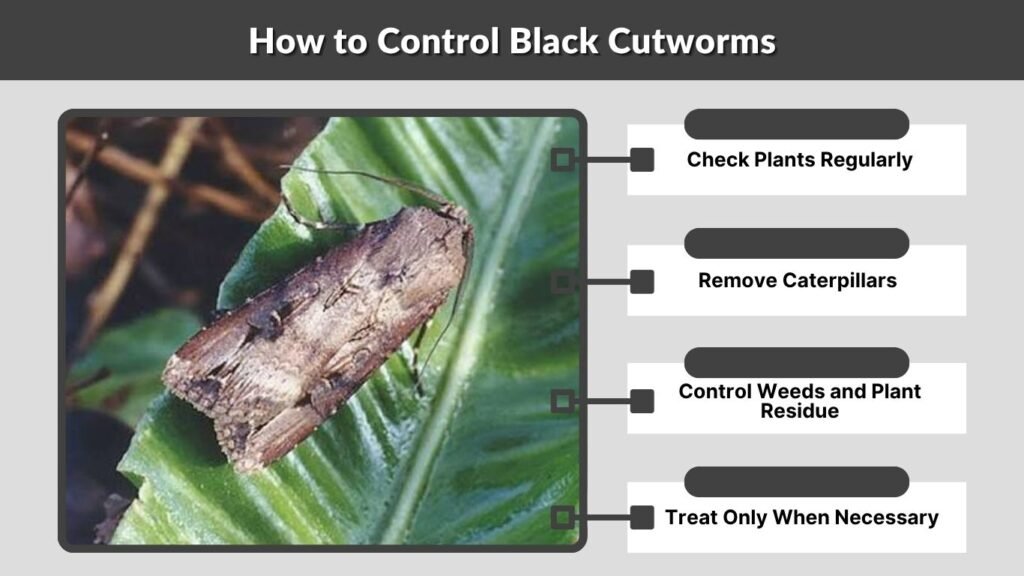
The best control strategy depends on whether you are dealing with a garden or agricultural field.
Check Plants Regularly
Look for freshly cut seedlings, irregular holes in leaves, and wilted plants. Search the upper few inches of soil around damaged plants for curled caterpillars.
Remove Caterpillars
In small gardens, hand-picking can be effective. University of Minnesota Extension notes that physical removal can successfully manage cutworms in many garden situations.
Control Weeds and Plant Residue
Reducing excessive weeds and plant debris can make the environment less favorable for egg laying and larval shelter.
Treat Only When Necessary
Large-scale crop management should be based on scouting, caterpillar size, crop stage, and established economic thresholds rather than simply seeing adult moths.
FAQs
Is the black cutworm moth harmful to humans?
Black cutworm moths do not bite or sting people. Their importance comes mainly from the agricultural damage caused by their caterpillars.
What does a black cutworm turn into?
A black cutworm caterpillar eventually becomes a pupa and then emerges as an adult black cutworm moth, Agrotis ipsilon.
Are black cutworm moths active during the day?
Adults are mainly nocturnal. They generally rest during daylight and become more active after sunset.
Why are there suddenly many black cutworm moths?
Large numbers can appear following seasonal migration events. Favorable winds and storms may carry migrating moths considerable distances into new regions.
What is the most damaging stage of the black cutworm?
The caterpillar stage causes plant damage. Mature larvae can sever young crops and seedlings close to the soil surface, sometimes killing the entire plant.
