
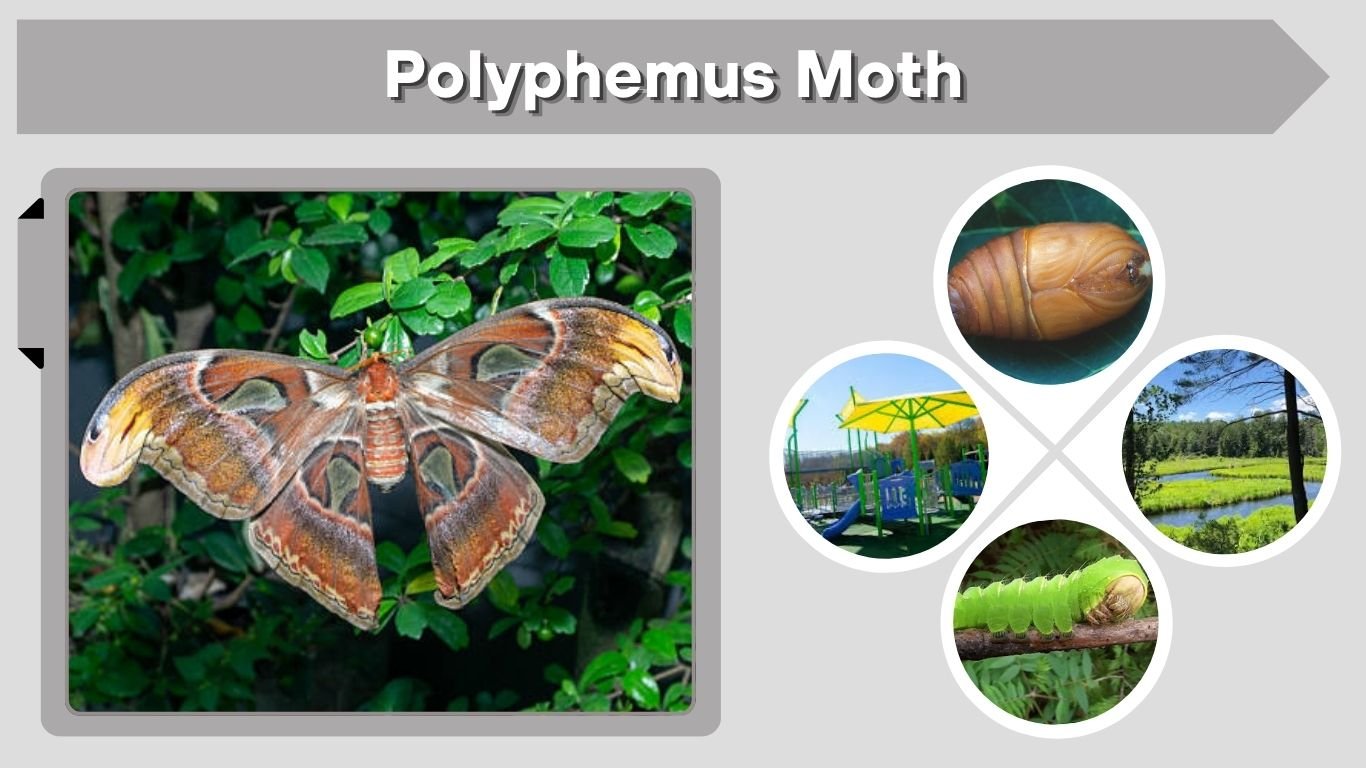
The Polyphemus moth is one of North America’s most eye-catching giant silk moths. Known for its large tan wings and bold eyespots, this moth often surprises people when it appears near porch lights, gardens, trees, or windows. Although it looks dramatic, it is harmless to humans. This guide explains its life cycle, caterpillar stage, cocoon, diet, lifespan, size, and common meanings.
What Is a Polyphemus Moth?
The Polyphemus moth, scientifically known as Antheraea polyphemus, is a large silk moth in the Saturniidae family. It gets its name from Polyphemus, the one-eyed Cyclops from Greek mythology, because the moth has large eye-like spots on its wings.
Adults are usually tan, brown, reddish-brown, or cinnamon-colored. Their most recognizable feature is the large eyespot on each hindwing. These eyespots may help confuse predators by making the moth look larger or more threatening than it really is.
Unlike many smaller moths, the Polyphemus moth does not live long as an adult. Its main purpose after emerging from the cocoon is to mate and reproduce.
Quick Polyphemus Moth Facts
| Feature | Details |
| Scientific name | Antheraea polyphemus |
| Family | Saturniidae, giant silk moths |
| Adult wingspan | Usually about 4 to 6 inches |
| Adult lifespan | Only a few days to about one week |
| Caterpillar food | Leaves of trees and shrubs |
| Adult food | Adults do not eat |
| Danger to humans | Not poisonous, not aggressive, and does not bite |
| Range | Widespread across much of North America |
Polyphemus Moth Identification
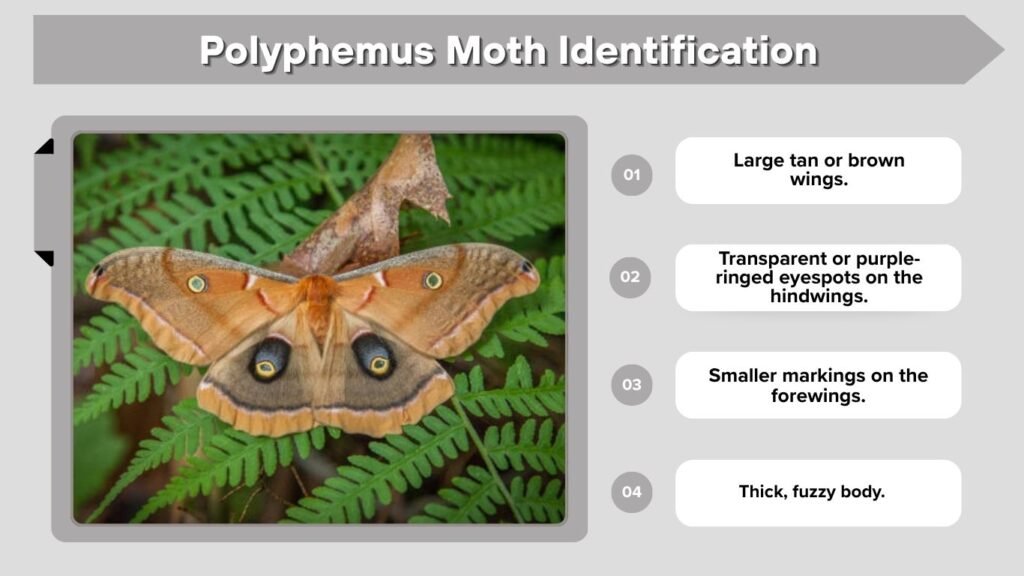
Polyphemus moths are easy to recognize once you know what to look for. Their large size and wing pattern make them stand out from many common moths.
Key identification signs include:
- Large tan or brown wings
- Transparent or purple-ringed eyespots on the hindwings
- Smaller markings on the forewings
- Thick, fuzzy body
- Feathery antennae, especially in males
- Broad wings that may stay partly closed when resting
The “face” of a Polyphemus moth can look soft and furry because the head and body are covered with fine scales. People often search for “polyphemus moth face” because close-up photos make the moth look almost mammal-like.
Polyphemus Moth Size
A full-grown Polyphemus moth is large compared with many backyard moths. Its wingspan is commonly around 4 to 6 inches, though size can vary by sex, nutrition during the caterpillar stage, and local conditions.
The caterpillar can also become surprisingly large. Mature larvae are bright green and may grow several inches long before spinning a cocoon.
Polyphemus Moth Life Cycle
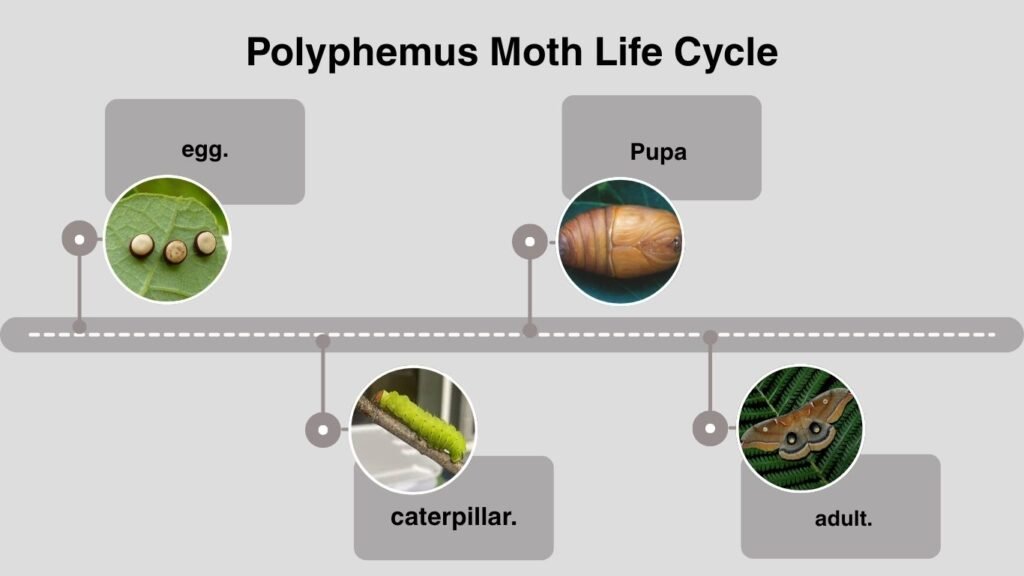
The Polyphemus moth goes through complete metamorphosis. That means it develops in four main stages: egg, caterpillar, pupa, and adult moth.
Each stage has a different purpose. The egg protects the developing larva, the caterpillar feeds and grows, the cocoon protects the pupa, and the adult moth focuses on reproduction.
Egg Stage
Female Polyphemus moths lay eggs on or near suitable host plants. The eggs are usually flat, rounded, and light-colored. They may be laid singly or in small groups on leaves.
After several days, tiny caterpillars hatch and begin feeding. The female does not care for the young after laying eggs.
Caterpillar Stage
The Polyphemus moth caterpillar is one of the most searched parts of this species because it looks very different from the adult moth. Young caterpillars are smaller and may appear yellowish, but later instars become bright green.
A mature Polyphemus caterpillar usually has:
- Bright green body
- Small yellow or silver markings
- Soft, plump appearance
- Rounded body segments
- Strong appetite for leaves
- No stinging spines
The caterpillar molts several times as it grows. During this period, it spends most of its energy eating leaves from host plants.
Cocoon and Pupa Stage
When the caterpillar is ready to pupate, it spins a brown silk cocoon. The cocoon is often attached to leaves, twigs, or sheltered areas near the host plant. In some regions, cocoons may fall with autumn leaves and remain hidden on the ground.
Inside the cocoon, the caterpillar transforms into a pupa. This is the stage where the body changes into the adult moth. Depending on climate and season, the moth may emerge within weeks or remain in the cocoon through winter.
Adult Moth Stage
The adult Polyphemus moth emerges from the cocoon with soft, folded wings. It must pump fluid into the wings and wait for them to expand and harden before flying.
Adults are mostly active at night. Females release pheromones to attract males, while males use their large feathery antennae to detect those scents from a distance.
What Do Polyphemus Moths Eat?
The answer depends on the life stage. Polyphemus moth caterpillars eat leaves, but adult moths do not eat at all.
Adult Polyphemus moths have reduced mouthparts, so they do not feed on nectar, fruit, plants, clothing, or stored food. Their energy comes from reserves built up during the caterpillar stage.
Polyphemus Moth Caterpillar Food
Polyphemus moth caterpillars feed on a wide range of host plants. Common food sources include:
- Oak
- Maple
- Birch
- Willow
- Elm
- Hickory
- Walnut
- Apple
- Cherry
- Pear
- Rose
- Grape
Because the caterpillars eat leaves, people sometimes worry about tree damage. In most cases, a few caterpillars do not cause serious harm to healthy trees. They are part of the natural food web and also provide food for birds, wasps, and other predators.
Polyphemus Moth Cocoon
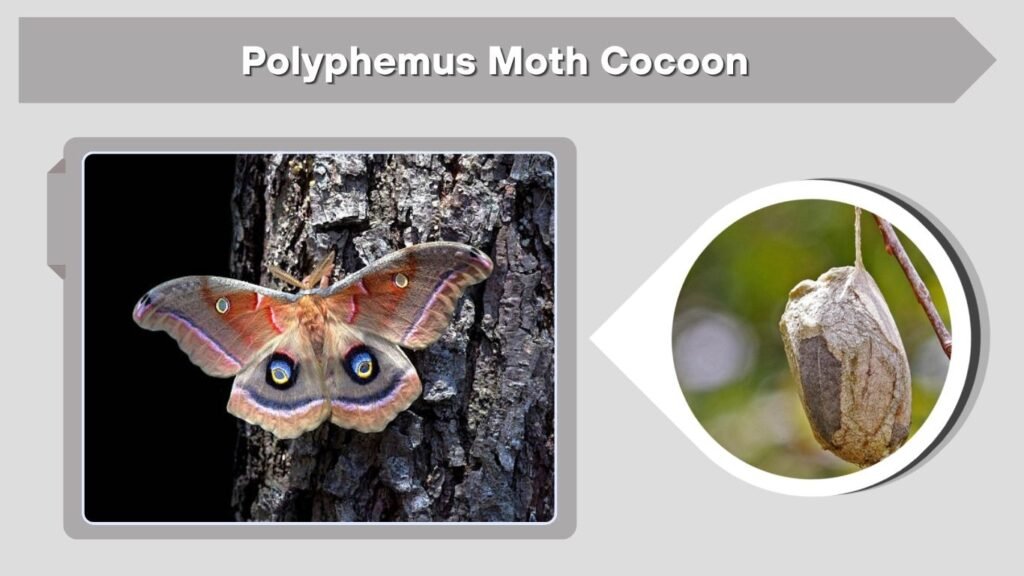
The Polyphemus moth cocoon is made of silk produced by the caterpillar. It is usually oval, brown, and tough enough to protect the pupa inside.
People often find cocoons in leaf litter, attached to twigs, or tucked among fallen leaves. If you find one outdoors, the best option is usually to leave it where it is or place it in a sheltered outdoor spot near trees. Keeping a wild cocoon indoors may cause the moth to emerge at the wrong time.
How Long Do Polyphemus Moths Stay in Their Cocoon?
The time inside the cocoon depends on temperature, season, and location. In warm conditions, an adult may emerge after a few weeks. In colder climates, the pupa may overwinter and emerge the following spring or summer.
This is why some cocoons seem inactive for a long time. They may still be alive and simply waiting for the right seasonal conditions.
Polyphemus Moth Lifespan
The adult Polyphemus moth has a very short lifespan. Once it emerges, it usually lives only a few days to about a week. Since adults do not eat, they must use their limited stored energy to find mates and lay eggs.
The full life cycle is much longer than the adult stage alone. Eggs, caterpillars, pupae, and overwintering cocoons can extend the total development period across weeks or months, depending on the climate.
Why Do Adults Live So Briefly?
Adult Polyphemus moths are built for reproduction, not long-term survival. They do not need to search for food because they cannot feed. Instead, males search for females, and females lay eggs after mating.
This short adult life is normal for many giant silk moths.
Male vs Female Polyphemus Moth
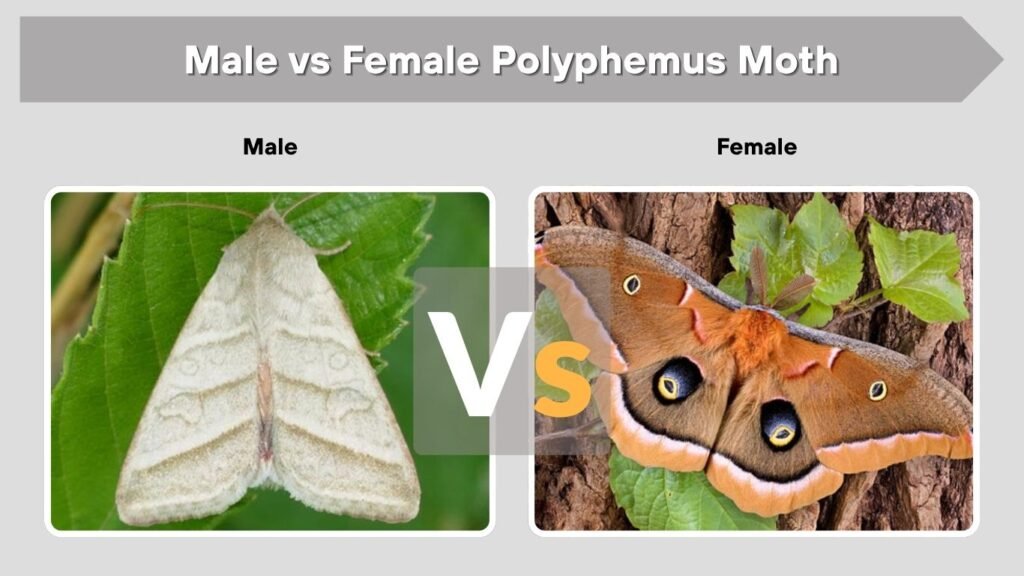
Male and female Polyphemus moths look similar at first, but there are some useful differences.
Males usually have larger, more feathery antennae. These antennae help them detect female pheromones at night. Females often have a fuller abdomen because they carry eggs.
Common differences include:
- Males have more dramatic, bushy antennae
- Females may have a larger, heavier abdomen
- Males are often more active in searching for mates
- Females usually stay closer to where they emerge and release pheromones
- Females lay eggs after mating
If you see a Polyphemus moth resting near a porch light, look closely at the antennae. Very wide, fern-like antennae usually indicate a male.
Are Polyphemus Moths Poisonous or Dangerous?
Polyphemus moths are not poisonous to humans. They are not aggressive, and adults do not bite. Because adult moths do not feed, they have no reason to attack people, pets, or household items.
The caterpillars are also generally harmless to touch, though handling wild insects is best avoided unless necessary. Oils, pressure, or rough handling can injure them. Some people may also have skin sensitivity after touching insects or plants, so it is better to observe them gently.
Do Polyphemus Moths Bite?
No, adult Polyphemus moths do not bite. Their mouthparts are not designed for biting or feeding. If one lands on you, it is not trying to harm you. It may simply be disoriented by light or searching for a safe place to rest.
Where Do Polyphemus Moths Live?
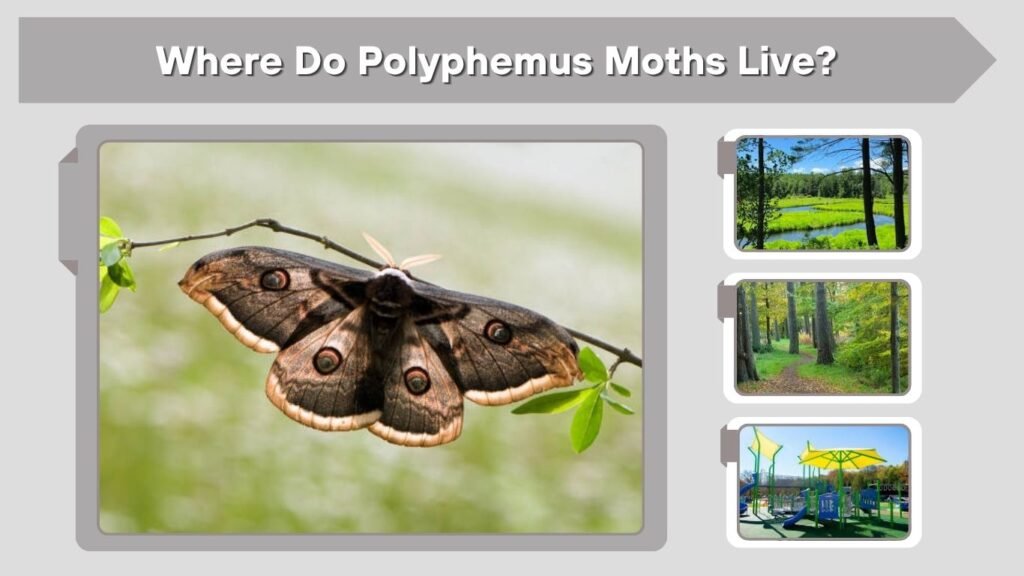
Polyphemus moths are found across much of North America. They can live in forests, woodlands, orchards, parks, wetlands, suburban yards, and other areas with suitable host plants.
Because their caterpillars feed on many types of trees, they can survive in a variety of habitats. Adults are often seen near lights at night, especially during warm months.
Polyphemus Moth in Florida, Texas, Ohio, Oregon, and Other States
Searches for “polyphemus moth Florida,” “polyphemus moth Texas,” “polyphemus moth Ohio,” and similar state-based terms are common because people often find one locally and want to know if it belongs there.
In many parts of the United States and Canada, seeing a Polyphemus moth is normal. Seasonal timing may vary by region. Warmer states may support more active periods, while colder regions may have longer overwintering stages.
Polyphemus Moth Meaning and Symbolism
Many people connect moths with transformation, intuition, mystery, and change. Because the Polyphemus moth has such dramatic eyespots and a short adult life, it is often seen as a symbol of awareness, hidden beauty, and personal growth.
Its life cycle also makes it a strong symbol of transformation. A green caterpillar becomes a silk-wrapped pupa and finally emerges as a large winged adult. This natural process can represent patience, renewal, and transition.
Spiritual Meaning of the Polyphemus Moth
The spiritual meaning of a Polyphemus moth is not scientific, but many people interpret seeing one as a reminder to notice quiet changes in life. Its large eyespots may symbolize protection, perception, or the need to look beyond appearances.
For nature lovers, however, the most meaningful interpretation may be simple: seeing one is a chance to appreciate a remarkable native moth.
Polyphemus Moth vs Luna Moth Caterpillar
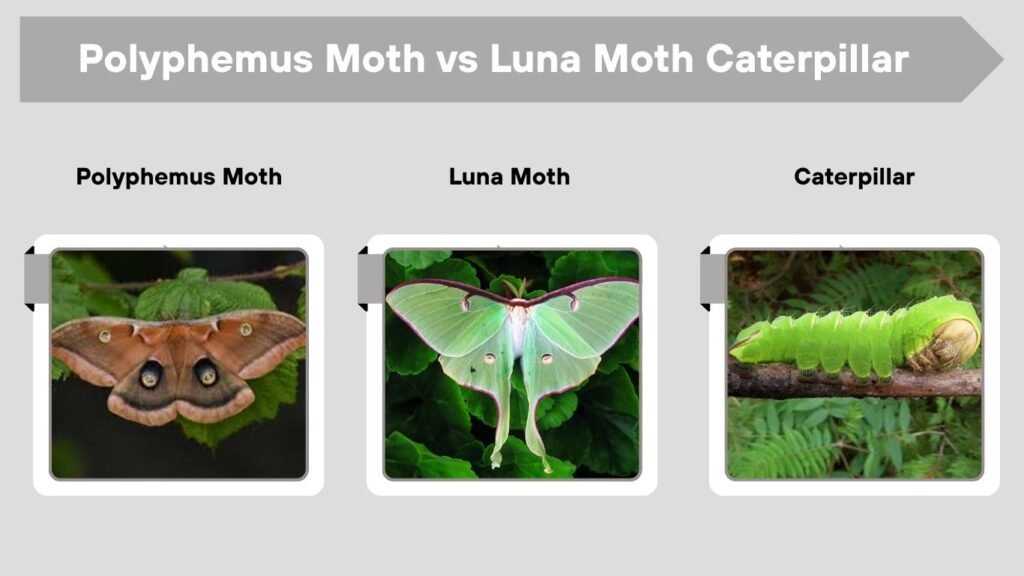
Polyphemus moth caterpillars are sometimes confused with luna moth caterpillars because both can be large, green, and leaf-feeding. However, they become very different adult moths.
Luna moths are pale green as adults and have long tails on their hindwings. Polyphemus moths are tan to brown and have large circular eyespots. Caterpillar identification can be harder, so host plant, markings, location, and photos may help.
If you find a large green caterpillar, avoid disturbing it. Many native moth caterpillars are important parts of local ecosystems.
Should You Care for a Polyphemus Moth Caterpillar?
Some people raise Polyphemus moth caterpillars to observe their life cycle. If you choose to do this, it is important to provide fresh leaves from the correct host plant and keep the enclosure clean, ventilated, and safe from extreme temperatures.
Basic care tips include:
- Use leaves from the same plant where the caterpillar was found
- Replace wilted leaves with fresh ones
- Avoid pesticide-treated plants
- Provide airflow to prevent mold
- Do not overcrowd caterpillars
- Release healthy adults outdoors at the right time
Raising wild insects requires care and responsibility. When possible, observing them in nature is better than removing them from their habitat.
FAQs
Are Polyphemus moths rare?
Polyphemus moths are not considered rare across much of their range, but people do not always see them because adults are nocturnal and short-lived. You are more likely to notice one near outdoor lights during warm months or find a cocoon around host trees.
How long do Polyphemus moths live?
Adult Polyphemus moths usually live only a few days to about one week. They do not eat as adults, so their short life is focused on mating and egg-laying. The full life cycle lasts longer when egg, caterpillar, cocoon, and overwintering stages are included.
What do Polyphemus moth caterpillars eat?
Polyphemus moth caterpillars eat leaves from many trees and shrubs, including oak, maple, birch, willow, elm, hickory, walnut, apple, cherry, and pear. Adults do not eat because their mouthparts are reduced and they rely on stored energy from the caterpillar stage.
Are Polyphemus moth caterpillars poisonous?
Polyphemus moth caterpillars are generally not poisonous and do not have the dangerous stinging spines found on some other caterpillars. Still, it is best to avoid unnecessary handling because the caterpillar can be injured, and some people may have mild skin sensitivity.
What does a Polyphemus moth cocoon look like?
A Polyphemus moth cocoon is usually brown, oval, and made of tough silk. It may be wrapped in leaves or hidden among leaf litter. In colder regions, the pupa may stay inside the cocoon through winter and emerge when seasonal conditions become favorable.
