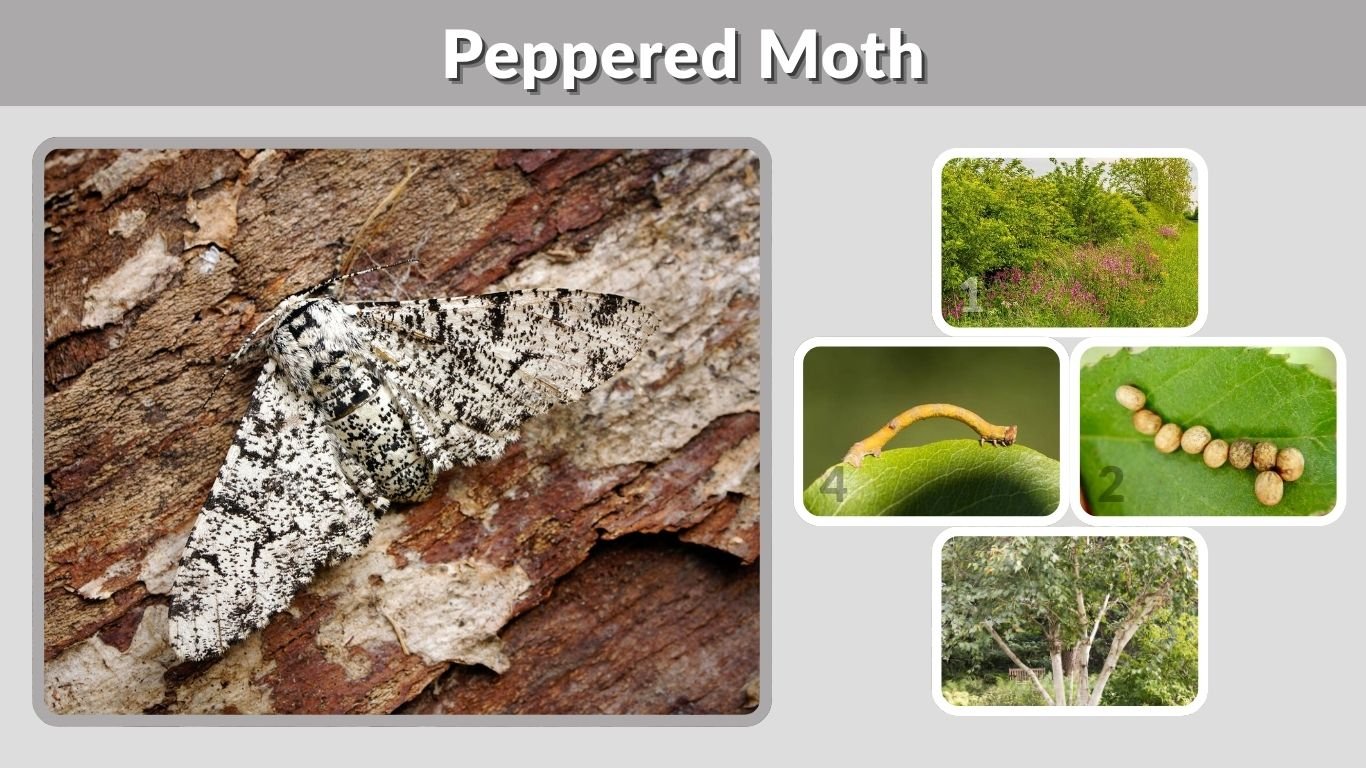
The peppered moth is one of the most famous moths in the world, not because it is large or colorful, but because it helped scientists explain natural selection. Known for its speckled wings and excellent camouflage, this night-flying insect blends into tree bark, branches, and lichen-covered surfaces. From its size and color forms to its habitat, diet, life cycle, and identification features, the peppered moth is a fascinating species to study.
What Is a Peppered Moth?
The peppered moth, scientifically known as Biston betularia, is a moth species in the family Geometridae. This family is often called the geometer moth family because many of its caterpillars move in a looping or “measuring” motion. The peppered moth is best known for its pale, speckled appearance, although darker forms also occur.
This moth is mostly active at night. During the day, it rests on tree trunks, branches, fences, walls, and other surfaces where its wing pattern helps it hide from birds and other predators. Its camouflage is one of the main reasons it became so important in biology.
The peppered moth is especially famous for industrial melanism. In polluted industrial areas, darker moths once became more common because they were better hidden on soot-darkened tree bark. In cleaner environments, lighter moths usually had the advantage because they blended better with pale bark and lichen.
Peppered Moth Size and Appearance
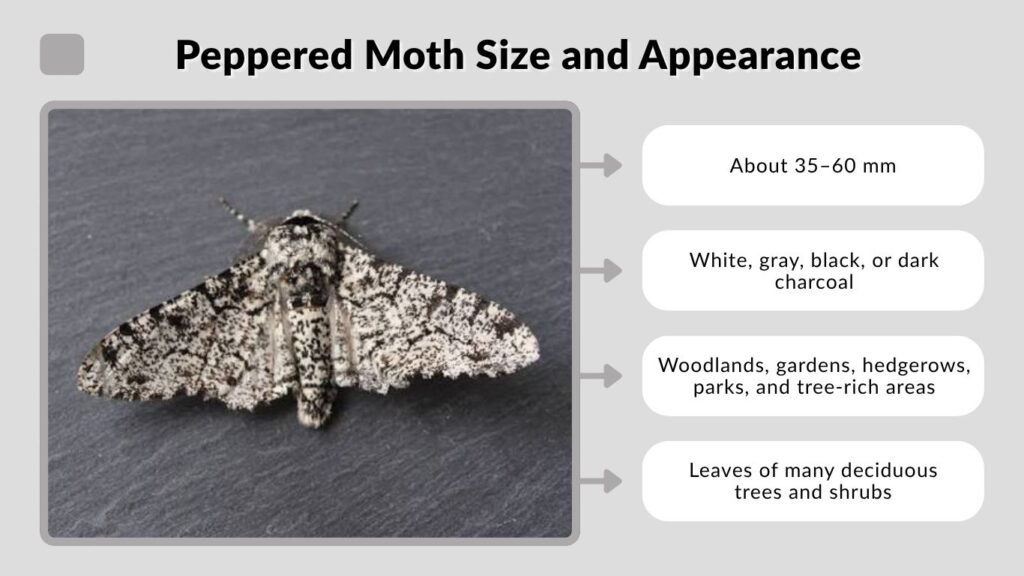
Peppered moths are medium-sized moths with a wingspan usually ranging from about 35 to 60 mm. Their bodies are fairly stout compared with some delicate moth species, and their wings are broad enough to create a flat, bark-like outline when resting.
The adult moth’s wings are usually held open when at rest. This resting posture helps break up its outline and makes the insect harder to notice. The body is generally pale, grayish, or dark depending on the color form.
| Feature | Description |
|---|---|
| Common name | Peppered moth |
| Scientific name | Biston betularia |
| Family | Geometridae |
| Average wingspan | About 35–60 mm |
| Main colors | White, gray, black, or dark charcoal |
| Activity | Mostly nocturnal |
| Main habitat | Woodlands, gardens, hedgerows, parks, and tree-rich areas |
| Larval food | Leaves of many deciduous trees and shrubs |
| Famous for | Camouflage, color forms, and natural selection |
Body Shape
The peppered moth has a thick body, long antennae, and wide wings. Males often have more feathered antennae than females, which help them detect scent signals from mates. The wings are not brightly colored like those of many butterflies. Instead, they are patterned for concealment.
Wing Pattern
The most common form has pale wings covered in many black or gray speckles. These tiny markings give the moth its “peppered” name. The speckled pattern resembles the texture of tree bark and lichen, making the moth difficult to spot when it rests on natural surfaces.
Peppered Moth Color Forms
Color is the most famous feature of the peppered moth. While many people imagine it as a pale moth with black speckles, the species can appear in different color forms.
The main color forms include:
- Typical light form: Pale whitish or grayish wings with black speckling.
- Dark melanic form: Mostly dark charcoal or black wings.
- Intermediate forms: Grayish moths with heavier dark markings than the typical pale form.
- Regional variations: Slight differences may occur depending on location and population.
The dark form is often called carbonaria. It became widely discussed because of its increase in polluted industrial regions in the 19th and 20th centuries. Soot from factories darkened tree bark and reduced lichen growth. As a result, dark moths were less visible to predators in those areas.
When pollution levels later decreased and tree surfaces became lighter again, the pale form became more common in many places. This shift is one of the best-known examples of how environmental change can influence survival.
Habitat of the Peppered Moth
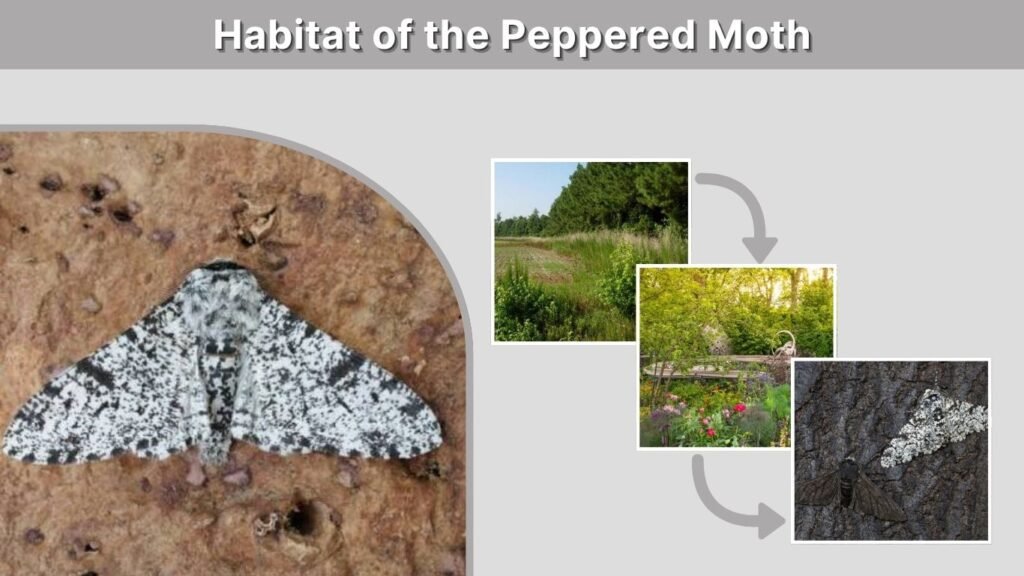
Peppered moths live mainly in temperate regions of the Northern Hemisphere. They are found in parts of Europe, Asia, and North America. They prefer areas with trees and shrubs because both adults and caterpillars depend on woody plants.
Their habitats include:
- Woodlands and forest edges where mature trees provide resting surfaces.
- Hedgerows and countryside lanes with shrubs and deciduous trees.
- Gardens and parks where host plants are available.
- Urban and suburban areas with enough trees, walls, and resting places.
- Mixed landscapes where moths can find shelter, mates, and larval food plants.
The adult moth is not limited to deep forests. It can survive in human-influenced areas if there are suitable trees and shrubs nearby. This flexibility helped the species become well known in both rural and industrial settings.
Daytime Resting Places
During the day, peppered moths usually remain still. They may rest on tree trunks, branches, stone walls, wooden fences, or other surfaces. Their survival depends heavily on choosing resting places where their wing color matches the background.
A pale moth is better hidden on lichen-covered bark, while a dark moth may be harder to see on dark bark or shaded surfaces. This relationship between color and background is central to the moth’s story.
Peppered Moth Diet
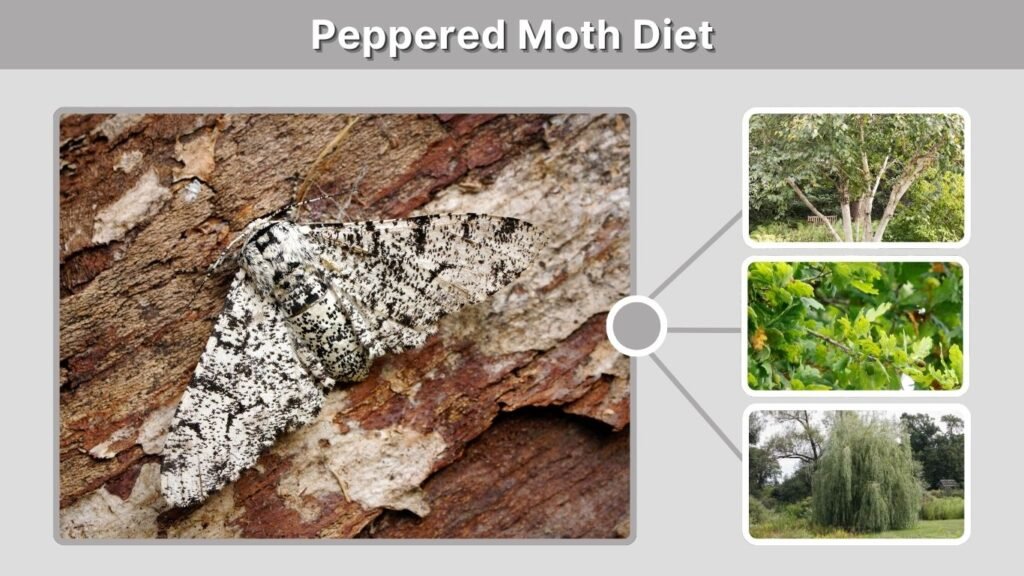
The diet of the peppered moth depends on its life stage. Like butterflies and other moths, it goes through complete metamorphosis: egg, caterpillar, pupa, and adult. The caterpillar stage is the main feeding stage.
Peppered moth caterpillars feed on leaves from a wide range of deciduous trees and shrubs. Adult moths do not chew leaves. If they feed, they take in liquid food sources, although the larval stage is much more important for growth.
Caterpillar Food Plants
Peppered moth caterpillars are flexible feeders. They may eat leaves from many plants, including:
- Birch
- Oak
- Willow
- Poplar
- Lime
- Beech
- Hawthorn
- Blackthorn
- Rose
- Sweet chestnut
- Currant
- Other deciduous trees and shrubs
Because the caterpillars can use many host plants, the species can live in different habitats. This broad diet helps it survive in woodlands, gardens, parks, hedgerows, and mixed landscapes.
Adult Feeding
Adult peppered moths live mainly to mate and reproduce. They are nocturnal and may visit flowers or other liquid sources, but they are not known as major plant pests. The adult stage is usually shorter and less focused on feeding than the caterpillar stage.
Life Cycle of the Peppered Moth
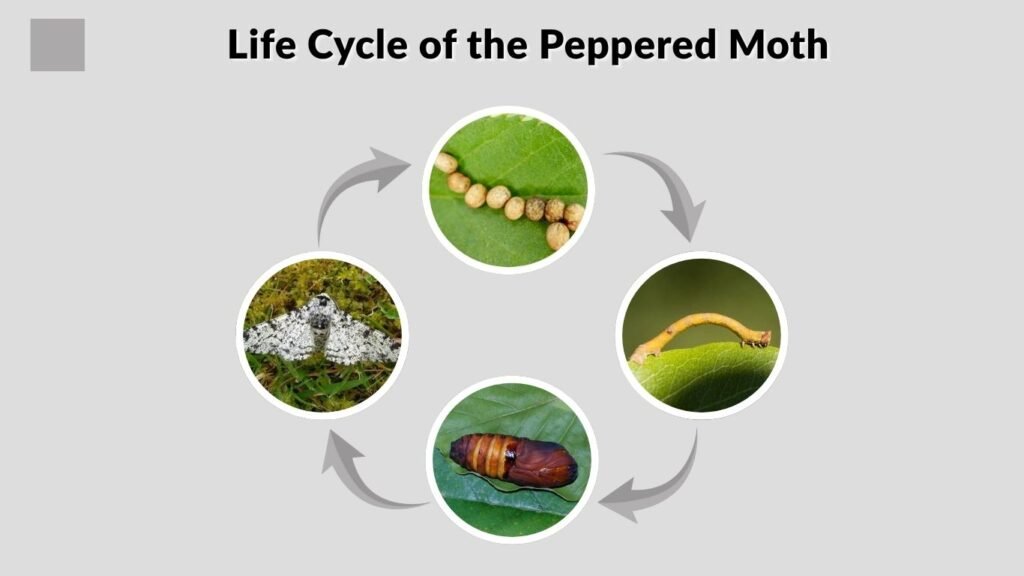
The peppered moth has a typical moth life cycle with four main stages. Each stage has a different role in survival and reproduction.
Egg Stage
Female moths lay eggs on or near suitable host plants. These eggs hatch into caterpillars that begin feeding on leaves. The location of the eggs is important because young larvae need access to food soon after hatching.
Caterpillar Stage
The caterpillar is a strong twig mimic. It can look like a small stick, both in shape and color. When disturbed, it may hold its body stiffly, making it even more branch-like. This camouflage helps protect it from birds and other predators.
Peppered moth caterpillars may appear green, brown, or twig-colored depending on their surroundings and development. Their narrow, elongated shape makes them easy to overlook among stems and branches.
Pupal Stage
After feeding and growing, the caterpillar pupates. In many regions, the pupa overwinters in or near the soil. This allows the insect to survive cold months before emerging as an adult when conditions improve.
Adult Stage
Adult moths usually appear during warmer months. They are mostly active at night and are often attracted to light. Their main goal is reproduction. After mating, females lay eggs, and the cycle begins again.
How to Identify a Peppered Moth
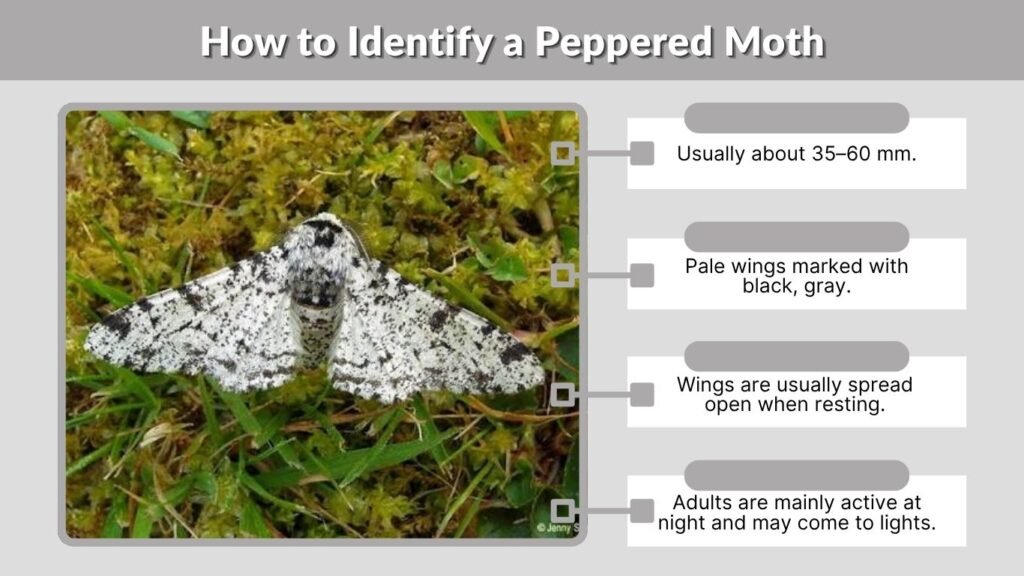
Identifying a peppered moth is easier when you look at size, wing pattern, resting posture, and habitat. However, some other geometer moths may look similar, so careful observation is important.
Look for these features:
- Medium wingspan: Usually about 35–60 mm.
- Speckled wings: Pale wings marked with black, gray, or pepper-like dots.
- Dark form possibility: Some individuals are mostly black or charcoal.
- Flat resting posture: Wings are usually spread open when resting.
- Nocturnal behavior: Adults are mainly active at night and may come to lights.
- Tree-rich habitat: Often found near woodlands, gardens, hedgerows, or parks.
- Twig-like caterpillar: Larvae resemble small sticks and may hold a stiff posture.
Light Form Identification
The light form has whitish or pale gray wings with scattered black speckles. It is the classic peppered appearance and is often the easiest to recognize. The markings are irregular rather than arranged in bold stripes or eye spots.
Dark Form Identification
The dark form can look almost entirely black or smoky gray. At first glance, it may not seem like the same species as the pale form. However, the body shape, wing structure, and behavior are similar.
Caterpillar Identification
The caterpillar can be harder to identify than the adult. It often looks like a small twig and may be greenish, brownish, or grayish. Its stick-like posture is one of the best clues. Like many geometer moth larvae, it may move in a looping motion.
Peppered Moth Adaptations
The peppered moth survives because of several useful adaptations. These adaptations help it avoid predators, find mates, and complete its life cycle.
Important adaptations include:
- Camouflage: Speckled wings blend with bark and lichen.
- Color variation: Different forms may survive better in different environments.
- Nocturnal activity: Flying at night reduces exposure to many daytime predators.
- Twig mimicry: Caterpillars look like small branches.
- Broad diet: Larvae feed on many kinds of deciduous plants.
The most famous adaptation is camouflage. Birds often hunt by sight, so a moth that blends into its resting surface is less likely to be eaten. Over many generations, moths with better camouflage in a particular environment may become more common.
Peppered Moth and Natural Selection
The peppered moth is one of the most widely taught examples of natural selection. Natural selection happens when individuals with helpful traits survive and reproduce more successfully than others.
In cleaner, lichen-rich habitats, pale peppered moths are usually better hidden. Their speckled wings match pale bark and lichen. Birds have a harder time seeing them, so they are more likely to survive.
In heavily polluted industrial areas, tree trunks once became darker because of soot. Lichens declined, and pale moths became easier for birds to see. Dark moths had better camouflage and survived more often. Over time, the dark form increased in some polluted areas.
Later, as air quality improved and soot levels fell, pale surfaces and lichen returned in many places. The pale form again became more successful in those environments. This change showed how quickly populations can respond when environmental pressures change.
The peppered moth does not “choose” to change color. Instead, different color forms already exist in the population, and the environment influences which forms survive better.
Predators and Threats
Peppered moths face many natural threats. Birds are among their most important predators, especially when moths are resting during the day. Bats may also catch flying adults at night. Spiders, parasitic insects, and other predators may attack eggs, caterpillars, or pupae.
Threats include:
- Bird predation during daytime resting.
- Bat predation during night flight.
- Parasites and parasitoids that attack larvae or pupae.
- Habitat loss when trees, hedgerows, and shrubs are removed.
- Pollution changes that alter bark color and lichen growth.
- Artificial lighting that may attract and disorient adults.
Although peppered moths are not usually considered rare across their broad range, local populations depend on suitable habitat. Maintaining trees, shrubs, and natural garden areas can support moths and many other insects.
Are Peppered Moths Harmful?
Peppered moths are not harmful to people. They do not bite, sting, or spread disease. The adults are harmless visitors to lights, walls, gardens, and wooded areas.
The caterpillars eat leaves, but they are not usually serious garden pests. Because they feed on a range of deciduous trees and shrubs, their feeding is usually spread out. In normal numbers, they are part of a healthy ecosystem.
Peppered moths also serve as food for birds, bats, and other wildlife. Their role in the food web makes them more beneficial than harmful.
Interesting Facts About the Peppered Moth
The peppered moth is small, but its scientific importance is huge. It has helped generations of students understand evolution, camouflage, and environmental change.
Here are some interesting facts:
- The name “peppered” comes from the black speckles on the pale wings.
- Its scientific name is Biston betularia.
- The caterpillar can resemble a twig to avoid predators.
- The adult moth is mostly active at night.
- The species is strongly associated with industrial melanism.
- Dark and light forms can belong to the same species.
- It is a classic example of natural selection in action.
- The caterpillars feed on many deciduous trees and shrubs.
- Adults are often attracted to artificial lights.
- Its color patterns can make it surprisingly difficult to spot in the wild.
FAQs
What is the size of a peppered moth?
A peppered moth usually has a wingspan of about 35 to 60 mm. This makes it a medium-sized moth. Its wings are broad and often held flat when resting, which helps it blend into tree bark, walls, and other natural surfaces.
What color is a peppered moth?
The classic peppered moth is pale gray or whitish with many black speckles. Some individuals are much darker and may appear charcoal or black. These different color forms are important because they help the moth blend into different backgrounds.
Where do peppered moths live?
Peppered moths live in temperate regions of the Northern Hemisphere, including parts of Europe, Asia, and North America. They are often found in woodlands, parks, gardens, hedgerows, and other places with deciduous trees and shrubs.
What do peppered moths eat?
Peppered moth caterpillars eat leaves from many deciduous trees and shrubs, including birch, oak, willow, hawthorn, poplar, and beech. Adult moths mainly focus on mating and reproduction, though they may take liquid food from flowers or other sources.
Why is the peppered moth famous?
The peppered moth is famous because it shows natural selection clearly. During industrial pollution, dark moths became more common in some areas because they blended into soot-darkened bark. When air quality improved, lighter moths became more common again in many places.