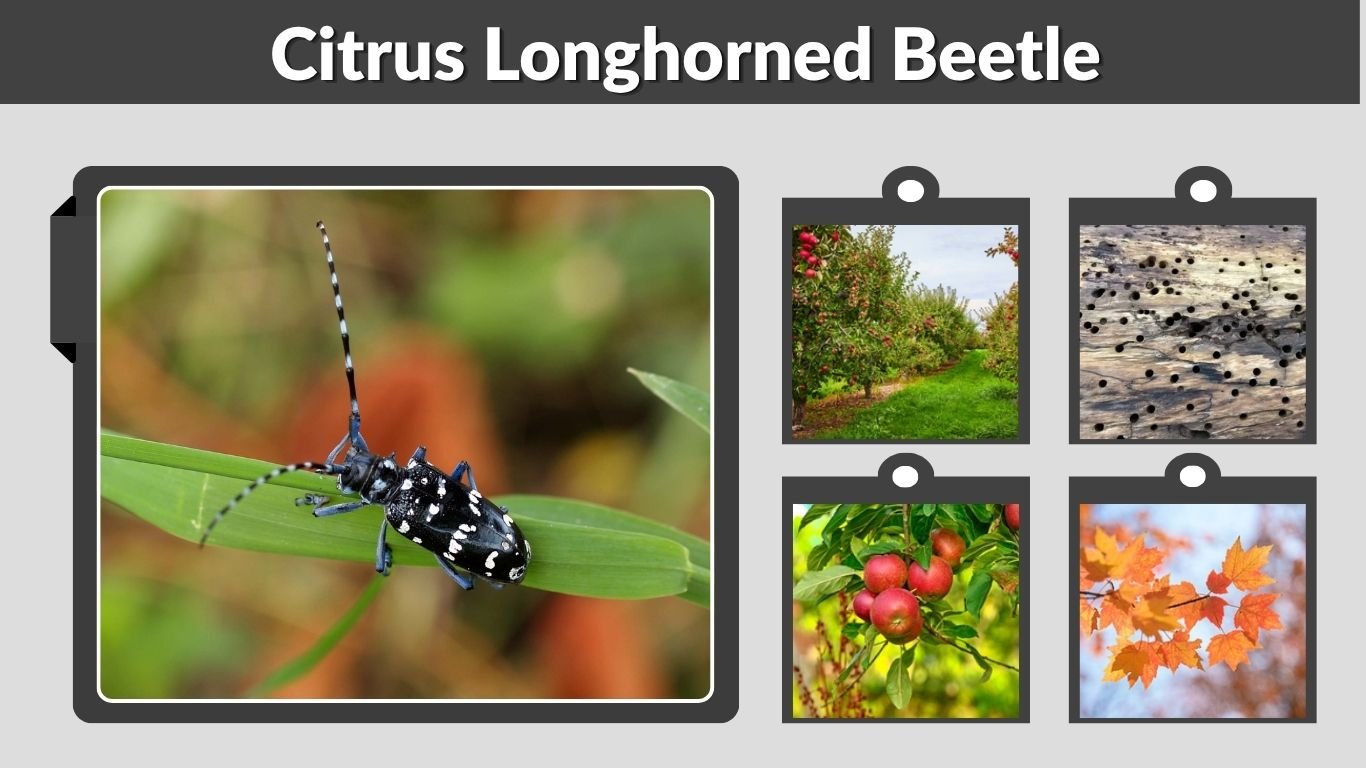
The citrus longhorned beetle is a destructive wood-boring insect known for its shiny black body, white spots, and unusually long antennae. Native to Asia, this beetle attacks citrus trees and many other hardwood species, making it a serious concern for gardeners, farmers, and forestry professionals. Its larvae tunnel through living wood, weakening trees and sometimes causing their death. Although the adult beetles are visually striking, their invasive potential creates significant environmental risks. Understanding citrus longhorned beetle identification, habitat, life cycle, feeding habits, and control methods is essential for protecting vulnerable trees.
What Is a Citrus Longhorned Beetle?
The citrus longhorned beetle (Anoplophora chinensis) is a wood-boring beetle belonging to the Cerambycidae family. It is also called the citrus longhorn beetle or citrus root cerambycid.
Unlike many native longhorn beetles that develop in dead or decaying wood, this species attacks living trees. Its larvae tunnel inside trunks and roots, potentially causing extensive structural damage.
The beetle is considered a serious invasive pest outside its native range because it can damage numerous economically and environmentally important tree species.
Citrus Longhorned Beetle Identification
Citrus longhorned beetles have a distinctive appearance featuring glossy black wing covers, irregular white spots, and extremely long antennae. Adults are relatively large compared with many common garden beetles.
Although their appearance resembles the Asian longhorned beetle, certain physical features help distinguish the two species.
Physical Characteristics
- Common Name: Citrus Longhorned Beetle
- Scientific Name: Anoplophora chinensis
- Family: Cerambycidae
- Body Length: Approximately 21–37 mm
- Body Color: Glossy black with irregular white spots
- Antennae: Long, black, and banded with pale blue or white
- Legs: Dark with occasional bluish coloration
- Wing Covers: Hard, black, and decorated with white markings
- Habitat: Forests, orchards, gardens, and tree nurseries
- Feeding Behavior: Wood-boring larvae and foliage-feeding adults
How Big Is a Citrus Longhorned Beetle?
Adult citrus longhorned beetles generally measure between 21 and 37 millimeters in body length.
Females are often larger and broader than males. Male beetles typically have antennae approaching twice their body length, while female antennae are somewhat shorter.
The combination of a large body, contrasting white markings, and elongated antennae makes these beetles relatively recognizable.
Where Do Citrus Longhorned Beetles Live?
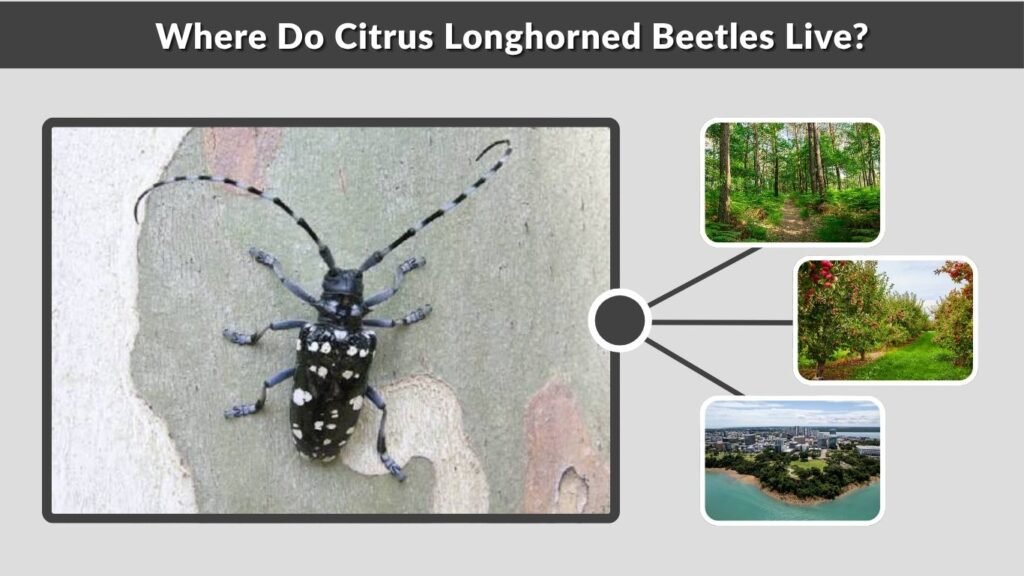
The citrus longhorned beetle is native to East and Southeast Asia, including China, Japan, Korea, and several neighboring countries.
It inhabits forests, orchards, urban landscapes, and areas containing suitable host trees.
Citrus Longhorned Beetle Distribution
The species has been introduced into parts of Europe through international trade, particularly through infested ornamental nursery plants.
Outbreaks have occurred in countries including Italy and France, where management programs have attempted to prevent further establishment.
The beetle is not established in the United Kingdom. Previous detections in the United States have also resulted in eradication efforts.
What Do Citrus Longhorned Beetles Eat?
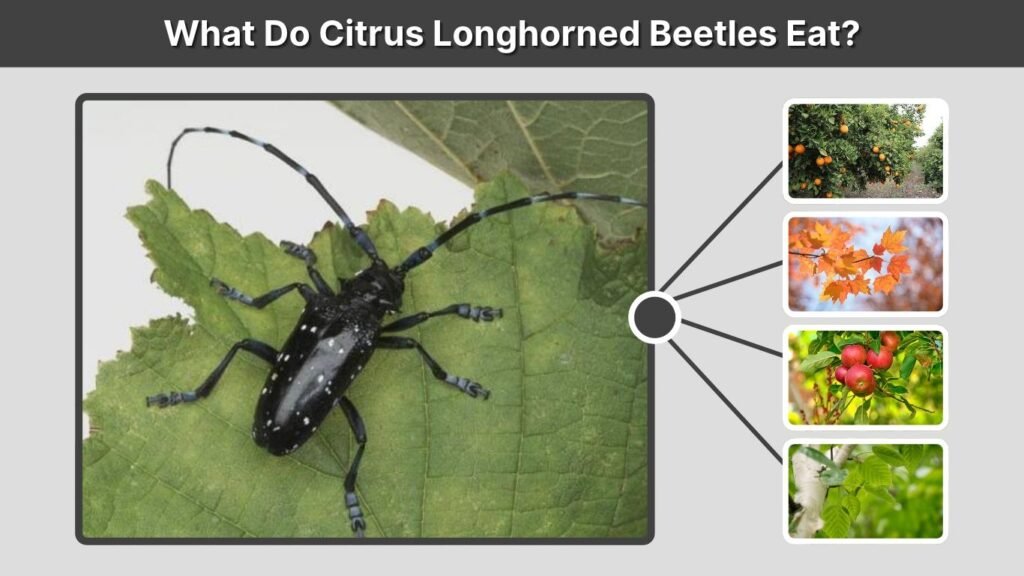
Citrus longhorned beetles feed on different plant tissues throughout their development. Adults consume leaves, leaf stalks, and tender bark, while larvae feed inside living wood.
Despite their name, citrus trees are not their only hosts. The species can develop in a wide variety of broadleaf trees and shrubs.
Common Host Trees
- Citrus Trees: Orange, lemon, and other citrus species
- Maple Trees: Various ornamental and native maples
- Apple Trees: Cultivated apple varieties
- Birch Trees: Several birch species
- Willow Trees: Different willow varieties
- Beech Trees: Broadleaf beech species
- Poplar Trees: Various poplar species
- Hazel Trees: Ornamental and wild hazels
- Plane Trees: Common urban landscape trees
Why Are Citrus Trees Vulnerable?
Citrus trees provide suitable living tissue for egg development and larval feeding.
Female beetles deposit eggs beneath the bark, often near the lower trunk or exposed roots.
After hatching, larvae feed beneath the bark and eventually tunnel deeper into the wood. Repeated feeding can weaken the tree and interfere with the movement of water and nutrients.
Citrus Longhorned Beetle Life Cycle
The citrus longhorned beetle undergoes complete metamorphosis, developing through egg, larva, pupa, and adult stages.
Females lay eggs inside small openings they create in the bark. The larvae hatch and begin feeding beneath the bark before boring deeper into the wood.
How Long Is the Life Cycle?
Development time depends on temperature, climate, and host conditions.
In some warm regions, the beetle can complete its life cycle in approximately one year. Under other conditions, development may take two or three years.
Adults eventually emerge through circular exit holes, leaving visible evidence of infestation.
Citrus Longhorned Beetle Damage to Trees
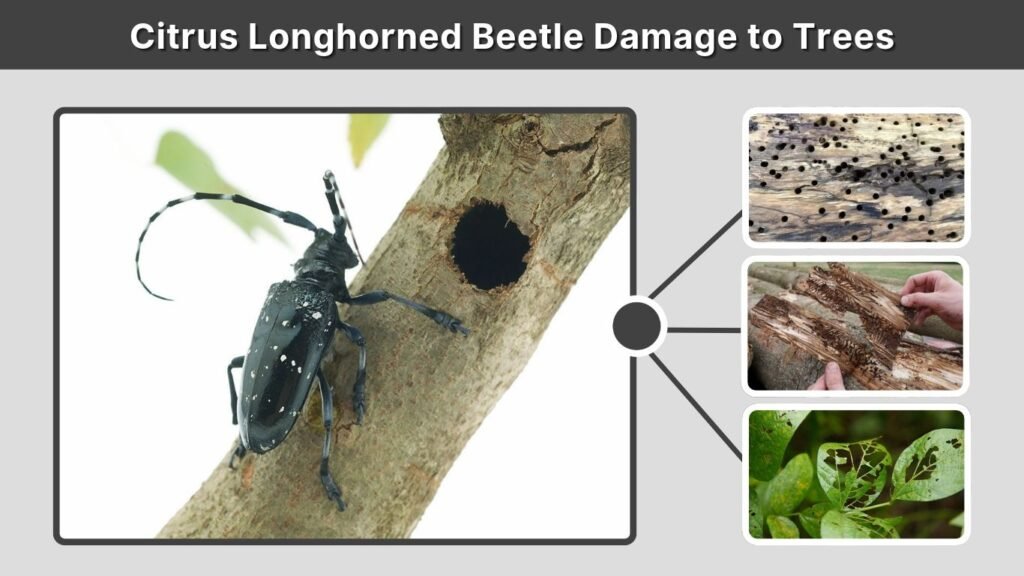
Citrus longhorned beetle larvae cause the greatest damage by creating tunnels inside living trunks and roots.
These tunnels weaken internal structures, disrupt nutrient movement, and increase vulnerability to diseases and environmental stress.
Severely infested trees may experience branch dieback, declining growth, or death.
Signs of Citrus Longhorned Beetle Infestation
- Round Exit Holes: Circular openings commonly found near the lower trunk or exposed roots
- Sawdust-Like Material: Frass collecting around the tree base
- Bark Damage: Small scars or T-shaped egg-laying slits
- Damaged Leaves: Feeding marks caused by adult beetles
- Weak Branches: Declining structural strength
- Tree Dieback: Gradual deterioration of affected branches
- Root Damage: Internal tunneling near the root collar
Citrus Longhorned Beetle vs. Asian Longhorned Beetle
The citrus longhorned beetle (Anoplophora chinensis) closely resembles the Asian longhorned beetle (Anoplophora glabripennis).
Both species feature glossy black bodies, white spots, and long banded antennae. However, their feeding locations and certain physical characteristics differ.
How Can You Tell Them Apart?
Citrus longhorned beetles commonly attack the lower trunk and exposed roots. Their wing covers have small granular projections near the base.
Asian longhorned beetles more frequently create damage higher on tree trunks and branches. Their wing-cover bases are generally smoother.
Because the species look similar, suspicious specimens should be examined by qualified identification specialists.
How to Control Citrus Longhorned Beetles
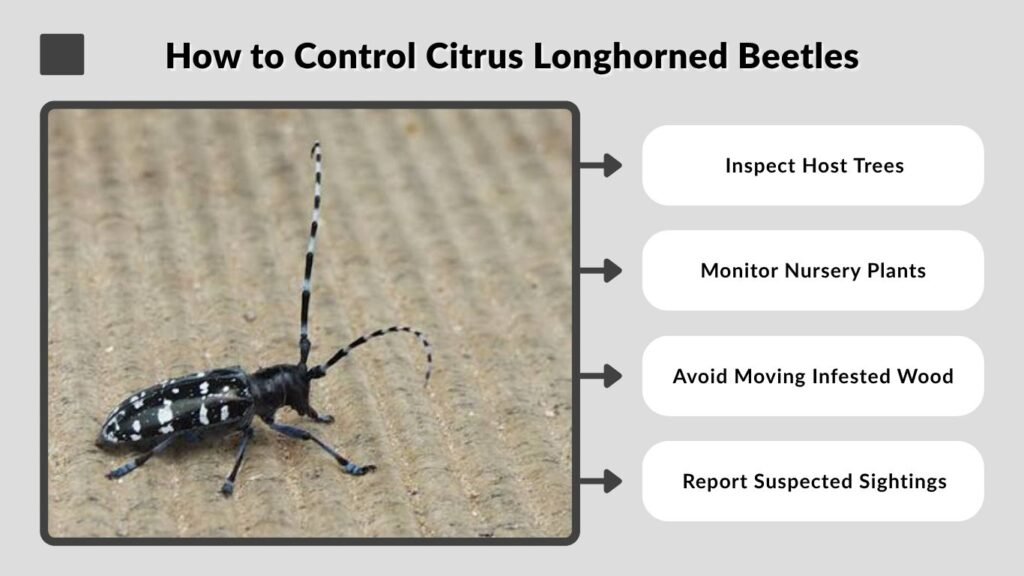
Citrus longhorned beetle control is challenging because larvae remain hidden inside wood for much of their development.
Early identification, proper monitoring, and preventing movement of infested plants are essential for limiting their spread.
Citrus Longhorned Beetle Control Methods
- Inspect Host Trees: Regularly examine lower trunks and exposed roots for exit holes, frass, or bark damage.
- Monitor Nursery Plants: Check imported ornamental trees and recently purchased plants for suspicious symptoms.
- Avoid Moving Infested Wood: Do not transport potentially infested firewood, logs, or nursery plants.
- Report Suspected Sightings: Contact local agricultural or plant health authorities for identification.
- Follow Official Management Instructions: Tree removal, disposal, and chemical treatments should be handled according to authorized pest management programs.
- Prevent Reintroduction: Purchase plants from reputable suppliers that follow applicable plant health regulations.
Citrus Longhorned Beetle in Animal Crossing: New Horizons
The citrus longhorned beetle also appears in Animal Crossing: New Horizons (ACNH), where players can catch it on tree stumps.
Unlike the real insect, which can seriously damage living trees, the game’s beetle is simply a collectible creature.
Citrus Longhorned Beetle ACNH Price
In Animal Crossing: New Horizons, the citrus long-horned beetle sells for 350 Bells at Nook’s Cranny.
Players can sell it to Flick for 525 Bells.
It appears on tree stumps throughout the year, in both hemispheres, and can be caught at any time of day using a net.
FAQs
1. Are Citrus Longhorned Beetles Dangerous to Humans?
Citrus longhorned beetles are not venomous and do not sting humans. However, they possess strong mandibles and may pinch when handled. Their primary danger is to trees, where developing larvae create destructive tunnels that can weaken or kill living plants.
2. What Is the Scientific Name of the Citrus Longhorned Beetle?
The scientific name of the citrus longhorned beetle is Anoplophora chinensis. It belongs to the Cerambycidae family and originates from Asia. This species is recognized internationally as a potentially destructive invasive pest of hardwood trees.
3. How Does the Citrus Longhorned Beetle Spread?
Citrus longhorned beetles spread naturally when adults fly between suitable host trees. Long-distance movement primarily occurs through international trade involving infested nursery plants, logs, and wood products. Inspecting imported plants and following quarantine regulations help reduce accidental introductions.
4. How Much Is a Citrus Longhorned Beetle Worth in ACNH?
In Animal Crossing: New Horizons, the citrus long-horned beetle sells for 350 Bells at Nook’s Cranny or 525 Bells to Flick. Players can find it on tree stumps throughout the year, regardless of hemisphere.
5. How Can You Identify Citrus Longhorned Beetle Damage?
Common signs include round exit holes near tree bases, sawdust-like frass, damaged bark, and declining tree health. Larval feeding occurs inside living wood, so early infestations may remain hidden. Suspected sightings should be reported to local plant health authorities.