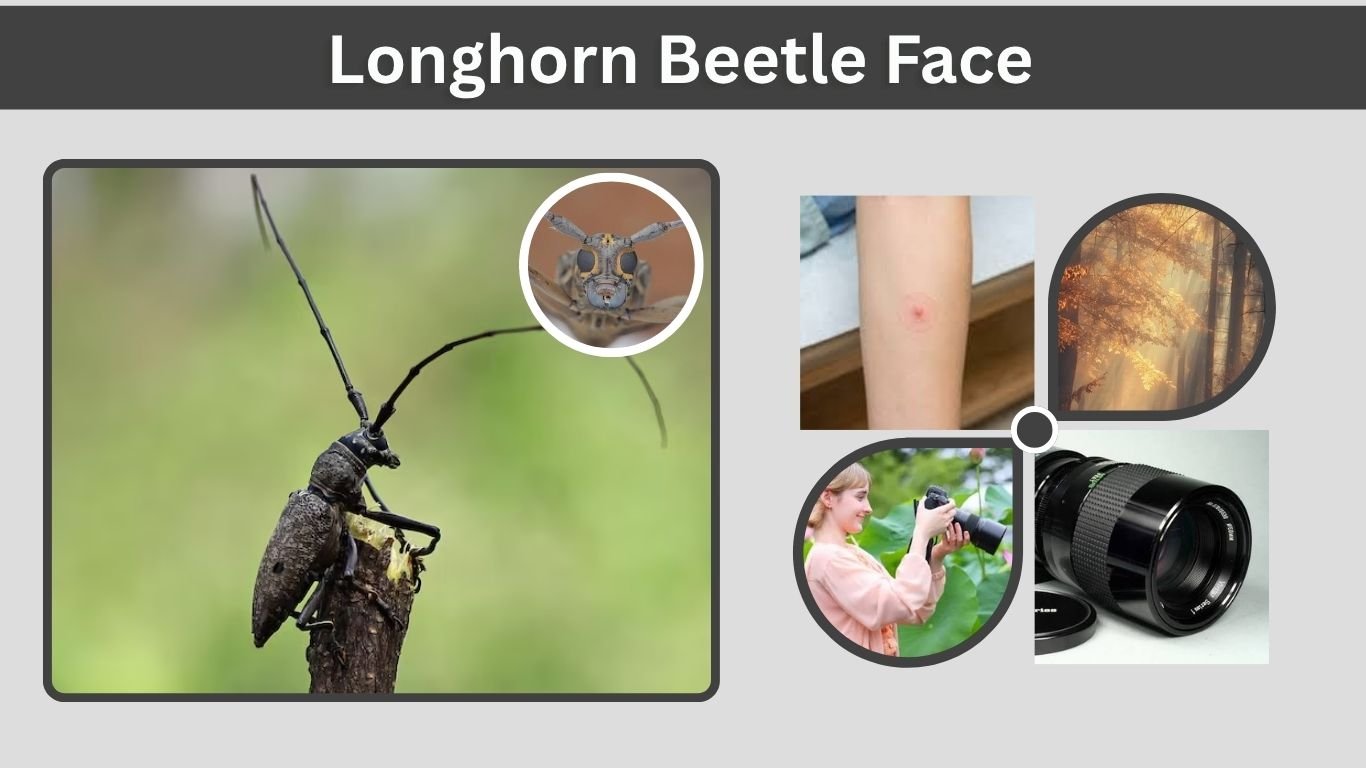
The longhorn beetle face has a fascinating appearance, featuring large compound eyes, powerful mandibles, and unusually long antennae. When viewed closely, these insects reveal intricate facial structures that help them locate food, recognize mates, and navigate their surroundings. Some species have rounded heads, while flat-faced longhorn beetles display a more vertical facial structure. Their unusual appearance makes them popular subjects for macro photography and insect identification. Understanding longhorn beetle facial anatomy, eye structure, mouthparts, and distinguishing features provides valuable insight into these remarkable wood-boring insects and their behavior.
What Does a Longhorn Beetle Face Look Like?
A longhorn beetle’s face typically features two prominent compound eyes, long segmented antennae, and strong chewing mouthparts. The head may appear rounded, elongated, or relatively flat depending on the species.
Longhorn beetles belong to the family Cerambycidae, which contains thousands of species worldwide. Their facial structures vary considerably, but several characteristics remain recognizable across the family.
Longhorn Beetle Facial Identification
- Scientific Family: Cerambycidae
- Common Name: Longhorn Beetle or Longhorned Beetle
- Head Shape: Rounded, elongated, or vertically flattened
- Eyes: Large compound eyes, frequently notched around the antennae
- Antennae: Usually long, segmented, and positioned near the eyes
- Mandibles: Strong chewing jaws located beneath the front of the head
- Mouthparts: Include maxillary and labial palps
- Facial Texture: Smooth, grooved, hairy, or covered with fine scales
- Coloration: Black, brown, gray, yellow, or metallic patterns
Longhorn Beetle Face Anatomy
The face of a longhorn beetle contains specialized structures that support feeding, sensory perception, and reproduction. Although these insects may appear intimidating under magnification, their facial features are adapted primarily for everyday survival.
Compound Eyes
Longhorn beetles possess compound eyes made of numerous individual visual units called ommatidia.
These eyes detect light, movement, and visual patterns. Many species have kidney-shaped or deeply notched eyes that partially surround the bases of their antennae.
The arrangement of the eyes varies among species and provides useful information for identification.
Antennae and Sensory Organs
Longhorn beetles are especially recognizable for their elongated antennae. In some species, the antennae extend two or three times the body length.
They contain sensory receptors that detect chemical signals, including odors associated with host plants and potential mates.
The antennae are typically composed of 11 segments, although exceptions occur.
Mandibles and Mouthparts
Mandibles are hard, jaw-like structures used for chewing plant material and other feeding activities.
Longhorn beetles also have smaller sensory appendages called palps, which help examine food and nearby surfaces.
Some species possess particularly strong mandibles, while others have relatively small mouthparts.
What Is a Flat-Faced Longhorn Beetle?
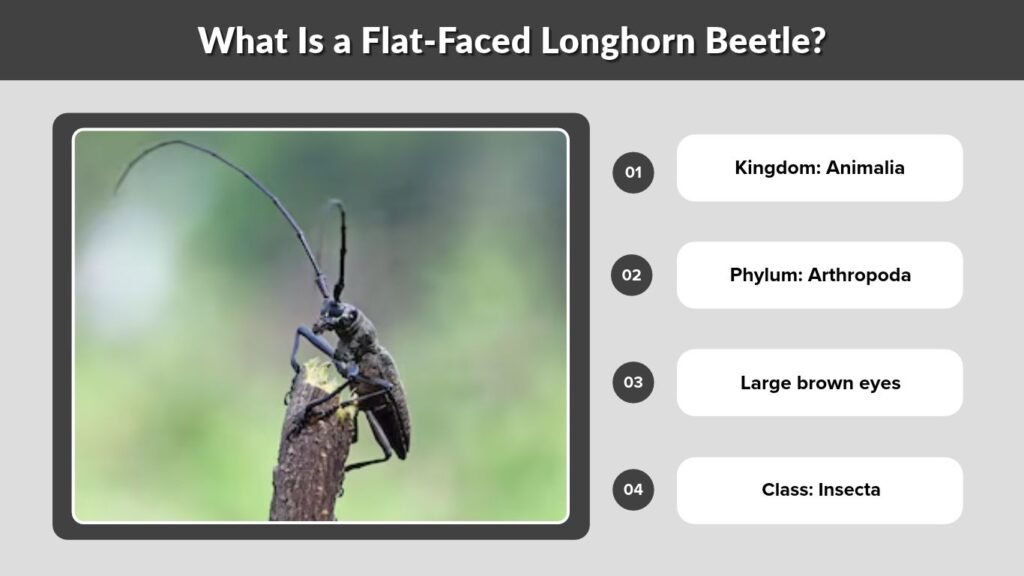
Flat-faced longhorn beetles belong to the subfamily Lamiinae within the family Cerambycidae. They are an extremely diverse group distributed across tropical, temperate, and other suitable habitats worldwide.
Their name refers to the relatively vertical orientation of the front of the head rather than a completely flattened body.
Flat-Faced Longhorn Beetle Classification
- Kingdom: Animalia
- Phylum: Arthropoda
- Class: Insecta
- Order: Coleoptera
- Family: Cerambycidae
- Subfamily: Lamiinae
- Common Name: Flat-Faced Longhorn Beetles
- Distribution: Worldwide, particularly diverse in tropical regions
- Larval Habitat: Living, weakened, dying, or dead woody plants, depending on species
Flat-Faced Longhorn Beetle Characteristics
Flat-faced longhorn beetles usually have a downward-facing or nearly vertical facial region.
Their compound eyes are often deeply notched, with the antennal bases positioned near the indentation.
Many species possess raised antennal bases and textured head surfaces covered with hairs or scales.
The group includes numerous wood-boring species, some of which are important forest pests.
Longhorn Beetle Face Close-Up
A close-up photograph of a longhorn beetle reveals structures that are difficult to observe without magnification.
The compound eyes appear as textured surfaces, while the antennae show distinct segments and fine sensory hairs.
What Can You See in a Magnified Longhorn Beetle Face?
Under magnification, the head reveals tiny structures that explain how these insects interact with their surroundings.
The eye surface contains numerous small facets arranged closely together. Antennal segments may display fine hairs and specialized sensory structures.
The mandibles appear curved or pointed, while the palps resemble small jointed appendages near the mouth.
Some species also have grooves, pits, and colorful scales across their facial surfaces.
Why Do Longhorn Beetles Have Unusual Faces?
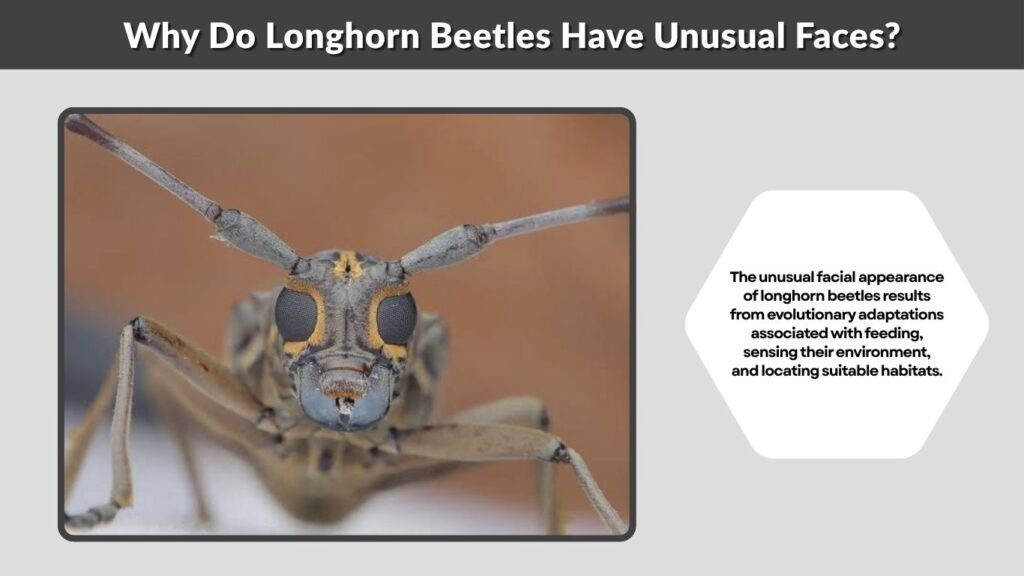
The unusual facial appearance of longhorn beetles results from evolutionary adaptations associated with feeding, sensing their environment, and locating suitable habitats.
Their antennae help them detect chemical signals, while their compound eyes support visual orientation.
How Does Their Face Help Them Survive?
Longhorn beetles rely on both chemical and visual information when locating food, mates, and host plants.
Their mandibles allow adults to chew suitable plant tissues, while sensory structures around the mouth help examine surfaces.
The precise functions of individual structures vary among species because longhorn beetles occupy many different ecological environments.
Asian Longhorned Beetle Face
The Asian longhorned beetle (Anoplophora glabripennis) is a recognizable member of the flat-faced longhorn beetle subfamily.
Its head is predominantly black, with prominent compound eyes and exceptionally long black-and-white banded antennae.
How Is Its Face Different?
The Asian longhorned beetle has distinctive antennal bases and a downward-oriented head.
Its glossy black body features irregular white spots, while the legs may appear bluish.
Although facial features help identify this species, accurate identification requires examining its complete body and markings.
This beetle is a destructive invasive pest in parts of North America and should be reported to appropriate agricultural authorities when suspected.
Can Flat-Faced Longhorn Beetles Bite?
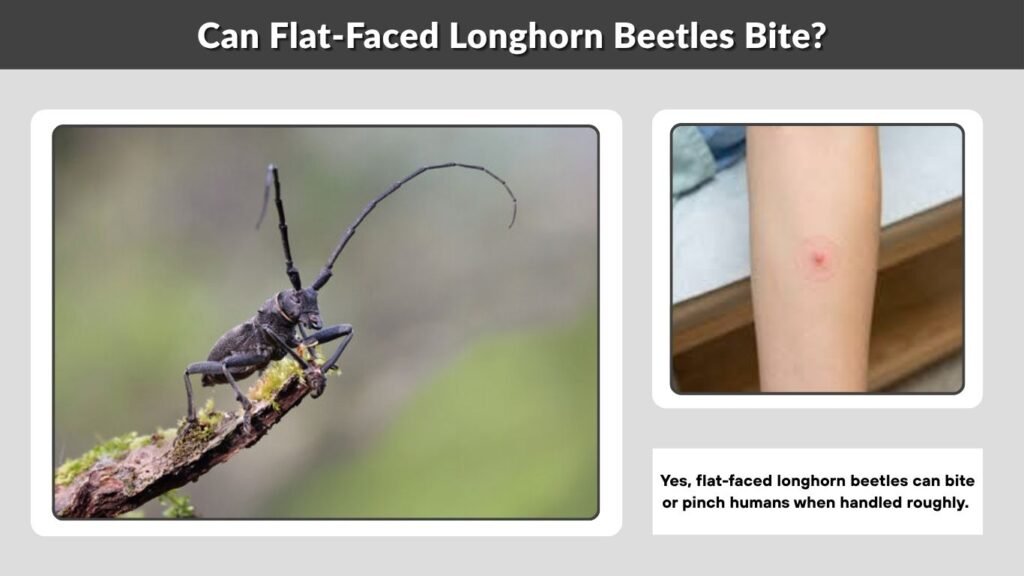
Yes, flat-faced longhorn beetles can bite or pinch humans when handled roughly. However, they are not naturally aggressive and do not attack people as prey.
Their mandibles are designed primarily for feeding and other biological activities rather than defending territories against humans.
How Painful Is a Flat-Faced Longhorn Beetle Bite?
Bite intensity varies depending on the beetle’s size and mandible strength.
Larger species may deliver a noticeable pinch capable of causing minor skin injuries. Smaller beetles may produce little discomfort.
Longhorn beetles do not possess venomous stingers, and their bites are generally not medically significant.
If bitten, wash the affected skin with soap and water. Seek medical advice if signs of infection develop.
How to Photograph a Longhorn Beetle Face
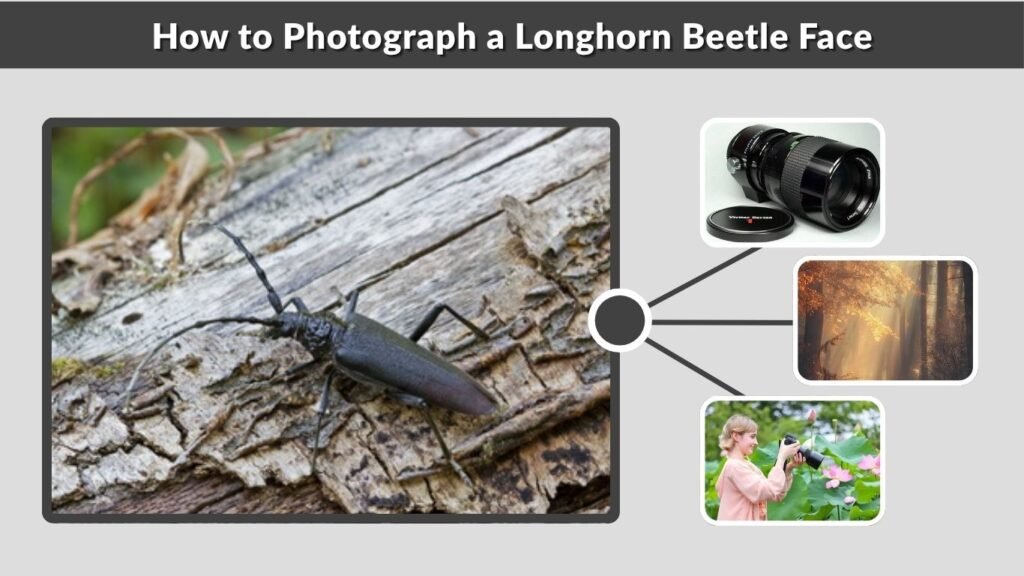
Longhorn beetles are popular macro photography subjects because their faces feature detailed textures, unusual eyes, and colorful patterns.
Getting a clear photograph requires careful lighting, close focusing, and patience.
Longhorn Beetle Macro Photography Tips
- Use a macro lens: Capture detailed images of compound eyes, antennae, and mouthparts.
- Choose soft lighting: Diffused natural light reduces harsh shadows and reflections.
- Focus on the eyes: Sharp eye details create a more engaging insect portrait.
- Keep a safe distance: Avoid touching or disturbing the beetle unnecessarily.
- Use a stable camera: A tripod or additional support helps minimize movement.
- Try focus stacking: Combine multiple focus distances when greater depth of field is needed.
- Capture different angles: Photograph the face from the front and side to reveal its structure.
Are Flat-Faced Longhorn Beetles Harmful to Trees?
Some flat-faced longhorn beetles can seriously damage trees because their larvae bore into living wood. Other species develop primarily in dead or weakened trees.
Their ecological impact depends on the species and host plant.
Do Longhorn Beetles Damage Homes?
Most longhorn beetles found outdoors do not threaten buildings. However, certain wood-boring species can develop in timber or wooden structures.
Beetles may also emerge indoors from stored firewood.
Repeated sightings alongside exit holes or sawdust-like material may justify professional identification and inspection.
FAQs
1. Why Does a Longhorn Beetle Face Look So Strange?
Longhorn beetles have large compound eyes, extended antennae, and prominent mandibles that create an unusual facial appearance. These structures help them sense environmental conditions, identify suitable plants, locate mates, and feed on vegetation.
2. What Is a Flat-Faced Longhorn Beetle?
A flat-faced longhorn beetle belongs to the subfamily Lamiinae. These beetles typically have a downward-facing or nearly vertical facial region, long antennae, and notched compound eyes. The group includes thousands of species worldwide.
3. Can a Flat-Faced Longhorn Beetle Bite Humans?
Yes, some flat-faced longhorn beetles can pinch human skin using their mandibles, particularly when handled or trapped. However, they are generally harmless, lack venomous stingers, and rarely bite unless physically disturbed.
4. Why Are Longhorn Beetle Eyes Kidney-Shaped?
Many longhorn beetles have notched or kidney-shaped compound eyes that partially surround their antennal bases. This arrangement is a characteristic feature of numerous species and helps distinguish longhorn beetles from certain other beetle families.
5. What Is the Difference Between Longhorn and Flat-Faced Longhorn Beetles?
Longhorn beetles belong to the family Cerambycidae, while flat-faced longhorn beetles form the subfamily Lamiinae within that family. Flat-faced species typically have a more vertical facial region, but both groups share characteristic elongated antennae and chewing mouthparts.