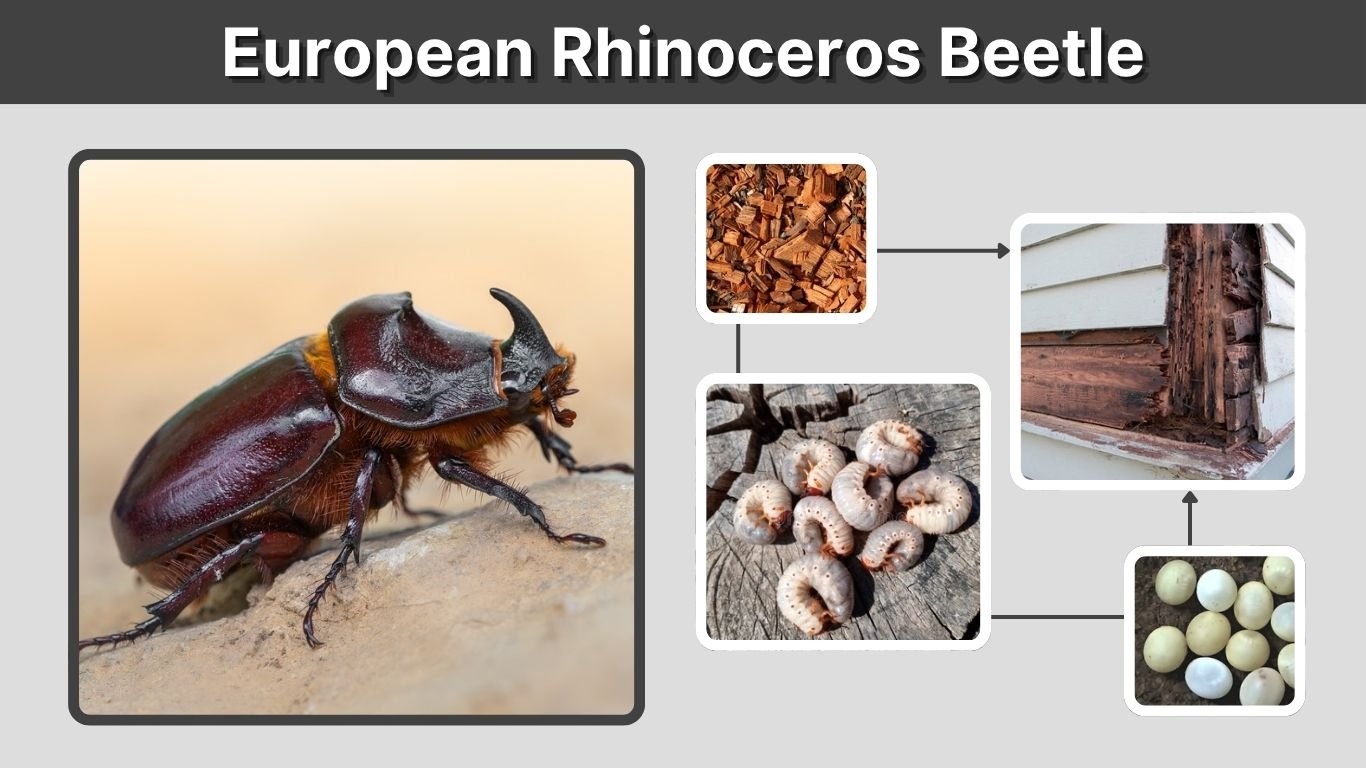
The European rhinoceros beetle (Oryctes nasicornis) is one of Europe’s most distinctive insects, recognized by its glossy brown body and the curved horn found on males. Although it looks powerful, this large beetle is harmless to people and plays a useful role in nature. Its larvae spend years developing inside decaying wood and organic matter, while adults appear mainly during warmer months. Learning about the European rhinoceros beetle’s identification, diet, habitat, lifespan, and life cycle reveals why this remarkable insect deserves protection.
European Rhinoceros Beetle Facts
The European rhinoceros beetle belongs to the scarab family, Scarabaeidae, and subfamily Dynastinae. Its name comes from the male’s rhinoceros-like horn.
Quick Facts
- Scientific name: Oryctes nasicornis
- Family: Scarabaeidae
- Adult size: Usually 20–40 mm; exceptional specimens may be larger
- Color: Shiny reddish-brown to dark chestnut
- Male feature: A curved horn on the head
- Larval food: Decaying wood and other decomposing plant matter
- Main habitat: Old wood, rotting stumps, sawdust, and compost
- Distribution: Mainland Europe and parts of western Asia and North Africa
- Adult activity: Mostly dusk and nighttime
Its larvae help break down dead plant material.
How to Identify a European Rhinoceros Beetle
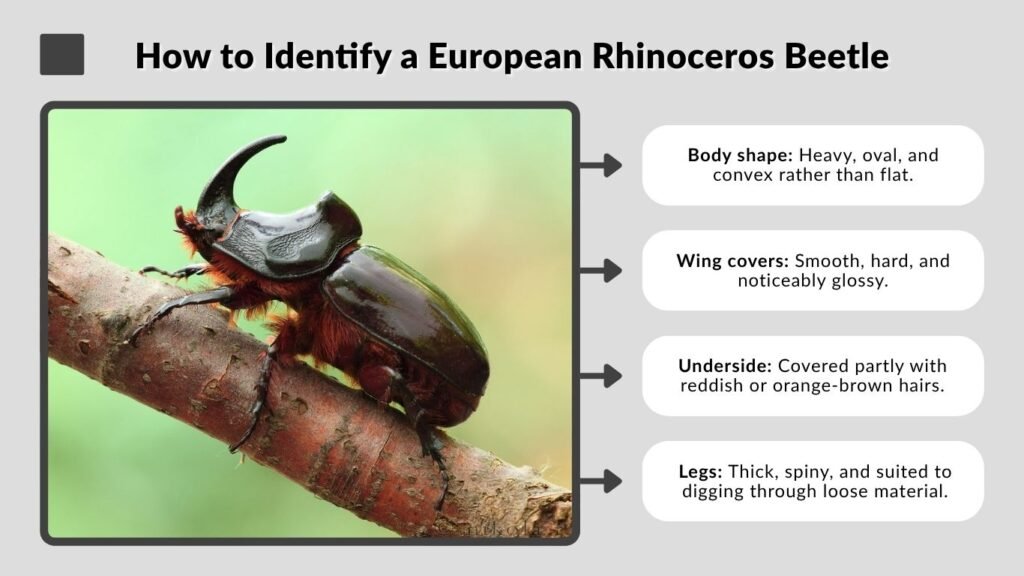
Adults have broad bodies and polished-looking wing covers. The head and pronotum, the shield behind the head, are often darker. They also have clubbed antennae and strong digging legs.
Key Identification Features
- Body shape: Heavy, oval, and convex rather than flat.
- Wing covers: Smooth, hard, and noticeably glossy.
- Underside: Covered partly with reddish or orange-brown hairs.
- Legs: Thick, spiny, and suited to digging through loose material.
- Horn: Large and curved in many males; absent in females.
Unlike rhinoceros beetles, stag beetles have enlarged jaws. Smaller rhinoceros beetle males may have reduced horns.
Male vs. Female European Rhinoceros Beetle
Both sexes have chestnut coloring, sturdy legs, and rounded wing covers, but their horns differ.
What Does a Male Look Like?
A typical male carries a horn rising from its head and curving backward. The pronotum may also have a pronounced depression. Males use their horns during contests with rivals for mating opportunities. Horn size varies considerably, and small males sometimes have only a short projection.
What Does a Female Look Like?
The European rhinoceros beetle female has no prominent head horn. Her head usually bears a small bump, while her pronotum is less dramatically sculpted. Females seek suitable decomposing material in which to lay their eggs, giving the larvae access to food immediately after hatching.
What Do European Rhinoceros Beetles Eat?
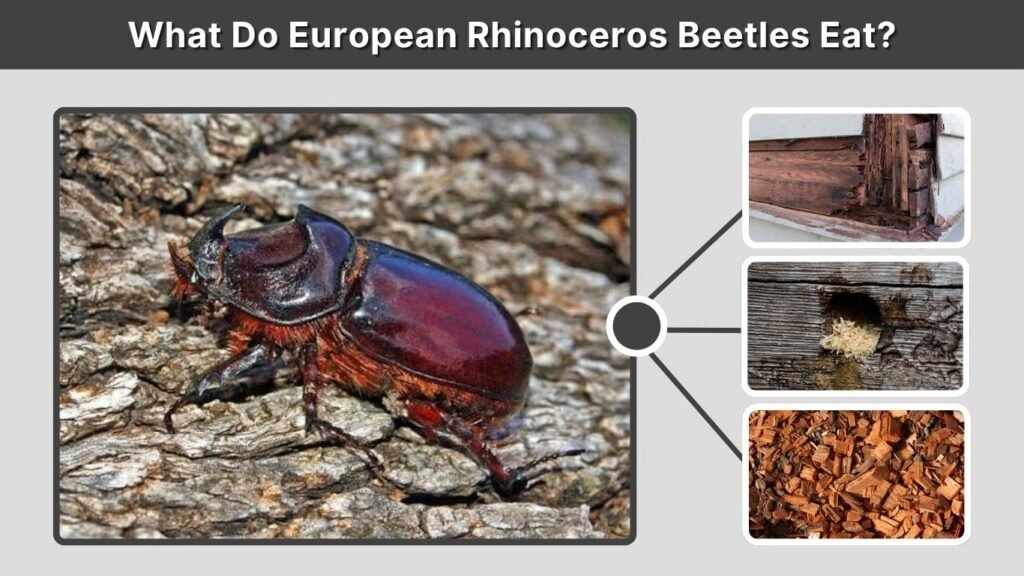
Larvae feed actively, but adults eat very little or nothing.
European Rhinoceros Beetle Larvae Diet
Larvae obtain nourishment from decomposing plant material, including:
- Rotting wood: Soft, broken-down wood in dead trunks and stumps.
- Decayed sawdust: Moist sawdust piles containing decomposed woody material.
- Old wood chips: Partially decomposed chips found in suitable compost.
- Organic compost: Rich mixtures containing decaying woody plant debris.
The larvae are not normally pests of healthy trees. Their feeding contributes to decomposition and nutrient recycling.
Do Adult European Rhinoceros Beetles Eat?
Adults are generally considered nonfeeding or very light-feeding insects. Rather than searching for substantial meals, they rely on energy reserves built up during the larval stage. Their brief adult lives are focused mainly on dispersal and reproduction. Claims that they regularly require fruit or sap should therefore be treated cautiously.
European Rhinoceros Beetle Life Cycle
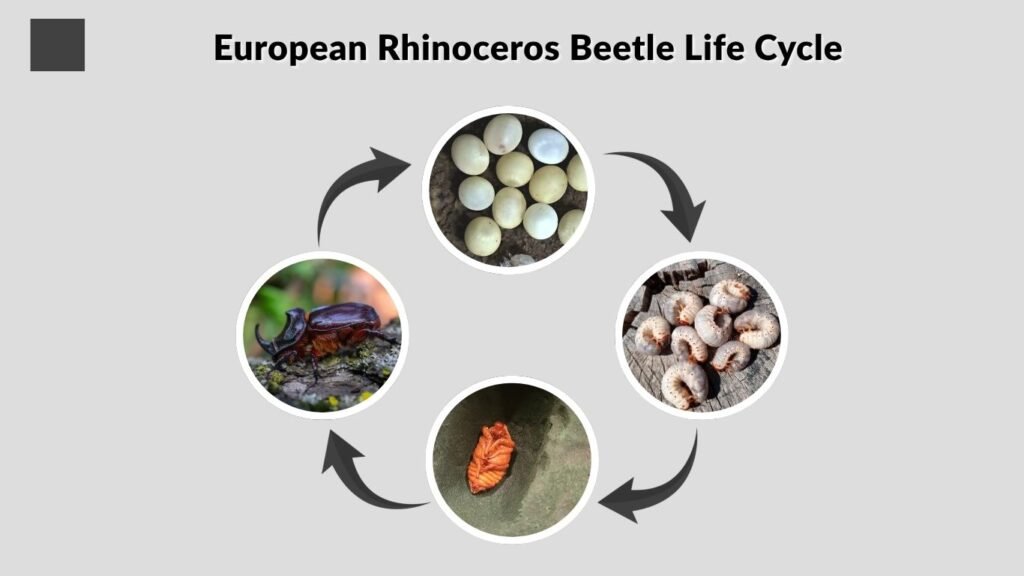
Oryctes nasicornis undergoes complete metamorphosis, spending most of its life concealed inside decomposing material.
Four Development Stages
- Egg: The female deposits eggs in decaying wood, compost, or similar organic material where newly hatched larvae can feed.
- Larva: A creamy-white, C-shaped grub with a brown head feeds and grows, passing through several molts. This stage often takes two years or longer.
- Pupa: The mature larva creates a chamber within the decomposing material and transforms into a pupa.
- Adult: The new beetle develops its characteristic hardened body and eventually emerges to fly, locate mates, and reproduce.
What Do the Larvae Look Like?
European rhinoceros beetle larvae are thick, pale grubs with curved bodies, brown heads, and three pairs of small legs. Fully grown larvae are much larger than young grubs and can be discovered in old compost heaps. They should not be confused automatically with plant-root pests because their usual food is decomposing material.
European Rhinoceros Beetle Habitat and Distribution
European rhinoceros beetles occur across much of mainland Europe, extending north into Scandinavia and east into parts of Asia. Their broader range also reaches North Africa. Local abundance varies, and some populations have legal protection.
Where Do They Live?
Historically, larvae developed in decaying timber within woodland habitats. Today they also inhabit old sawdust heaps, woodchip piles, and compost rich in woody material. These human-created sites can provide the warmth and food needed for slow larval development.
Are European Rhinoceros Beetles Found in the UK?
The species is not regarded as established in the British wild. A specimen discovered in Worcestershire in 2013 attracted attention, but that isolated record does not demonstrate a breeding population. An imported or escaped beetle remains a possible explanation.
European Rhinoceros Beetle Lifespan and Behavior
A European rhinoceros beetle’s total life cycle often lasts several years, commonly around two to four, depending on conditions. Most of that time is spent as a larva. Adults usually live only a few months, with sightings particularly frequent in summer.
Can European Rhinoceros Beetles Fly?
Yes. Despite their weight, adults have functional wings beneath their hardened wing covers. They fly most readily at dusk or after dark and may approach outdoor lights. Their nighttime activity explains why a large beetle can be present nearby without being seen during the day.
Are European Rhinoceros Beetles Dangerous?
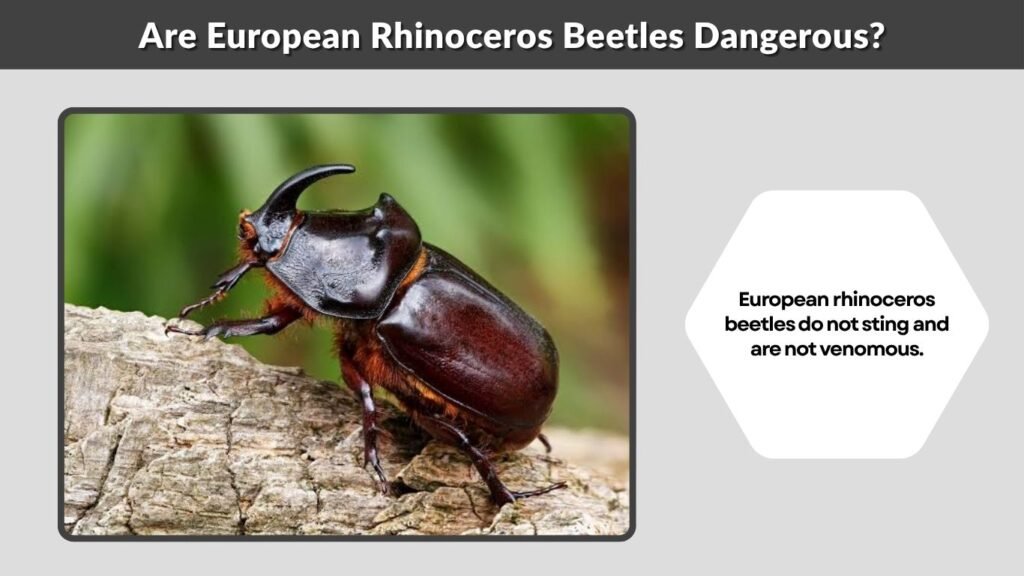
European rhinoceros beetles do not sting and are not venomous. The male’s horn is primarily a tool for competing with other males, not a weapon used against humans. They can be handled gently when necessary, but unnecessary collection should be avoided.
Because larvae help recycle deadwood, protecting rotting logs and suitable compost habitat benefits this species. Avoid disturbing occupied breeding sites, especially in places where beetles receive legal protection.
FAQs
1. How Big Is a European Rhinoceros Beetle?
Adult European rhinoceros beetles typically measure 20–40 mm in length, although exceptionally large individuals can approach 50 mm or more. Males often appear larger because of their prominent horns. Adult size depends on nutrition, environmental conditions, and larval development.
2. How Long Do European Rhinoceros Beetles Live?
European rhinoceros beetles generally complete their life cycle in two to four years, depending on environmental conditions. Most of this time is spent developing as larvae inside decaying wood. Adults usually survive only a few months, primarily focusing on reproduction.
3. Are European Rhinoceros Beetle Larvae Harmful?
European rhinoceros beetle larvae are generally harmless to humans, plants, and healthy trees. They primarily consume decaying wood and decomposing organic material. Their feeding activities help recycle nutrients, improve decomposition, and support natural ecological processes in forests and gardens.
4. Can You Buy a European Rhinoceros Beetle?
European rhinoceros beetles may be available from specialized insect breeders and exotic pet suppliers. Prices vary depending on location, availability, and developmental stage. Before purchasing, check local wildlife regulations and ensure the beetles originate from legal, responsibly maintained breeding populations.
5. Why Do Male European Rhinoceros Beetles Have Horns?
Male European rhinoceros beetles possess distinctive curved horns primarily used during competition with other males. These horns help them push or displace rivals when competing for mating opportunities. Larger males often develop more prominent horns, while females lack these structures.