
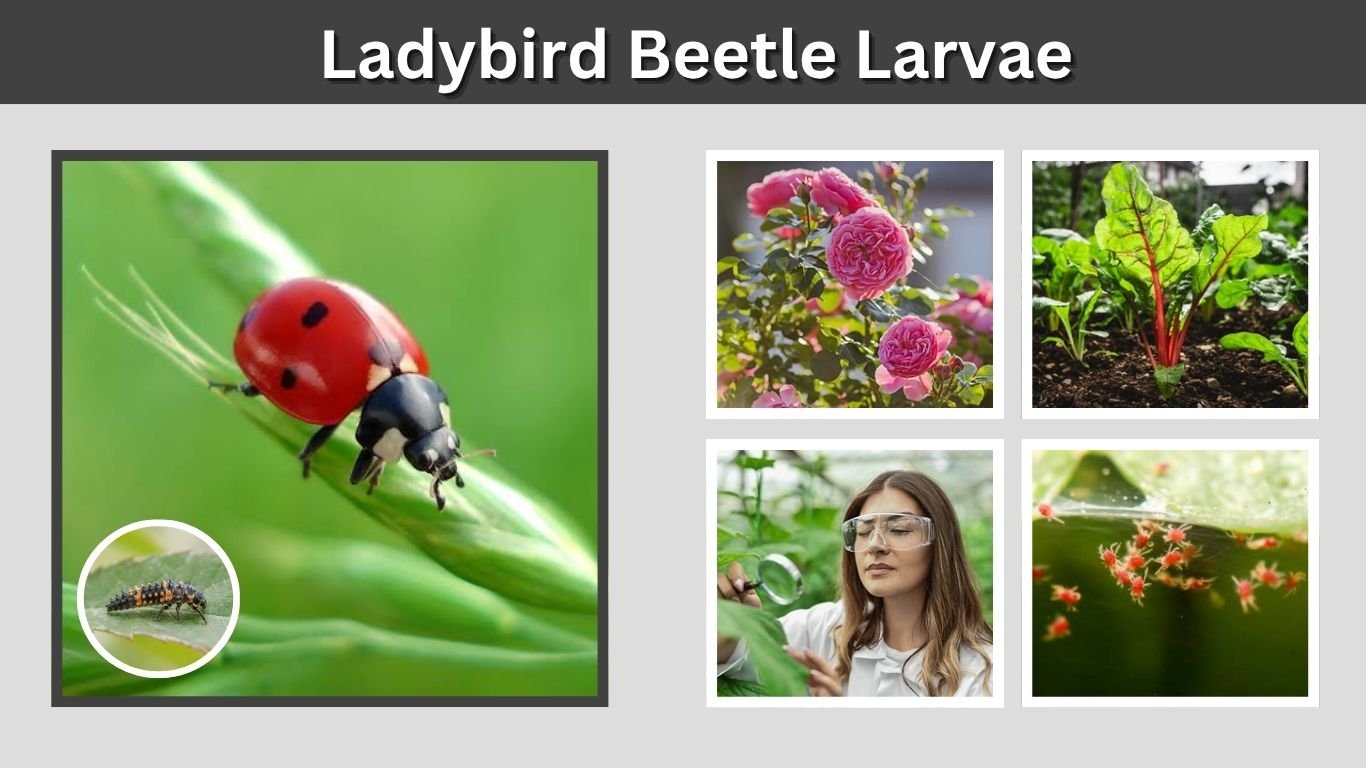
Ladybird beetle larvae are fascinating young insects that look surprisingly different from the familiar round, spotted adult ladybugs. Their elongated bodies, dark coloration, and tiny spines often make them resemble miniature alligators. Despite their intimidating appearance, most ladybird larvae are beneficial garden predators that feed on aphids and other small pests. They play an essential role in natural pest control while developing into adult beetles. Understanding their identification, feeding habits, life cycle, and different species can help gardeners recognize and protect these useful insects.
What Are Ladybird Beetle Larvae?
Ladybird beetle larvae are the immature stages of insects belonging to the Coccinellidae family. They emerge from eggs laid by adult female ladybirds, usually near colonies of small insects that serve as food. Unlike adult ladybugs, larvae have elongated bodies, visible abdominal segments, and well-developed legs.
Ladybird Beetle Larvae Identification
- Body shape: Long, narrow, and somewhat flattened.
- Color: Usually dark grey or black, often with orange or yellow markings.
- Size: Commonly reaches approximately 5–12 mm, depending on species.
- Legs: Six jointed legs near the front of the body.
- Spines: Small bumps, bristles, or branching projections along the body.
- Head: Distinct head with strong chewing mouthparts.
- Movement: Crawls actively across stems and leaves while hunting prey.
Ladybird Larvae vs. Adult Ladybugs
Ladybird larvae and adult ladybugs look completely different. Adults have rounded bodies protected by hardened wing covers, while larvae have long, segmented bodies without wings.
Adults are often brightly colored, whereas larvae commonly display darker camouflage patterns.
Both developmental stages can be beneficial predators, but larvae are especially active feeders because they require nutrients for rapid growth.
Different Types of Ladybird Beetle Larvae
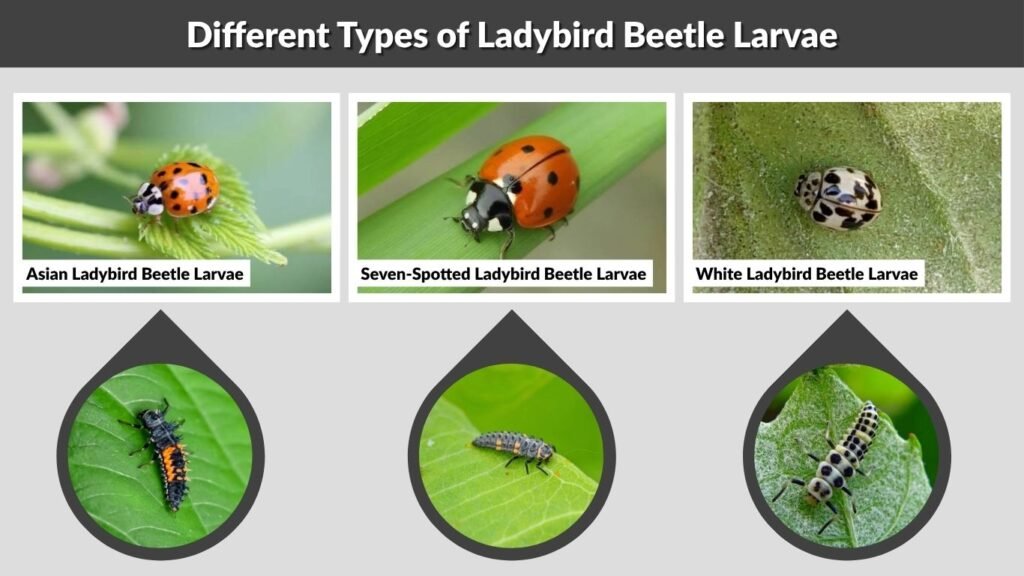
There are thousands of ladybird species worldwide, and their larvae vary in color, size, and appearance. Some have dark bodies with orange markings, while others are covered with waxy white substances. Recognizing these differences helps distinguish beneficial insects from common garden pests.
Asian Ladybird Beetle Larvae
Asian ladybird beetle larvae (Harmonia axyridis) have dark grey or black bodies with prominent orange markings and branching spines.
Their appearance resembles a small, spiky alligator.
These larvae feed primarily on aphids and other soft-bodied insects. They are commonly observed on trees, shrubs, and garden plants.
The species is also called the Harlequin Ladybird in Britain.
Seven-Spotted Ladybird Beetle Larvae
Seven-spotted ladybird larvae (Coccinella septempunctata) have dark grey or bluish-black bodies with orange markings.
Their elongated bodies contain several visible segments with small projections.
They are highly active predators that hunt aphids on crops, ornamental plants, and wild vegetation.
White Ladybird Beetle Larvae
Some ladybird larvae are covered in white, waxy filaments rather than appearing dark and spiny.
These include species in the genus Hyperaspis, some Scymnus species, and the Mealybug Destroyer (Cryptolaemus montrouzieri).
Their waxy covering makes them resemble mealybugs or small pieces of cotton.
However, these larvae are predators that consume mealybugs, scale insects, and other soft-bodied pests.
What Do Ladybird Beetle Larvae Eat?
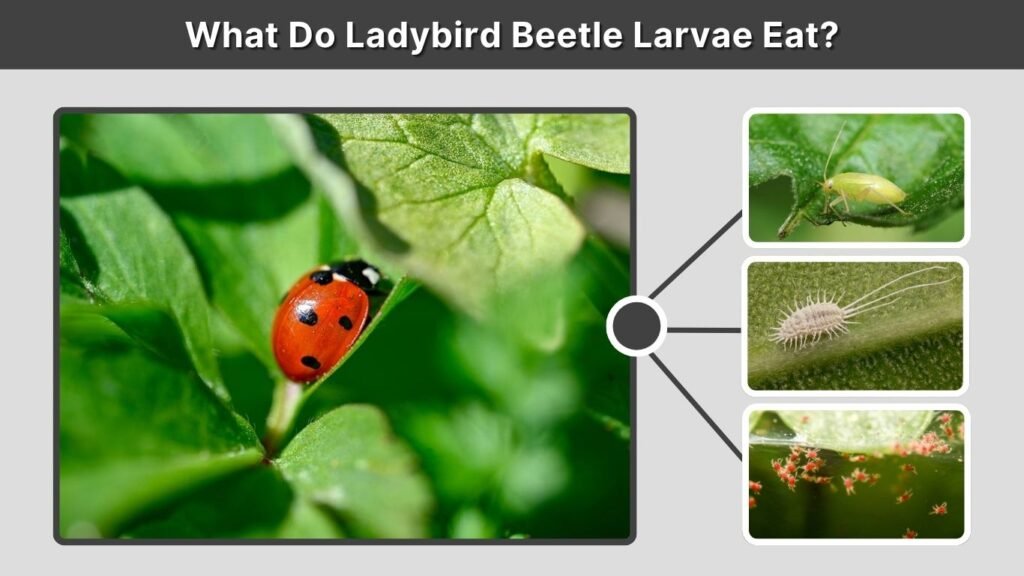
Most familiar ladybird larvae are carnivorous predators that feed on small insects found on plants. Their chewing mouthparts allow them to capture prey and consume it efficiently. Food availability strongly influences their growth, development, and survival.
Common Food Sources
- Aphids: The primary food for many ladybird species.
- Mealybugs: Consumed by specialized predatory larvae.
- Scale insects: Important prey for several species.
- Spider mites: Eaten by some small ladybird larvae.
- Insect eggs: Provide additional nutrients.
- Small insect larvae: Occasionally captured by larger individuals.
How Do Ladybird Larvae Eat Aphids?
Ladybird larvae actively search leaves and stems for aphid colonies.
After locating prey, they grasp aphids with their mouthparts and consume them.
As larvae grow through successive developmental stages, their appetite generally increases.
A single larva can consume numerous aphids before reaching maturity, making it valuable for natural pest control.
However, not every ladybird species is predatory. Some feed on fungi or plant materials.
Ladybird Beetle Larvae Life Cycle
Ladybird beetles undergo complete metamorphosis, passing through four distinct developmental stages: egg, larva, pupa, and adult. The larval stage is particularly important because the insect must consume enough food to support development. Temperature, species, and food availability determine how quickly the transformation occurs.
Egg Stage
Adult female ladybirds usually lay clusters of yellow or orange eggs on leaves and stems.
Eggs are frequently deposited close to aphid colonies, ensuring that newly hatched larvae have access to food.
Depending on the species and temperature, the eggs generally hatch within a few days.
Ladybird Beetle Larval Stages
After hatching, a ladybird larva begins feeding and growing.
Most species pass through four larval stages called instars.
Between these stages, larvae shed their outer skeleton through a process known as molting.
Their body size increases significantly as they progress toward maturity.
For many common species, larval development takes approximately two to four weeks under favorable conditions.
Ladybird Beetle Pupa
Once fully grown, the larva attaches itself to a leaf, stem, or another suitable surface.
It then transforms into a pupa, which is usually rounded or oval and may display orange, yellow, or dark markings.
During this stage, the insect undergoes major internal changes before emerging as an adult.
Adult Ladybird Beetle
Newly emerged adults initially have soft, pale wing covers.
Their colors gradually become stronger as the outer skeleton hardens.
Mature adults begin feeding and eventually reproduce, completing the life cycle.
Where Do Ladybird Beetle Larvae Live?
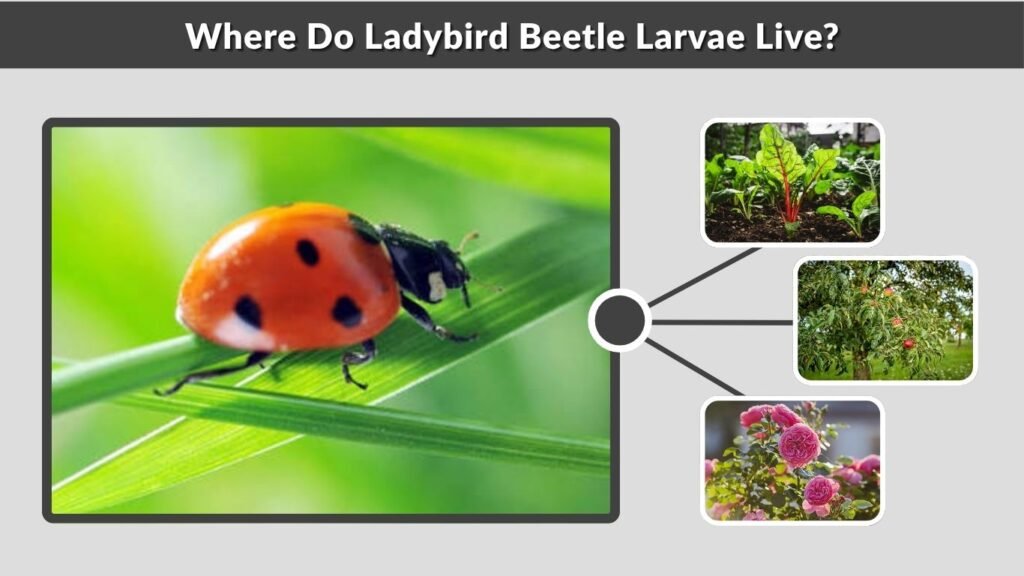
Ladybird larvae occur in habitats containing suitable food sources and vegetation. They are especially common where aphids and other small insects feed on plants. Gardens, orchards, agricultural fields, and woodland edges provide favorable conditions for many species.
Common Habitats
Ladybird larvae frequently live on vegetable plants, fruit trees, roses, flowering shrubs, and grasses.
They are often found on the undersides of leaves or near clusters of aphids.
Different ladybird species prefer different habitats, depending on their feeding requirements.
When Can You Find Ladybird Larvae?
Ladybird larvae are most frequently observed during spring and summer in temperate regions.
Warmer temperatures encourage adult reproduction and provide favorable conditions for larval development.
In warmer climates, some species may remain active across a much longer period.
Do Ladybird Beetle Larvae Bite?
Ladybird larvae have functional jaws used for capturing prey. Although these mouthparts can occasionally pinch human skin, the larvae are not considered dangerous. Their primary purpose is feeding on small insects, not attacking people or larger animals.
Are Ladybird Beetle Larvae Dangerous?
Ladybird larvae are generally harmless to humans.
They do not possess stingers and are not venomous.
A larva may occasionally pinch someone who handles it, but this usually causes little or no injury.
Avoid squeezing or handling larvae unnecessarily to protect both the insect and your skin.
Can Ladybird Larvae Damage Plants?
Most commonly encountered ladybird larvae are beneficial predators and do not damage plants.
They often appear on leaves because they are searching for pests.
However, certain plant-feeding ladybird species have larvae that consume foliage.
Identifying the species is therefore important before assuming every ladybird larva is beneficial.
Ladybird Beetle Larvae vs. Harmful Garden Insects
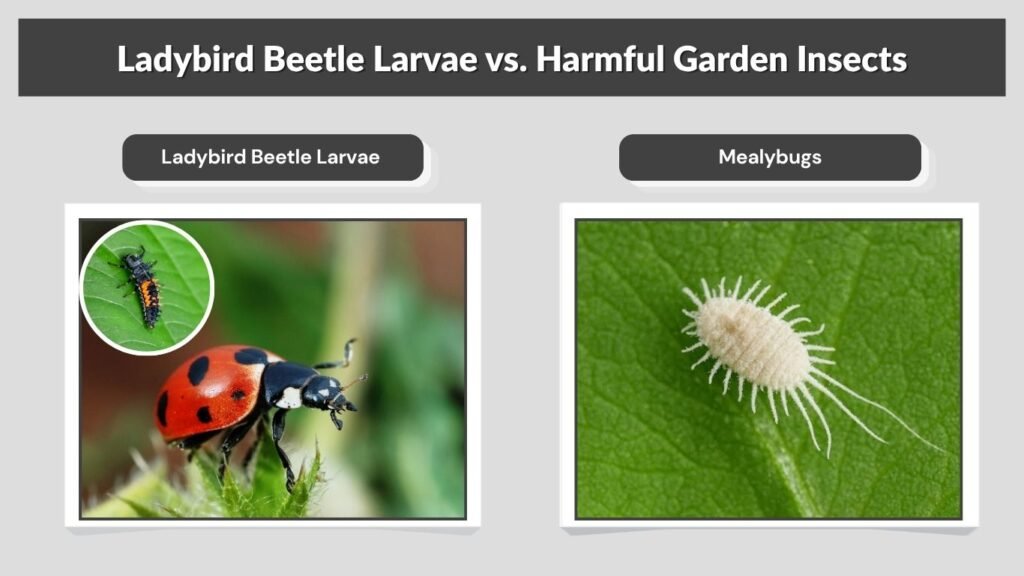
Ladybird larvae can resemble other small insects because of their segmented bodies and unusual markings. Gardeners sometimes mistake beneficial larvae for pests and remove them unnecessarily. Understanding their distinguishing characteristics helps prevent accidental harm to natural predators.
Ladybird Larvae vs. Mealybugs
Most ladybird larvae have dark, segmented bodies with visible legs.
However, wax-covered larvae such as Cryptolaemus and Hyperaspis species can resemble white mealybugs.
These predatory larvae often move more actively than the pests they consume and may have longer waxy filaments.
Ladybird Larvae vs. Colorado Potato Beetle Larvae
Colorado potato beetle larvae have plump, reddish-orange bodies with rows of dark spots.
Typical predatory ladybird larvae are more elongated and often have darker coloration with spines or raised projections.
Colorado potato beetle larvae feed on potato and related plants, while many ladybird larvae hunt insects.
How to Protect Ladybird Beetle Larvae in Gardens
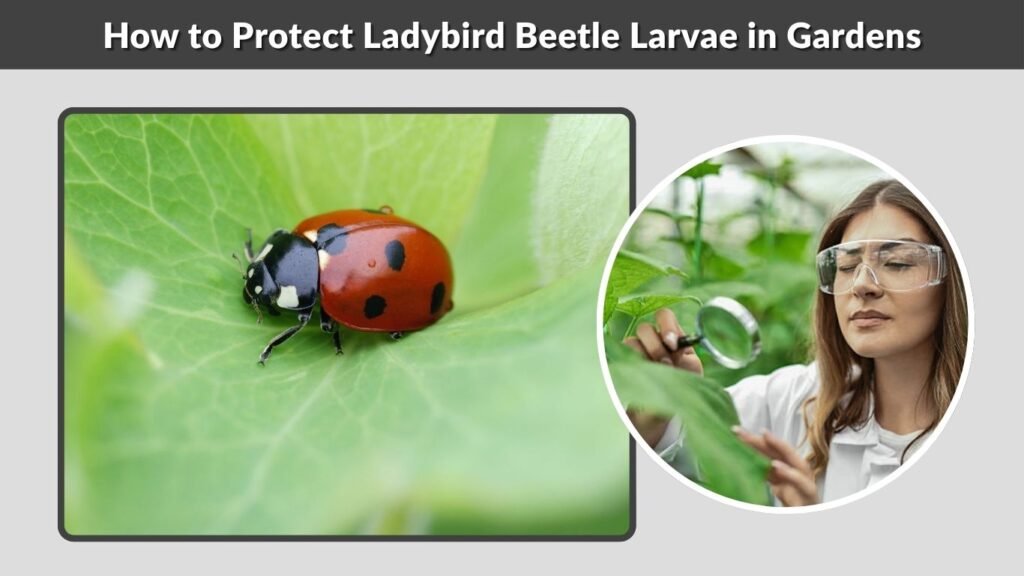
Ladybird larvae are valuable components of healthy gardens because many species help reduce pest populations. Supporting their development requires suitable prey, natural shelter, and reduced exposure to harmful chemicals. Protecting these insects can contribute to long-term biological pest control.
Garden Protection Tips
- Avoid unnecessary pesticides: Broad-spectrum insecticides can kill beneficial larvae.
- Grow diverse plants: Flowering plants provide resources for adult ladybirds.
- Check leaves carefully: Identify larvae before removing unfamiliar insects.
- Preserve natural vegetation: Maintain sheltered areas where beneficial insects can develop.
- Leave small aphid populations: Some prey is necessary to support predatory larvae.
FAQs
1. What Do Ladybird Beetle Larvae Look Like?
Most have elongated, dark bodies with orange or yellow markings and small spines. Their appearance is often compared to tiny alligators. However, some species have white waxy coverings.
2. Are Asian Ladybird Beetle Larvae Harmful?
Asian ladybird beetle larvae are generally harmless to humans. They are active predators that eat aphids and other small insects, although the species can negatively affect some native ladybird populations.
3. Can Ladybird Beetle Larvae Bite Humans?
They can occasionally pinch skin when handled, but they are not venomous and do not have stingers. Bites are uncommon and generally cause little discomfort.
4. How Long Does the Ladybird Larval Stage Last?
The larval stage commonly lasts approximately two to four weeks, although development depends on species, temperature, and food availability.
5. Why Are Some Ladybird Beetle Larvae White?
Certain species, including Mealybug Destroyers and some Hyperaspis beetles, produce white waxy coverings. These coverings can help protect them and make them resemble the mealybugs or scale insects they prey upon.
