
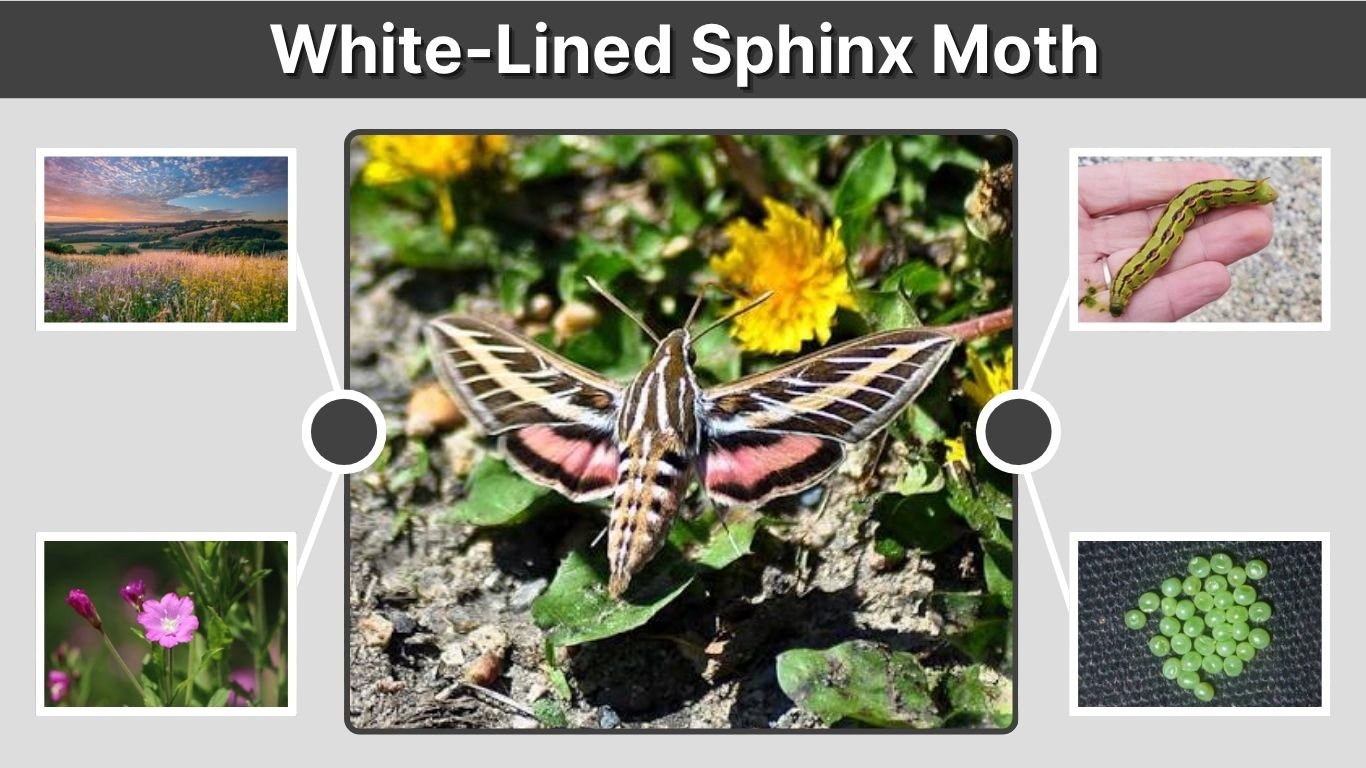
The white-lined sphinx moth (Hyles lineata) is a large, fast-flying moth found across much of North America and beyond. Its striking white-striped wings, pink hindwings, and hummingbird-like hovering make it one of the easiest sphinx moths to notice around flowers. Its caterpillar is equally distinctive, appearing in several colors and carrying a harmless horn at the rear. This guide covers white-lined sphinx moth identification, caterpillars, size, host plants, diet, range, life cycle, lifespan, behavior, and whether the species is beneficial or harmful.
White-Lined Sphinx Moth Identification
The white-lined sphinx is a member of the hawk moth family Sphingidae. Its streamlined body and narrow wings are built for rapid flight, while its long proboscis allows it to hover in front of flowers and drink nectar. The combination of brown forewings, strong cream-white markings, and bright pink hindwings makes an adult relatively easy to recognize.
Adult Identification
- Scientific name: Hyles lineata
- Family: Sphingidae
- Forewings are olive-brown to dark brown
- A pale stripe runs from near the wing tip toward the base
- Several white streaks occur along the wing veins
- Hindwings are mostly black with a broad reddish-pink band
- Abdomen has contrasting pale and dark markings
- Body is thick and streamlined
- Long proboscis is used for drinking flower nectar
- Wingspan is approximately 2.4–3.6 inches, or 6.3–9 cm
Size and Male vs. Female
Adults are substantial moths, but their size can make them appear even larger when hovering rapidly around flowers. Their wingspan commonly reaches about 3 inches and may approach 3.6 inches in larger individuals.
Male and female white-lined sphinx moths look broadly similar. Females tend to have a somewhat fuller abdomen because of developing eggs, while males may appear slimmer. Sexing individuals from casual observation is usually much harder than identifying the species itself.
White-Lined Sphinx Moth Caterpillar
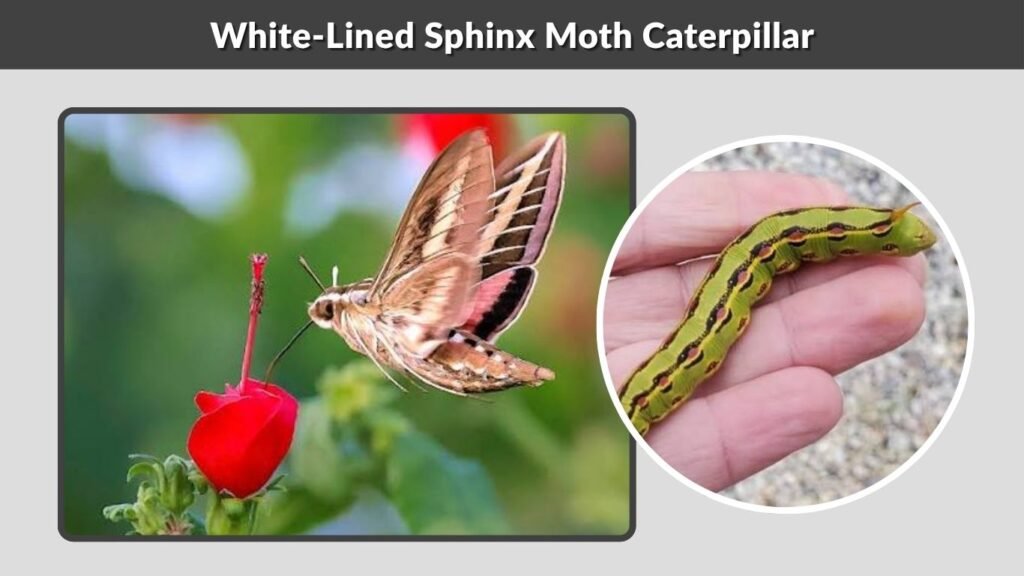
The white-lined sphinx moth caterpillar is commonly called a hornworm because of the noticeable projection at the rear of its abdomen. Caterpillar coloration is highly variable, ranging from green to yellowish, brown, or almost black. This variation sometimes makes identification confusing, but the species typically displays bold longitudinal markings and contrasting spots. Fully grown larvae can reach around 3 inches or more.
Caterpillar Identification
- Usually grows to roughly 3–3.5 inches long
- Color may be green, yellow-green, brown, or nearly black
- Often has longitudinal yellow or pale lines
- Black markings may cover much of the body
- Red, orange, yellow, or pale spots can appear along the sides
- A prominent horn projects from the rear
- Body is smooth rather than densely hairy
- Young caterpillars may feed together before dispersing as they grow
Is the White-Lined Sphinx Caterpillar Poisonous?
No. The white-lined sphinx caterpillar is not venomous, and its rear horn does not contain venom. Sphinx moth caterpillar horns are primarily defensive structures that can make the larva appear more intimidating to predators.
The caterpillar is therefore not considered dangerous simply because it has a horn. As with wild insects generally, unnecessary handling is still best avoided. The moth itself is also harmless to people and does not possess a stinger.
Habitat, Range, and Hummingbird-Like Behavior
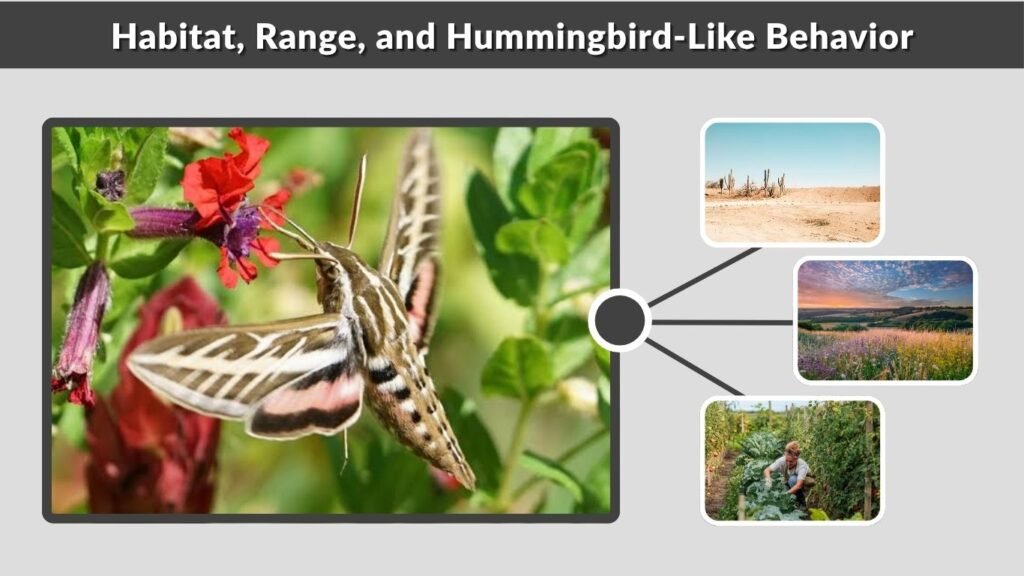
White-lined sphinx moths occupy an unusually broad range of environments. They appear in deserts, meadows, gardens, suburbs, grasslands, and other open habitats wherever nectar plants and suitable caterpillar hosts occur. Their ability to move long distances contributes to their widespread distribution, and population explosions can sometimes result in remarkable mass movements of caterpillars or adults.
Where Does the White-Lined Sphinx Moth Live?
In the Americas, its range extends from Central America and Mexico north through most of the United States into southern Canada. The species also occurs in other parts of the world, including Eurasia and Africa.
In the United States, observations are especially common across western and southwestern states such as California, Arizona, Utah, Colorado, and New Mexico, but the moth can occur far beyond the Southwest.
Why Is It Called a Hummingbird Moth?
White-lined sphinx moths can hover in front of flowers while extending a long proboscis into blossoms. Their rapid wingbeats, large body, and ability to remain suspended in one place can cause them to be mistaken for tiny hummingbirds.
Adults commonly fly around dusk and dawn, although they may also forage during daylight or at night. Sphinx moths are effective flower visitors and can transport pollen while moving between blossoms.
White-Lined Sphinx Moth Diet and Host Plants
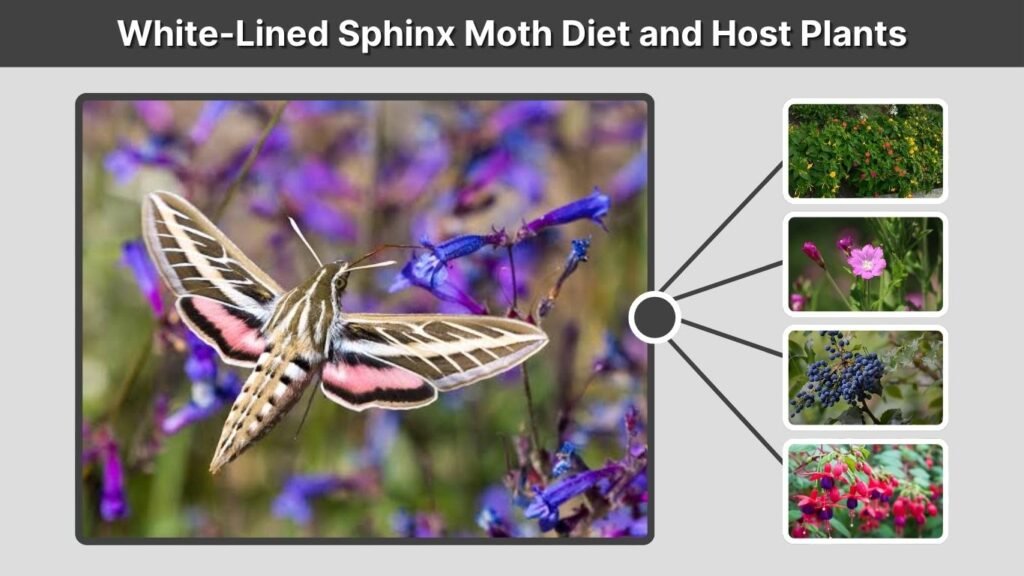
White-lined sphinx moths have very different diets as larvae and adults. Caterpillars chew leaves from a surprisingly broad range of plants, while adult moths rely primarily on flower nectar. This flexibility is one reason the species can survive in habitats ranging from deserts to suburban gardens and can rapidly increase in abundance when host plants become plentiful.
What Do the Caterpillars Eat?
Common white-lined sphinx moth host plants include:
- Evening primrose
- Purslane and portulaca
- Four-o’clocks
- Willowherb
- Wild grape and cultivated grape
- Apple
- Elm
- Fuchsia
- Tomato
- Various weeds and desert shrubs
- Spiderling plants (Boerhavia)
What Do Adult White-Lined Sphinx Moths Eat?
Adults drink nectar rather than eating leaves. Known nectar sources include columbine, larkspur, petunia, honeysuckle, moonvine, lilac, clover, thistles, and jimsonweed or datura.
Their long proboscis makes deep, tubular flowers particularly accessible. During evenings, pale-colored and strongly scented blossoms can be especially attractive to sphinx moths.
White-Lined Sphinx Moth Life Cycle and Lifespan
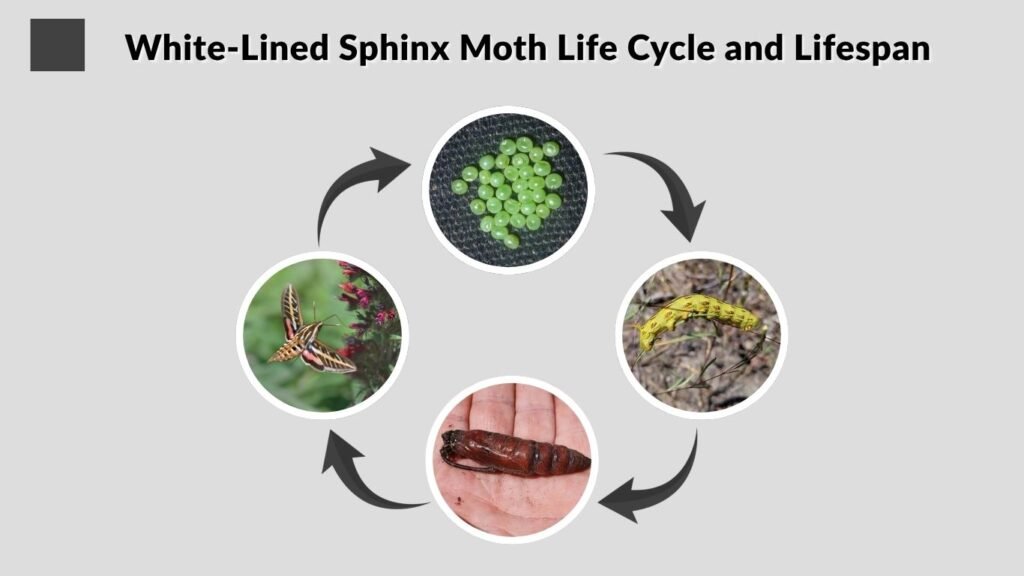
Like other moths, Hyles lineata undergoes complete metamorphosis through egg, caterpillar, pupa, and adult stages. Much of its development is spent feeding as a caterpillar. When mature, the larva leaves its host plant and burrows into loose soil, where it changes into a brownish pupa rather than hanging openly from vegetation like many butterfly chrysalises.
Life Cycle Stages
- Egg: Females lay eggs on appropriate host plants.
- Larva: Caterpillars feed intensively and grow through several molts.
- Pre-pupa: Mature caterpillars leave plants and search for loose soil.
- Pupa: Pupation occurs in a shallow underground chamber.
- Adult: The moth emerges, feeds on nectar, mates, and starts another generation.
Pupa, Generations, and Lifespan
Under favorable warm conditions, the pupal stage may last roughly two to three weeks before an adult emerges. Pupae produced late in the season can instead overwinter underground.
Butterflies and Moths of North America lists two broods and adult activity extending broadly from February through November, although timing varies with climate and location. The exact total lifespan is therefore not fixed; temperature, season, food supply, and whether the insect overwinters as a pupa can substantially change development time.
Is the White-Lined Sphinx Moth Good or Bad?
The answer depends on which life stage and situation you are considering. Adults can be valuable flower visitors and pollinators, while caterpillars sometimes consume enough foliage to concern gardeners. Most populations cause limited problems, but unusually large outbreaks can strip vegetation and occasionally damage garden or agricultural plants.
Beneficial Pollinator or Garden Pest?
Adult white-lined sphinx moths are generally beneficial because they move among flowers while feeding on nectar. The U.S. Forest Service includes sphinx moths among important pollinating moths.
Caterpillars can occasionally become pests when numerous. Recorded host plants include tomatoes and grapes, and outbreaks have caused garden-crop damage in some areas. Usually, however, their ecological role as herbivores and eventual pollinating adults makes them a normal part of the ecosystem rather than insects that automatically need control.
White-Lined Sphinx Moth Spiritual Meaning
There is no scientifically established spiritual meaning for a white-lined sphinx moth. Symbolic interpretations are personal or cultural rather than biological facts.
Because moths undergo dramatic metamorphosis, people may associate them with transformation, change, persistence, or renewal. The white-lined sphinx’s unusual ability to hover like a hummingbird can also inspire symbolic ideas about energy and adaptability. These meanings should be understood as interpretations, not characteristics documented by entomology.
FAQs
1. Are white-lined sphinx moths rare?
No. Hyles lineata is widespread and considered globally secure. It may seem uncommon in some locations because numbers vary dramatically from year to year, but in favorable conditions enormous populations can develop.
2. Are white-lined sphinx moths dangerous?
No. Adult white-lined sphinx moths are harmless to people. Their caterpillars have an obvious rear horn, but sphinx moth horns are not venomous.
3. How big does a white-lined sphinx moth get?
Adults have a wingspan of approximately 2 7/16 to 3 9/16 inches (6.3–9 cm). Caterpillars commonly reach around 3 inches long and occasionally slightly more.
4. Does a white-lined sphinx moth make a cocoon?
Not a typical silk cocoon. Mature caterpillars burrow into shallow soil and form a pupa underground. They may remain there for a few weeks or overwinter before emerging as adult moths.
5. What attracts white-lined sphinx moths?
Flowering plants rich in nectar are the main attraction. Adults visit petunias, honeysuckle, evening-blooming flowers, columbines, thistles, and many other blossoms. Pale, fragrant evening flowers can be particularly attractive to sphinx moths.
