
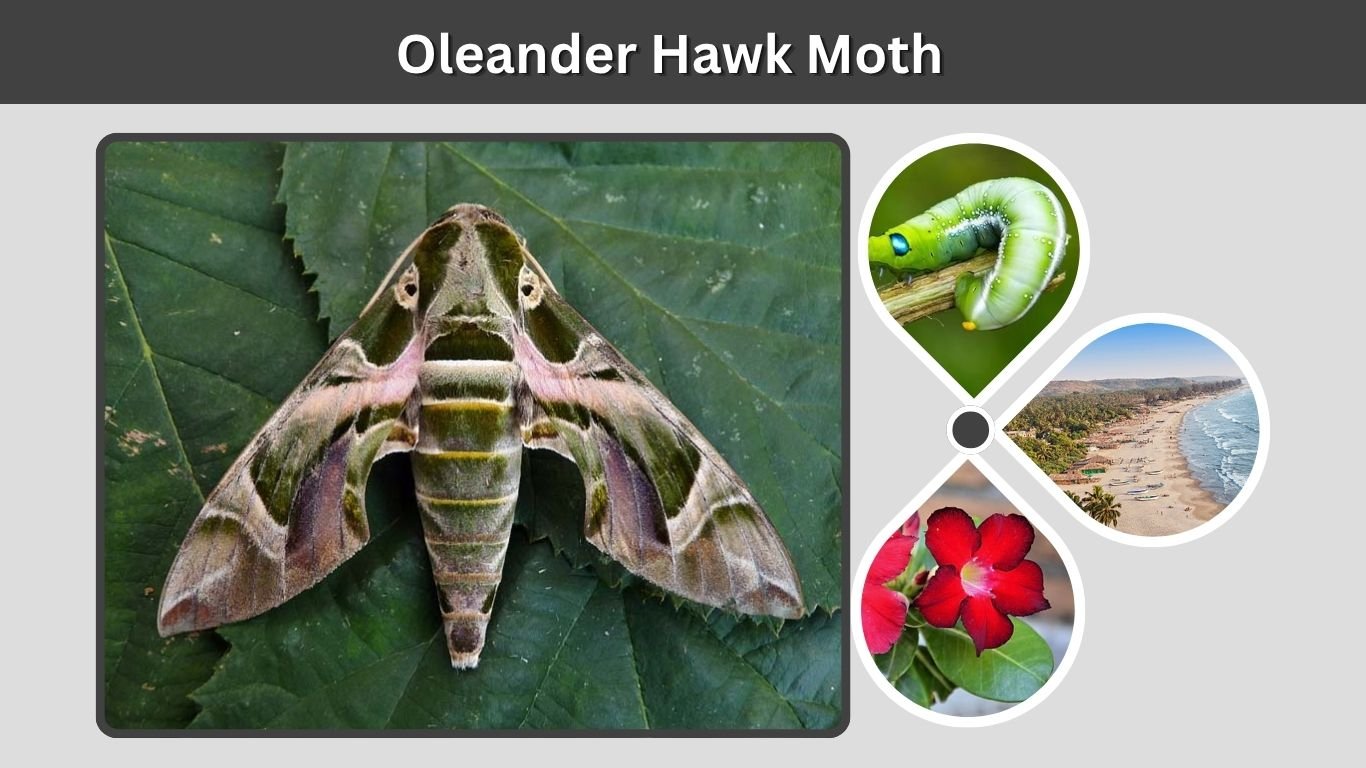
The oleander hawk moth (Daphnis nerii) is a large, striking moth recognized by its camouflage-like green wings and unusually colorful caterpillar. Found mainly across Africa and Asia, with populations or migrants reaching southern Europe and Hawaii, it is closely associated with oleander and other plants in the dogbane family. Its caterpillar can look intimidating because of its large eyespots and tail horn, but it is not a stinging caterpillar. Below, learn how to identify it, what it eats, its life cycle, size, range, and potential danger.
What Is an Oleander Hawk Moth?
The oleander hawk moth belongs to the hawk-moth family Sphingidae and has the scientific name Daphnis nerii. Adults are large, fast-flying moths with elaborate green, olive, white, pink, and purplish markings. The pattern provides excellent camouflage when the moth rests among foliage. Its wingspan is commonly around 90–110 mm, although somewhat larger individuals occur.
Quick Identification Features
- Scientific name: Daphnis nerii
- Family: Sphingidae
- Wingspan: Usually around 90–110 mm
- Green and olive camouflage pattern
- White or cream bands across the wings
- Pink to purple patches on the forewings
- Thick, streamlined body
- Long wings suited to fast flight
- Primarily active around dusk and at night
Green, Purple, and “Blue” Oleander Hawk Moths
Adult oleander hawk moths are primarily green, but their complex wing patterns can include olive, cream, pink, brown, and purple. Lighting or photographs sometimes make these markings look bluish.
A true separate “blue oleander hawk moth” is not generally recognized as a distinct species. Searches for blue or purple individuals usually refer to color impressions or variations in photographs of Daphnis nerii rather than separate species.
Oleander Hawk Moth Caterpillar Identification
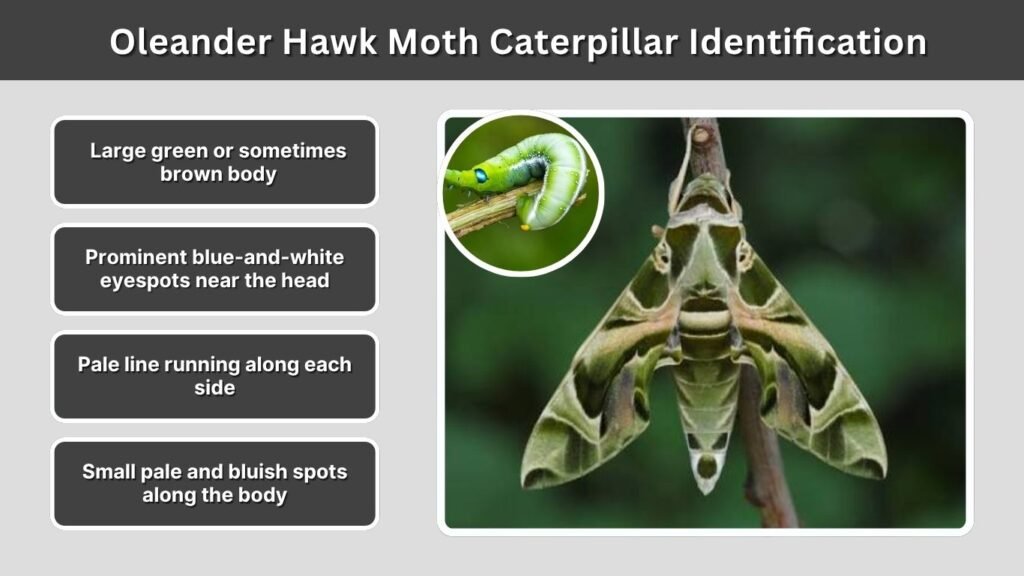
The oleander hawk moth caterpillar is almost as impressive as the adult. Young larvae begin very small and change dramatically as they grow. Mature caterpillars are typically green or brown and develop conspicuous eyespots near the front of the body. They also possess the characteristic rear horn seen in many hawk-moth larvae.
What Does the Caterpillar Look Like?
- Large green or sometimes brown body
- Prominent blue-and-white eyespots near the head
- Pale line running along each side
- Small pale and bluish spots along the body
- Dark breathing openings along the sides
- Short curved horn at the rear
- Mature larvae can become several centimeters long
- Body may become browner shortly before pupation
The large eyespots are not actual eyes. When disturbed, the caterpillar can draw its head inward, making the eyespots appear larger and potentially startling a predator.
Orange Oleander Hawk Moth Caterpillar
People sometimes report orange, yellowish, or brown oleander hawk moth caterpillars. Color can change with larval stage, individual variation, and preparation for pupation.
A mature larva may lose its vivid green appearance and become brownish as it stops feeding and searches for a suitable pupation site. Therefore, color alone should not be used for identification.
What Do Oleander Hawk Moth Caterpillars Eat?
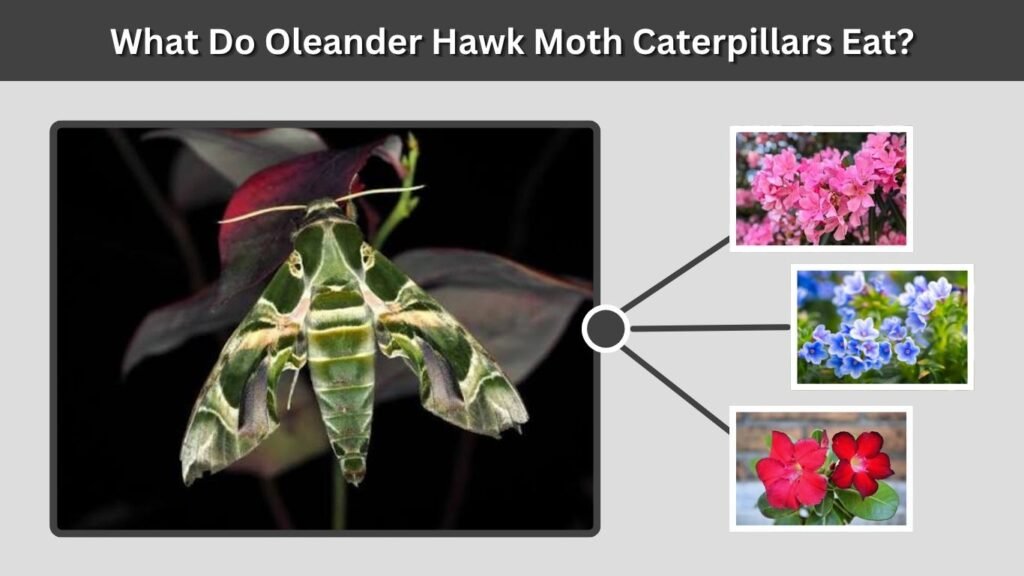
The caterpillar gets its common name from its close association with oleander. However, Daphnis nerii is capable of feeding on several related plants, especially members of the dogbane family. Host records differ somewhat by region.
Common Caterpillar Food Plants
- Oleander (Nerium oleander)
- Periwinkle (Vinca species)
- Desert rose (Adenium obesum)
- Pinwheel flower (Tabernaemontana divaricata)
- Carissa species
- Rauvolfia species
- Plumeria
- Other suitable Apocynaceae plants
Oleander contains powerful cardiac glycosides called cardenolides. Remarkably, the caterpillars possess physiological adaptations that allow them to feed on this chemically defended plant.
What Do Adult Oleander Hawk Moths Eat?
Adults no longer chew leaves. Like other nectar-feeding hawk moths, they visit flowers and use a long proboscis to drink nectar.
They are particularly active during twilight and after sunset, often hovering in front of flowers while feeding. Fragrant evening flowers can therefore attract them.
Oleander Hawk Moth Life Cycle
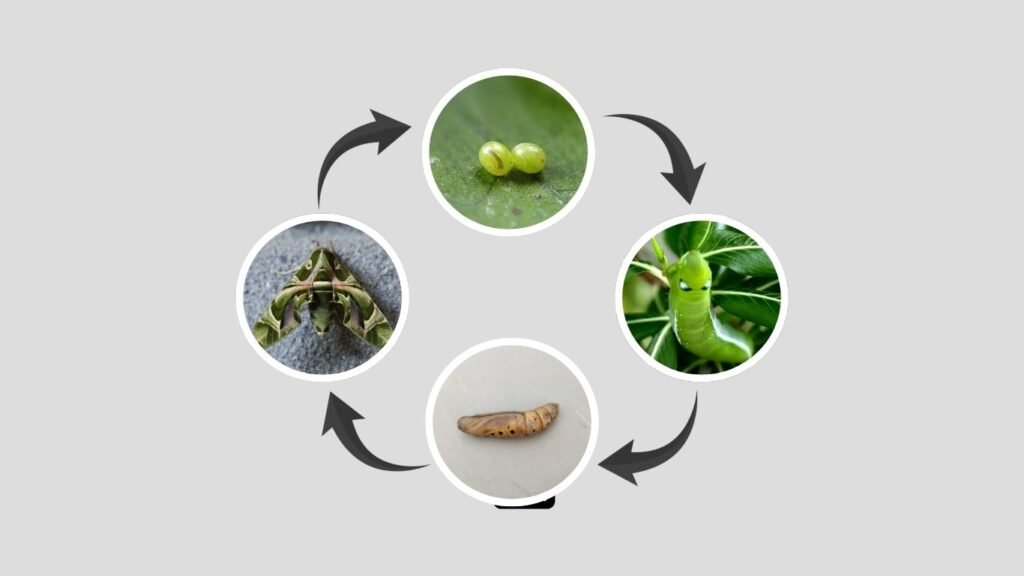
The oleander hawk moth undergoes complete metamorphosis, progressing through egg, caterpillar, pupa, and adult stages. Development speed varies with temperature and climate. In warmer regions, development may occur relatively quickly, whereas cooler conditions can slow each stage.
Egg to Caterpillar
Females place pale green eggs individually on suitable host leaves. Reported egg development can take roughly 5–12 days depending on temperature. Newly hatched caterpillars are only a few millimeters long and look very different from mature larvae.
The larvae feed heavily and pass through several growth stages, becoming progressively larger and developing their famous eyespots.
Pupa and Adult
When fully grown, the caterpillar stops eating and searches for a sheltered location near the ground. Pupation usually occurs among dry leaves, debris, or other cover rather than in a conspicuous silk cocoon hanging from a plant.
The pupal stage may last roughly two to three weeks under favorable conditions, though temperature can alter development time. Eventually, the adult emerges, expands its wings, and begins the reproductive stage of the cycle.
Where Does the Oleander Hawk Moth Live?
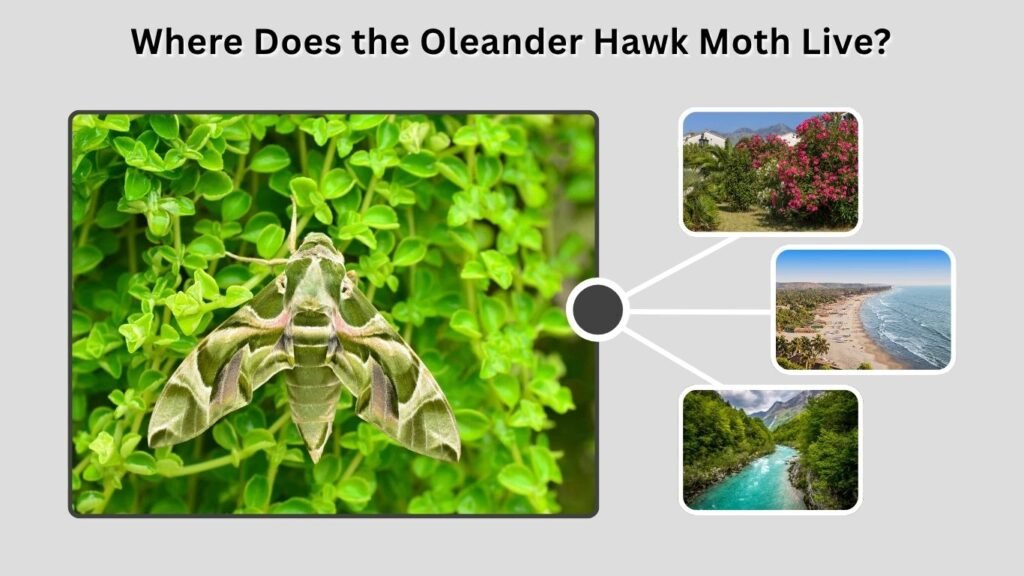
The species has a broad warm-climate distribution. Its core range includes large portions of Africa and Asia, with populations extending into southern Europe. It is also established in Hawaii. Strong migratory ability allows occasional individuals to travel considerably beyond their normal breeding range.
Distribution and Habitat
- Africa
- South and East Asia
- India and surrounding regions
- Parts of the Middle East
- Southern Europe
- Hawaii
- Occasional migrants farther into Europe
- Gardens containing oleander or periwinkle
- Coastal areas and river valleys
- Warm shrublands and vegetated habitats
In Britain, for example, the oleander hawk moth is considered a very rare migrant rather than a common resident. UK records occur primarily in late summer and autumn.
Is the Oleander Hawk Moth Poisonous?
Because its caterpillar eats poisonous oleander, many people assume the insect itself is highly poisonous. Research has detected oleander-derived cardenolides in larvae and their waste, but this does not mean the caterpillar is a dangerous stinging species.
Is It Dangerous to Humans?
The caterpillar’s rear “horn” is not a stinger, and the adult moth is not equipped to attack people. Normal observation is therefore not considered a significant hazard.
However, it is sensible not to eat or deliberately handle caterpillars unnecessarily, especially because they may have been feeding on toxic oleander. More importantly, avoid getting oleander sap into your mouth or eyes and wash your hands after handling the plant.
The adult moth is primarily a nectar feeder and poses no meaningful biting threat to people.
FAQs
1. Is the oleander hawk moth caterpillar poisonous?
It feeds on poisonous oleander and can contain plant-derived cardenolides, but it is not considered a stinging caterpillar. Avoid ingesting it and minimize unnecessary handling, especially after it has fed on oleander.
2. Does an oleander hawk moth bite?
Adult oleander hawk moths do not normally bite people. They use their feeding apparatus to drink nectar from flowers rather than to attack humans.
3. How big is an oleander hawk moth?
Adults commonly have a wingspan of about 90–110 mm, making them substantially larger than many ordinary garden moths.
4. Is the oleander hawk moth rare?
It depends on location. It occurs widely across Africa and Asia and is established in Hawaii, but it is an uncommon migrant in areas such as Britain and parts of northern Europe.
5. What is the scientific name of the oleander hawk moth?
Its scientific name is Daphnis nerii (Linnaeus, 1758). It belongs to the family Sphingidae, the hawk moth or sphinx moth family.
