
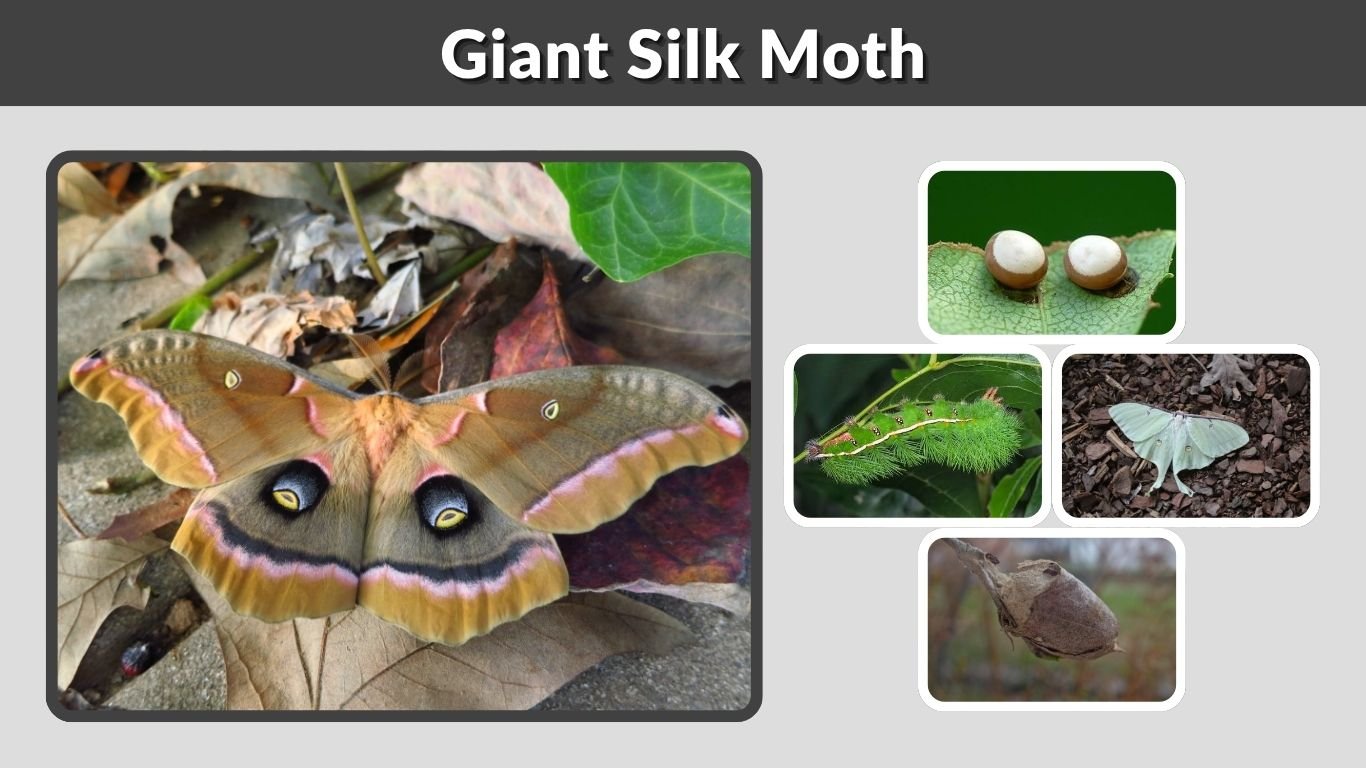
The giant silk moth is not a single species but a name used for large moths in the family Saturniidae. This spectacular group includes Cecropia, Polyphemus, Luna, Promethea, and Io moths. Many have enormous patterned wings, feathery antennae, and colorful caterpillars that feed on trees and shrubs. Their larvae often produce silk cocoons before becoming adults. One of their most unusual traits is that many adult giant silk moths have reduced mouthparts and do not eat, surviving entirely on energy stored during the caterpillar stage.
What Is a Giant Silk Moth?
Giant silk moths belong to Saturniidae, a widespread family containing some of the largest and most impressive moths in the world. North American members are sometimes called giant silkworm moths. Their thick bodies, broad wings, eyespots, and feather-like antennae make many species easy to recognize. Caterpillars can also become unusually large before pupation.
Giant Silk Moth Identification
Typical characteristics include:
- Family: Saturniidae
- Medium to extremely large wingspan
- Thick, hairy body
- Broad and often colorful wings
- Large eyespots in many species
- Strongly feathered antennae, especially in males
- Large green or colorful caterpillars
- Silk cocoons in many species
- Reduced or absent functional adult mouthparts
Wing patterns vary greatly. Luna moths are pale green with long hindwing tails, while Cecropia moths have reddish-brown wings decorated with white, red, and black markings.
How Big Do Giant Silk Moths Get?
Many North American giant silk moths have wingspans between roughly 10 and 15 cm, although size varies considerably among species.
The Cecropia moth (Hyalophora cecropia) is North America’s largest native moth. Individuals exceeding about 6 inches across have been documented, while commonly encountered specimens have wingspans of approximately 5–6 inches.
Their large wings make them appear even more impressive because the actual body is considerably smaller than the overall wingspan.
Giant Silk Moth Caterpillar
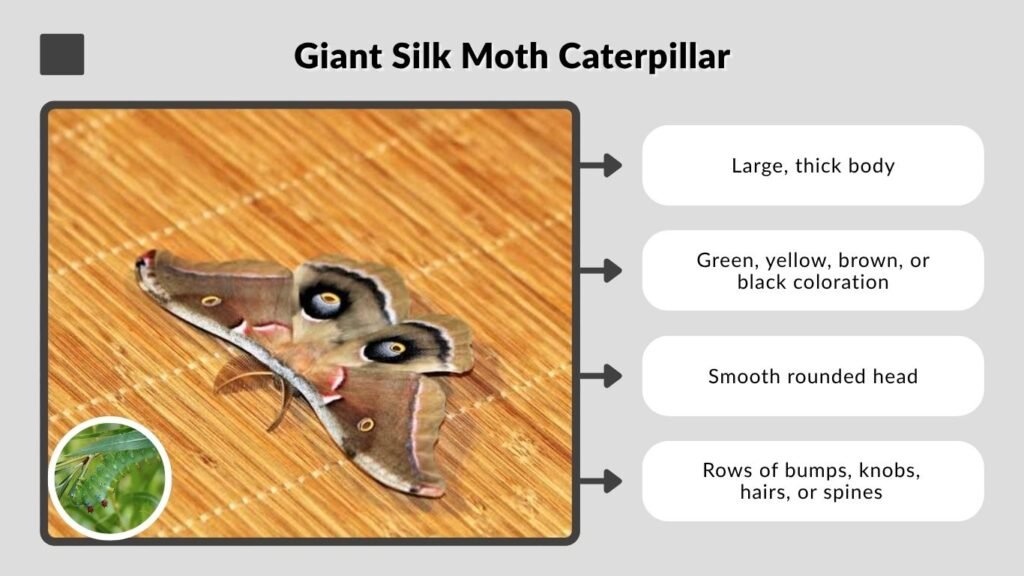
The caterpillar stage is when giant silk moths feed, grow, and accumulate the energy needed for adulthood. Mature Saturniid caterpillars can reach 4–10 cm or more, depending on species. Many are green and decorated with knobs, hairs, or spines. Younger caterpillars may feed together before becoming more solitary as they grow.
What Does the Caterpillar Look Like?
Common features include:
- Large, thick body
- Green, yellow, brown, or black coloration
- Smooth rounded head
- Rows of bumps, knobs, hairs, or spines
- Six true legs near the head
- Fleshy abdominal prolegs
- Strong chewing mouthparts
- Several molts before reaching full size
A mature Cecropia caterpillar can reach about four inches long. It is light green with large orange-red knobs behind the head and smaller yellow and blue tubercles farther along the abdomen.
The Polyphemus caterpillar is also green but generally has a simpler appearance with sparse hairs and pale markings.
What Do Giant Silk Moth Caterpillars Eat?
Caterpillars are herbivores and primarily consume leaves from trees and shrubs.
The exact host plants depend on species. Cecropia caterpillars can feed on maple, cherry, willow, birch, apple, elm, poplar, and many other hardwoods.
Polyphemus caterpillars commonly feed on oak, maple, birch, willow, ash, and other woody plants.
Luna moth caterpillars use trees such as walnut, hickory, sweetgum, and birch.
Adults, in contrast, normally do not feed.
Giant Silk Moth Cocoon and Life Cycle
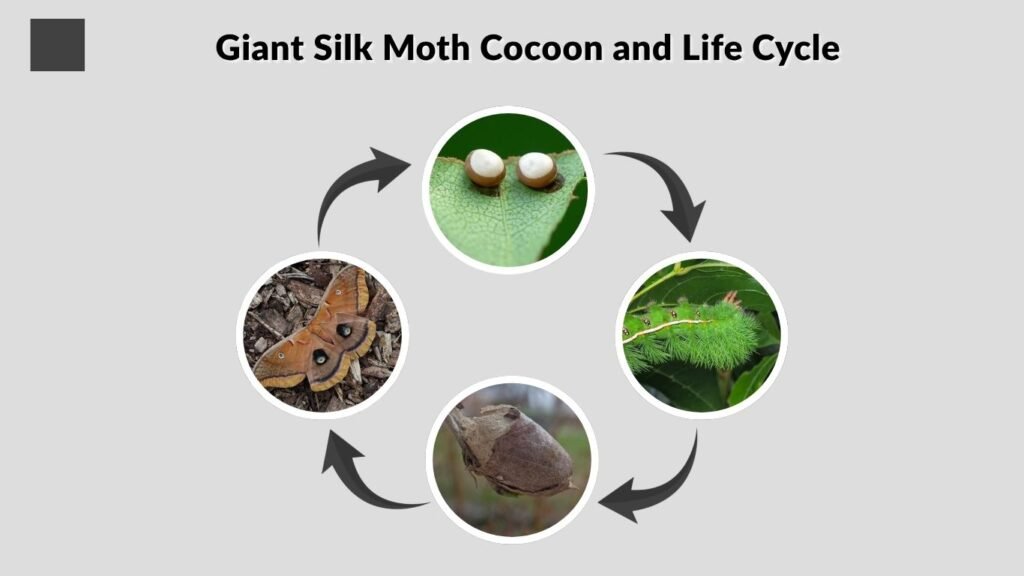
Like other moths, giant silk moths undergo complete metamorphosis through egg, caterpillar, pupa, and adult stages. Many members of the family produce substantial silk cocoons, although not every Saturniid pupates the same way. Some attach cocoons to vegetation, others conceal them among fallen leaves, and certain related species pupate underground.
Giant Silk Moth Life Cycle
The four primary stages are:
- Egg: Females deposit eggs on or near suitable caterpillar host plants.
- Caterpillar: Larvae hatch, feed heavily, and molt several times.
- Pupa: Mature caterpillars pupate, often inside a silk cocoon.
- Adult: The moth emerges, expands its wings, mates, and females lay another generation of eggs.
In colder parts of North America, many species spend winter as pupae before emerging as adults the following spring or summer.
What Does a Giant Silk Moth Cocoon Look Like?
Cocoon shape depends on species.
A Cecropia caterpillar builds a tough, elongated cocoon attached along a twig or branch. Inside, the caterpillar becomes a pupa and may remain dormant through winter.
A Polyphemus caterpillar usually creates an oval silk cocoon incorporated into a leaf. The leaf and cocoon may eventually fall to the ground, where the pupa overwinters.
Luna moth cocoons are also commonly associated with leaves and leaf litter.
When the adult is ready to emerge, it escapes from the cocoon, expands its initially small wings, and waits while they harden before flying.
Are Giant Silk Moth Caterpillars Poisonous?
Most giant silk moth caterpillars people encounter are not dangerous, but the entire family should not be described as harmless. Saturniidae includes species whose caterpillars possess defensive stinging spines. Appearance alone can therefore be misleading, and unfamiliar spiny caterpillars are best observed without touching them.
Cecropia and Polyphemus Caterpillars
Cecropia and Polyphemus caterpillars may look intimidating because of their knobs or hairs, but they are not among the well-known venomous Saturniid caterpillars.
Their large size and colorful ornamentation can make them appear more threatening than they actually are.
Unnecessary handling is still best avoided because caterpillars are delicate and some people can experience skin irritation from contact with insect hairs.
Io Moth Caterpillar
The Io moth (Automeris io) is different.
Its green caterpillar carries branching spines capable of delivering irritating venom when touched. Contact can cause immediate burning, itching, redness, swelling, or dermatitis.
Kentucky Extension lists the Io and Buck moth among Saturniid caterpillars with medically important stinging spines in that region.
Adult giant silk moths do not have these stinging caterpillar spines and are harmless to people.
Common Giant Silk Moth Species
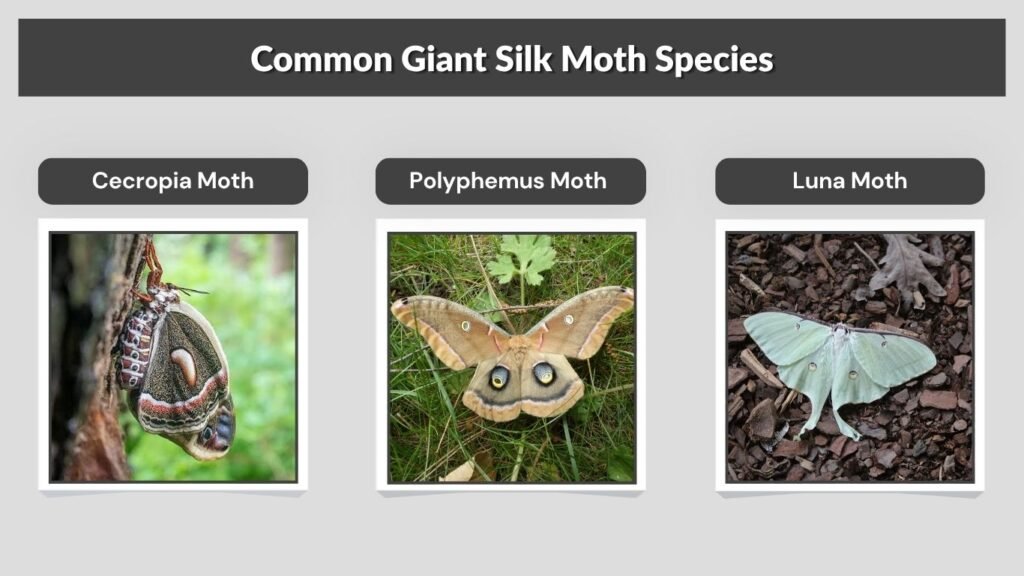
North America supports dozens of Saturniid species, ranging from enormous Cecropia moths to brightly colored Io and Rosy Maple moths. Their caterpillars often rely on native trees, making forests, woodland edges, gardens, and suburban landscapes important habitat. Around 75 Saturniid species occur in North America north of Mexico.
Well-Known Giant Silk Moths
Some notable examples are:
- Cecropia Moth (Hyalophora cecropia): North America’s largest native moth, with striking reddish-brown wings.
- Polyphemus Moth (Antheraea polyphemus): Large brown moth with dramatic transparent-centered hindwing eyespots.
- Luna Moth (Actias luna): Pale green moth with long tails extending from its hindwings.
- Promethea Moth (Callosamia promethea): Strongly sexually dimorphic species; males are much darker than females.
- Io Moth (Automeris io): Yellowish males and reddish-brown females with prominent hindwing eyespots.
- Imperial Moth (Eacles imperialis): Large yellow moth patterned with purple-brown markings.
These species are wild moths and should not be confused with the domesticated silk moth, Bombyx mori.
Giant Silk Moths in North America
Cecropia, Luna, Polyphemus, and related species occur across substantial portions of the United States and Canada.
Which species you encounter depends on climate and habitat. Cecropia moths occur widely across eastern North America and reach west toward the Rocky Mountains.
Regional searches from Michigan, Wisconsin, Minnesota, Ontario, Pennsylvania, Virginia, and other northern or eastern locations therefore often refer to Cecropia, Luna, or Polyphemus moths.
Giant Silk Moth Lifespan, Mouth and Pet Care
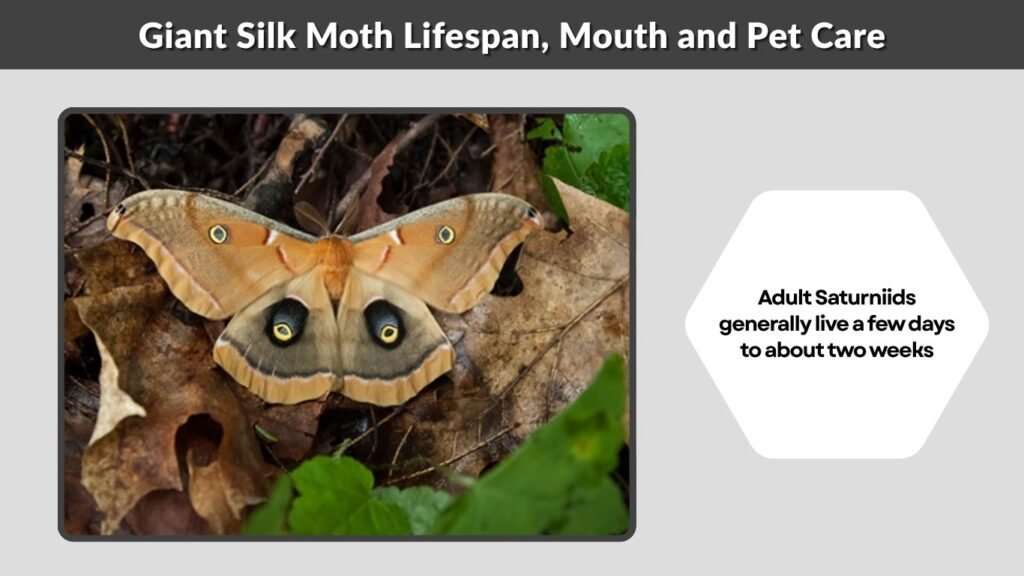
The adult stage of a giant silk moth is surprisingly brief. Most growth and feeding occur while the animal is a caterpillar. Once adulthood begins, the moth focuses almost entirely on reproduction. Reduced mouthparts prevent many Saturniid adults from eating or drinking, so they must survive on stored energy accumulated earlier in life.
How Long Do Giant Silk Moths Live?
Adult Saturniids generally live a few days to about two weeks, depending on species and environmental conditions. Missouri’s conservation department notes that adults usually survive about two weeks or less because they cannot replenish their energy by feeding.
The complete life cycle is much longer because the egg, caterpillar, and especially overwintering pupal stages may occupy many months.
Do Giant Silk Moths Have Mouths?
Adult giant silk moths have greatly reduced or nonfunctional mouthparts and do not normally eat.
Their caterpillars, however, possess strong chewing mouthparts and eat large quantities of foliage.
This unusual arrangement means nearly all the energy needed for adult flight, mating, and egg production was originally collected by the caterpillar.
Can Giant Silk Moths Be Kept as Pets?
Some people raise giant silk moths for education, photography, or observation. Their caterpillars require the correct fresh host plant, adequate ventilation, cleanliness, and sufficient space to molt and form cocoons.
Local wildlife regulations should be checked before collecting, buying, transporting, or raising native moths. Non-native species should never be released outdoors.
Because adults live so briefly, raising them is better viewed as observing an entire life cycle than keeping a conventional long-term pet.
FAQs
Giant silk moths attract attention because of their enormous wings, colorful caterpillars, and unusual non-feeding adult stage. Most questions involve whether their caterpillars are dangerous, how large the adults become, what the larvae eat, and what happens inside their silk cocoons. The answers vary somewhat among species because Saturniidae includes many different moths.
1. What is the scientific name of the giant silk moth?
There is no single scientific name. Giant silk moths belong to the family Saturniidae. Cecropia, Luna, Polyphemus, and Io moths are all members of this family.
2. Are giant silk moth caterpillars poisonous?
Many are harmless, but some species have venomous stinging spines. The Io moth caterpillar is an important example and should not be handled.
3. What do giant silk moth caterpillars eat?
They feed primarily on leaves of trees and shrubs. Host plants vary by species and may include oak, maple, willow, birch, hickory, cherry, walnut, and many others.
4. How long does an adult giant silk moth live?
Most adults live only several days to around two weeks because their mouthparts are nonfunctional and they cannot feed.
5. What is the largest giant silk moth in North America?
The Cecropia moth (Hyalophora cecropia) is North America’s largest native moth. Wingspans greater than six inches have been documented.
