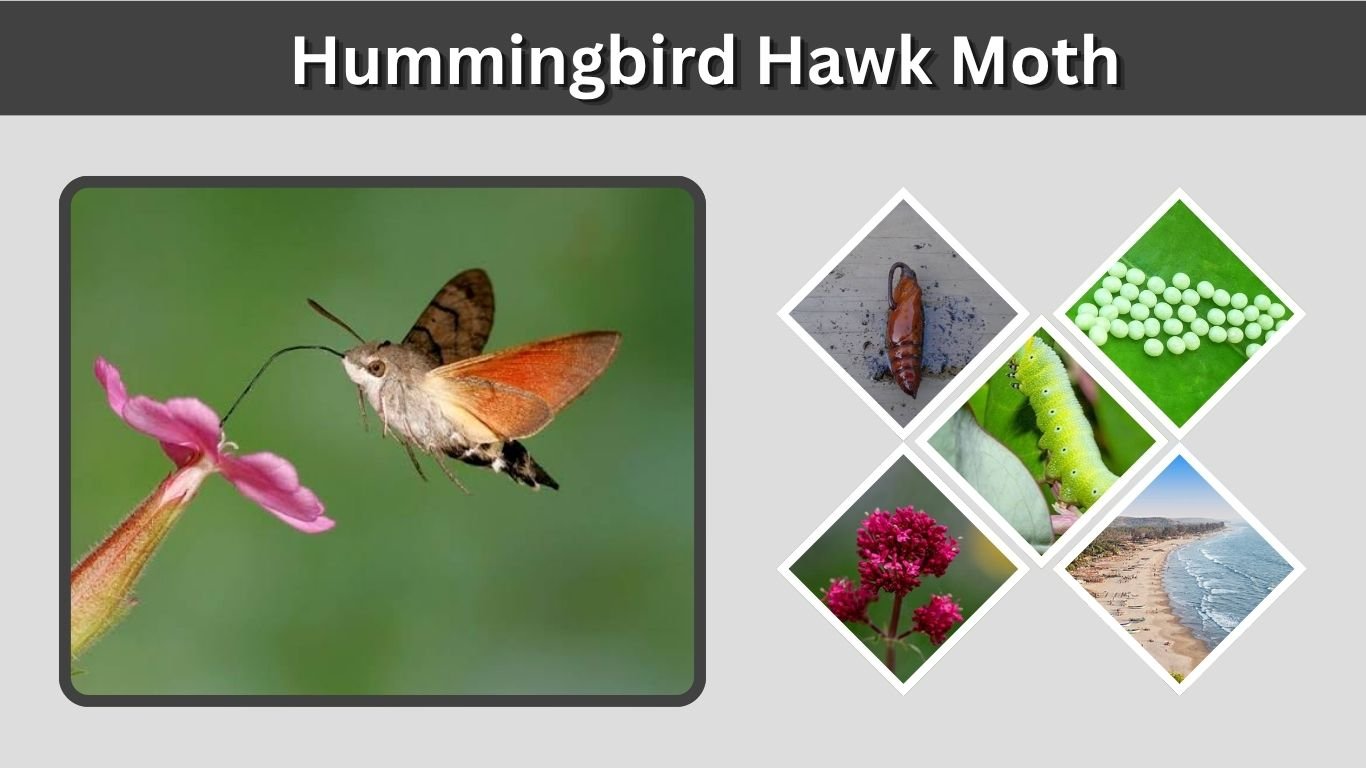
The hummingbird hawk moth is a remarkable day-flying moth famous for hovering in front of flowers much like a tiny hummingbird. Scientifically known as Macroglossum stellatarum, it has rapidly beating wings, bright orange hindwings, and an exceptionally long proboscis used to drink nectar without landing. The species is widespread across Europe, parts of Africa, and Asia and is a familiar summer visitor in the UK. This guide covers its size, identification, caterpillar, host plants, habitat, diet, life cycle, migration, and safety.
What Is a Hummingbird Hawk Moth?
The hummingbird hawk moth belongs to the hawk moth family Sphingidae. Unlike many moths that are most active after dark, this species commonly flies during sunny daylight. Its ability to hover almost motionless while feeding, combined with its fast wingbeats and stout body, causes many first-time observers to mistake it for a hummingbird.
Hummingbird Hawk Moth Identification
Several features make an adult hummingbird hawk moth distinctive:
- Grayish-brown forewings
- Bright orange hindwings
- Black-and-white markings along the abdomen
- Fan-shaped dark hairs at the end of the abdomen
- Large eyes suited to locating flowers
- Very long, flexible proboscis
- Rapid hovering flight
- Mostly daytime feeding behavior
The orange hindwings may be difficult to see when the moth is resting but become conspicuous during flight.
Why Does It Look Like a Hummingbird?
The resemblance comes mainly from behavior rather than close physical similarity. A hummingbird hawk moth hovers in front of a flower and extends its proboscis into the bloom while remaining airborne.
Its body stays relatively steady while the wings move so quickly that they may appear blurred. This feeding style allows the moth to visit numerous flowers rapidly and also makes it an effective pollinator.
Hummingbird Hawk Moth Size
Despite appearing surprisingly large while hovering, the hummingbird hawk moth is much smaller than an actual hummingbird. Its broad wings, thick body, and rapid movement make it appear larger than it really is, particularly when viewed briefly in a flower garden.
How Big Is a Hummingbird Hawk Moth?
Adult hummingbird hawk moths have a wingspan of approximately 40–50 mm, or about 1.6–2 inches.
Important size features include:
- Wingspan around 40–50 mm
- Compact, thick-bodied appearance
- Long proboscis that can reach deep flowers
- Caterpillars reaching around 50 mm when mature
- Females and males broadly similar in general appearance
The moth may appear larger during flight because its rapidly moving wings create a wider visual profile.
Hummingbird Hawk Moth Caterpillar
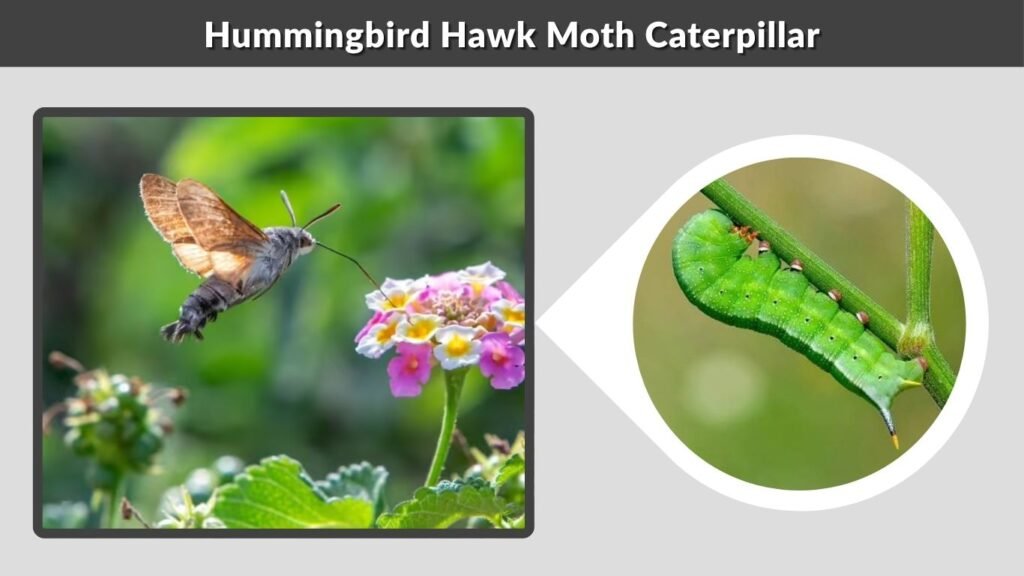
The caterpillar looks completely different from the adult. It is generally green and relatively slender, with pale longitudinal markings and a horn-like projection at the rear. Some individuals can become grayish or brownish as they approach pupation.
Caterpillar Identification
A mature hummingbird hawk moth caterpillar typically has:
- Green or occasionally brownish coloration
- Pale cream or yellowish lines along the body
- Small pale spots
- A pointed horn at the rear
- Smooth rather than densely hairy skin
- A length that may reach roughly 50 mm
The rear horn can look threatening but is not a stinger and is harmless to people. Caterpillars may darken and stop feeding shortly before entering the pupal stage.
Hummingbird Hawk Moth Host Plants
Bedstraws are the principal larval food plants. Females search for appropriate plants on which to lay their eggs.
Common host plants include:
- Hedge bedstraw
- Lady’s bedstraw
- Other Galium species
- Wild madder
- Related plants in the Rubiaceae family
UKMoths specifically identifies bedstraw (Galium) as the major larval food source.
What Do Hummingbird Hawk Moths Eat?
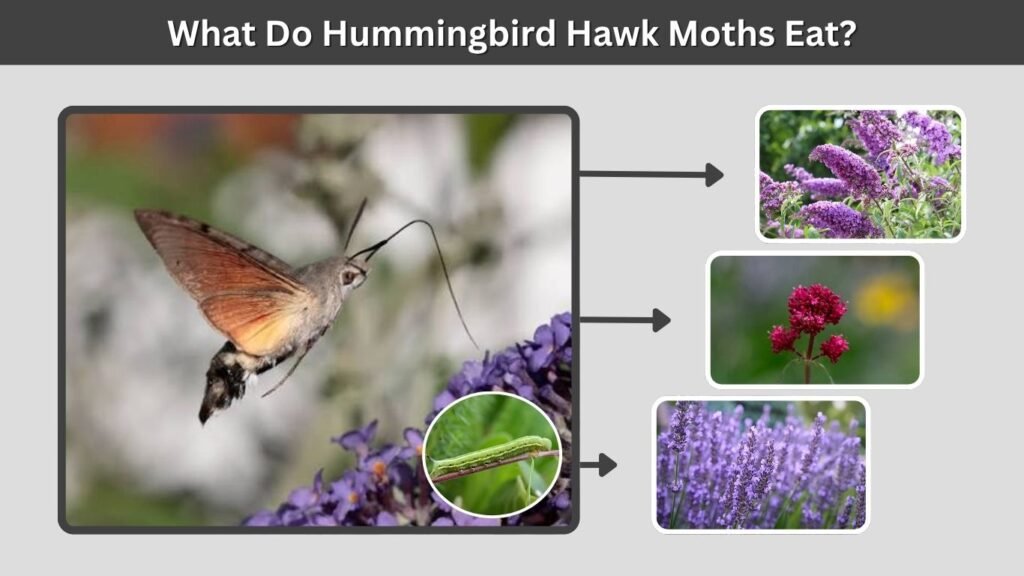
Adult moths and caterpillars have entirely different diets. Caterpillars chew leaves, while adults live primarily on flower nectar. Their long proboscis gives adults access to nectar inside deep tubular blossoms that many shorter-tongued insects cannot reach.
Adult Diet and Favorite Flowers
Adult hummingbird hawk moths visit many nectar-rich flowers, including:
- Buddleia
- Red valerian
- Lavender
- Salvia
- Viper’s bugloss
- Aubrieta
- Other tubular garden flowers
The moth hovers rather than landing and inserts its long proboscis into each flower. It often moves quickly from one bloom to another and can return repeatedly to productive flower patches.
How to Attract Hummingbird Hawk Moths
A garden with flowers producing plentiful nectar from spring through autumn offers the best opportunity to attract visiting adults.
Planting red valerian, buddleia, lavender, salvia, and other nectar-rich flowers can provide feeding opportunities. Allowing bedstraw to grow nearby may also provide potential food plants for caterpillars where the species breeds.
Avoid unnecessary insecticide use around flowering plants because it can harm moths and other pollinating insects.
Where Do Hummingbird Hawk Moths Live?
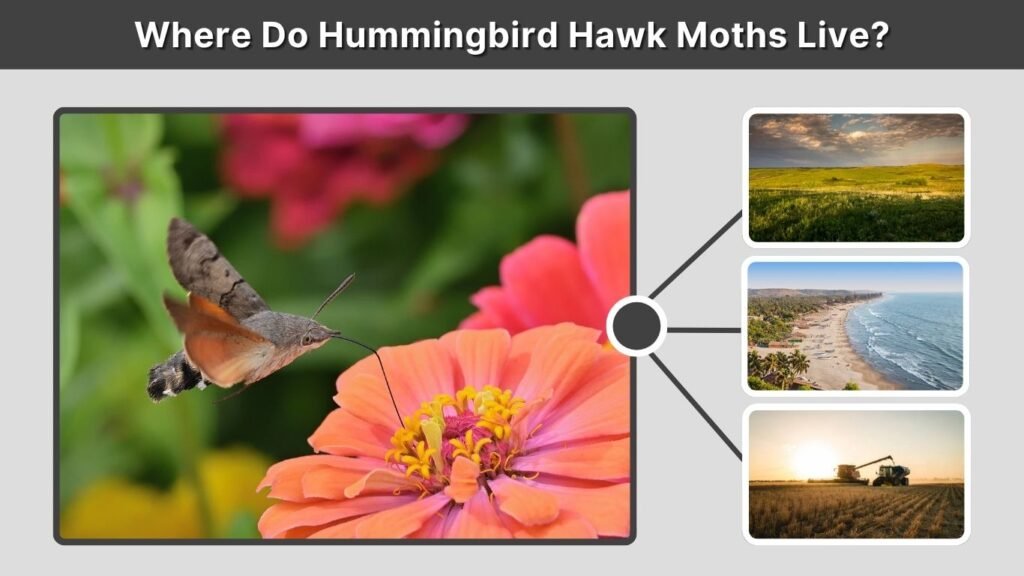
Macroglossum stellatarum is primarily an Old World species. Its broad distribution includes Europe, parts of Africa, and Asia. It thrives in open habitats containing abundant flowers and can appear in gardens, grasslands, coastal areas, farmland, woodland clearings, and urban spaces.
Hummingbird Hawk Moth in the UK
The moth is particularly famous as a migrant to Britain. Large numbers can arrive during warm weather accompanied by favorable southerly winds.
UKMoths records the species primarily between June and October, with July among the months producing the greatest number of observations.
Historically it was viewed mainly as an immigrant, although increasingly mild conditions have allowed more breeding and a stronger year-round presence in Britain. The Natural History Museum now describes it as breeding in the UK and having a permanent presence.
Hummingbird Hawk Moths in Texas, Ohio and Colorado
This is an important identification point. The true hummingbird hawk moth, Macroglossum stellatarum, is not a common established North American species. Its normal range is Europe, Africa, and Asia, and BugGuide treats it as a rare North American vagrant.
People in Texas, Ohio, Colorado, Michigan, Pennsylvania, and other U.S. states often use “hummingbird moth” for native sphinx moths, particularly Hemaris species. Therefore, a hummingbird-like moth in an American garden should not automatically be identified as M. stellatarum.
Hummingbird Hawk Moth Life Cycle
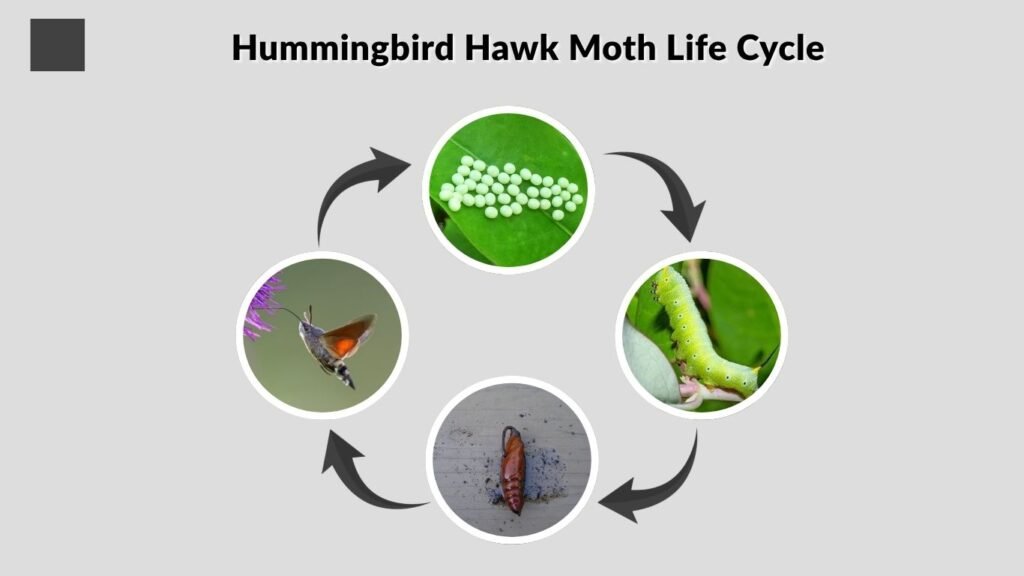
Like other moths, the species undergoes complete metamorphosis through egg, larva, pupa, and adult stages. Development can proceed relatively quickly during warm weather, allowing later generations to appear after the arrival of spring migrants.
Egg and Caterpillar Stages
Females generally deposit eggs individually on suitable bedstraw plants. Under warm conditions, eggs may hatch within roughly one to two weeks.
The young caterpillar begins feeding immediately and passes through several growth stages. It can become fully grown within about a month under favorable conditions.
Pupa and Adult
When mature, the caterpillar stops eating, leaves its host plant, and prepares to pupate. Pupation commonly occurs close to or just beneath the soil surface.
The adult later emerges and begins searching for nectar and mates. Warm-weather development can be fast enough for offspring of early migrants to produce adults later during the same season.
Are Hummingbird Hawk Moths Dangerous?
Their large size, buzzing flight, and long proboscis sometimes make people worry about being bitten or stung. In reality, hummingbird hawk moths are harmless visitors to gardens and are much more interested in flowers than people.
Do Hummingbird Hawk Moths Sting or Bite?
No. Hummingbird hawk moths do not have a stinger.
Their long proboscis is a feeding tube designed to drink flower nectar, not a biting or piercing weapon. The caterpillar’s rear horn is also harmless.
The moth can therefore be watched around flowers without concern. Avoid unnecessarily capturing or handling it, since moth wings and bodies can be damaged easily.
Hummingbird Hawk Moth vs Hummingbird Moth
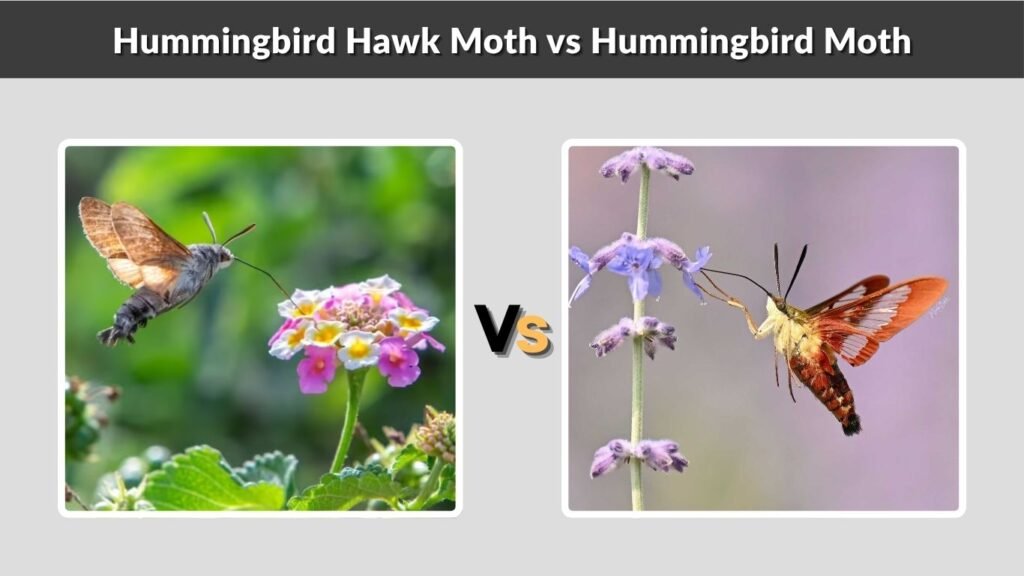
The terminology becomes confusing because “hummingbird moth” is used for several different moths. Hummingbird hawk moth usually refers specifically to Macroglossum stellatarum, while North Americans often call species in the genus Hemaris hummingbird moths.
Key Differences
- Hummingbird hawk moth: Usually Macroglossum stellatarum
- Main range: Europe, Africa, and Asia
- Wings: Gray-brown forewings with orange hindwings
- North American hummingbird moths: Often Hemaris species
- Clear wings: Common in several Hemaris species
- Behavior: Both groups may hover and drink nectar with long proboscises
So a clear-winged hummingbird-like moth in the United States is more likely to be a native Hemaris moth than the Eurasian hummingbird hawk moth.
FAQs
The unusual flight of this moth creates confusion about its identity, rarity, size, and even whether it is a bird or an insect. Its migratory behavior also means abundance changes significantly by location and year.
Are hummingbird hawk moths rare?
They are common across much of their normal Eurasian range but can fluctuate greatly because of migration and weather. They are regular in the UK during favorable years but extremely unusual as true Macroglossum stellatarum in North America.
Do hummingbird hawk moths sting?
No. They have no stinger and are harmless to humans. Their long proboscis is only used for drinking nectar.
What does a hummingbird hawk moth caterpillar eat?
The caterpillar mainly feeds on bedstraws, especially plants in the genus Galium. Wild madder and other related Rubiaceae plants may also be used.
How big is a hummingbird hawk moth?
Adults typically have a wingspan of approximately 40–50 mm. Their thick body and rapid hovering flight can make them appear considerably larger.
Why is it called a hummingbird hawk moth?
It gets its name from its remarkable hummingbird-like feeding behavior. The moth hovers in front of flowers while extending a long proboscis to drink nectar, creating an appearance and flight style that closely resembles a tiny hummingbird.