
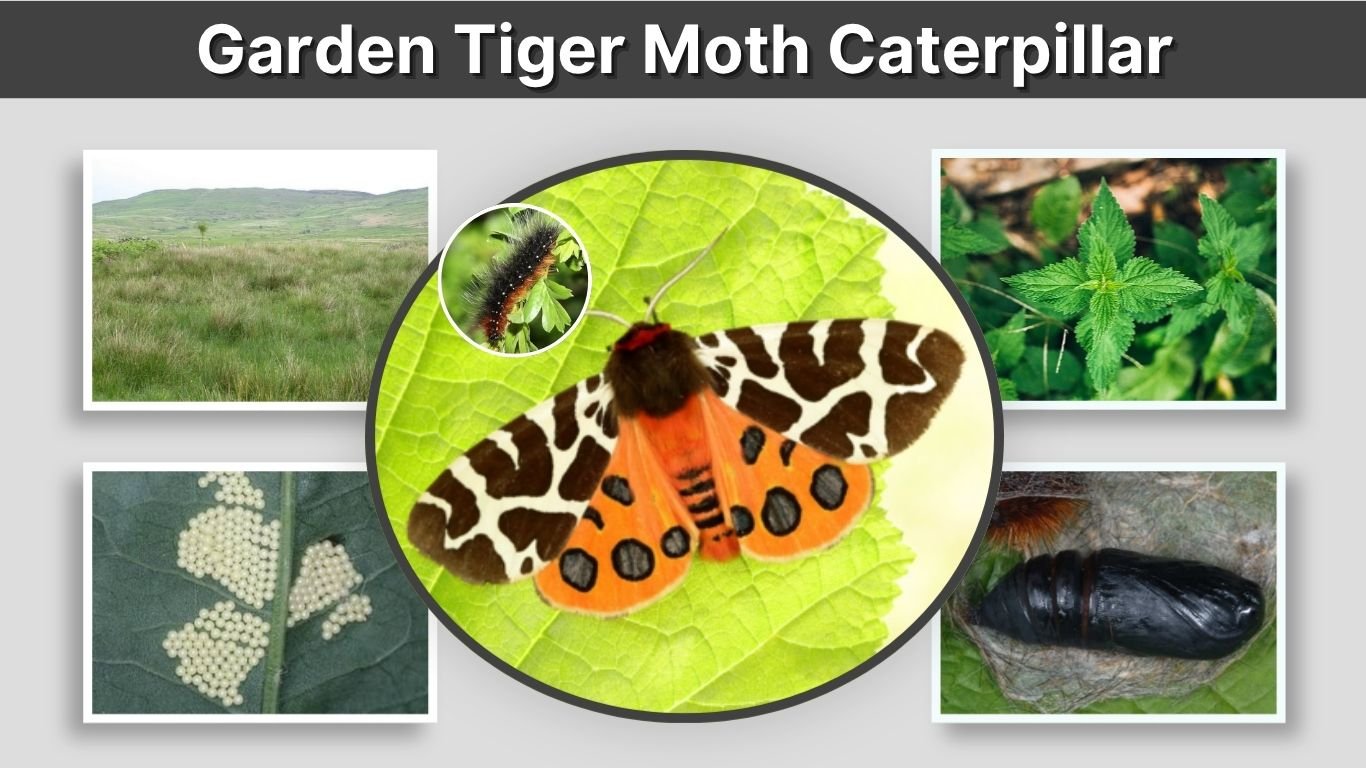
The garden tiger moth caterpillar is a distinctive hairy larva known as a “woolly bear.” Scientifically called Arctia caja, it has long black, brown, orange, and whitish hairs that make it easy to recognize. These caterpillars feed on many common plants, including nettles, docks, dandelions, and other herbaceous vegetation. Although their fuzzy appearance may seem dangerous, they do not have a venomous sting. However, their hairs can irritate sensitive skin. This guide covers identification, diet, habitat, safety, care, and the complete life cycle.
What Is a Garden Tiger Moth Caterpillar?
The garden tiger moth caterpillar is the larval stage of Arctia caja, a tiger moth in the family Erebidae. Its caterpillar is commonly called a woolly bear because its body is densely covered with long hairs. The species occurs across Eurasia and parts of northern North America and is particularly well known in Britain.
Garden Tiger Moth Caterpillar Identification
A mature garden tiger caterpillar has a striking appearance that makes it easier to distinguish from many smooth-bodied larvae.
- Body densely covered in long hairs
- Upper surface usually dark brown or black
- Lower and side hairs often rusty orange or brown
- Long whitish hairs mixed with darker hairs
- Small pale spots may appear along the sides
- Caterpillar becomes relatively large before pupation
- Moves surprisingly quickly when searching for food or a pupation site
Young caterpillars can look somewhat different from mature individuals because their coloration and hair length change as they grow and molt.
Why Is It Called a Woolly Bear?
The name “woolly bear” refers to the caterpillar’s dense covering of hairs. Garden tiger larvae are among the classic woolly bear caterpillars remembered by many people in Britain. They may become especially noticeable when mature larvae cross paths, gardens, and other open ground while searching for somewhere to pupate.
What Does a Garden Tiger Moth Caterpillar Eat?
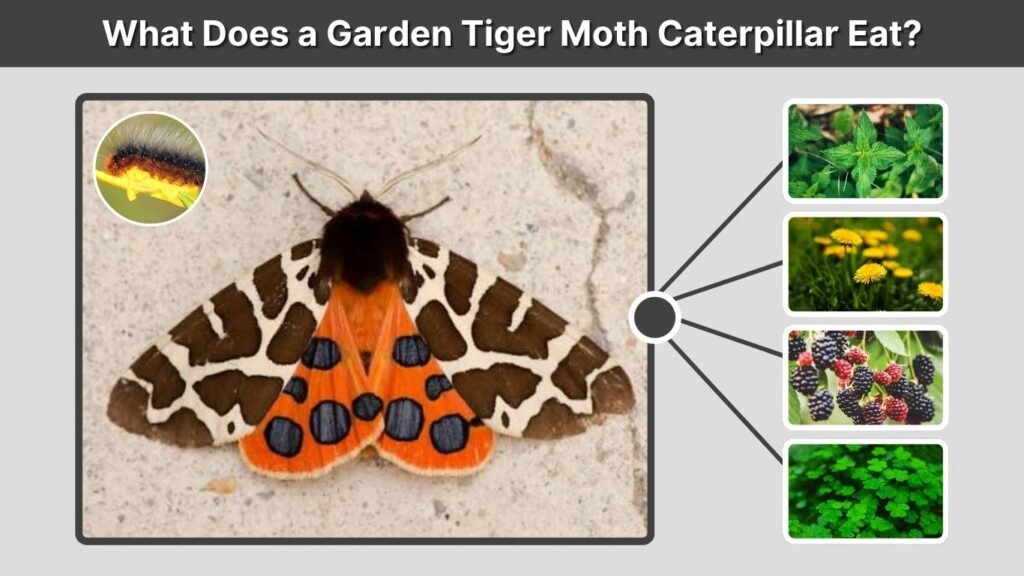
Garden tiger caterpillars are polyphagous, meaning they can eat many different plant species instead of relying on a single host. This broad diet allows them to survive in gardens, grasslands, woodland edges, hedgerows, and other habitats containing varied low-growing vegetation. Nettles and docks are among their best-known food plants.
Garden Tiger Caterpillar Food Plants
Common food plants include:
- Nettles
- Docks
- Dandelions
- Plantains
- Groundsel
- Bramble
- Clover
- Various herbaceous garden plants
- Other suitable broad-leaved plants
Because individual populations may encounter different plants, the exact diet varies by habitat.
How Do They Feed?
Caterpillars spend much of their larval stage eating because they need to accumulate enough energy for pupation and adulthood. They chew leaves with strong mouthparts and increase greatly in size as they develop.
As they grow, they shed their skin several times. Feeding continues between molts until the mature larva stops eating and begins searching for a suitable location in which to form its cocoon.
Are Garden Tiger Moth Caterpillars Dangerous?
Their thick hairs make garden tiger caterpillars look intimidating, leading to searches about whether they are poisonous or capable of stinging. They are not equipped with a true venomous stinger. However, hairy caterpillars should still be handled cautiously because their hairs can cause mechanical irritation, particularly in people with sensitive skin.
Do Garden Tiger Caterpillars Sting?
Garden tiger caterpillars do not sting like bees, wasps, or venomous caterpillars with specialized urticating spines.
Their defensive hairs mainly make them difficult or unpleasant for predators to attack. The dense covering can also make it harder for parasitoid insects to reach the caterpillar’s body.
Are Garden Tiger Caterpillars Poisonous?
The caterpillar should not generally be described as dangerously poisonous to people. The more practical concern is skin irritation from its hairs.
For safe handling:
- Avoid picking it up with bare hands.
- Do not rub your eyes after touching a hairy caterpillar.
- Keep young children from handling it.
- Wash exposed skin if irritation occurs.
- Move it with a leaf or container if relocation is necessary.
The adult garden tiger moth also uses chemical defenses against predators, and tiger moths can acquire defensive compounds from some larval food plants.
Garden Tiger Moth Caterpillar Habitat
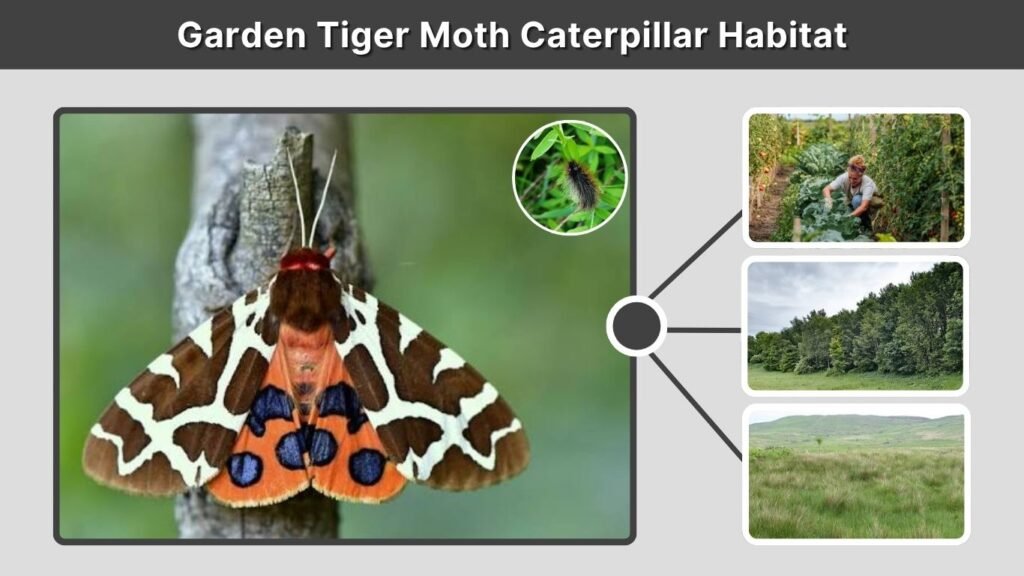
Garden tiger caterpillars occur in places where suitable food plants grow. They are associated with open spaces, gardens, woodland margins, rough grassland, hedgerows, and similar vegetation-rich areas. Unlike highly specialized caterpillars, their broad diet allows them to survive in many different habitats.
Garden Tiger Caterpillars in the UK
The garden tiger was historically widespread and familiar across Britain, although its numbers have declined substantially over recent decades. UKMoths still records the species widely, with adults most frequently observed during summer.
In Britain, the caterpillars typically overwinter as larvae. They resume development as conditions improve and eventually pupate before adults appear during the warmer months.
Are Garden Tiger Caterpillars Found in Texas?
Arctia caja occurs in northern parts of North America, but its established North American range is primarily farther north and west rather than Texas. Records cited by BugGuide extend from parts of Canada and the northern United States southward in the West to areas such as Colorado, Utah, Nevada, and northern California.
A very hairy black-and-orange caterpillar found in Texas may therefore be another woolly bear or tiger moth species rather than Arctia caja. Identification should consider location as well as appearance.
Garden Tiger Moth Caterpillar Life Cycle
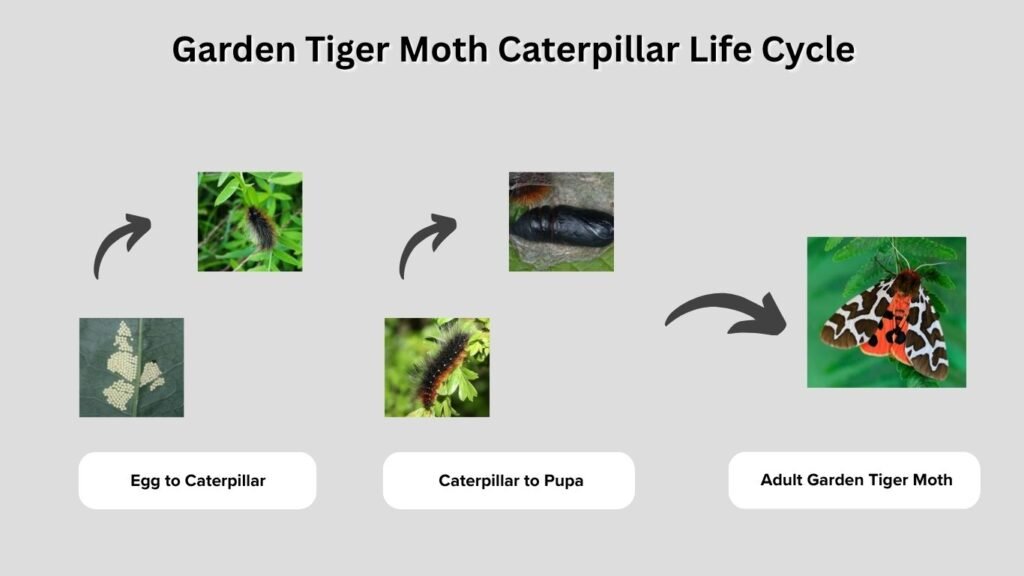
Like other moths, the garden tiger passes through four basic stages: egg, caterpillar, pupa, and adult. In Britain, the species usually completes one generation each year. The caterpillar stage lasts for a substantial portion of this cycle because larvae overwinter before completing development the following season.
Egg to Caterpillar
Female garden tiger moths lay eggs after mating. The eggs hatch into small larvae that begin feeding on suitable vegetation.
The caterpillars grow through several molts. Rather than immediately pupating before winter, young larvae typically overwinter and continue developing later.
Caterpillar to Pupa
Once fully grown, the woolly bear stops feeding and searches for a sheltered location near low vegetation or leaf litter.
The caterpillar makes a cocoon using:
- Silk produced by the larva
- Some of its own body hairs
- Nearby plant material in some situations
Pupation occurs inside this protective structure. Wildlife Insight reports that an adult can emerge after roughly two to four weeks, depending on conditions such as temperature.
Adult Garden Tiger Moth
The adult looks dramatically different from its caterpillar.
Its forewings have bold cream-white and chocolate-brown markings, while the hindwings are typically orange or reddish with dark blue-black spots. Adult wingspan is approximately 45–65 mm according to UKMoths. In Britain, adults are particularly associated with July and August.
How to Care for a Garden Tiger Moth Caterpillar
People sometimes find a woolly bear in the garden and want to raise it until the adult moth emerges. The safest approach is usually to leave a healthy wild caterpillar where it was found. If temporary care is necessary, the enclosure should imitate its natural environment and provide the same food plant it was already eating.
Basic Caterpillar Care
- Provide fresh leaves from the plant where it was found.
- Keep the enclosure ventilated rather than airtight.
- Replace wilted leaves regularly.
- Remove droppings and moldy plant material.
- Avoid spraying plants with pesticides.
- Provide leaf litter or vegetation when it approaches pupation.
- Keep the container away from excessive heat and direct sunlight.
- Avoid frequent handling because the hairs may irritate skin.
Do not continuously switch between unfamiliar food plants simply because the species has a broad diet. Offering leaves from the caterpillar’s original host plant is generally the simplest approach.
Why Garden Tiger Caterpillars Matter
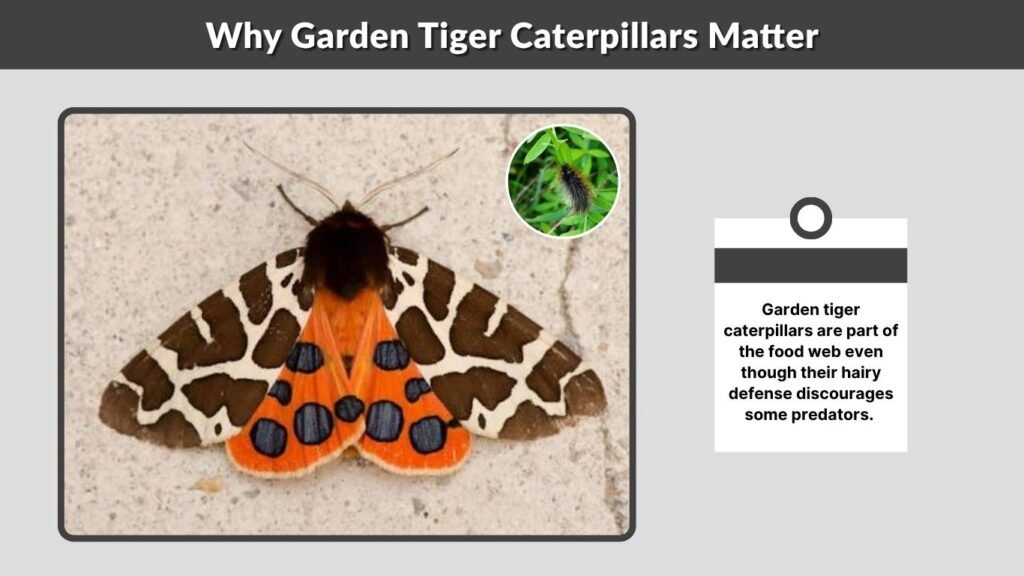
Garden tiger caterpillars are part of the food web even though their hairy defense discourages some predators. They interact with plants, birds, parasitoids, and other organisms throughout their development. Their adult moths are also visually distinctive members of temperate moth communities.
Garden Tiger Decline in Britain
The species deserves particular attention because it has experienced a major decline in Britain. Long-term monitoring reported a roughly 92% decline in abundance between 1968 and 2007, although the moth remains widely distributed. Climate conditions and changes to habitat quality are among factors investigated in relation to this decline.
Leaving patches of nettles, docks, and varied native vegetation can provide food and shelter for garden tiger larvae and many other moth species.
FAQs
Garden tiger caterpillars are memorable because their black-and-orange hairs look both attractive and potentially threatening. Most questions involve whether they sting, what plants they eat, and what the woolly caterpillar eventually becomes. Understanding its life cycle also makes it easier to recognize why mature caterpillars may suddenly appear crossing paths or lawns.
Is a garden tiger moth caterpillar poisonous?
It is not considered a dangerous poisonous caterpillar to people. However, its dense hairs can irritate sensitive skin, so handling it directly is best avoided.
Does a garden tiger moth caterpillar sting?
No. It does not possess a venomous stinger. Its hairs mainly function as physical protection, although they can cause irritation if handled.
What does a garden tiger moth caterpillar eat?
It eats many herbaceous plants, including nettles, docks, dandelions, groundsel, bramble, and plantains. The species is a generalist feeder rather than depending on one host plant.
What does a garden tiger caterpillar turn into?
It becomes the garden tiger moth, Arctia caja. The adult has striking brown-and-cream forewings and orange or reddish hindwings marked with dark spots.
When can you see garden tiger caterpillars in the UK?
The species spends winter as a caterpillar, and larger larvae may be noticed during the following spring and early summer before they pupate. Adults are most commonly seen in Britain during July and August.
