
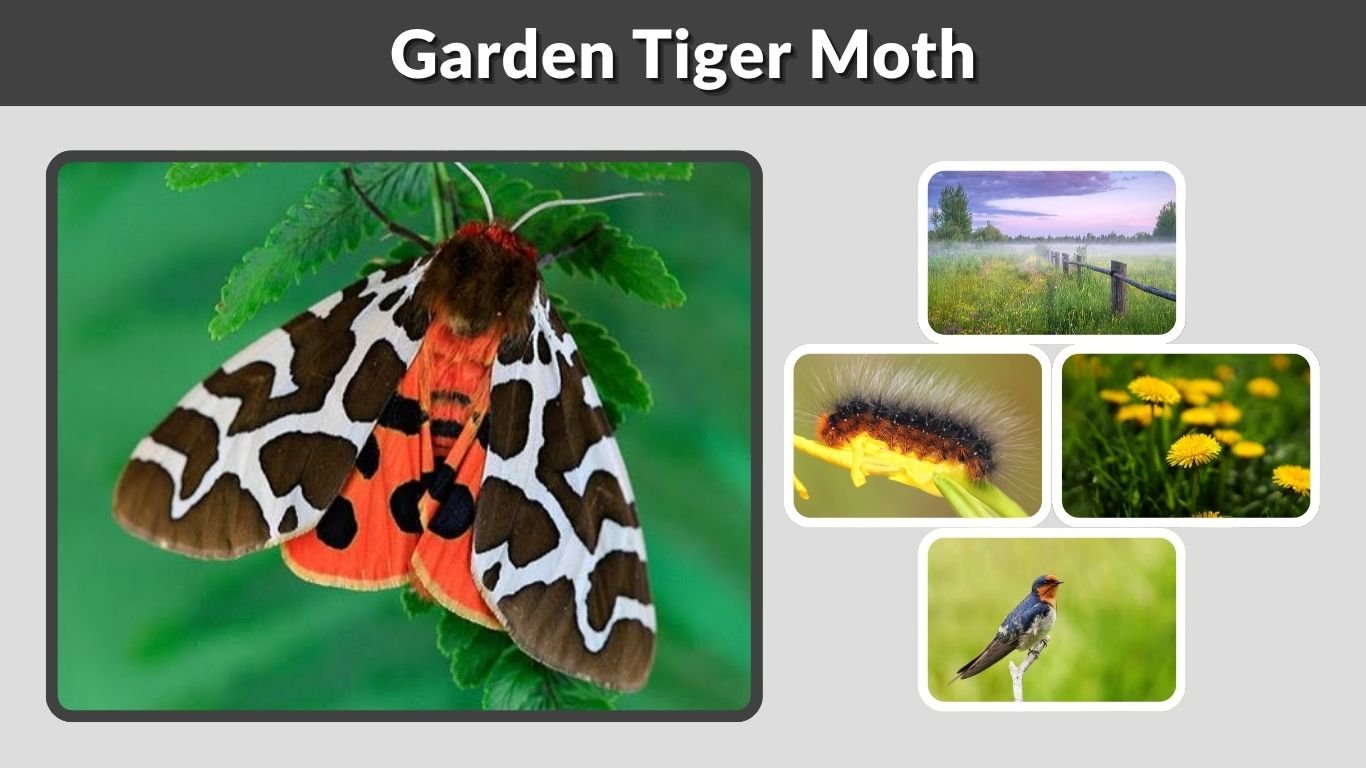
The garden tiger moth (Arctia caja) is a colorful tiger moth known for its bold brown-and-white forewings and bright orange-red hindwings marked with dark blue or black spots. Its caterpillar is equally distinctive and is commonly called a woolly bear because of its dense covering of long hairs. Garden tiger moths occur across much of Europe and parts of Asia and North America. Although once common in many areas, populations have declined in parts of Britain, making the species an important focus for conservation.
What Is a Garden Tiger Moth?
The garden tiger moth belongs to the family Erebidae and subfamily Arctiinae, a group commonly known as tiger moths.
Its scientific name is Arctia caja.
Adults are mostly active at night and are often found in gardens, grasslands, woodland edges, wetlands, and other habitats containing plenty of low-growing vegetation.
Garden Tiger Moth Quick Facts
- Scientific name: Arctia caja
- Family: Erebidae
- Subfamily: Arctiinae
- Caterpillar: Woolly bear
- Adult wingspan: About 45–70 mm
- Main colors: Brown, cream, orange-red, blue-black
- Activity: Mainly nocturnal
- Caterpillar diet: Many herbaceous plants
- Life cycle: Egg, caterpillar, pupa, adult
- Overwintering stage: Caterpillar
- Defense: Warning colors and chemical protection
What Does a Garden Tiger Moth Look Like?
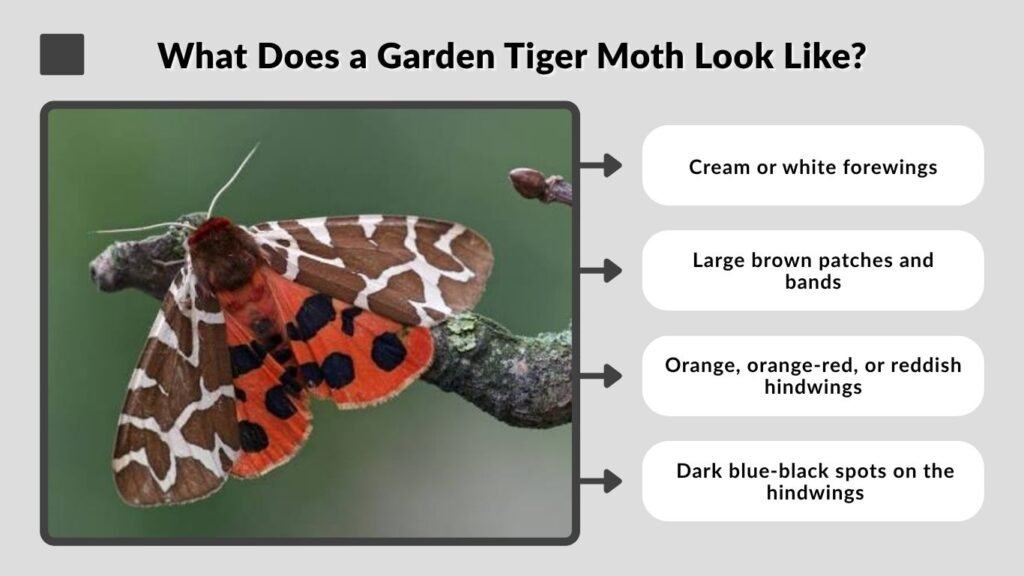
The garden tiger moth is one of the easiest European moths to recognize.
Its forewings are cream or white with irregular dark brown markings. When resting, these patterned forewings cover the brighter hindwings.
Adult Identification
Look for:
- Cream or white forewings
- Large brown patches and bands
- Orange, orange-red, or reddish hindwings
- Dark blue-black spots on the hindwings
- Thick, furry body
- Rounded wings
- Wingspan approaching 7 cm in large individuals
The exact brown-and-cream forewing pattern varies considerably between individuals.
This natural variation means two garden tiger moths may look surprisingly different while still belonging to the same species.
Why Does the Garden Tiger Moth Have Bright Hindwings?
The bright hindwings are part of the moth’s defense against predators.
While resting, the moth can remain relatively inconspicuous because the brown-and-cream forewings provide camouflage.
If threatened, it can suddenly reveal its bright orange-red hindwings.
Warning Coloration
Bright red, orange, yellow, and black colors often function as warning coloration, or aposematism.
They signal to potential predators that an animal may taste unpleasant or contain defensive chemicals.
The sudden flash of color may also startle an attacking bird long enough for the moth to escape.
Garden Tiger Moth Caterpillar
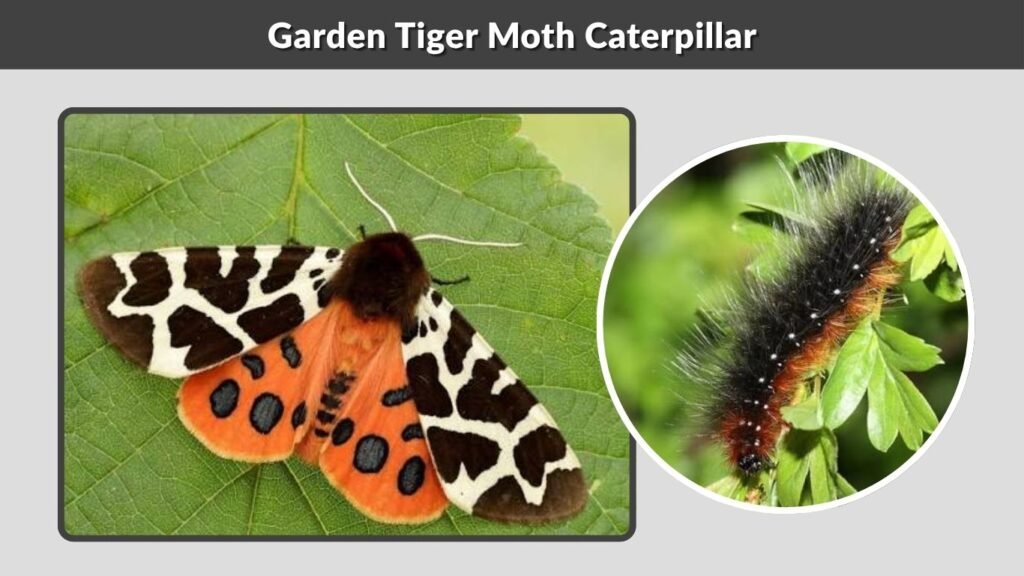
The garden tiger moth caterpillar is commonly known as a woolly bear caterpillar.
It has a thick covering of long hairs that gives it a furry appearance.
Caterpillar Identification
A mature caterpillar typically has:
- Dark brown or black body
- Long black hairs along the upper surface
- Reddish-brown hairs along the sides
- Thick, woolly appearance
- Dark head
- Length of roughly 5–6 cm when mature
Young caterpillars may look smaller and darker.
As they grow through successive molts, the hairs become more noticeable and the characteristic woolly bear appearance develops.
Are Garden Tiger Moth Caterpillars Dangerous?
Garden tiger caterpillars are not considered dangerously venomous caterpillars.
However, their hairs can cause skin irritation in some people.
Can the Caterpillar Sting?
The hairs do not function like the venomous spines of an Io moth caterpillar or puss caterpillar.
However, touching a woolly bear can sometimes cause:
- Mild itching
- Redness
- Skin irritation
- Discomfort in sensitive individuals
For this reason, unnecessary handling is best avoided.
Children should also be discouraged from rubbing hairy caterpillars against their skin.
Are Garden Tiger Moths Poisonous?
Garden tiger moths are chemically defended and may be distasteful to predators.
The caterpillars feed on a wide range of plants, including some that contain defensive compounds. The moth can retain chemical protection that helps discourage birds and other predators.
This does not mean the adult moth is dangerously poisonous to humans through ordinary contact.
Garden tiger moths:
- Do not bite people
- Do not sting
- Are not aggressive
- Are safe to observe
They should simply be left undisturbed.
What Do Garden Tiger Moth Caterpillars Eat?
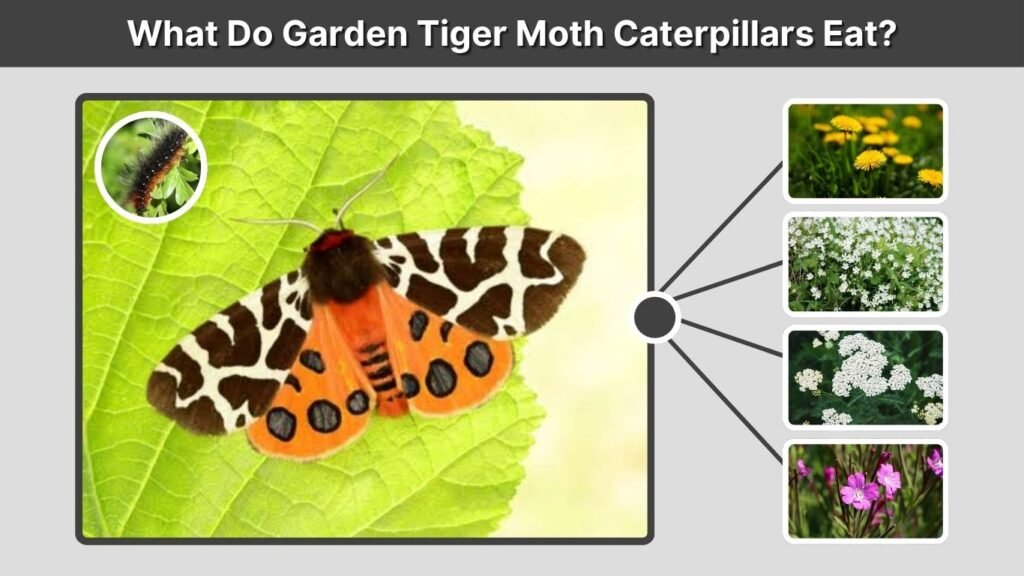
Garden tiger caterpillars are generalist feeders, meaning they can eat many different plants.
This allows them to survive in a variety of habitats.
Caterpillar Food Plants
Common foods include:
- Dandelion
- Dock
- Plantain
- Nettle
- Chickweed
- Yarrow
- Willowherb
- Sorrel
- Bramble
- Various garden weeds
- Other low-growing herbaceous plants
They may also feed on leaves of some shrubs and cultivated plants.
Because their diet is so broad, finding a woolly bear on one plant does not necessarily mean that plant is its only food source.
What Do Adult Garden Tiger Moths Eat?
Adult garden tiger moths feed much less than their caterpillars.
Some adults may take small amounts of nectar, but reproduction is the main purpose of the adult stage.
Most of the energy required for adult life was accumulated during the caterpillar stage.
This is why the larval period is so important: the caterpillar must eat enough to support pupation, metamorphosis, flight, mating, and egg production.
Garden Tiger Moth Life Cycle
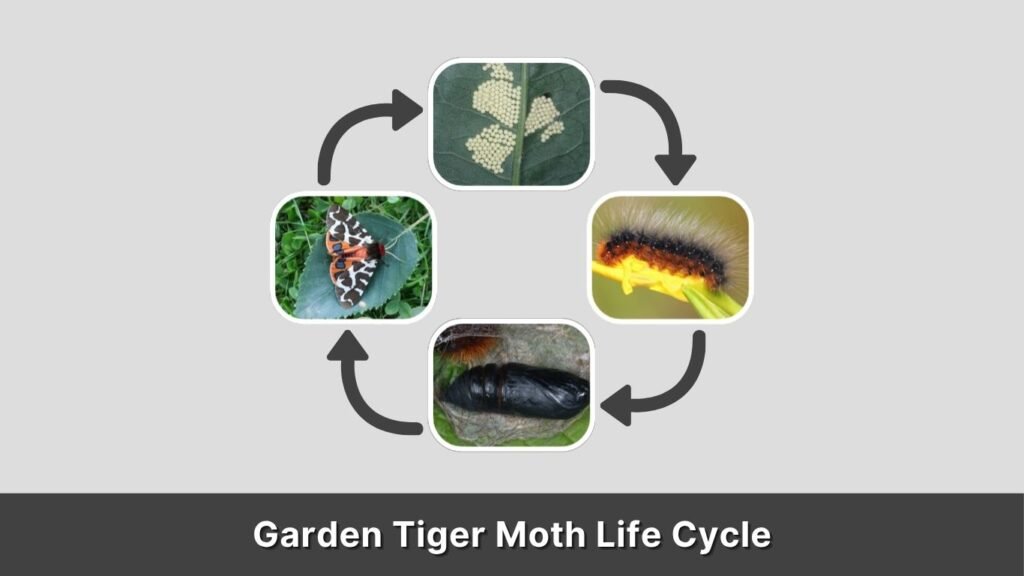
The garden tiger moth undergoes complete metamorphosis through four stages:
Egg → Caterpillar → Pupa → Adult
In much of its range, the species usually completes one generation each year.
Eggs
After mating, the female lays clusters of eggs on or near suitable food plants.
The eggs are:
- Small
- Rounded
- Pale when newly laid
- Usually deposited in groups
After hatching, the young caterpillars begin feeding on nearby vegetation.
Caterpillar Stage
The larvae grow through several molts during summer and autumn.
Unlike many moths, the garden tiger commonly spends the winter as a partly grown caterpillar.
During cold weather, feeding slows or stops.
When warmer spring conditions return, the caterpillar begins feeding again and completes its development.
Cocoon and Pupa
When fully grown, the caterpillar searches for a sheltered place near the ground.
It forms a loose cocoon incorporating:
- Silk
- Caterpillar hairs
- Plant debris
- Nearby material
Inside this cocoon, it transforms into a dark pupa.
Adult Moth
The adult emerges during the warmer months.
Adults are generally most noticeable in summer, when males search for females and females prepare to lay eggs.
After mating and reproduction, the adult life stage ends and a new generation begins.
What Does a Garden Tiger Moth Cocoon Look Like?
The cocoon is not usually a clean, smooth silk structure.
Instead, it tends to be loosely constructed and partly hidden within vegetation or debris.
Cocoon Identification
A garden tiger moth cocoon may be:
- Brownish or gray
- Covered with caterpillar hairs
- Mixed with dried vegetation
- Hidden near ground level
- Positioned among leaves or stems
Inside is a dark brown or blackish pupa.
The incorporated caterpillar hairs may help provide additional physical protection.
Garden Tiger Moth Habitat
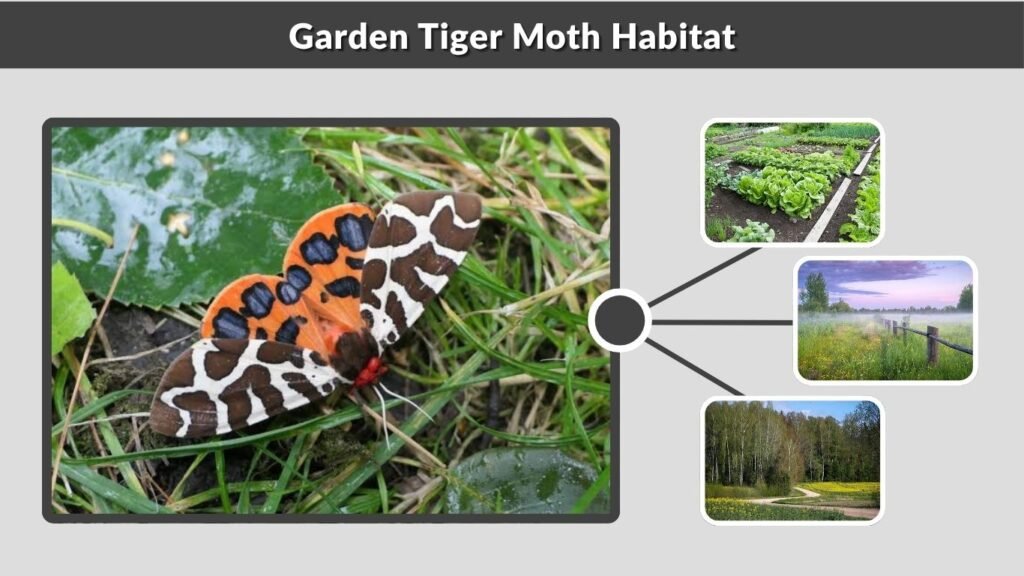
Garden tiger moths prefer habitats containing diverse low-growing plants for caterpillar feeding.
They can occur in both natural and human-modified landscapes.
Typical Habitats
They may be found in:
- Gardens
- Meadows
- Grasslands
- Woodland edges
- Hedgerows
- Roadside vegetation
- Wetlands
- Coastal areas
- Moorland
- Parks
- Scrub
Habitats with a mixture of grasses, weeds, herbs, and shrubs provide especially good caterpillar feeding opportunities.
Garden Tiger Moth in the UK and Ireland
The garden tiger is one of Britain’s most recognizable large moths.
It remains widespread, but its population has undergone substantial declines in parts of the UK over recent decades.
The species also occurs in Ireland, where it can be found in gardens, grasslands, coastal habitats, and other vegetated areas.
Why Has the Garden Tiger Declined?
Possible contributing factors include:
- Habitat loss
- Changes in land management
- Agricultural intensification
- Removal of weeds and wild vegetation
- Climate-related changes
- Wetter winter conditions
- Changes in caterpillar survival
Because the caterpillar overwinters above ground, unusually wet or unstable winter conditions may affect survival.
Maintaining diverse, pesticide-free vegetation can benefit this and many other moth species.
Male vs. Female Garden Tiger Moth
Males and females share the same general wing pattern, so they are not always easy to distinguish from appearance alone.
Male
Males tend to have:
- More strongly feathered antennae
- Slightly slimmer abdomen
- More active mate-searching behavior
The feathery antennae help males detect female pheromones.
Female
Females usually have:
- Less strongly feathered antennae
- Broader abdomen
- Heavier appearance when carrying eggs
Body size can overlap, so antennae and abdomen shape are more reliable than size alone.
Garden Tiger Moth Predators
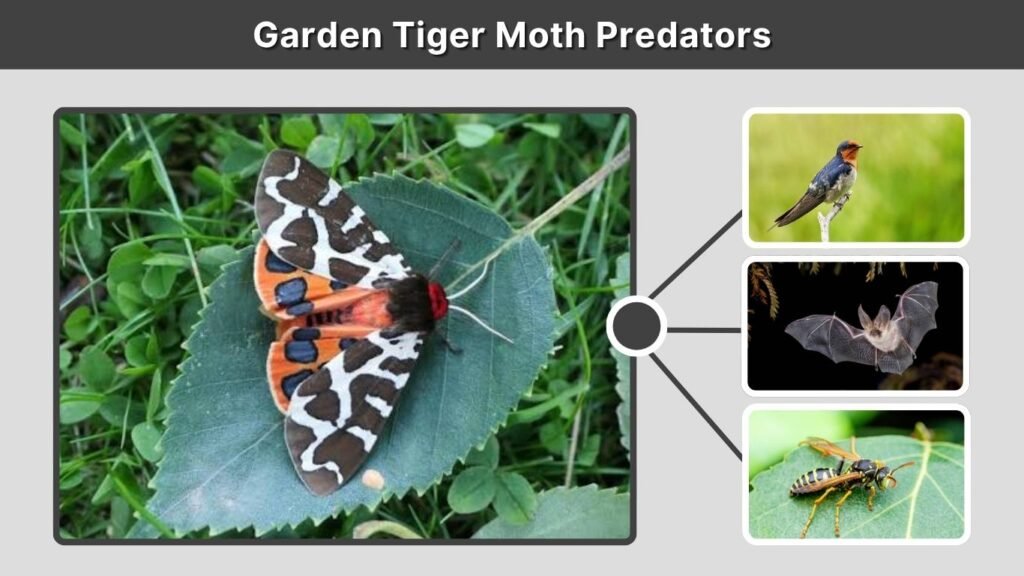
Garden tiger moths face predators during every stage of life.
Potential predators include:
- Birds
- Bats
- Spiders
- Predatory insects
- Small mammals
- Parasitoid wasps
- Parasitoid flies
Their defenses change with age.
Hairy caterpillars are difficult for some predators to handle, while adults use camouflage, warning coloration, chemical defenses, and even sound production to reduce attacks.
Are Garden Tiger Moths Bad for Gardens?
Usually, no.
Although caterpillars eat leaves, they generally do not cause serious garden damage.
They feed on many common weeds and wild plants and are part of a healthy garden ecosystem.
A few caterpillars on dandelions, docks, nettles, or other plants normally do not require control.
Avoid using broad-spectrum insecticides simply because woolly bear caterpillars are present. Such products can also harm butterflies, bees, predatory insects, and other beneficial wildlife.
Are Garden Tiger Moths Rare?
The garden tiger is not extinct or globally exceptionally rare, but it has declined significantly in parts of its former range.
In some locations it remains fairly easy to encounter, while in others it is now much less common than several decades ago.
This makes local habitat conservation increasingly important.
Leaving areas of native vegetation, avoiding unnecessary pesticide use, and allowing some common caterpillar food plants to remain can help support local populations.
FAQs
What is the scientific name of the garden tiger moth?
The scientific name is Arctia caja. It belongs to the tiger moth group within the family Erebidae.
What do garden tiger moth caterpillars eat?
They eat many plants, including dandelion, dock, nettle, plantain, chickweed, willowherb, bramble, and various other herbaceous plants.
Are garden tiger moth caterpillars poisonous?
They are not considered dangerously venomous. Their long hairs can cause mild irritation in sensitive people, so handling is best avoided.
What does a garden tiger moth cocoon look like?
It is usually a loose silk cocoon mixed with caterpillar hairs and vegetation. It is commonly hidden close to the ground among leaves or plant debris.
Are garden tiger moths rare?
They remain widespread across parts of their range but have declined considerably in some regions, especially parts of the UK. Habitat loss, land-use changes, and climate-related factors may contribute to these declines.
