
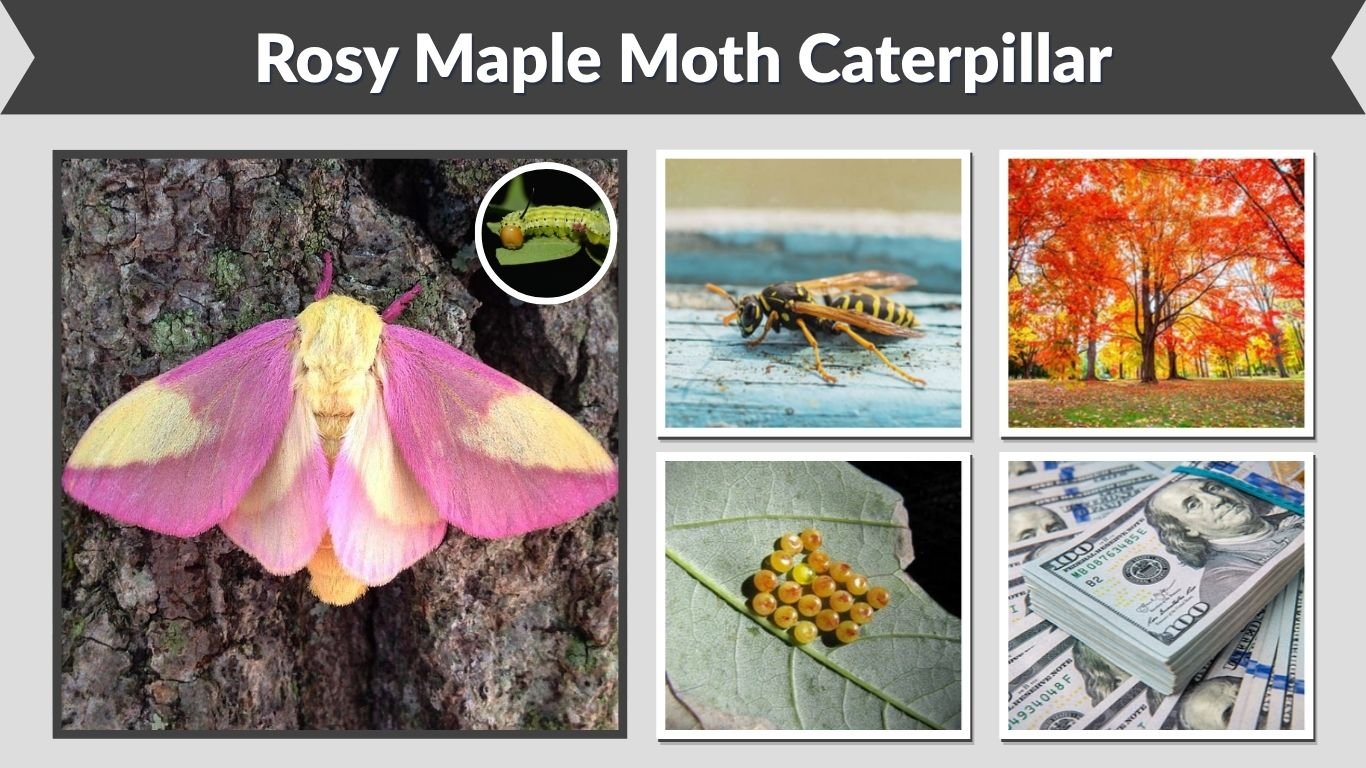
The rosy maple moth caterpillar is the larval stage of the colorful rosy maple moth (Dryocampa rubicunda). Unlike the pink-and-yellow adult, the caterpillar is mostly green and is commonly called the greenstriped mapleworm. It feeds primarily on maple leaves and may occur in forests, parks, yards, and neighborhoods where maple trees grow. Although its body has small spines and two prominent projections near the head, it is not considered a dangerous stinging caterpillar. As it develops, it passes through several stages before pupating underground and emerging as an adult moth.
What Does a Rosy Maple Moth Caterpillar Look Like?
Rosy maple moth caterpillars look dramatically different from the adults. Mature larvae are generally green with pale stripes running lengthwise along the body.
Their appearance also changes as they grow, so young and mature caterpillars can look somewhat different.
Rosy Maple Moth Caterpillar Identification
Look for these features:
- Green body
- Several pale green or whitish longitudinal stripes
- Reddish-brown to orange-brown head
- Small black spines along the body
- Two longer dark projections behind the head
- Thick, cylindrical body
- Approximately 1.5–2 inches long when mature
The caterpillar’s common name, greenstriped mapleworm, comes from its green striped appearance and preference for maple trees.
What Do Young Rosy Maple Moth Caterpillars Look Like?
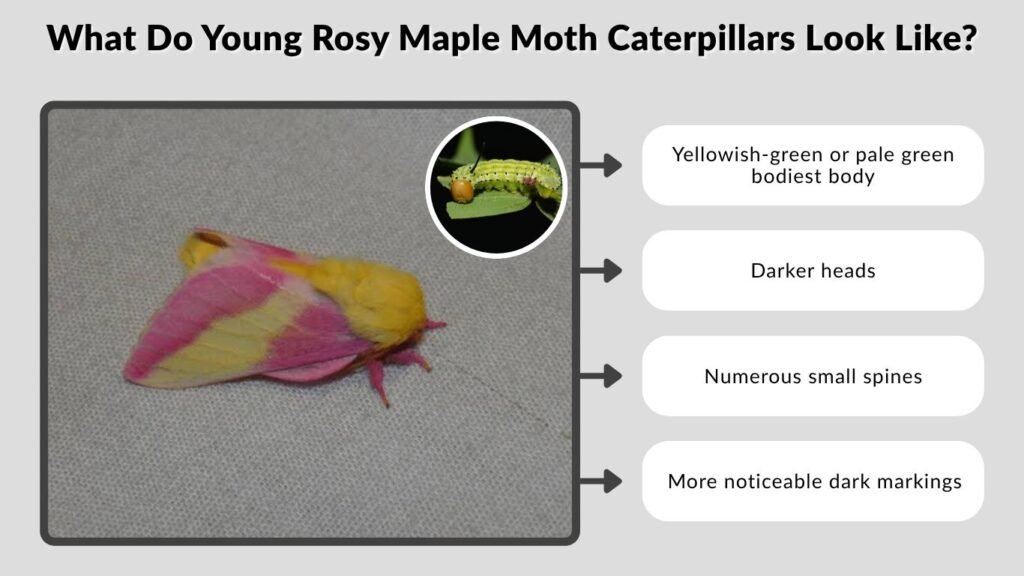
Newly hatched larvae are much smaller and darker than mature caterpillars.
During their earliest stages, they may have:
- Yellowish-green or pale green bodies
- Darker heads
- Numerous small spines
- More noticeable dark markings
- A tendency to remain together in groups
Young caterpillars are social feeders. Several larvae may remain close together while consuming leaves from the same branch.
As they grow and molt, their coloration becomes greener and their pale longitudinal stripes become easier to see.
Rosy Maple Moth Caterpillar Stages
Like other moth caterpillars, the greenstriped mapleworm grows through a series of developmental stages called instars.
The rosy maple moth caterpillar generally passes through five larval instars before pupating.
Early Instars
Newly hatched caterpillars are small and commonly feed together.
They remain relatively close to the egg-laying site and consume the softer parts of maple leaves.
Middle Instars
As they molt and increase in size, their green coloration and striped pattern become more obvious.
Their appetite also increases significantly.
Final Instar
Fully developed larvae become much larger and generally separate from the group.
A mature caterpillar eventually stops eating, leaves the host tree, and searches for soil where it can pupate.
What Do Rosy Maple Moth Caterpillars Eat?
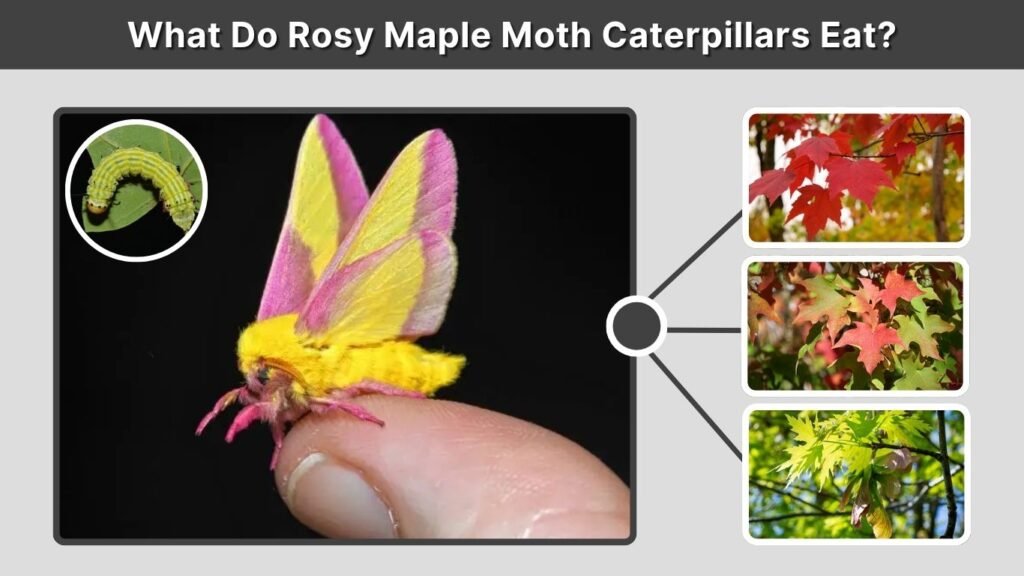
The caterpillar is primarily a leaf eater and has a strong association with maple trees.
Maple foliage provides the nutrients needed for the caterpillar to grow and store enough energy for pupation and adulthood.
Rosy Maple Moth Host Plants
Important host trees include:
- Red maple
- Sugar maple
- Silver maple
- Box elder
- Other maple species
- Occasionally some oak species
Maples are by far the host plants most strongly associated with the species.
Do They Eat Roses?
Despite the word “rosy” in their name, rosy maple moth caterpillars are not named for eating roses.
“Rosy” refers to the pink coloration of the adult moth.
The caterpillars are primarily associated with maple trees rather than rose bushes.
Can Rosy Maple Moth Caterpillars Damage Maple Trees?
Yes, caterpillars can remove noticeable amounts of foliage when their population becomes large.
Young larvae sometimes feed together in groups, which can result in significant leaf loss on individual branches.
Signs of Feeding
You may notice:
- Chewed leaf edges
- Leaves with missing sections
- Groups of green caterpillars
- Partially skeletonized leaves
- Droppings beneath affected branches
- In severe cases, considerable defoliation
Healthy established maple trees can usually recover from moderate feeding.
Large outbreaks can cause substantial temporary defoliation, but serious long-term damage is less common in otherwise healthy mature trees.
Do Rosy Maple Moth Caterpillars Sting?
Rosy maple moth caterpillars are not considered medically important stinging caterpillars.
They have visible spines, particularly the two longer projections toward the front of the body, but these should not be confused with the venom-delivering spines of an Io moth caterpillar.
Can You Touch One?
Brief accidental contact is unlikely to cause the intense pain associated with truly venomous caterpillars.
However, it is still better to avoid unnecessary handling.
Their small spines may mechanically irritate sensitive skin, and handling can also injure the caterpillar.
If you need to move one, allow it to crawl onto a leaf or small branch instead of squeezing it with your fingers.
Rosy Maple Moth Caterpillar vs. Io Moth Caterpillar
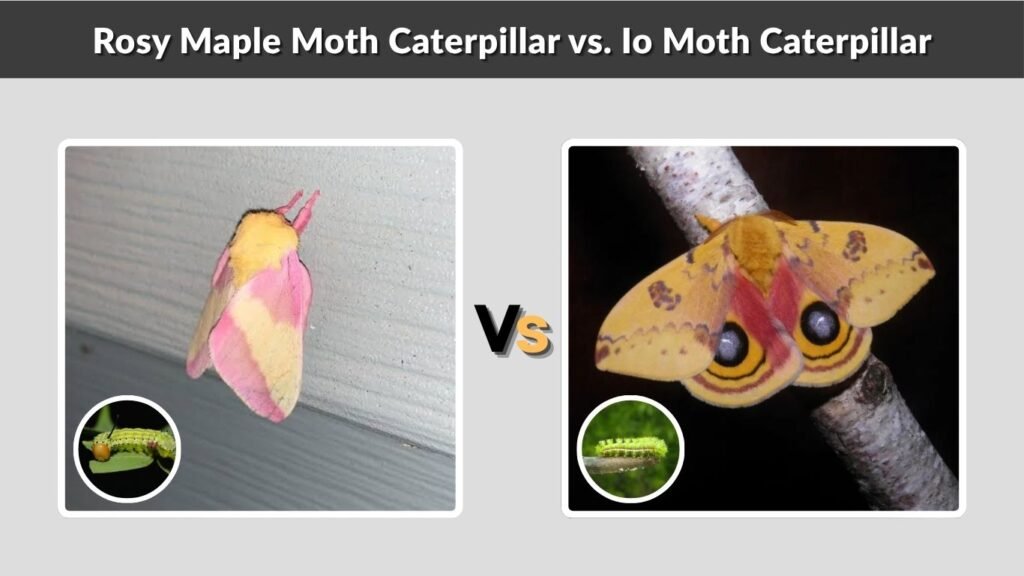
Both species belong to the Saturniidae family, and both caterpillars may be green. However, their defensive structures are quite different.
Rosy Maple Moth Caterpillar
- Green with pale longitudinal stripes
- Relatively sparse small spines
- Two obvious dark projections near the head
- Feeds heavily on maples
- Not considered a dangerous stinging caterpillar
Io Moth Caterpillar
- Bright green
- Prominent red-and-white stripe along each side
- Dense clusters of branching spines
- Spines contain irritating venom
- Contact can cause immediate burning and pain
If an unidentified green caterpillar is densely covered with branching spines, avoid touching it until you can identify it confidently.
Rosy Maple Moth Caterpillar vs. Luna Moth Caterpillar
The Luna moth caterpillar can also be confused with the rosy maple moth larva because both are green members of the silk moth family.
Luna Moth Caterpillar
Luna moth larvae are typically:
- Bright green
- Thick-bodied
- Marked with small reddish or yellow bumps
- Relatively smooth in appearance
- Found on walnut, hickory, sweetgum, birch, and other trees
Rosy Maple Moth Caterpillar
Greenstriped mapleworms generally have:
- Clear longitudinal stripes
- More noticeable body spines
- Two dark horn-like projections toward the front
- Strong preference for maple foliage
The host tree can therefore provide an important identification clue.
Rosy Maple Moth Caterpillar Life Cycle
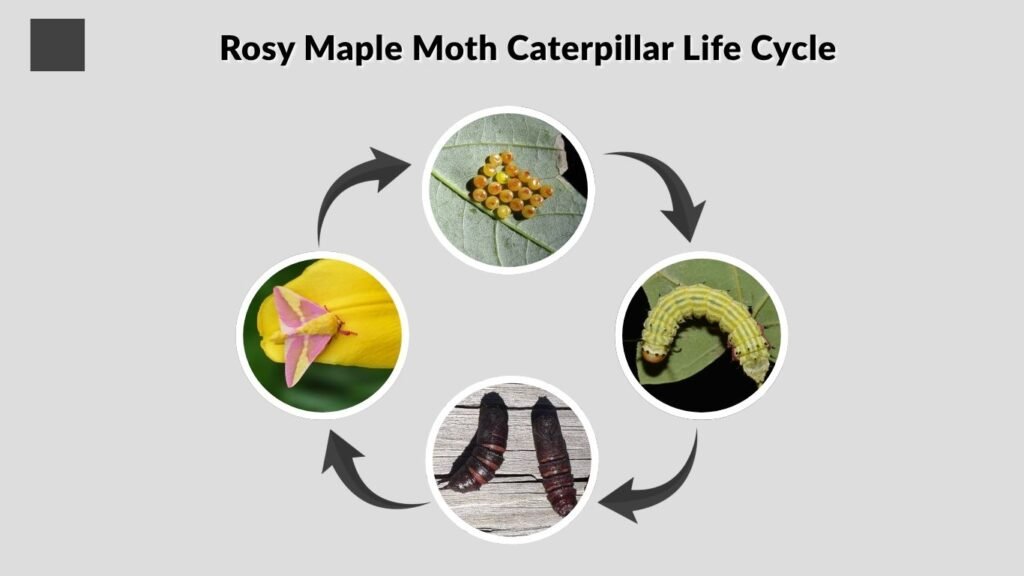
The rosy maple moth undergoes complete metamorphosis through four major stages:
Egg → Caterpillar → Pupa → Adult moth
The timing depends heavily on temperature, season, and location.
Eggs
After mating, the female deposits clusters of eggs on the underside of host-tree leaves.
The eggs are small and usually pale yellow.
After about one to two weeks under favorable conditions, tiny caterpillars emerge and begin feeding.
Larval Stage
The caterpillars pass through approximately five instars.
Young larvae feed communally, while larger larvae increasingly spread apart.
The larval period typically lasts several weeks.
Pupal Stage
When fully grown, the caterpillar descends from its host tree.
Rather than constructing a large silk cocoon on a branch, it usually burrows into loose soil and forms a protected underground pupal chamber.
The pupa is brown and relatively compact.
Adult Stage
The adult eventually emerges from the soil as the familiar pink-and-yellow rosy maple moth.
In cooler regions, the species may spend winter underground as a pupa before emerging the following spring or summer.
Where Are Rosy Maple Moth Caterpillars Found?
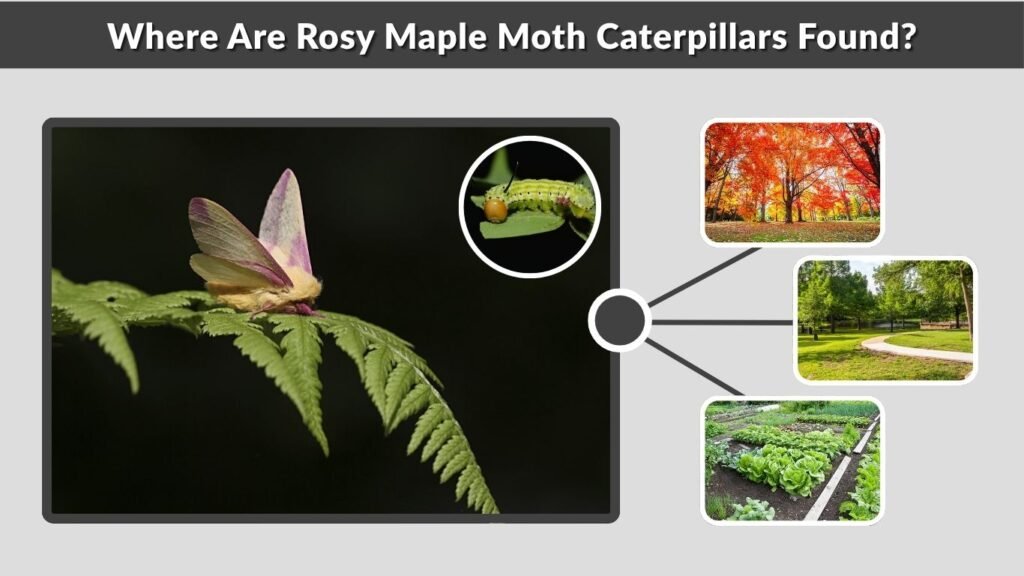
The species occurs across a large portion of eastern North America.
It is most likely to occur wherever suitable maple trees are abundant.
Typical Habitat
Look for caterpillars in:
- Maple forests
- Deciduous woodland
- Suburban yards
- Parks
- School grounds
- Gardens
- Forest edges
- Streets lined with maple trees
The species occurs from parts of Canada south through the eastern United States.
Rosy Maple Moth Caterpillars in Pennsylvania
Rosy maple moths occur in Pennsylvania, where extensive deciduous woodland and numerous native maple species provide suitable habitat.
Caterpillars may be found on red, sugar, and other maples during the warmer months.
Because adults are nocturnal, homeowners may discover caterpillars on a maple tree without ever seeing the adult moth that laid the eggs.
What Happens When the Caterpillar Is Ready to Pupate?
A mature caterpillar may suddenly disappear from the tree.
This does not necessarily mean it was eaten.
When larval development is complete, the caterpillar naturally leaves the host plant and searches for suitable ground.
Before Pupation It May:
- Stop feeding.
- Become restless.
- Crawl down the tree.
- Search through leaf litter.
- Enter loose soil.
- Form a pupal chamber.
- Transform into a brown pupa.
This underground pupation strategy protects the developing moth from some predators and harsh environmental conditions.
How Long Is the Caterpillar Stage?
The exact duration varies according to temperature and environmental conditions.
Generally, the larval period lasts several weeks, during which the caterpillar molts multiple times and grows rapidly.
In northern areas there may be only one generation each year, while warmer southern locations can support multiple generations.
The overwintering pupal stage can make the total life cycle much longer than the visible caterpillar period.
What Eats Rosy Maple Moth Caterpillars?
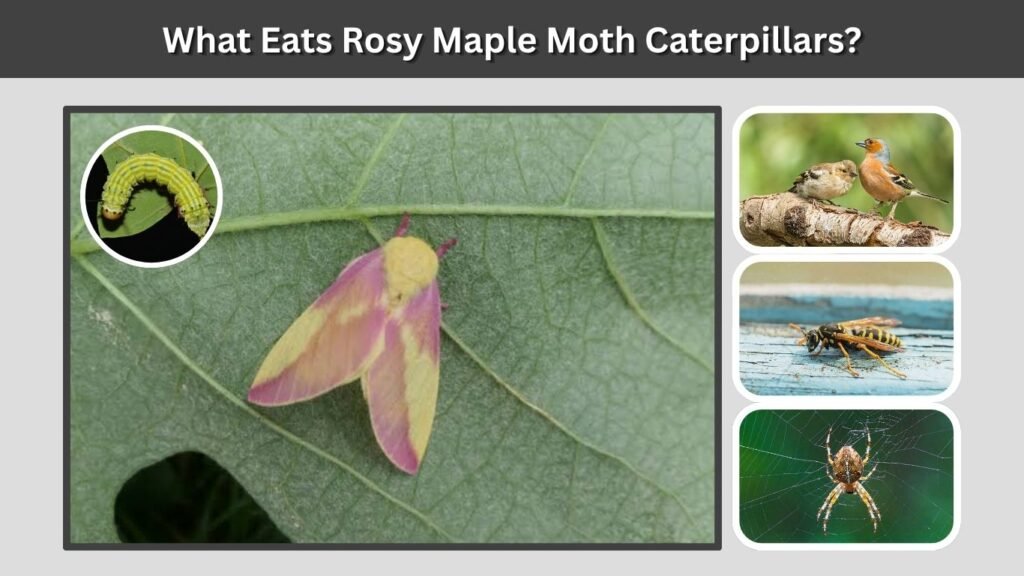
Greenstriped mapleworms are part of the natural food web and face many predators.
Potential predators include:
- Birds
- Spiders
- Predatory bugs
- Wasps
- Small mammals
- Parasitoid flies
- Parasitoid wasps
Young caterpillars feeding in exposed groups can be particularly vulnerable.
Their green coloration provides some camouflage among maple leaves.
How to Control Rosy Maple Moth Caterpillars
Most homeowners do not need to control a few greenstriped mapleworms.
They are native insects, and a healthy mature maple can normally tolerate limited feeding.
When Control May Be Needed
Consider action if:
- A small young tree is heavily infested.
- Caterpillars are stripping large portions of foliage.
- Defoliation happens repeatedly.
- Tree health is already poor.
For small infestations, caterpillars can often simply be removed from valuable young trees and relocated where appropriate.
Avoid broad insecticide applications when possible because they can also kill beneficial butterflies, moths, bees, and natural predators.
Can You Keep a Rosy Maple Moth Caterpillar?
It is possible to observe a caterpillar temporarily for educational purposes where local regulations allow it.
However, successful development requires:
- Correct host plant leaves
- Fresh pesticide-free foliage
- Good ventilation
- Clean enclosure conditions
- Space to molt
- Suitable soil for pupation
The caterpillar should be supplied with leaves from the same type of tree on which it was found whenever possible.
Wild caterpillars should not be collected commercially simply because adult rosy maple moths are popular online.
Rosy Maple Moth Caterpillars for Sale
Rosy maple moth caterpillars and eggs sometimes appear in the insect hobby trade.
Before purchasing them, verify:
- Local wildlife regulations
- Whether interstate transport is permitted
- The seller’s breeding history
- Whether specimens are captive bred
- Availability of appropriate host plants
Never release captive insects into an area outside their natural range.
FAQs
What does a rosy maple moth caterpillar look like?
A mature caterpillar is green with pale longitudinal stripes, small dark spines, a reddish-brown head, and two larger dark projections near the front of its body.
Does a rosy maple moth caterpillar sting?
It is not considered a dangerous stinging caterpillar. Its small spines may cause minor mechanical irritation in sensitive people, so unnecessary handling is still best avoided.
What do rosy maple moth caterpillars eat?
They primarily eat maple leaves, including those of red, sugar, silver, and other maple species.
How big does a rosy maple moth caterpillar get?
Fully developed greenstriped mapleworms can approach approximately 2 inches long before leaving the host plant to pupate.
Where does a rosy maple moth caterpillar pupate?
A mature caterpillar normally leaves its host tree, enters loose soil or leaf litter, and forms an underground pupal chamber where it transforms into an adult moth.
