
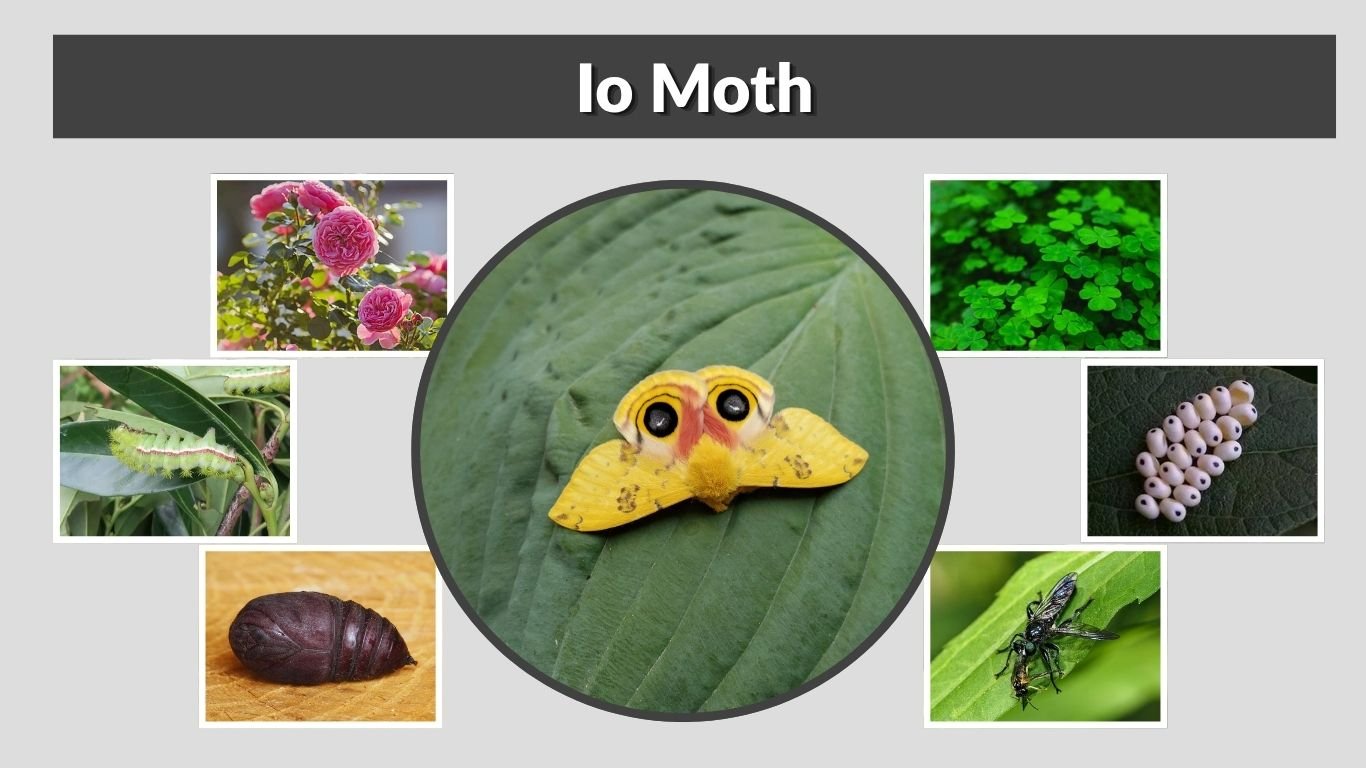
The Io moth (Automeris io) is a colorful giant silk moth recognized by the dramatic eyespots hidden on its hindwings. Adults occur across much of eastern North America, while their bright green caterpillars are famous for something less pleasant—their venomous spines can cause a painful sting. Male and female Io moths also look surprisingly different, with males usually yellow and females more reddish-brown. From eggs and host plants to cocoons and adult behavior, the Io moth has a fascinating and highly distinctive life cycle.
What Is an Io Moth?
The Io moth belongs to the giant silk moth family Saturniidae and is one of the most recognizable members of the genus Automeris. Adults have a wingspan of roughly 50–80 mm, or about 2–3 inches. Their large hindwing eyespots serve as a defensive display, while the larvae rely on conspicuous coloration and venom-bearing spines for protection.
Io Moth Quick Facts
- Scientific name: Automeris io
- Family: Saturniidae
- Order: Lepidoptera
- Wingspan: About 50–80 mm
- Caterpillar length: Around 60–70 mm when mature
- Male color: Usually yellow
- Female color: Usually reddish-brown
- Caterpillar color: Mature larvae are bright green
- Range: Southern Canada through much of the eastern United States into eastern Mexico
- Diet: Adults do not feed; caterpillars eat many plants
- Defense: Adult eyespots and caterpillar venomous spines
What Does an Io Moth Look Like?
When resting, an Io moth can appear relatively plain because its forewings cover the brightly patterned hindwings. If disturbed, the moth spreads its wings and reveals two enormous black, blue, and white eyespots.
These markings may startle birds and other predators long enough for the moth to escape.
Males tend to be yellowish, while females are generally larger and more reddish or brown. Males also have much broader, feather-like antennae used for detecting female pheromones.
Male vs. Female Io Moth
Male and female Io moths show clear sexual dimorphism, meaning the sexes differ noticeably in appearance. Their wing coloration, antennae, and body size can usually separate them at a glance. Both sexes, however, possess the dramatic hindwing eyespots characteristic of the species and use essentially the same daytime camouflage strategy while resting.
Male Io Moth
Male Io moths typically have:
- Yellow to golden-yellow forewings
- Large hindwing eyespots
- Broad, strongly feathered antennae
- Smaller overall body size
- Reddish or pink areas surrounding the hindwing eyespots
Their large antennae are particularly important because males locate females by detecting airborne sex pheromones.
Female Io Moth
Females typically have:
- Reddish-brown or purplish forewings
- A larger and heavier body
- Large black-and-blue hindwing eyespots
- Narrower, almost thread-like-looking antennae
- More subdued coloration while resting
Females are generally larger because they must carry and produce eggs.
Why Do Io Moths Have Eyespots?
The eyespots function primarily as a predator-defense mechanism. While resting, the moth keeps them concealed beneath its forewings.
When threatened, it can suddenly expose the hindwings. The appearance of two large “eyes” may surprise a bird or other predator.
This defensive tactic is especially useful because adults are short-lived and have few other ways to defend themselves.
Io Moth Caterpillar Identification and Sting
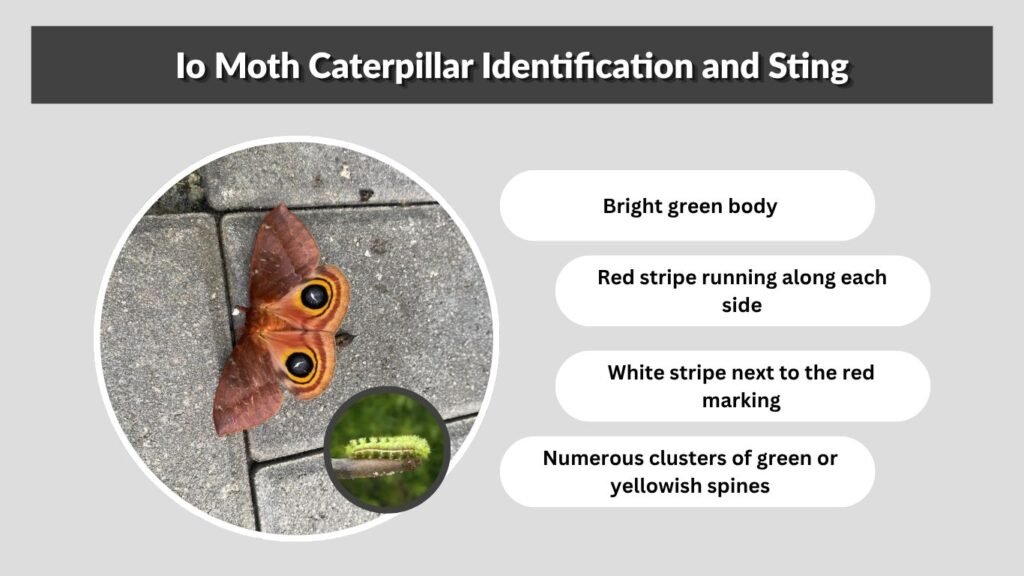
The Io moth caterpillar is even more important to recognize than the adult because its body carries numerous venomous spines. Mature caterpillars are bright green with red-and-white stripes running along the sides. Contact with the spines can produce immediate burning pain, itching, redness, and welts, although serious systemic reactions are uncommon.
Io Moth Caterpillar Identification
A mature caterpillar typically has:
- Bright green body
- Red stripe running along each side
- White stripe next to the red marking
- Numerous clusters of green or yellowish spines
- Dark tips on many spines
- Reddish legs
- Length around 60 mm, sometimes somewhat larger
Young caterpillars look different. Newly hatched larvae are reddish-brown, and later stages gradually become lighter before developing the familiar green coloration.
Can an Io Moth Caterpillar Sting?
Yes. The caterpillar’s spines are associated with venom and can break or penetrate the skin when touched.
Common effects include:
- Immediate burning or stinging pain
- Redness
- Itching
- Local swelling
- Raised welts
- Tenderness
University of Florida guidance reports that pain commonly subsides within a few hours, with localized skin reactions often resolving within several more hours. Sensitivity varies between people.
Io Moth Caterpillar Sting Treatment
After accidental contact:
- Avoid rubbing the affected skin.
- Use adhesive tape gently to help remove embedded spine tips.
- Wash the area with soap and water.
- Apply a wrapped cold or ice pack.
- Monitor for worsening symptoms.
Poison Control also recommends removing remaining hairs or spines with tape before treating the irritation. Seek medical help for serious blistering, difficulty breathing or swallowing, widespread swelling, or another severe reaction.
Io Moth Habitat, Range, and Diet
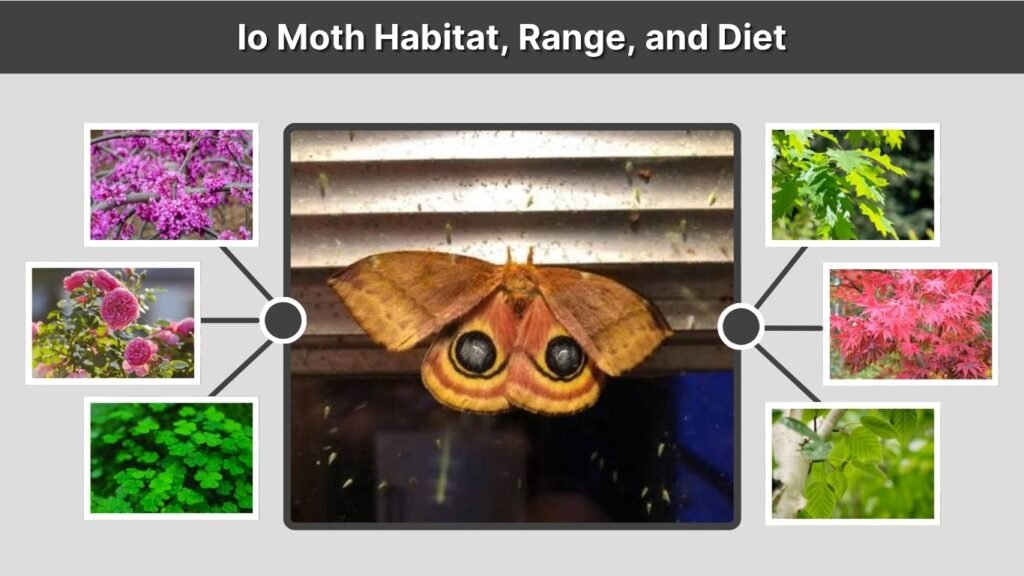
Io moths occupy woodland edges, forests, gardens, suburban landscapes, and other places containing suitable caterpillar host plants. Their broad diet during the larval stage helps explain their extensive distribution. The species occurs from southern Canada through much of the eastern United States and south into eastern Mexico, including Florida and other southeastern states.
Io Moth Host Plants
Io caterpillars can feed on many plants, including:
- Oak
- Willow
- Maple
- Elm
- Birch
- Redbud
- Hibiscus
- Azalea
- Wisteria
- Rose
- Clover
- Cotton
- Some palms
- Some grasses
This unusually broad host range allows the caterpillars to survive in many different environments.
What Do Adult Io Moths Eat?
Adult Io moths do not eat.
Like many giant silk moths, the adult stage has one primary purpose: reproduction. Adults rely on energy stored during the caterpillar stage and are therefore relatively short-lived.
After emerging from the cocoon, females attract males with pheromones, mate, and begin laying eggs during the subsequent night–?
Usually not. Caterpillars may chew noticeable holes in leaves, particularly when young larvae feed together in groups, but they are generally not abundant enough to cause severe landscape damage.
When control is necessary, avoiding direct skin contact is important. Gloves and protective clothing can reduce the chance of accidentally contacting the venomous spines.
Io Moth Life Cycle
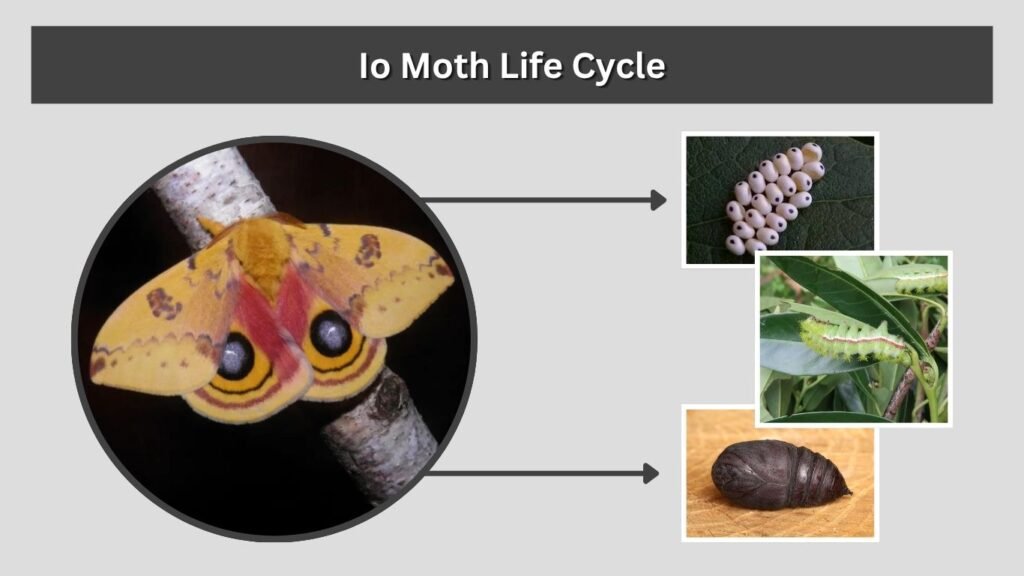
The Io moth undergoes complete metamorphosis through four major stages: egg, caterpillar, pupa, and adult. The number of generations per year varies considerably with climate. Northern populations may have only one generation annually, whereas populations in warmer parts of Florida can produce several generations.
Eggs and Young Caterpillars
Females lay eggs in clusters, usually on the undersides of leaves or on stems. The eggs generally hatch in about 8–11 days.
Newly hatched caterpillars often eat portions of their eggshells before turning to the host plant.
Young larvae are social and may travel together in organized lines while following silk trails. This behavior becomes less pronounced as they grow.
Caterpillar Stages
Io moth larvae usually pass through about five developmental stages, called instars, although environmental conditions can sometimes result in additional molts.
Early caterpillars are reddish or brownish. With successive molts they change significantly, eventually becoming the large green, heavily spined caterpillars most people recognize.
Older caterpillars tend to become more solitary rather than remaining in groups.
Io Moth Cocoon
When fully grown, the caterpillar leaves its host plant and searches for a protected pupation site.
The cocoon is:
- Thin and papery
- Usually brown
- Often hidden in leaf litter
- Sometimes placed in cracks among logs or rocks
- Frequently camouflaged with surrounding debris
Inside is a dark-brown pupa. In colder regions, the species can overwinter in this pupal stage before the adult emerges during warmer weather.
Io Moth Behavior, Defense, and Predators
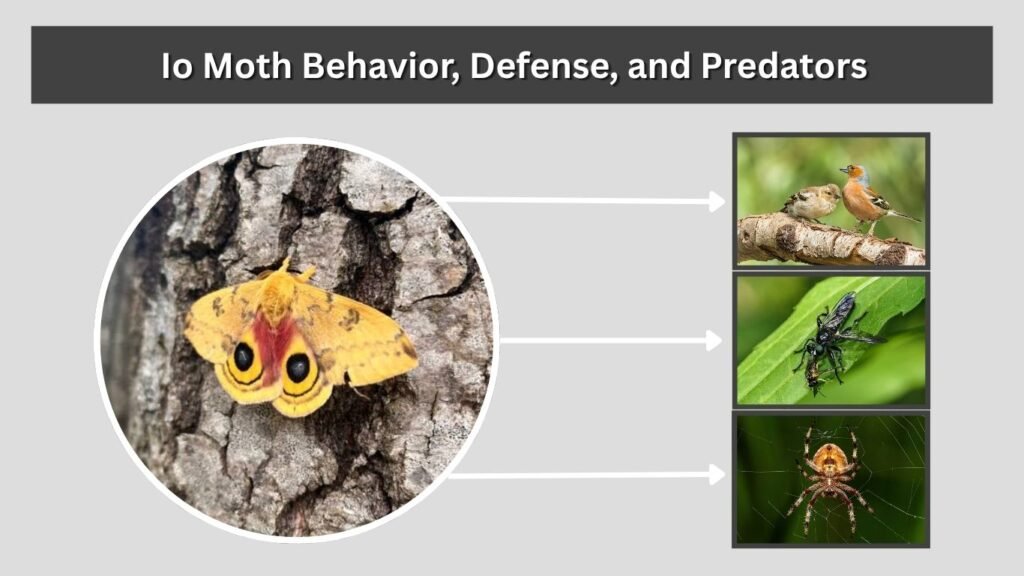
Io moths use different defenses during different stages of life. Caterpillars advertise their ability to sting through bright coloration, while adults rely largely on camouflage and their dramatic eyespots. Adults are nocturnal and normally remain motionless during daylight, when their yellow, brown, and reddish coloring can resemble dead leaves.
Adult Behavior
Adults generally emerge earlier in the day but remain quiet until evening. Activity increases after dark.
Females release chemical pheromones that males can detect using their large antennae. Once mating is complete, females lay clusters of eggs over several nights.
Because adults cannot feed, their limited stored energy must support mating, egg production, and dispersal.
Predators and Defense
Io moths may face birds, predatory insects, spiders, parasitoid wasps, and other natural enemies.
The caterpillar’s defensive spines discourage many would-be predators. Adults lack those spines, so their cryptic resting coloration and sudden eyespot display become their main protections.
FAQs
The Io moth attracts attention because the beautiful adult and potentially painful caterpillar appear so different. Understanding which stage can sting, what the species eats, and how its life cycle progresses makes encounters much safer and helps prevent harmless adult moths from being mistaken for dangerous insects.
Are Io moths poisonous?
Adult Io moths are harmless and do not sting. Their caterpillars, however, possess venomous spines capable of causing painful skin reactions.
What happens if you touch an Io moth caterpillar?
Contact can cause immediate burning or stinging, followed by redness, itching, swelling, or welts. Avoid touching the caterpillar with bare skin.
What do Io moth caterpillars eat?
They feed on many plants, including oak, willow, maple, elm, hibiscus, wisteria, rose, azalea, and several other trees and shrubs.
What do adult Io moths eat?
Nothing. Adult Io moths do not feed and survive using energy accumulated while they were caterpillars.
How can you tell a male Io moth from a female?
Males are generally smaller and yellow with broad, feathery antennae. Females are larger, usually reddish-brown, and have much narrower antennae. Both sexes have large eyespots on their hindwings.
