
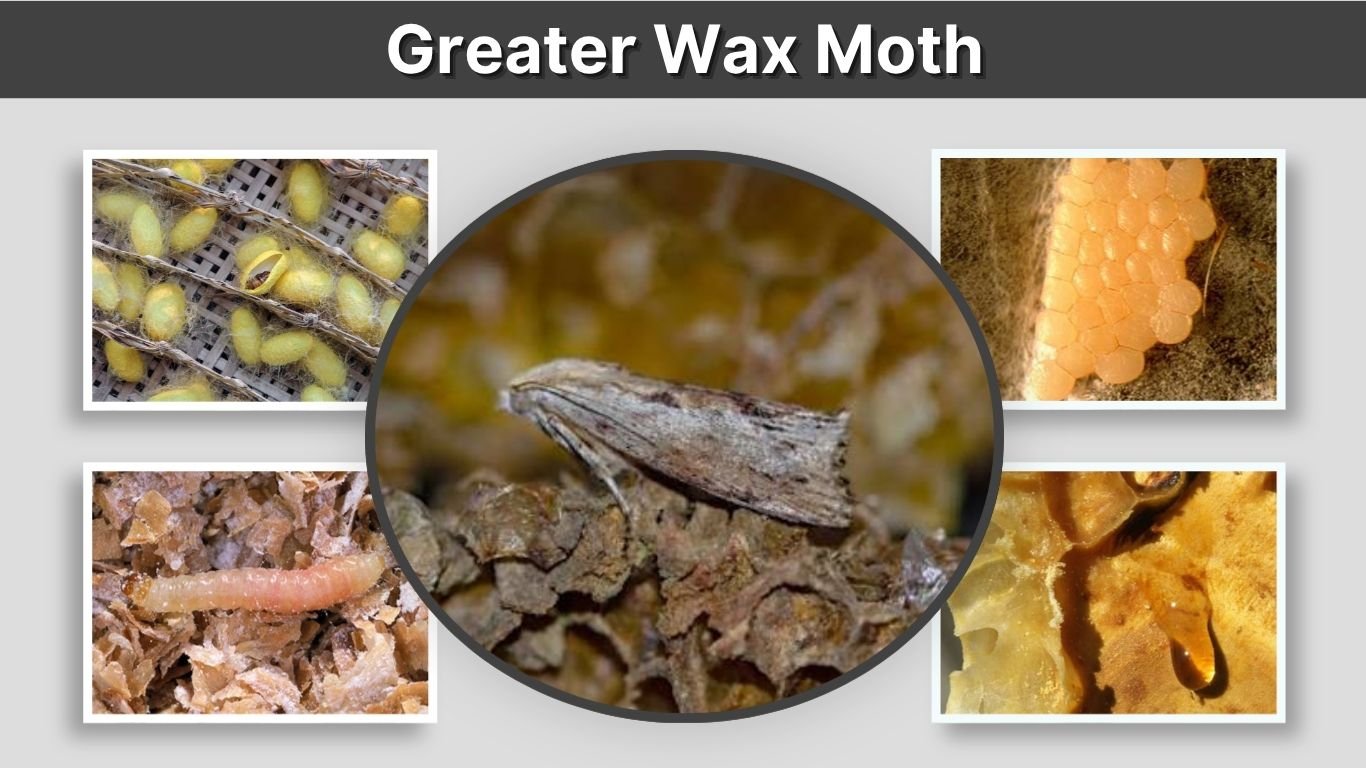
The greater wax moth is a widespread beehive pest whose larvae tunnel through honeycomb and cover it with dense silk, fecal pellets, and cocoons. Scientifically named Galleria mellonella, it usually causes serious damage in weak, abandoned, or poorly protected colonies rather than healthy hives. Stored brood frames are especially vulnerable. Beyond its importance to beekeepers, this moth is famous for hearing ultrasound approaching 300 kilohertz—the highest confirmed upper-frequency hearing limit recorded in an animal—and for larvae that show unusual interactions with polyethylene plastic.
What Is a Greater Wax Moth?
The greater wax moth, also called the honeycomb moth or bee moth, belongs to the family Pyralidae. Its caterpillar is commonly known as a waxworm. Adults reproduce around beehives, while larvae feed and develop within combs containing organic material.
Scientific Classification
- Scientific name: Galleria mellonella
- Family: Pyralidae
- Subfamily: Galleriinae
- Order: Lepidoptera
- Larval name: Waxworm
- Other names: Honeycomb moth and bee moth
- Distribution: Nearly worldwide
The species probably originated in the Old World but has spread through the movement of honey bees and beekeeping equipment. It is established in the UK, continental Europe, the Americas, Asia, Africa, and Australia.
Adult Identification
Adult greater wax moths have:
- A body approximately 13–20 millimeters long
- A wingspan commonly around 30–40 millimeters
- Gray, brown, bronze, or nearly black forewings
- Pale gray hindwings
- Mottled or irregular wing markings
- Wings held like a roof or narrow boat
- A pointed, beak-like appearance
- Mostly nocturnal activity
Adults often enter hives after dark to avoid guard bees. Their small, flattened shape allows them to hide inside cracks while searching for egg-laying sites.
Male vs. Female Greater Wax Moth
Adult males and females differ in size, color, body shape, and forewing structure. These differences are easiest to recognize when specimens of both sexes can be compared directly.
Identification Differences
| Feature | Male | Female |
| Body size | Smaller | Larger and heavier |
| Color | Usually lighter | Often darker |
| Abdomen | Narrower | Broader for carrying eggs |
| Forewing margin | More strongly concave | Comparatively straight |
| Behavior | Produces ultrasonic courtship signals | Searches for hives and lays eggs |
| Adult lifespan | Often longer | Commonly shorter after egg laying |
Size and color vary with larval nutrition, so forewing shape offers a more dependable clue than color alone.
Greater Wax Moth Eggs and Larvae
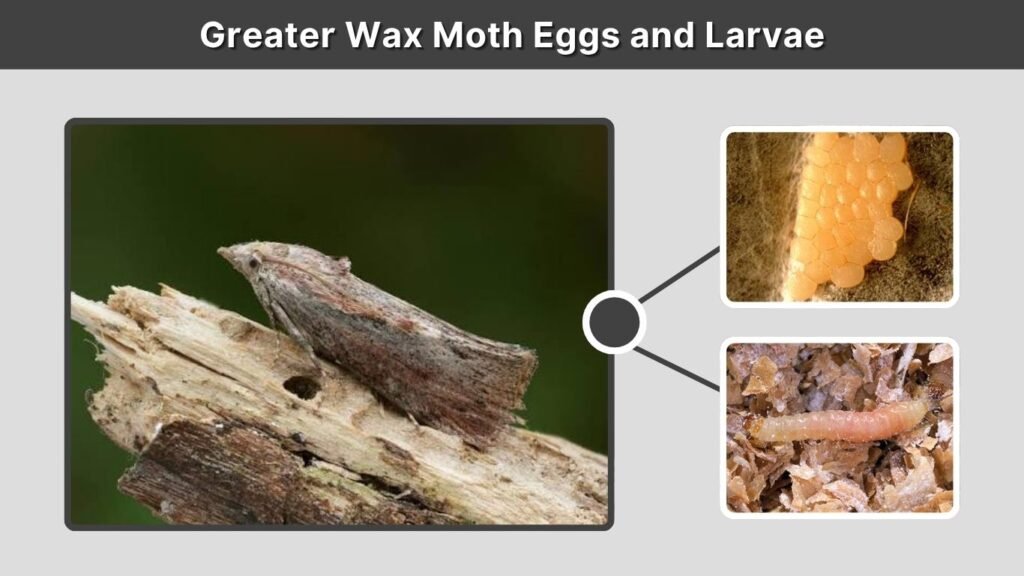
The adults cause no feeding damage. Females lay eggs in inaccessible spaces, and the caterpillars begin feeding shortly after hatching. Their protective tunnels allow them to remain concealed from honey bees.
Eggs
Greater wax moth eggs are:
- Roughly 0.5 millimeters across
- Cream, pinkish white, or pearly white
- Yellowish shortly before hatching
- Deposited in clusters
- Hidden in cracks, joints, and crevices
- Difficult to detect without magnification
A female can produce several hundred eggs. Hatching may occur within several days under warm conditions but takes longer when temperatures are low.
Greater Wax Moth Larvae
Newly hatched larvae are white and approximately 1–3 millimeters long. Mature caterpillars may reach about 25–28 millimeters.
Identification features include:
- Cream, gray, or brownish body
- Brown head capsule
- Smooth, segmented appearance
- Three pairs of thoracic legs
- Fleshy abdominal prolegs
- Continuous production of silk
- Rapid movement when disturbed
- Dark fecal pellets surrounding tunnels
Waxworms are commercially sold as feeder insects and fishing bait. Captive larvae should never be released because they can infest local bee colonies and stored equipment.
What Do Greater Wax Moth Larvae Eat?
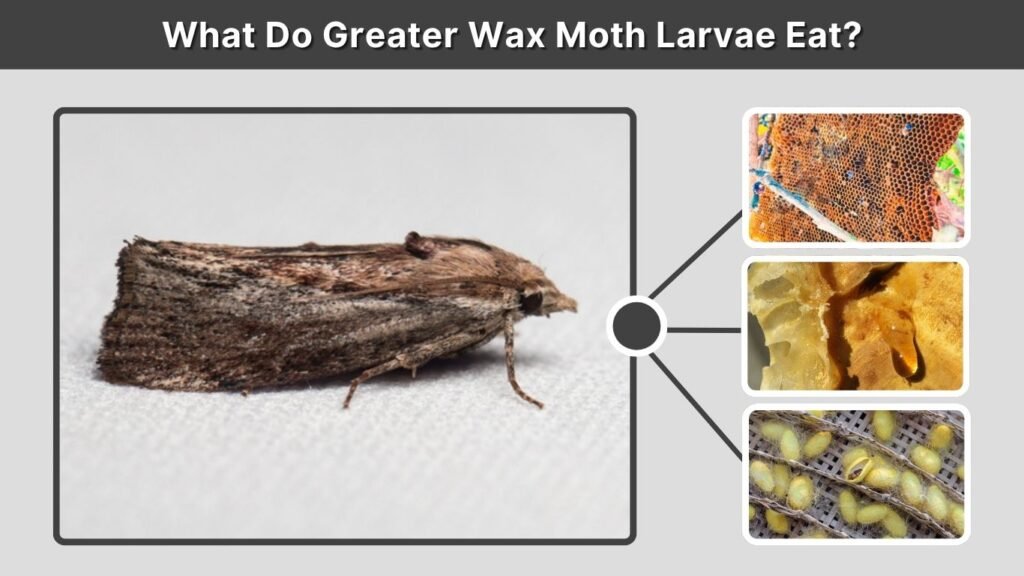
Waxworms are associated with beeswax, but they develop most successfully in old brood comb containing organic residues. Pure, clean wax alone provides an incomplete diet.
Larval Foods
They consume or utilize:
- Pollen stored in cells
- Honey residues
- Cast bee larval skins
- Bee cocoon silk
- Brood-cell debris
- Propolis in small amounts
- Wax surrounding nutritious material
Dark brood comb is more attractive than clean honey-super comb because it contains more pollen, cocoons, and organic residue. A scientific review found that larvae tunnel along the midrib of comb containing pollen, brood remains, and honey.
Greater Wax Moth Life Cycleoth Life Cycle
Greater wax moths undergo complete metamorphosis through egg, larval, pupal, and adult stages. Development is strongly controlled by temperature. Warm hives and storage rooms permit rapid reproduction, while freezing temperatures kill exposed stages.
Life-Cycle Stages
- A female enters a hive and deposits eggs in protected cracks.
- Eggs hatch into tiny white larvae.
- Larvae feed while constructing silken tunnels.
- Mature caterpillars leave the comb to find a pupation site.
- They chew shallow depressions into wood and spin tough cocoons.
- Pupae gradually darken as the adults develop.
- Adults emerge, mate, and repeat the cycle.
Under favorable conditions, the cycle may be completed in approximately six to eight weeks. Cool temperatures, limited food, or diapause can extend development for several months.
Greater Wax Moth Damage
Wax moths commonly exploit colonies that are already weak, queenless, diseased, starving, or too small to defend their hive space. They are often a symptom of an underlying colony problem rather than the original cause of failure.
Signs of Infestation
- Dense silk covering the comb
- Tunnels beneath cell cappings
- Dark frass mixed with webbing
- Larvae moving across frames
- “Bald brood” with partially uncapped cells
- White cocoons attached to woodenware
- Grooves chewed into frames
- Damaged wax foundation
- Matted and unusable comb
- Moths escaping when the hive is opened
Stored frames may be destroyed rapidly because no worker bees are present to remove eggs and young larvae.
Greater vs. Lesser Wax Moth
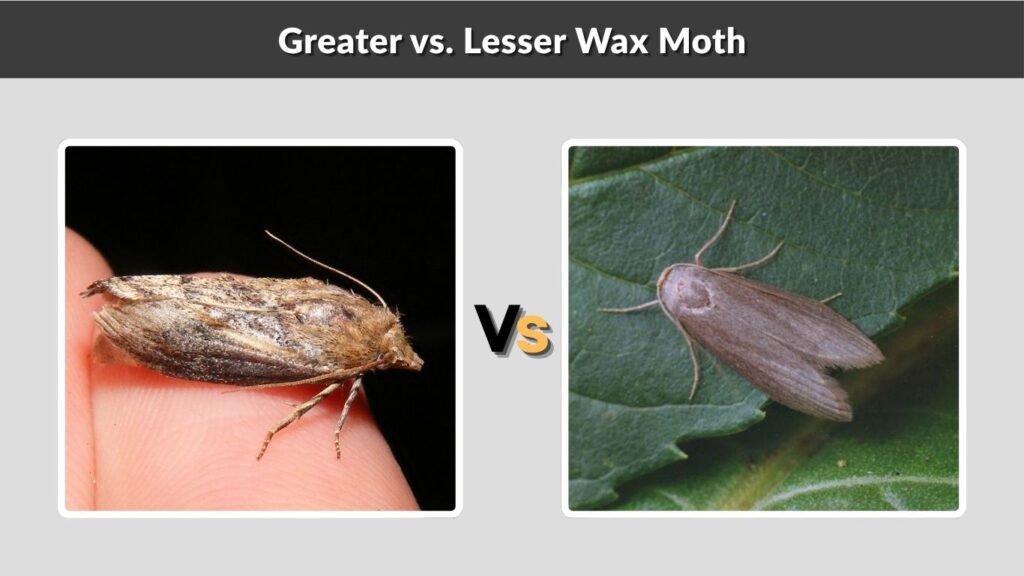
The lesser wax moth, Achroia grisella, inhabits similar environments but is smaller and usually less destructive.
| Feature | Greater Wax Moth | Lesser Wax Moth |
| Scientific name | Galleria mellonella | Achroia grisella |
| Adult length | About 13–20 mm | About 10–13 mm |
| Mature larva | Up to 25–28 mm | Around 13 mm |
| Adult color | Gray-brown or bronze | Pale gray or silver |
| Damage | Often extensive | Usually more localized |
| Frequency | More common major pest | Less common |
Larval size provides a practical clue, but microscopic examination may be necessary for a confident identification.
Greater Wax Moth Hearing Range
The greater wax moth possesses two tympanal hearing organs on the first abdominal segment. Each relatively simple ear connects to only a few auditory sensory cells, yet it responds across an extraordinary ultrasonic range.
Can It Really Hear 300 kHz?
Yes. A 2013 peer-reviewed study measured mechanical movement of the eardrum and electrical activity in the auditory nerve. Responses continued at frequencies approaching 300 kHz.
The moth is commonly described as hearing approximately 20–300 kHz. However, this should not be interpreted as equal sensitivity at every frequency. Hearing thresholds change with frequency, sound intensity, sex, and experimental method.
Why Does It Hear Such High Frequencies?
Its hearing may serve two purposes:
- Detecting ultrasonic echolocation calls produced by bats
- Receiving courtship signals produced by male moths
Male greater wax moths produce ultrasonic pulses, commonly concentrated around 70–90 kHz. Females can recognize the timing pattern of these signals while distinguishing them from approaching bats.
The extreme upper limit may also provide very rapid timing information rather than existing specifically to detect a known 300 kHz biological sound.
How Far Can It Hear?
There is no single confirmed distance. Detection depends on:
- Frequency
- Sound pressure
- Background noise
- Air temperature and humidity
- Direction of the moth
- Size and strength of the source
Very high-frequency ultrasound weakens rapidly while traveling through air. A moth may detect a strong nearby signal but fail to detect a weaker signal at the same frequency from farther away.
Is It a Guinness World Record?
Yes. Guinness World Records lists the greater wax moth for the highest-frequency animal hearing and describes its upper limit as 300 kHz.
This is a frequency-range record, not proof that the moth hears every sound more sensitively or accurately than every other animal.
Do Greater Wax Moths Eat Plastic?
Studies have found that greater wax moth larvae and enzymes in their saliva can oxidize and break down some polyethylene under laboratory conditions. This has generated interest in possible plastic-recycling technologies.
However, waxworms are not currently a practical solution for household plastic waste. Feeding plastic directly to larvae may produce incomplete breakdown products, and uncontrolled rearing creates a risk to beekeeping equipment. The more promising research involves isolating and studying the responsible enzymes.
How to Control Greater Wax Moths
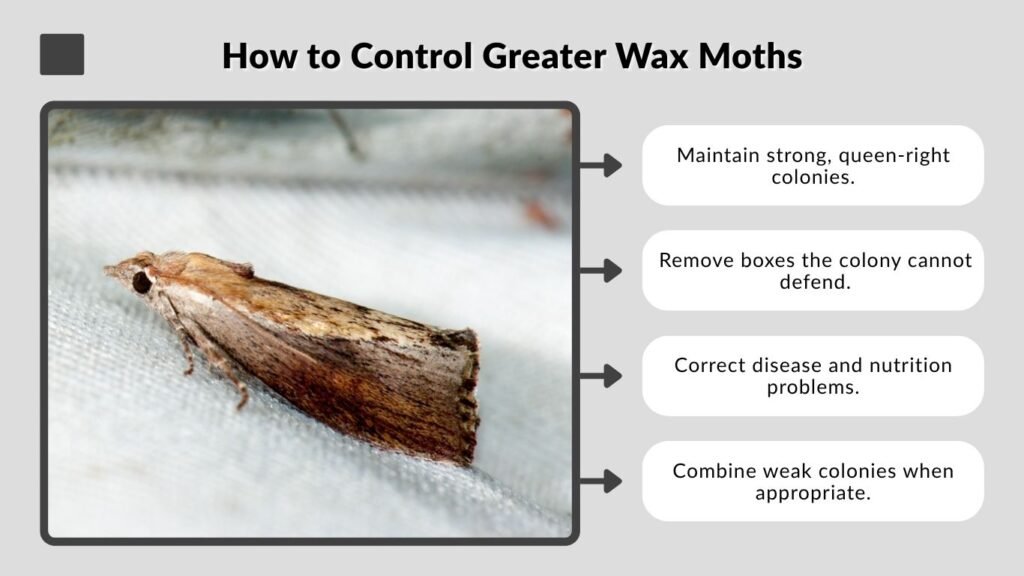
The best control inside a working hive is a strong bee population capable of defending every frame. Chemical treatment cannot compensate for a failing queen, disease, starvation, or excessive empty space.
Control in Active Hives
- Maintain strong, queen-right colonies.
- Remove boxes the colony cannot defend.
- Correct disease and nutrition problems.
- Combine weak colonies when appropriate.
- Remove abandoned or heavily damaged comb.
- Keep bottom boards and equipment clean.
- Inspect colonies regularly during warm weather.
- Avoid leaving exposed comb near the apiary.
Wax moth traps may capture adults outside the hive but will not kill larvae concealed inside comb.
Treating Infested Frames
Use this process:
- Remove affected frames from the colony.
- Freeze them for at least 24 hours.
- Allow thicker stacks additional freezing time.
- Thaw frames in an insect-proof area.
- Remove webbing, cocoons, larvae, and frass.
- Inspect the wood and foundation.
- Return lightly damaged frames to a strong colony.
- Render or discard severely damaged comb.
Freezing kills existing stages but does not provide continuing protection after the frames thaw.
Protecting Stored Comb
- Freeze comb before storage.
- Store frames in cold, dry conditions.
- Provide light and airflow where appropriate.
- Inspect equipment frequently.
- Separate brood comb from clean honey comb.
- Keep stored supers inaccessible to adult moths.
- Re-freeze frames if new activity appears.
Never place ordinary mothballs or unapproved chemicals in hive equipment. Vapors can contaminate wax and honey.
Bt Wax Moth Treatment
Some registered wax moth products contain Bacillus thuringiensis subsp. aizawai. The treatment is applied to empty comb before storage, and larvae die after eating treated material.
The EPA describes strain ABTS-1857 as producing a protein toxic to wax moth larvae while being applied to empty stored frames.
Product registration differs by country. Use only a product specifically labeled for wax moth control on bee comb and follow its current instructions exactly.
Are Greater Wax Moths Dangerous?
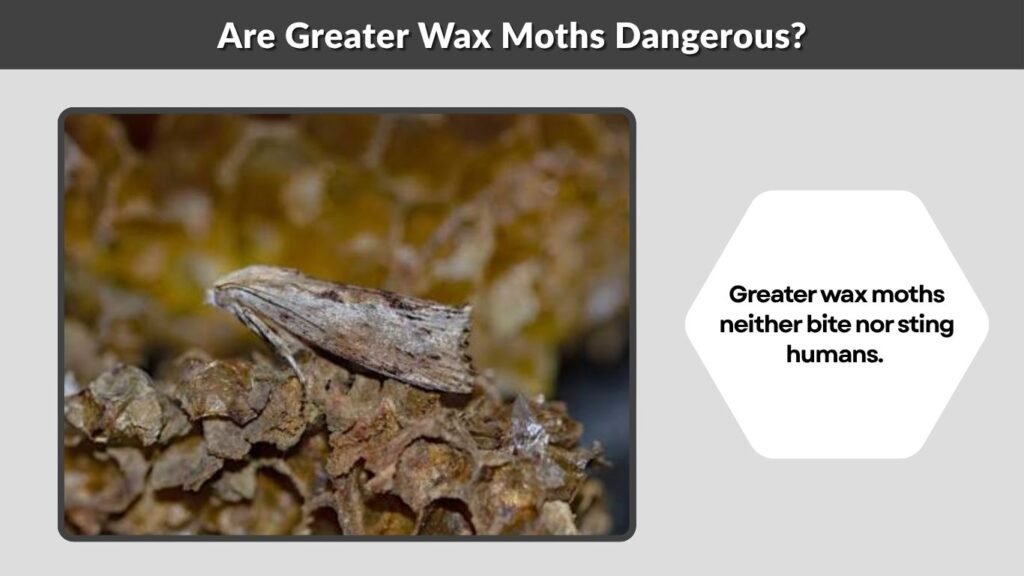
Greater wax moths neither bite nor sting humans. Their larvae are not poisonous and do not parasitize people. Their primary danger is economic damage to honeycomb, stored equipment, and weakened colonies.
Heavily infested honeycomb should not be extracted for human consumption because it may contain silk, frass, larvae, cocoons, and other contaminants.
FAQs
Is a waxworm a greater wax moth larva?
Many commercial waxworms are greater wax moth larvae, although lesser wax moth larvae may also be called waxworms.
What is greater wax moth frass?
Frass is larval feces. It appears as dark pellets mixed with silk, skins, and damaged comb.
Can a strong colony control greater wax moths?
Yes. Healthy colonies normally remove eggs and larvae. Serious damage usually occurs when bees cannot defend all available comb.
Can damaged frames be reused?
Lightly damaged frames can often be frozen, cleaned, and returned to a strong colony. Replace frames with severe contamination, weakened comb, or badly gouged wood.
Does the greater wax moth have the best hearing?
It holds the confirmed record for the highest detected sound frequency, approaching 300 kHz. “Best hearing” is broader and could also refer to sensitivity, localization, or discrimination.
