
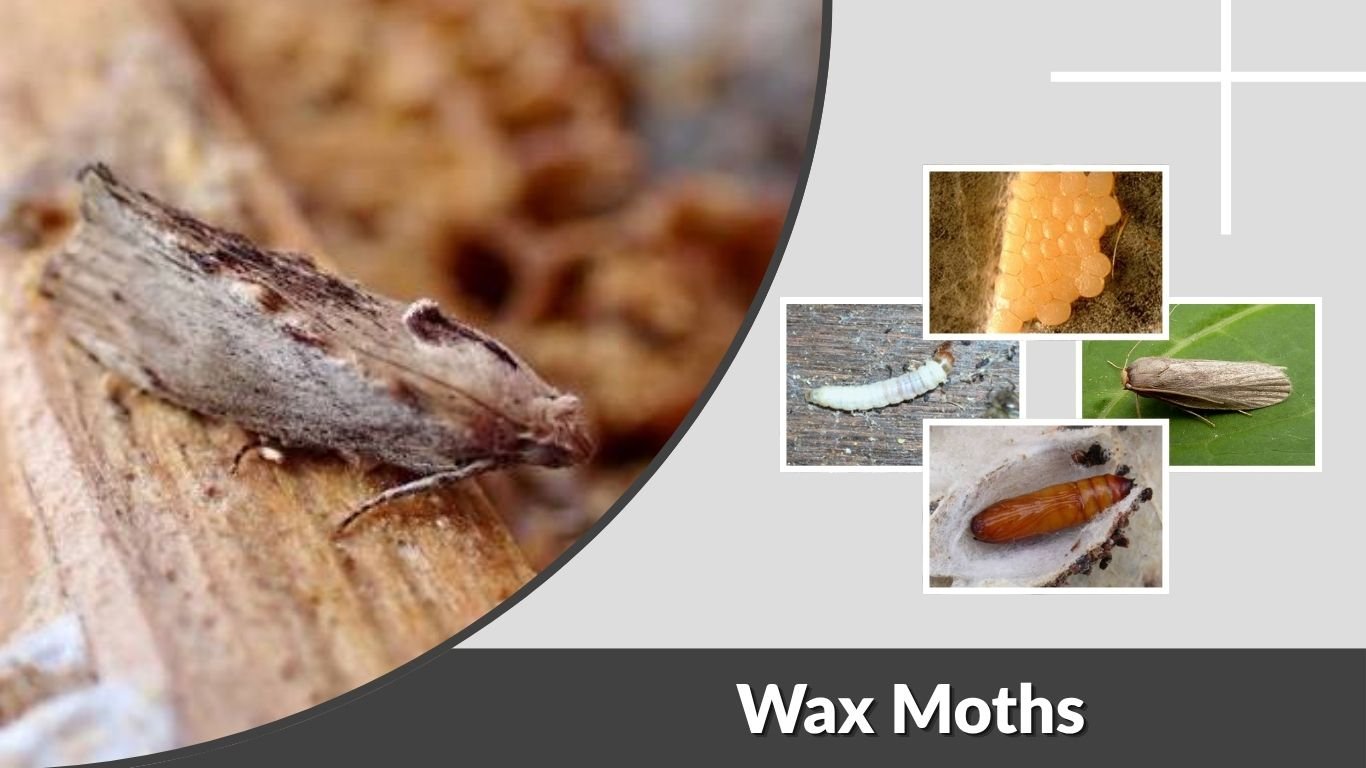
Wax moths are destructive beehive pests whose larvae tunnel through wax comb while feeding on pollen, honey, shed bee skins, and other organic material. Strong honey bee colonies usually remove invading moths and larvae, but weak, abandoned, or poorly managed hives can suffer extensive damage. Stored brood comb is particularly vulnerable. An infestation produces webbing, tunnels, fecal pellets, cocoons, and damaged frames. Control depends on maintaining strong colonies, freezing affected equipment, protecting stored comb, and using only treatments specifically approved for beekeeping.
What Is a Wax Moth?
The term “wax moth” primarily refers to two moth species associated with honey bee colonies. The greater wax moth causes the most extensive damage, while the lesser wax moth is smaller and generally less destructive. Their larvae are commonly called waxworms and are also commercially raised as fishing bait and animal food.
Scientific Classification
The two principal species are:
- Greater wax moth: Galleria mellonella
- Lesser wax moth: Achroia grisella
- Family: Pyralidae
- Order: Lepidoptera
- Larval name: Waxworm
- Other names: Bee moth and honeycomb moth
Both species have complete metamorphosis, progressing through egg, larval, pupal, and adult stages.
What Does an Adult Wax Moth Look Like?
Adult greater wax moths usually have:
- A body approximately 1/2 to 3/4 inch long
- Gray, brown, bronze, or nearly black wings
- Mottled markings on the forewings
- Lighter-colored hindwings
- Wings held in a roof or boat shape
- A somewhat pointed, beak-like head
- Rapid activity around hives after dark
Adults normally enter beehives around dusk. They hide in crevices and avoid direct contact with guard bees while searching for protected egg-laying sites.
Greater vs. Lesser Wax Moth
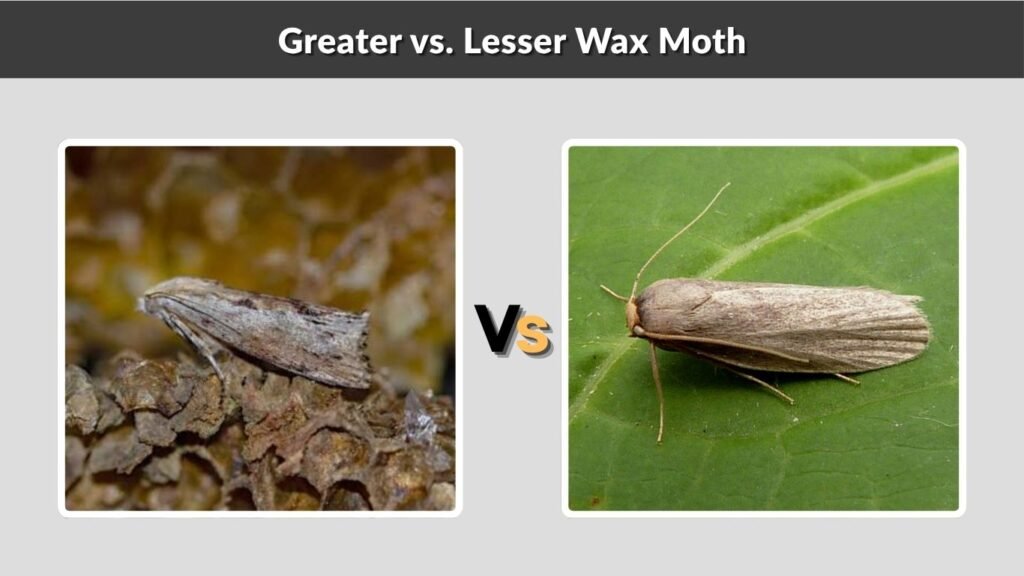
Both species damage comb and produce silk, but size is the most noticeable difference. Greater wax moth larvae can destroy substantial areas of brood comb, while lesser wax moth infestations are often more localized.
| Feature | Greater Wax Moth | Lesser Wax Moth |
| Scientific name | Galleria mellonella | Achroia grisella |
| Adult length | Approximately 13–20 mm | Approximately 10–13 mm |
| Mature larval length | Up to about 28 mm | Around 13 mm |
| Adult color | Gray-brown with mottling | Pale gray or silver-gray |
| Relative damage | Usually more destructive | Generally less destructive |
| Common location | Brood comb and stored frames | Comb debris and neglected areas |
Microscopic features provide more reliable identification, but size and the severity of damage are useful field clues. BeeAware’s wax moth guide compares the two species and their life stages.
Wax Moth Eggs and Larvae
Adult moths cause little direct harm. Females concentrate on reproduction, while larvae perform all destructive feeding. Eggs are normally hidden in cracks where worker bees cannot easily reach them.
Wax Moth Eggs
Wax moth eggs are:
- Approximately 0.5 millimeters wide
- Pearly white, cream, or pale pink
- Yellowish as development progresses
- Deposited in clusters
- Hidden inside hive cracks and crevices
- Difficult to see without magnification
Greater wax moth females may lay several hundred eggs. Warm conditions can produce rapid hatching, while cooler temperatures slow development.
Wax Moth Larvae
New larvae are tiny and white. As they grow, they become cream or gray with a brown head capsule. Mature greater wax moth larvae may reach approximately one inch long.
Common features include:
- Smooth, segmented body
- Brown head
- Three pairs of legs near the head
- Additional fleshy prolegs on the abdomen
- Silk tunnels through the comb
- Rapid movement when exposed
- Dark fecal pellets around feeding areas
The larvae feed within protective silken tunnels that make it difficult for worker bees to remove them.
Small Hive Beetle Larvae vs. Wax Moth Larvae
Small hive beetle larvae are frequently mistaken for waxworms. Both may occur in a struggling colony, but their bodies and damage differ.
| Feature | Wax Moth Larva | Small Hive Beetle Larva |
| Body surface | Relatively smooth | Covered with visible spines |
| Legs | Thoracic legs and abdominal prolegs | Three pairs near the head only |
| Webbing | Produces extensive silk | Does not create silken tunnels |
| Movement | Often moves quickly | Usually crawls more slowly |
| Damage | Tunnels through comb | Makes honey slimy and fermented |
| Waste | Pellets mixed with silk | Wet contamination and fermentation |
A slimy hive with a rotten-orange odor is more typical of small hive beetles. Dry webbing and tunneled comb strongly suggest wax moth larvae.
Wax Moth Life Cycle
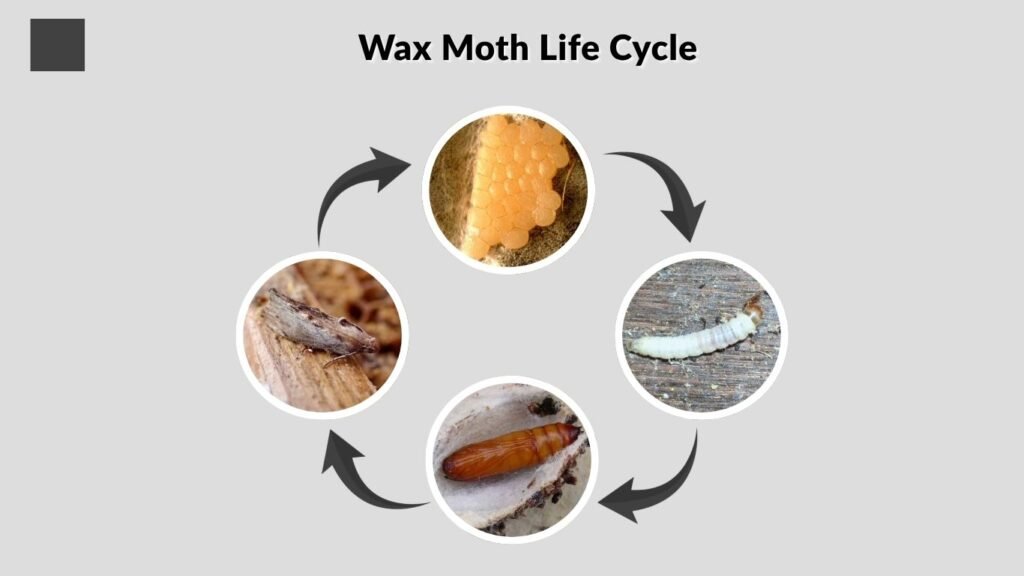
Temperature greatly affects development. Warm conditions inside a hive or storage building allow the life cycle to proceed quickly. Cold weather slows or stops development, while freezing can kill eggs, larvae, and pupae.
Egg Stage
Females enter the hive at night and place eggs in protected openings. Depending on temperature, eggs may hatch within several days or take considerably longer.
Larval Stage
Larvae begin feeding and spinning silk immediately. They pass through several molts, with most destruction occurring during their later growth stages.
Their diet includes:
- Old brood comb
- Pollen
- Honey residues
- Cast bee larval skins
- Silk from bee cocoons
- Other organic hive debris
They do not survive efficiently on clean beeswax alone. Dark brood comb is especially attractive because it contains more pollen, cocoons, and organic residue.
Pupal Stage
Mature larvae leave the feeding tunnel and search for a protected location. They often chew shallow depressions into wooden frames or hive walls before spinning tough, white cocoons.
Several cocoons may occur together. Pupae begin pale and gradually become dark brown before the adults emerge.
Adult Stage
Adult wax moths do not feed. They live long enough to mate and reproduce. Under favorable warmth, the entire life cycle may be completed in approximately six to eight weeks, although cool conditions can extend it for months.
Signs of Wax Moths in a Beehive
Finding an adult moth does not necessarily indicate severe damage. The condition of the colony and presence of larvae provide more useful information.
Infestation Signs
Look for:
- White or gray silk covering comb
- Tunnels running through brood cells
- Cream or gray caterpillars
- Black fecal pellets, known as frass
- Bald or uncapped brood
- Tough cocoons on frames
- Grooves chewed into woodenware
- Matted comb containing skins and waste
- Damaged foundation
- Bees abandoning heavily infested sections
Wax moths usually take advantage of a weak or abandoned hive rather than causing a healthy colony to collapse. Their presence should prompt an inspection for queen failure, disease, starvation, swarming, or another underlying problem.
How to Control Wax Moths in Active Hives
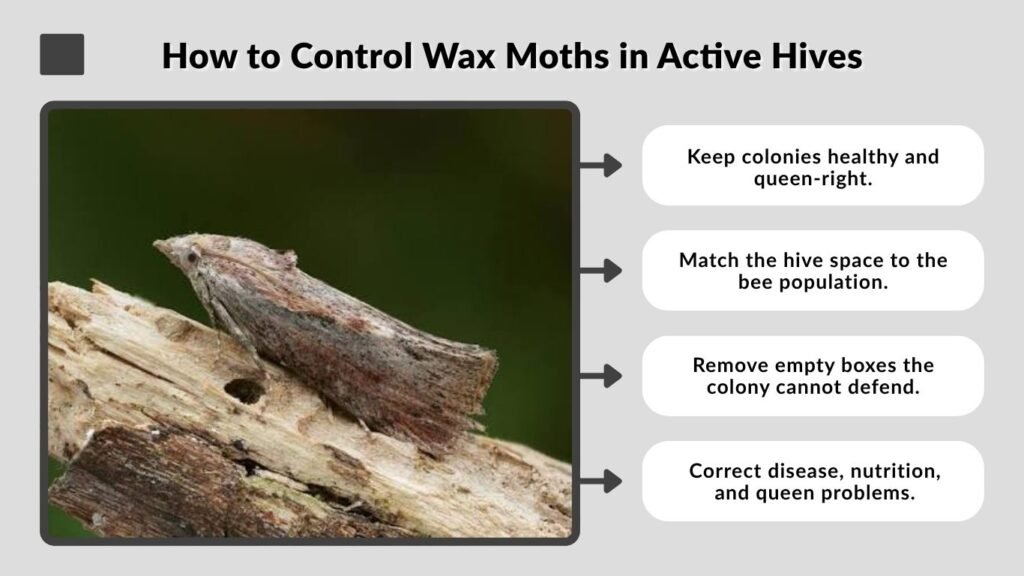
A strong colony is the best defense. Worker bees patrol the comb, remove eggs and larvae, and prevent moths from becoming established.
Active-Hive Control
- Keep colonies healthy and queen-right.
- Match the hive space to the bee population.
- Remove empty boxes the colony cannot defend.
- Correct disease, nutrition, and queen problems.
- Avoid leaving abandoned comb inside weak colonies.
- Remove heavily damaged frames.
- Combine weak colonies when appropriate.
- Maintain clean bottom boards and hive equipment.
Traps placed outside a hive may capture some adults but cannot eliminate larvae already inside the comb. Homemade bottle traps should be treated as monitoring tools, not primary control.
Treating Infested Frames
Frames with light damage may sometimes be cleaned and reused. Severely weakened comb, extensive frass, offensive odors, or structural damage usually justifies removing or rendering the wax.
Freezing Wax Moth Frames
Freezing is one of the safest ways to kill wax moth life stages:
- Place frames in a freezer for at least 24 hours.
- Use a longer period for tightly packed equipment or an unreliable freezer.
- Thaw the frames in a protected area.
- Remove larvae, cocoons, webbing, and loose debris.
- Inspect the foundation and wooden frame.
- Return usable frames to a strong colony or secure storage.
Freezing kills the infestation but does not prevent another adult moth from laying eggs afterward. Clemson Extension recommends freezing infested unused frames for 24 hours.
Can Wax-Moth-Damaged Frames Be Reused?
Frames may be reused when:
- The wooden structure remains sound.
- The foundation is not badly distorted.
- Webbing and frass can be removed.
- There is no fermentation or offensive odor.
- The comb has not been exposed to an unsafe chemical.
Strong colonies can repair limited comb damage. Frames with deep grooves, collapsed comb, extensive contamination, or unknown chemical exposure should be replaced.
Extracting Honey from Infested Comb
Do not extract honey from comb heavily contaminated with larvae, webbing, feces, or cocoons. Even if some cells remain capped, the frame’s sanitation and product quality may be unacceptable.
Lightly affected equipment should be separated and inspected carefully. Commercial beekeepers must follow applicable food-safety and honey-handling regulations.
Protecting Stored Supers and Comb
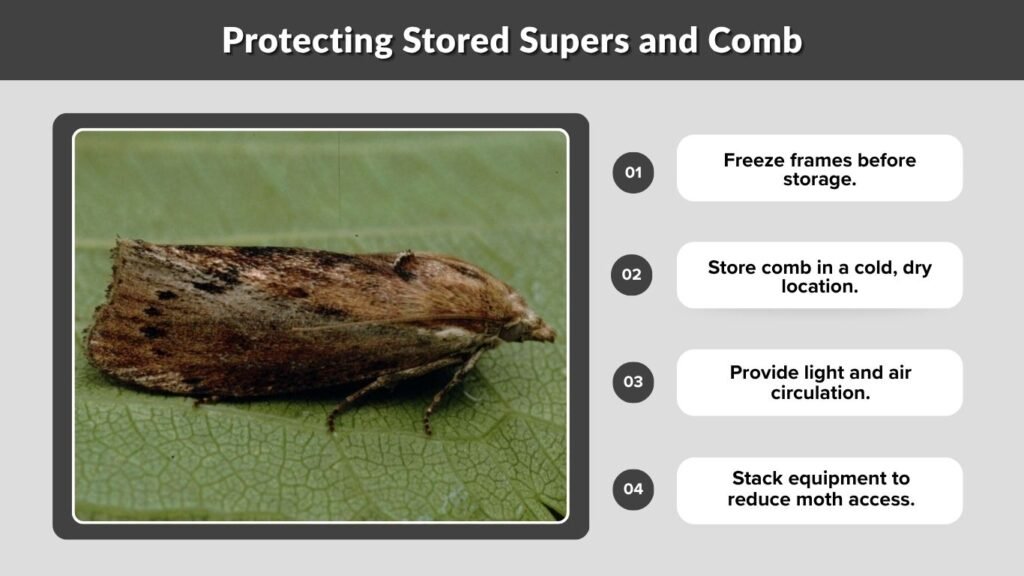
Unprotected stored brood comb can be destroyed quickly during warm weather. Honey supers containing clean, light-colored comb are less attractive but still require protection.
Storage Methods
- Freeze frames before storage.
- Store comb in a cold, dry location.
- Provide light and air circulation.
- Stack equipment to reduce moth access.
- Inspect stored comb regularly.
- Separate brood comb from clean honey supers.
- Return frames to strong colonies when practical.
- Re-freeze equipment if activity appears.
Do not place ordinary mothballs in beekeeping equipment. Naphthalene and other household moth-control chemicals can contaminate wax and honey.
B402 and Certan Wax Moth Treatment
Products sold as B402 or Certan use a strain of Bacillus thuringiensis designed to kill wax moth larvae after they consume treated comb. These products are generally intended for protecting empty stored frames rather than correcting the weakness of an occupied colony.
The U.S. The Environmental Protection Agency describes Bacillus thuringiensis subsp. aizawai ABTS-1857 as an active ingredient that controls larvae through a protein acting in their digestive system.
Registration and instructions differ by country. Only use a currently registered product exactly as its label directs. Do not substitute an agricultural Bt product unless its label specifically permits that use on bee comb.
Are Wax Moths Dangerous?
Wax moths do not bite or sting people. They are not poisonous, and adult moths generally avoid human contact. Their importance comes from damage to comb, equipment, and stored hive products.
Waxworms sold as animal feed should come from a controlled supplier. Larvae collected from beehives may have contacted pesticides, medications, pathogens, or contaminated material.
Greater Wax Moth Hearing
Greater wax moths possess extremely sensitive ultrasonic hearing. Research found that their ears respond to frequencies approaching 300 kilohertz, representing the highest upper-frequency hearing limit documented in an animal.
This ability may help them detect bats and participate in ultrasonic courtship communication. The exact ecological reason for such an extreme upper range remains uncertain.
Male vs. Female Wax Moths
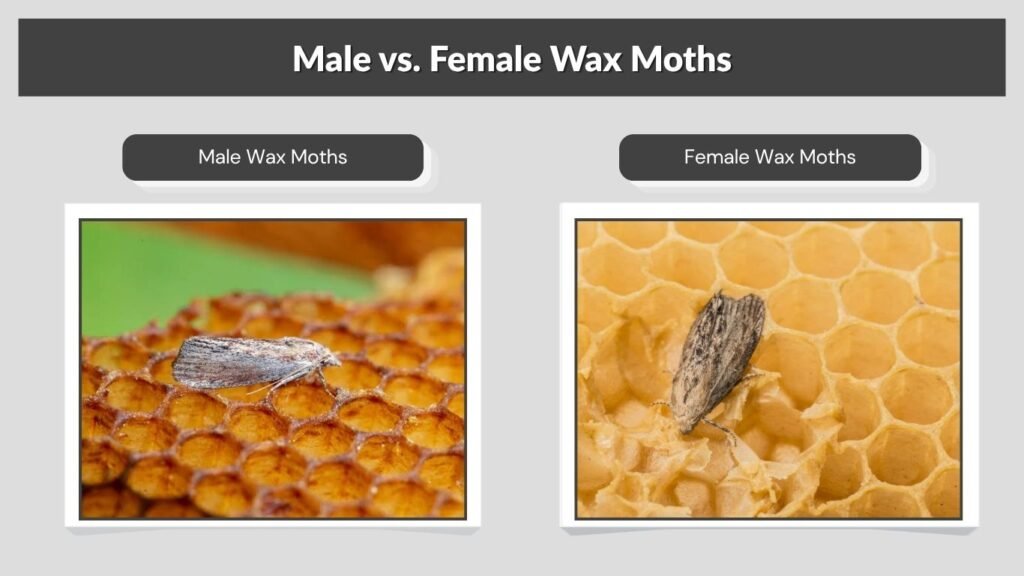
Female greater wax moths are generally larger, heavier, and darker than males. Males tend to be smaller and lighter.
Identification Differences
- Females usually have broader bodies.
- Males often have a more concave outer forewing margin.
- Female forewing margins appear comparatively straight.
- Females have a more pronounced beak-like head.
- Males produce ultrasonic courtship signals.
- Females deposit eggs in hive crevices.
Color and size vary, so wing shape is often more useful than color alone.
FAQs
What is wax moth poop?
Wax moth poop is called frass. It appears as small dark pellets mixed with silk, skins, and damaged comb.
Do wax moth larvae eat plastic?
Laboratory research suggests waxworm saliva can oxidize polyethylene, but this does not make larvae a practical plastic-recycling solution. They may also chew or damage some hive materials while seeking pupation sites.
Can wax moths destroy a healthy hive?
A strong colony normally controls them. Serious infestation more often indicates that the colony was already weak, queenless, diseased, or unable to defend its comb.
Are wax moth traps effective?
Traps may capture or monitor adults but cannot reach larvae inside comb. Colony management and stored-frame protection remain more important.
How long should frames be frozen?
A minimum of 24 hours in a dependable freezer is commonly recommended. Thick stacks or warmer freezers may require additional time to ensure every frame freezes completely.
