
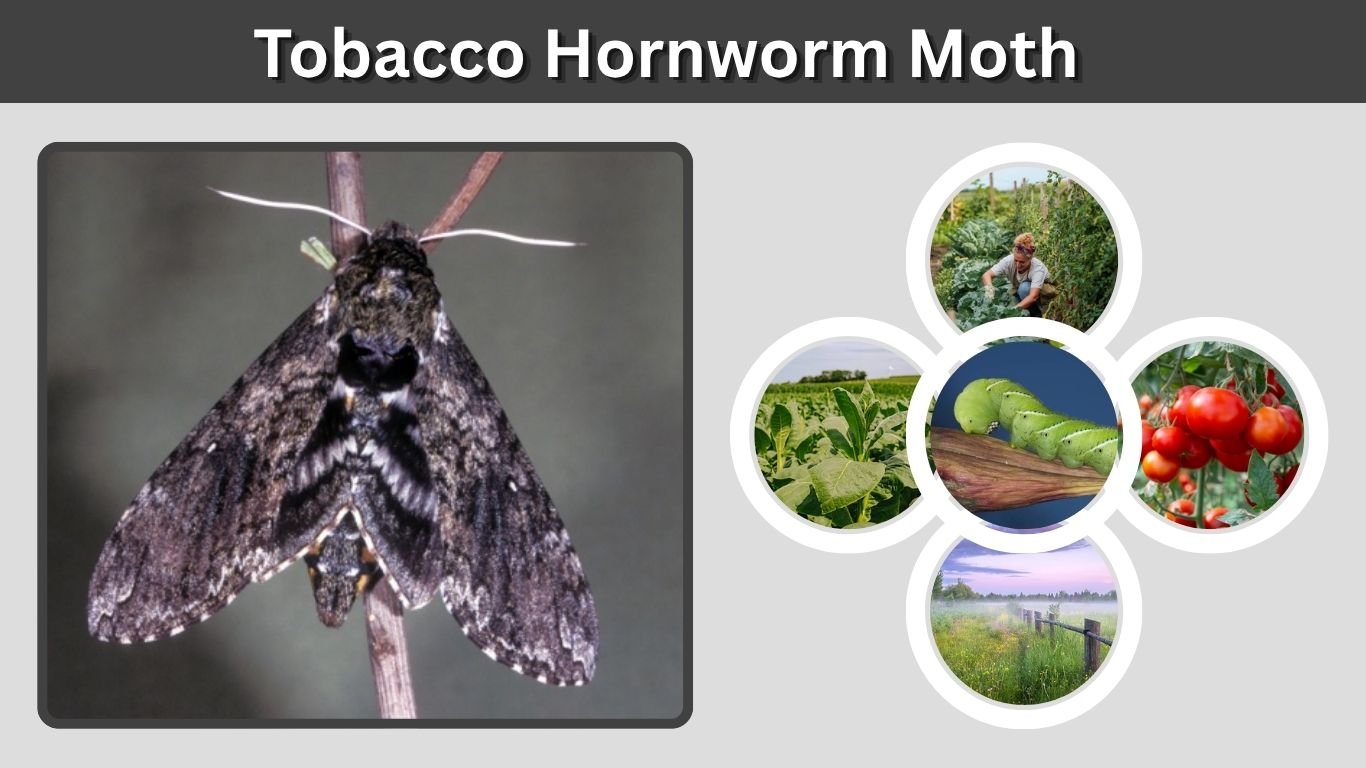
The tobacco hornworm moth is the adult form of the large green tobacco hornworm caterpillar. Scientifically named Manduca sexta, it is also called the Carolina sphinx or tobacco hawk moth. The caterpillar can severely defoliate tobacco, tomato, pepper, and other nightshade plants, while the adult moth drinks nectar and may pollinate flowers. Its powerful hovering flight sometimes causes it to be mistaken for a hummingbird. Despite its intimidating size, the moth neither bites nor stings and is not dangerous to humans.
What Is a Tobacco Hornworm Moth?
The tobacco hornworm is the caterpillar stage of Manduca sexta, a member of the sphinx moth family. The larva and adult look completely different, which sometimes leads people to believe they are separate insects. This species is also widely used in scientific research because of its large size and well-understood development.
Scientific Classification
The species is classified as:
- Scientific name: Manduca sexta
- Family: Sphingidae
- Order: Lepidoptera
- Caterpillar name: Tobacco hornworm
- Adult names: Carolina sphinx and tobacco hawk moth
- Other name: Six-spotted sphinx moth
The word sexta refers to the six pairs of yellowish-orange spots found along the adult moth’s abdomen.
Adult Moth Identification
An adult tobacco hornworm moth has:
- A wingspan of approximately 3.75 to 4.75 inches
- A thick, streamlined body
- Mottled gray, brown, black, and white forewings
- Alternating light and dark bands on the hindwings
- Six pairs of orange or yellow abdominal spots
- A long, coiled proboscis for drinking nectar
- Narrow wings adapted for rapid, hovering flight
- A triangular shape when resting
The moth’s gray-brown pattern provides camouflage against tree bark. Its large body, rapid wingbeats, and ability to hover in front of flowers explain why it is sometimes called a hummingbird moth. UF/IFAS Extension provides detailed adult and larval identification.
Tobacco Hornworm Caterpillar
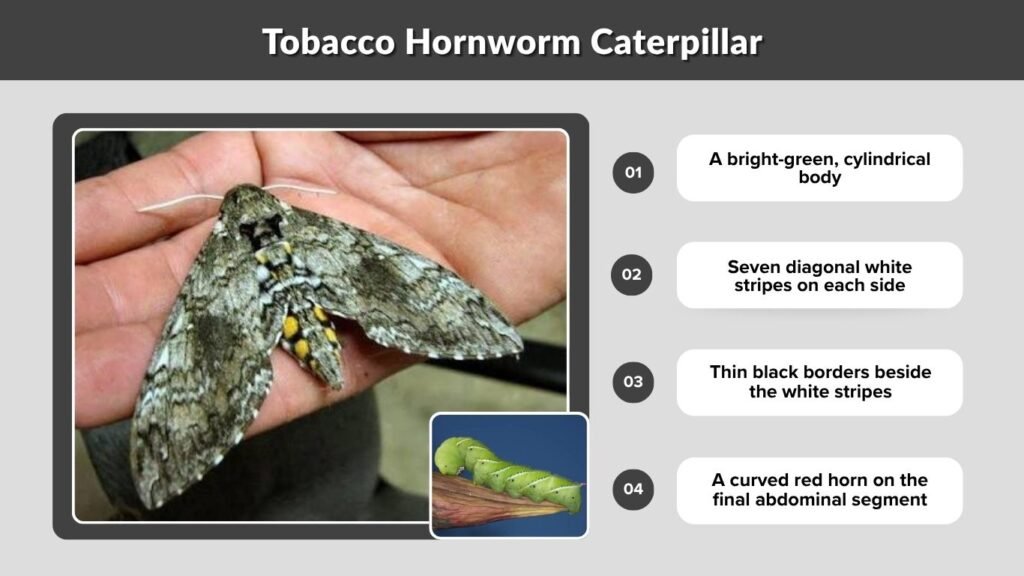
The caterpillar is one of the largest larvae commonly found in vegetable gardens. Although its tail has a prominent horn, this projection is flexible and harmless. It is not a stinger and cannot inject venom.
Caterpillar Identification
Tobacco hornworms commonly have:
- A bright-green, cylindrical body
- Seven diagonal white stripes on each side
- Thin black borders beside the white stripes
- A curved red horn on the final abdominal segment
- Small black breathing openings along the body
- A mature length of three to four inches
- Green or black droppings beneath damaged plants
Young caterpillars are pale green and have darker horns. Their red horn and seven straight diagonal markings become clearer as they mature.
Caterpillar Damage
Hornworms consume leaves, stems, flowers, and developing fruit. Damage often begins near the top of a plant because females commonly place eggs on young foliage.
Signs include:
- Large sections missing from leaves
- Entire stems stripped of foliage
- Damaged flowers or green tomatoes
- Large, dark droppings on leaves
- Bare leaf stalks
- A large camouflaged caterpillar nearby
Most feeding occurs during the final larval stages, when a hornworm can consume vegetation rapidly.
Tobacco Hawk Moth Habitat and Distribution
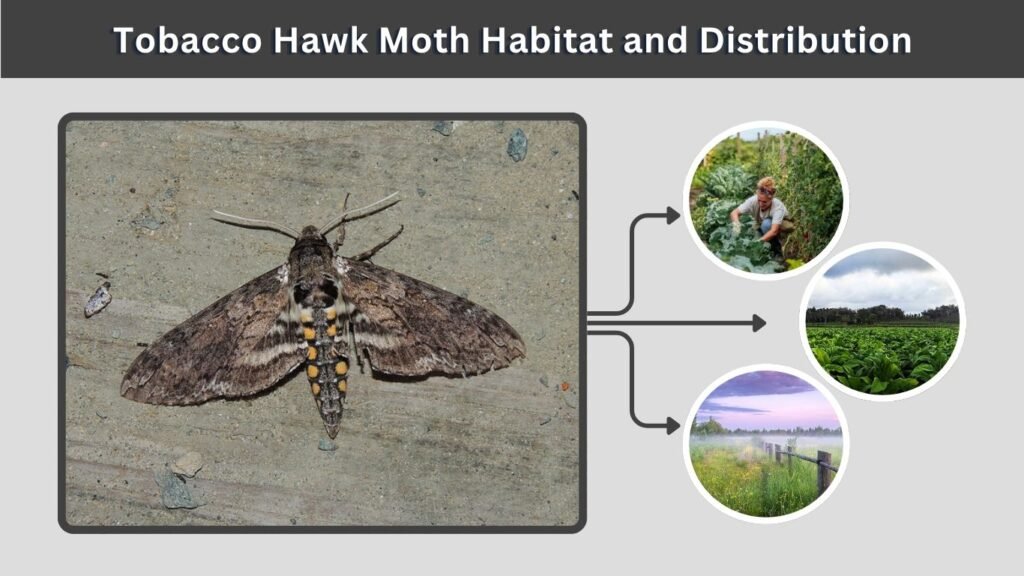
The tobacco hornworm occurs widely across the Americas. Its range extends through much of the United States and continues south through Mexico, Central America, and parts of South America. It is particularly common wherever tobacco, tomatoes, and related plants are grown.
Where Does It Live?
Suitable habitats include:
- Vegetable gardens
- Tobacco fields
- Farms and agricultural borders
- Meadows containing wild nightshades
- Suburban landscapes
- Open woodlands
- Desert and grassland habitats
- Areas with nectar-rich flowers
According to the USDA, Manduca sexta occurs from Massachusetts to northern California and south into Argentina and Chile.
Tobacco Hawk Moth Life Cycle
The tobacco hawk moth undergoes complete metamorphosis through egg, larval, pupal, and adult stages. Its development speed depends on temperature, food quality, latitude, and season. Warm regions may support multiple generations, while colder populations spend winter underground as pupae.
Egg Stage
Female moths place small, round eggs individually on host-plant leaves, often after sunset. The eggs are pale green or whitish and approximately 1/16 inch in diameter.
They commonly hatch within three to five days. Newly emerged caterpillars immediately begin feeding on the leaf.
Larval Stage
The caterpillar passes through five or sometimes six growth stages called instars. It molts between each stage and grows rapidly for approximately three weeks under favorable conditions.
Once fully grown, the caterpillar stops feeding, changes color slightly, and wanders away from the host plant in search of suitable soil.
Pupal Stage
The mature larva burrows several inches underground and forms a dark reddish-brown pupa. Unlike many moth caterpillars, it does not spin an external silken cocoon.
The pupa has a distinctive curved, handle-like structure that encloses the developing proboscis. A summer generation may emerge after several weeks, while late-season pupae can remain underground throughout winter. The Smithsonian confirms that tobacco hornworms burrow into soil and overwinter as pupae in colder areas.
Adult Stage
The adult emerges from the soil, expands its wings, and becomes active around dusk. Adults usually live for approximately one to three weeks, depending on environmental conditions.
After mating, females locate host plants through chemical signals and begin laying eggs. Two or three generations may occur annually in warm parts of the United States.
What Do Tobacco Hawk Moths Eat?
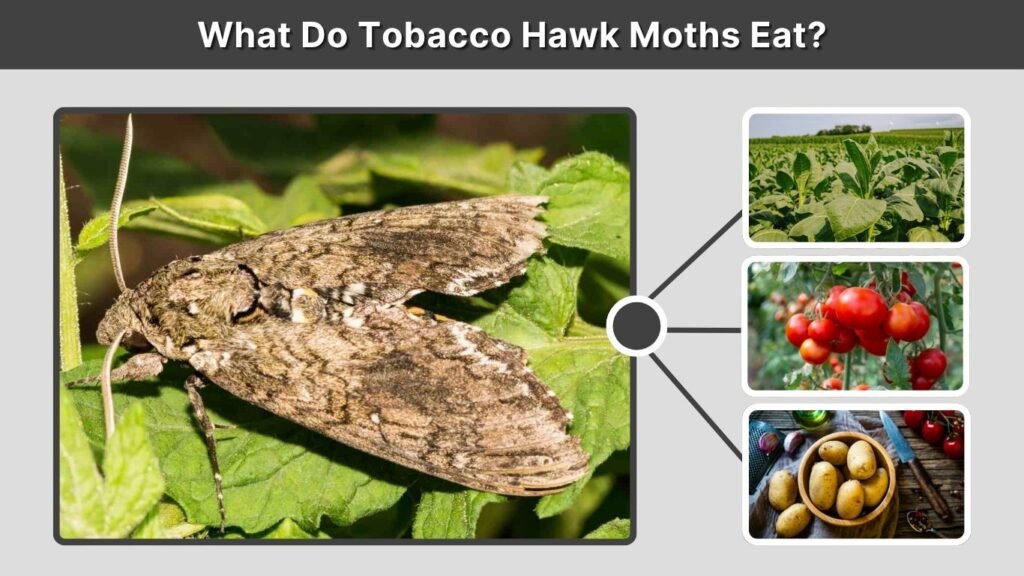
Caterpillars and adults have entirely different diets. Larvae eat foliage from selected host plants, while adults rely on flower nectar.
Caterpillar Food Plants
Tobacco hornworms primarily eat members of the nightshade family, including:
- Tobacco
- Tomato
- Pepper
- Eggplant
- Potato
- Jimsonweed
- Moonflower
- Other wild nightshades
They do not feed exclusively on tobacco. Tomato and pepper plants are also common hosts.
Adult Moth Diet
Adults visit deep, tubular flowers and use their long proboscis to reach nectar while hovering. They are especially active at dusk and during the night.
Flowers visited may include:
- Moonflowers
- Sacred datura
- Petunias
- Honeysuckle
- Evening primrose
- Trumpet-shaped native flowers
Adults do not chew plant leaves and cause no hornworm-like garden damage. Their flower visits can transfer pollen, giving the adult a beneficial ecological role.
Tobacco Hawk Moth Defense Mechanisms
The red tail horn may discourage predators, but it cannot sting. Green coloration also provides excellent camouflage among leaves. If disturbed, a caterpillar may thrash its body, raise its front end, click its mandibles, or regurgitate.
Nicotine Defense
Tobacco contains nicotine that is toxic to many insects. Tobacco hornworms can tolerate and process this chemical. Caterpillars feeding on nicotine-containing tobacco can move a small amount into their body fluid and release it through their spiracles.
Researchers found that this “defensive halitosis” can repel predatory wolf spiders, although it does not deter every predator.
Tobacco Hornworm vs. Tomato Hornworm Moth
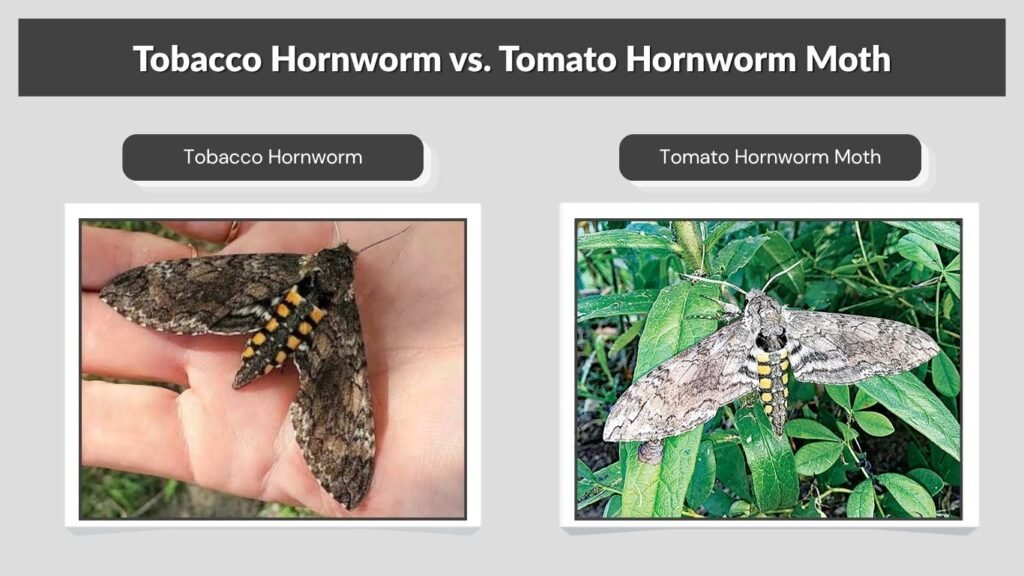
The tobacco and tomato hornworms are closely related and frequently occur on the same plants. Caterpillar markings and adult abdominal spots provide the easiest distinctions.
| Feature | Tobacco Hornworm | Tomato Hornworm |
| Scientific name | Manduca sexta | Manduca quinquemaculata |
| Caterpillar stripes | Seven diagonal lines | Eight V-shaped markings |
| Tail horn | Usually red | Usually dark blue or black |
| Adult name | Carolina sphinx | Five-spotted hawk moth |
| Adult abdominal spots | Six pairs | Five pairs |
| Common hosts | Tobacco, tomato, pepper | Tomato, tobacco, potato |
Both caterpillars can reach approximately four inches and cause similar garden damage. NC State Extension confirms the seven-stripe/red-horn and eight-chevron/dark-horn distinction.
Tobacco Hornworm vs. Tobacco Budworm
The tobacco budworm is a different and much smaller species. Currently classified as Chloridea virescens, it was formerly known as Heliothis virescens. Its caterpillar feeds on flower buds, blossoms, and young plant growth.
Important Differences
- Tobacco hornworms are large, smooth, and have a tail horn.
- Tobacco budworms are smaller, hairy, and lack a horn.
- Hornworms become large sphinx moths.
- Budworms become smaller brownish noctuid moths.
- Hornworms often strip leaves.
- Budworms commonly damage buds, flowers, and seed structures.
Is the Tobacco Moth the Same Species?
The name “tobacco moth” can also refer to Ephestia elutella, a small stored-product pest known as the warehouse or cacao moth. That species infests stored tobacco, cocoa, grain, dried fruit, nuts, and other products.
It is unrelated to the large Carolina sphinx. Checking the scientific name prevents confusion:
- Manduca sexta: tobacco hornworm or tobacco hawk moth
- Chloridea virescens: tobacco budworm moth
- Ephestia elutella: stored-product tobacco moth
Are Tobacco Hornworm Moths Dangerous?
Adult moths do not bite, sting, or carry venom. The caterpillar’s horn is harmless, although a frightened larva may thrash or nip weakly if handled.
Safe Handling
- Avoid squeezing or dropping the caterpillar.
- Wash your hands after touching it or its host plant.
- Do not handle plants recently treated with pesticides.
- Keep wild hornworms away from pets that may eat them.
- Never assume a wild caterpillar is safe feeder food.
Commercial feeder hornworms are raised on controlled diets. Wild hornworms may contain plant chemicals or pesticide residues unsuitable for reptiles and other pets.
How to Control Tobacco Hornworms
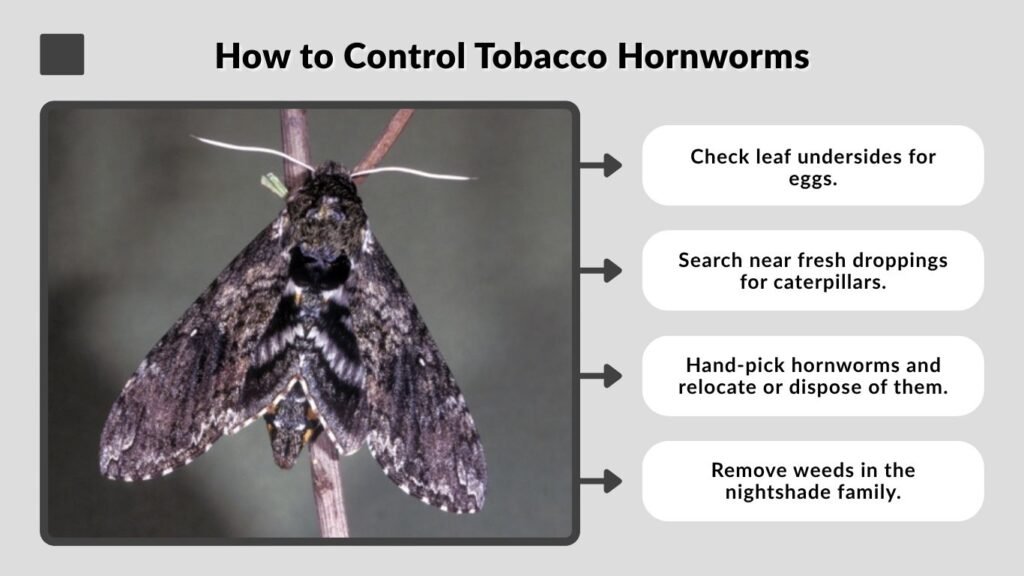
Small garden infestations usually do not require broad insecticide applications. Regular inspection and physical removal are often sufficient.
Control Methods
- Check leaf undersides for eggs.
- Search near fresh droppings for caterpillars.
- Hand-pick hornworms and relocate or dispose of them.
- Remove weeds in the nightshade family.
- Encourage birds and beneficial insects.
- Use row covers before flowering where practical.
- Apply Bacillus thuringiensis var. kurstaki to young larvae if necessary.
- Follow all product labels and crop restrictions.
Do not kill hornworms carrying numerous white, rice-like cocoons. These cocoons belong to parasitoid wasps that have already killed or disabled the caterpillar and can help control additional hornworms.
FAQs
How big is a tobacco hornworm moth?
Adults usually have a wingspan of approximately 3.75 to 4.75 inches, making them among the larger moths commonly seen around gardens.
Is a tobacco hornworm a hummingbird moth?
It is often called a hummingbird moth because it hovers at flowers. More precisely, its adult form is the Carolina sphinx or tobacco hawk moth.
How can you identify a male or female moth?
Males generally have a narrower abdomen ending in visible claspers. Females usually have a broader abdomen and a more pointed egg-laying structure.
What soil do tobacco hornworms need for pupation?
In nature, mature caterpillars burrow into loose, well-drained soil. They need enough depth to form an underground chamber without remaining waterlogged.
Do adult tobacco hawk moths damage plants?
No. Adults drink nectar and may pollinate flowers. Plant damage is caused by the caterpillar stage.
